


Key Points
- AI marketing tools should be chosen as part of a governed workflow, not as isolated productivity apps.
- The real risk is unmanaged adoption: tool sprawl, brand drift, weak auditability, customer data leakage.
- Teams should evaluate tools by workflow fit, data posture, integration surface, and control requirements before focusing on features.
When you select AI marketing tools, you’re actually defining how marketing work runs across systems, teams, and customer data. That decision determines whether AI accelerates output or quietly introduces risk, inconsistency, and rework.
It’s easy to evaluate AI tools based on how quickly they can create content such as blog posts, landing pages, social media posts, and the like. But speed alone doesn’t hold up under real operating pressure. Campaigns become harder to reproduce, brand voice starts to drift, and customer information can move in ways that aren’t visible or governed.
When coordination breaks, marketing teams move faster but learn less, and also become less efficient. Another risk is more down-to-earth: the public is increasingly frustrated with low-quality AI content, and poorly envisioned campaigns could backfire. As people put it on social media, if you slop, you flop.
Recent enterprise surveys show that nearly 88% of organizations use AI in at least one business function, but most remain stuck in pilot mode, with only a minority achieving meaningful impact at scale. This gap is less about model capability and more about operationalization. This gap isn’t about model quality, as LLMs are starting to mature and deliver good results, but operationalization is where things go south.
In marketing specifically, this manifests as a fragmentation problem: teams adopt AI quickly, but lack the operating model to standardize, govern, and measure it across campaigns.
Unmanaged Adoption Is Where ROI Dies
Top-rated AI marketing tools often optimize for individual productivity, not team performance. Content is created faster when team members adopt the AI writing assistants of their choice and share prompts, knowledge files, and Claude skills informally. At an enterprise level, that approach works briefly, but after a few weeks, it begins to break.
Suddenly, a single campaign pivots between three tools. Email copy no longer matches the landing page. There are multiple versions of “final” content, and no clear system of record for brand voice or messaging.
This is the hidden tax: rework, inconsistency, and lost time across teams.
Now the team is spending more time reconciling outputs than producing them. Fragmentation creates operational drag, and also opens you up to risk.
Cisco’s 2024 Data Privacy Benchmark Study found that 48% of surveyed respondents admit to entering non-public company information into generative AI tools. In a B2B organization, that might mean pasting pipeline notes or segmentation exports into a chatbot to speed up messaging, without access control or auditability.
These aren’t isolated incidents. They reflect a broader pattern of unmanaged AI usage, where speed outpaces governance and introduces systemic risk across marketing operations.
Where AI Marketing Stacks Break
AI marketing fails because systems behave differently at scale. What looked good in the pilot simply fails to perform, and a few patterns show up consistently:
Common AI Failure Patterns
| Pattern | Failure Characteristics |
| Prompt Drift | Lack of standardized inputs leads to erratic results:
Outputs diverge in ways that are hard to detect internally but easy for customers to notice. |
| No System of Record | Institutional knowledge is trapped in silos:
When performance changes, there’s no centralized trail to trace the root cause. |
| Tool Sprawl | A fragmented tech stack creates operational drag:
Multiple “black boxes” eliminate any reliable source of truth. |
| Reduced Auditability | Governance gaps make basic questions unanswerable:
A lack of transparency introduces regulatory and governance risk. |
| Data Exposure | Ungoverned AI usage creates security vulnerabilities:
Data leakage outside of governed environments creates massive liability. |
Map the Work Before You Touch the Tools
Fixing this doesn’t start with better tools, but with structuring the work itself.
A team can ship an e-commerce product page in record time and still burn through weeks of untangling where the brief lived, which prompt produced the final copy, and why the CMS version doesn’t match downstream variants.
Speed’s easy, traceability not so much. Therefore, before selecting tools, define and map the work across a consistent lifecycle. To make this operational, map every marketing task to a consistent, repeatable lifecycle:
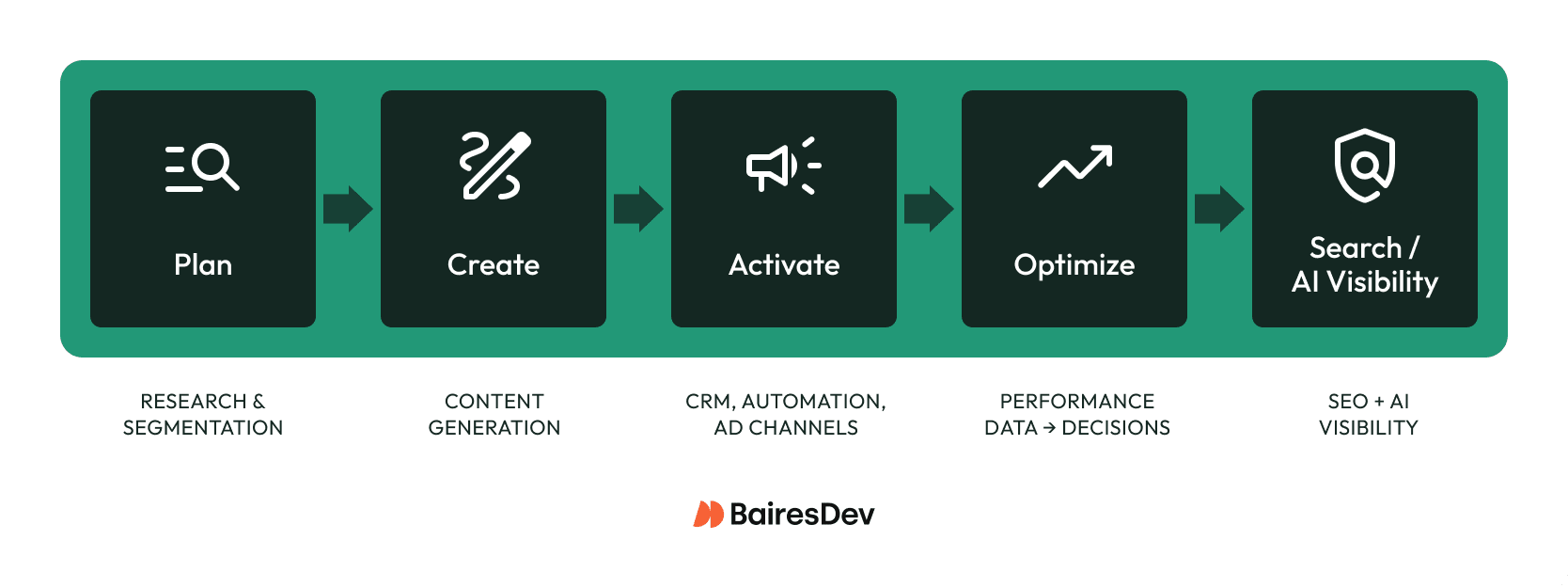
This isn’t new, but applying it rigorously changes how AI fits into the operating model. Think of it as an assembly line for AI-powered marketing:
- Plan: This is where AI capabilities are often underused. Use AI tools to synthesize customer interactions, analyze consumer behavior, and improve audience segmentation. When paired with machine learning and predictive analytics, these insights strengthen upstream marketing decisions.
- Create: Use tools that generate content in the formats you actually ship, while enforcing a consistent brand voice through templates and constraints.
- Activate: This is where most AI marketing stacks break. If content is manually moved between systems—or worse, copied from one tool to another—you lose control of both data and process. Activation touches CRM systems, marketing automation, social media platforms, and digital advertising channels.
- Optimize: Connect outputs to outcomes. Performance data should map back to specific inputs, enabling consistent, traceable decision-making. In mature teams, evaluation becomes continuous. Linking prompt structure, inputs, and outputs directly to campaign performance, rather than relying on post-hoc analysis.
- Search/AI visibility: Content must perform across both traditional search and AI-driven discovery. Align SEO, content strategy, and AI visibility efforts to ensure consistent presence across channels. Monitor and improve your digital footprint to ensure consistent visibility across all touchpoints.
In high-performing teams, this lifecycle is not conceptual: it’s instrumented, meaning each stage is connected to systems of record, evaluation signals, and enforcement controls.
AI Marketing Tool Evaluation Matrix (What Actually Matters)
A tool can demo well, then fail quietly once standardized by Marketing Ops. When Security and Procurement evaluate it, gaps in governance and integration become blockers during evaluation. The issue is rarely output quality. It’s more about how the tool fits within your existing operating model.
Evaluate tools based on how they support approvals, identity, data boundaries, and measurement:
| Criterion | Typical Weight | What to Check for |
|---|---|---|
| Purpose Fit | 15–25% | Does it cover the full marketing task or just generate drafts?
|
| Brand Controls | 15–25% | Can it enforce brand voice consistently?
|
| Data Posture | 20–30% | How is the data handled, stored, and exposed?
|
| Integration Surface | 15–25% | How compatible is it with existing systems?
|
| Reliability | 10–20% | How does the tool perform consistently under real usage conditions?
|
| Measurement & Cost | 10–20% | Can you tie usage to outcomes?
|
| Evaluation & Observability | 10-20% | Can you trace outputs back to inputs and decisions?
|
To use this matrix effectively, first set minimum thresholds for:
- Data Posture
- Integration Surface
If a tool fails either threshold, eliminate it early. It won’t hold up in production—regardless of how strong its AI features appear.
This isn’t just anecdotal, as recent data backs it up. A 2024 IBM study found that organizations that prioritize governance, integration, and operational discipline in AI systems were 29% more likely to realize ROI from their AI investments.
Shortlisting AI Marketing Tools
Guardrails limit where work can fork or bypass controls. The evaluation matrix helps eliminate poor fits early and compare viable options.
When workflows cross systems, integrated platforms are more sustainable than disconnected point solutions. Otherwise:
- Data gets duplicated
- Ownership becomes unclear
- Integration becomes brittle
Example: If you’re generating email variants using AI, pulling from CRM data, and publishing via marketing automation, you need a single governed layer, not multiple disconnected systems.
Point tools, however, still make sense for narrow, low-risk tasks like early-stage ideation.
Example: If you’re ideating and performing work that never touches customer data or publishing, lightweight point tools can be used without introducing meaningful risk.
Step 1: Set Hard “No” Criteria
Disqualify tools that:
- Don’t support SSO or role-based access
- Lack audit logs
- Have unclear policies around customer information, data, or training
Step 2: Standardize Where It Matters
Anything that:
- Publishes to owned channels
- Touches customer data
- Becomes part of shared workflows
…should run through a small number of approved platforms.
Step 3: Allow Controlled Flexibility
Support experimentation through:
- Sandbox environments
- Limited-use tools
- Defined boundaries
But ensure that all outputs flow back into a system of record.
Cost behavior is often underestimated in AI tool selection. As usage scales across teams and campaigns, token consumption, API calls, and agentic workflows can increase costs nonlinearly; turning what appears to be an inexpensive tool at a pilot stage into a significant operational expense.
Rollout With No Slowdown
The same pattern shows up in broader enterprise surveys. A 2024 Salesforce survey found that while 84% of CIOs believe AI will be as significant as the internet, only 11% report full implementation, highlighting the gap between adoption and operational readiness.
This reinforces a broader pattern: adoption is easy, but scaling requires coordination across systems, governance, and workflows. These are areas where most organizations are still immature.
Under deadline pressure, teams will route around friction. A marketer may grab a free chatbot, paste a segment export, and ship campaign copy that performs in‑market. But there’s no visibility into where the data went or how to reproduce the result.
Scaling AI marketing requires an operating model you can run like a shared service, with identity and policy built in. The goal is to make the governed path the fastest path.
Rollout Control Framework
| Control Area | Baseline Requirement | What It Enables |
|---|---|---|
| Identity & Permissions | Require SSO (and SCIM if available); map roles to capabilities (draft vs. publish vs. admin); disable unmanaged personal workspaces for production | Accountable access and reduced shadow IT |
| Templates & Voice System | Reusable templates tied to style guide and claim policy; store where marketing teams work (CMS/MA/collab tool), not a static doc | Consistent outputs and faster adoption |
| Approval Gates | Define where AI output must route to human review (brand, legal, product marketing) before owned-channel publishing | Prevents brand/legal drift under deadline pressure |
| Logging & Audit | Capture who generated what, from which inputs, and where it was routed | Traceability for retros and incident-style reviews |
| Data Boundaries | Ban pasting customer/pipeline details unless retention controls and auditability exist; treat ad-hoc uploads as data egress | Reduced risk of customer data leakage |
| Integration & Measurement | Write outputs back to system of record (CMS, MA, analytics); tag generations to tie usage to campaign outcomes | Measurable impact and governable workflow |
The Part Most Teams Miss
AI doesn’t break loudly. It degrades quietly. That’s where a lot of reputational risk lies. If your clients start seeing poor outputs, it might take a while before you pick it up.
At first, you get:
- Faster content creation
- More campaigns
- More experimentation
Then:
- More inconsistency
- More rework
- Less clarity
Eventually, teams slow down because the system around the AI broke down.
More Choice is A Good Thing, But…
We already have fairly mature tools that can genuinely save time and money, helping marketing teams collect and analyze data, organize their work, and speed up content production. So, the question is no longer whether or not marketing teams should leverage AI, but how they should do it without breaking things.
It’s about leaving fewer decisions to chance. In practice, that means aligning AI with existing workflows, enforcing data boundaries by default, and ensuring outputs remain consistent and traceable as teams scale. Teams also have to do their best to avoid tool sprawl and shadow AI, while maintaining quality.
All this requires time and experimentation, so don’t fall to FOMO and rush to adopt the latest tools every quarter. Scaling takes time, with or without AI.
The competitive advantage is no longer access to AI marketing tools, but the ability to operationalize them consistently across teams, campaigns, and systems.
Clear Ownership Model
Scaling only works when ownership is explicit. Without clear responsibility across platform, operations, and security, governance breaks down even if the right tools are in place.
- Platform Engineering: identity, integration, infrastructure
- Marketing Ops: workflows, templates, performance
- Security: policy and compliance
If ownership stops at tool adoption, output may increase, but results won’t.