



Healthcare’s hardest data problem lives in the seams between organizations that all run their own systems. Blockchain works as a complementary trust layer across those seams, recording provenance and consent without forcing centralization. This guide covers the specific data-sharing use cases where blockchain earns its place in the digital health stack.
Key Points
- Clinical records stay in the existing EHR and lab systems, while the blockchain network only stores hashes and consent metadata.
- The $200 to $400 billion global counterfeit drug market is one of the strongest commercial cases for blockchain-tracked supply chains and targeted recalls.
- Clinical trial audits become tractable when consent changes and protocol updates are written as immutable events on a shared ledger.
- Blockchain pays off when leaders treat it as a targeted tool for specific cross-organizational data-sharing problems.
Healthcare keeps investing in digital health, yet your medical data is still hard to trust and expensive to secure. You feel this every time your team tries to connect one more system or vendor.
Meanwhile, healthcare breaches remain the costliest across all industries. Counterfeit and falsified medical products represent a global market estimated at between $200 and $400+ billion a year, undermining patient safety and your brand at the same time.
This creates a clear opportunity for a different kind of infrastructure play: using blockchain technology.
We’ll explore the most realistic and high-value enterprise use cases for blockchain in healthcare, highlight implementation considerations, and position blockchain as a complementary layer within modern digital health stacks.
Why Blockchain Belongs in Your Digital Health Stack
A blockchain network gives you a shared, tamper-evident ledger that multiple healthcare organizations can trust without handing control to any single party.
For your business, that translates into concrete benefits:
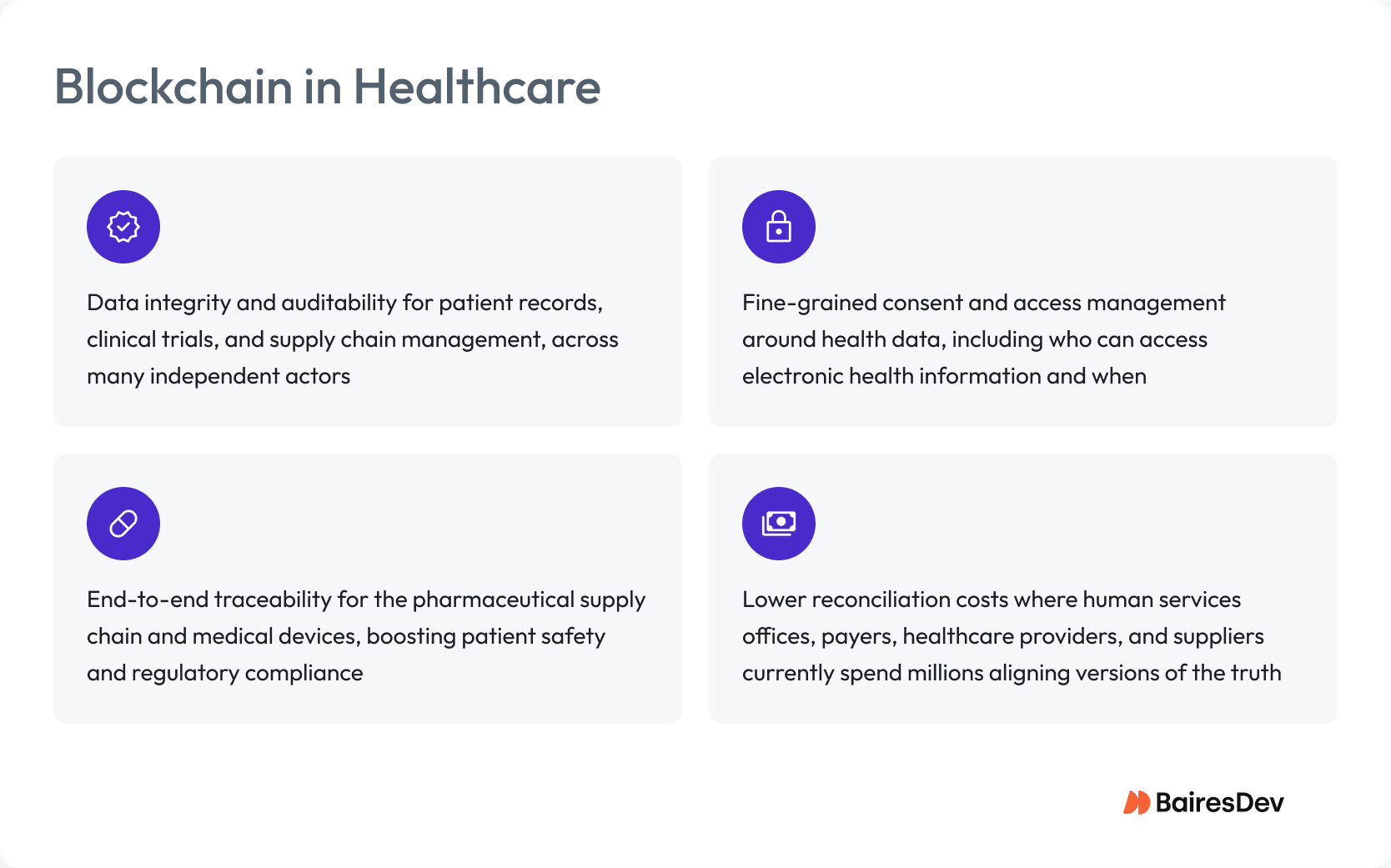
The blockchain system records hashes, permissions, consent changes, and critical events, while keeping sensitive clinical data in existing systems (EHRs, labs, imaging). This adds a secure, auditable layer that’s difficult to tamper with and easy to verify across organizations.
High-Value Applications of Blockchain in Healthcare
Interoperable Patient Data Networks
Most healthcare systems already run a mix of EHRs, lab systems, and insurance platforms. The real friction sits in the gaps between them. Blockchain adds a shared coordination layer between those systems without forcing centralized data ownership. Clinical data stays where it is today, EHR, LIS, PACS, while the network only keeps hashes, pointers, and consent logic.
With that in place, you can build longitudinal patient records and enable secure data sharing between providers and payers. Patients can see who accessed their information, clinicians get a trustworthy history, and your teams cut down on duplicate tests and manual data cleaning. You improve care coordination and transparency without a disruptive rip-and-replace project.
Pharmaceutical and Medical Supply Chain You Can Actually Trust
From manufacturers to wholesalers, logistics partners, pharmacies, and hospitals, few supply chain partners share a single source of truth. A blockchain-based system gives everyone a common, verifiable view of each product’s journey, from production, through distribution, to the point of care. Every hand-off is recorded as a signed event on the network and tied to a batch, serial number, or device ID.
Providers can see that drugs and devices are genuine and correctly handled. Regulators get near real-time visibility into compliance. Your organization can run precise, targeted recalls instead of large, expensive ones. Fewer counterfeits, fewer disputes, and faster investigations translate into better patient safety, protected revenue, and smoother day-to-day operations.
Secure Clinical Trial Data Sharing and Auditability
Clinical trials bring together sponsors, CROs, sites, labs, and regulators who all rely on the same core asset: trustworthy data. Blockchain adds an immutable provenance layer to that ecosystem. Key events, enrolment, consent changes, data capture, protocol updates, analysis milestones, are written to a distributed ledger with references to the underlying datasets.
This shared, tamper-evident log makes quiet changes harder and audits easier. Regulators and ethics boards can confirm that endpoints, outcomes, and timelines match the approved protocol. For your business, stronger data integrity means fewer disputes, faster reviews, and the ability to reuse verified data in follow-on trials and real-world evidence work with more confidence.
Device Lifecycle, Digital Health, and Post-Market Safety
Medical devices and digital health products live for years, moving between hospitals, service providers, and even countries. Each party usually holds only part of the story. A healthcare blockchain lets you pull that history into a single, trusted lifecycle record. Manufacturing, certification, installation, software updates, maintenance, and decommissioning can all be logged as timestamped events on the network.
When a safety signal appears, your teams can quickly see which devices are affected, where they are deployed, and which patients might be impacted. Combined with EHR and digital health data (under strict access controls), this traceability supports better outcomes, fewer errors, and stronger evidence in regulatory or legal reviews. You end up with a durable, cross-organizational audit trail that supports both patient safety and operational accountability.
Emerging Intersections with Analytics and AI
Data-driven healthcare depends on trusted inputs. As you train models on patient records, device telemetry, and other clinical data, stakeholders increasingly want proof that the data is accurate and untampered.
A blockchain layer can help by recording dataset provenance, anchoring model versions to specific data snapshots, and giving regulators a verifiable chain from input to insight, especially in high-risk areas like diagnostic support or personalized care.
These use cases are still emerging, but they extend naturally from the same blockchain infrastructure you’d deploy for records, supply chain, or clinical trials. Once in place, that shared ledger offers low marginal cost but high governance value.
Strategic Outlook: A Pragmatic Alliance
Healthcare remains one of the most data-rich yet coordination-poor industries. You already own many of the core systems: electronic health, billing, insurance records, clinical data warehouses, and digital health platforms. The gap lies between them, how patient data flows across organizational boundaries with verifiable trust.
Leaders who treat blockchain as a targeted pool for specific high-friction, multi-party problems, rather than a broad philosophy, achieve the best ROI. Start small, prove value on one use case, maintain strong governance, and expand from there.