



CRM platforms have stopped being passive systems of record and become the operating layer for the full customer lifecycle. The shift is uneven across most organizations, with AI, automation, and data governance all at different levels of maturity. This guide explains which CRM trends matter most for 2026 and where the investment leverage actually lives.
Key Points
- McKinsey research links well-executed personalization to 10-15% revenue lift, which puts CRM journey design on the same footing as growth marketing.
- 83% of sales teams using AI grew revenue in 2024 compared with 66% without; the gains come from auditable use cases and human-in-the-loop guardrails.
- CRM has shifted from account tracking to journey orchestration, mapping the full customer path from first touch through renewal and advocacy.
- Data governance is the prerequisite for AI and automation to deliver, since CRM platforms can only act on the data quality teams agree to enforce.
Over the past few years, CRM has quietly evolved into the nerve center of customer strategy, connecting data, teams, and channels across the business.
Now, as companies push for tighter integration, faster response times, and more predictive insights, customer relationship management platforms are under pressure to deliver more than just contact management. Leaders now expect CRM software to strengthen customer relationships, improve customer engagement, and support broader digital transformation initiatives.
The trends shaping this space reflect a broader shift: from siloed systems to unified, intelligence-driven customer operations. Let’s look at the key CRM trends defining that shift.
The Central Role of the Customer
What we’ve seen in recent years is that CRM platforms are transitioning from “account tracking” to journey orchestration. This enables teams to map and manage the full customer path—from first touch through renewal and advocacy, across email, web, mobile apps, social platforms, and service channels.
A consistent, personalized customer experience remains one of the few levers that reliably drives customer satisfaction, customer engagement, and long-term customer relationships.
Done well, these experiences can lift revenue by 10–15% and reduce frustration when journeys break.
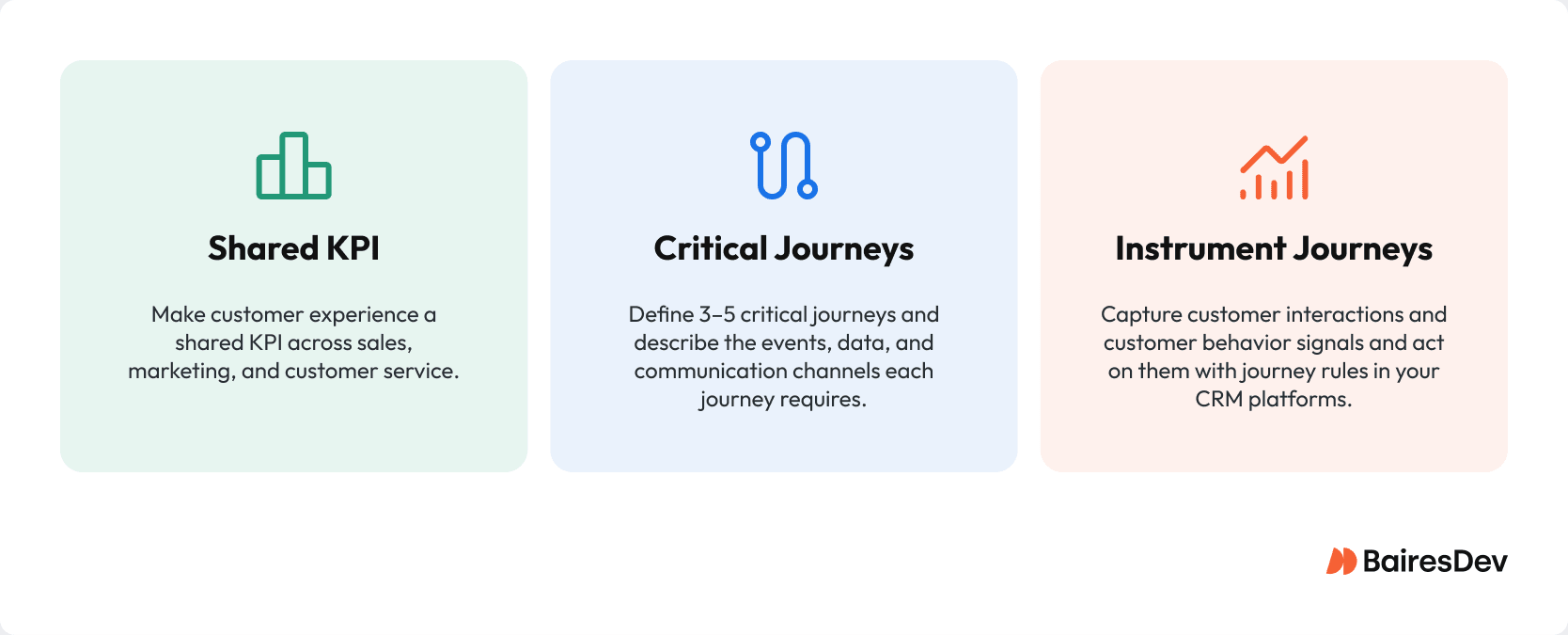
- Make customer experience a shared KPI across sales, marketing, and the customer service department.
- Define 3–5 critical journeys (onboarding, expansion, retention, win-back). Have your CRM strategy describe the events, data, and communication channels each journey requires.
- Instrument each journey with measurable events and behavioral signals, such as opens, clicks, product usage, and support cases. Act on these with journey rules in your CRM platforms.
Data‑Fueled Strategies at Scale
Teams are knitting together customer data platforms (CDPs) with CRM systems to build a unified view, manage customer data centrally, and analyze customer data in one place. Reliable data governance is becoming foundational to transforming CRM from a reporting tool into a disciplined software system for operational decision-making. The point is to make relevant data channels dependable and usable.
It may pay off as teams with trustworthy data ship better marketing campaigns and faster customer handling in service, without forcing customers to repeat known details.
What to do next:
- Name an owner for customer data quality. Create lightweight data contracts for the fields your sales teams, marketing teams, and customer service agents rely on (e.g., consent, lifecycle stage, product usage).
- Implement data governance directly in your CRM software: validation rules, required fields, and deduplication.
- Push up-to-date information into profiles (billing status, product tier, last activity). If you run a CDP, decide which attributes the customer relationship management system is authoritative for, and which come from elsewhere.
- Start small with one data product: e.g., “active customer” definition used by sales representatives, service representatives, and finance.
Cloud and Mobile by Default
Cloud CRM and mobile access are now the baseline for distributed organizations. Mobility correlates with quota attainment and productivity; studies show mobile-CRM users hit targets at far higher rates, and roughly 87% of CRM systems now run in the cloud, reflecting the demand for anywhere access and elastic scale.
For distributed sales and service teams, reliable mobile access now affects responsiveness, pipeline hygiene, and forecast accuracy directly.
Your goal is to equip field teams with offline-capable apps that sync reliably, standardize communication inside the CRM they already use, and lean on cloud elasticity for seasonal peaks, from campaign surges to holiday support.
AI and Line-of-Business Results
Predictive next-best actions, AI-assisted forecasting, lead and churn scoring, case deflection, and agent summarization are producing measurable gains.
In 2024, Salesforce reported that 83% of sales teams using AI grew revenue versus 66% without it. Service organizations are seeing similar results: Verizon, for example, cut handle times and lifted sales during support calls by nearly 40% using a Google AI assistant.
Build narrow, auditable cases like opportunity scoring or case summaries, keep humans in the loop for high-stakes decisions, and measure outcomes you’d defend in a board deck, win-rate lift, average handle time, engagement, and CSAT.
Wrap this in a small governance layer (prompt templates, feedback capture, approval rules) so admins can iterate safely.
Social CRM Integrations
Social media interactions (LinkedIn, Instagram, X) are flowing into CRM profiles in real time.
You get word-of-mouth marketing at scale when issues are resolved publicly and quickly. You also capture signals for customer segmentation and marketing efforts in one place.
Consider the following actions:
- Pipe social media channels into the CRM queue. Use the same SLAs you apply to email or chat.
- Add social fields to the CRM profile; track influence, topics, and sentiment.
- Measure deflection and first-contact resolution on social, then loop insights back into marketing campaigns and product.
Automation Across the Entire Customer Lifecycle
Automation used to be email drips. Now, CRM solutions orchestrate lead routing, approvals, territory assignment, renewals, and proactive support triggers across the customer journey.
You remove latency and reduce variability. Nucleus Research has long tracked CRM’s ROI; classic studies put average returns at $8.71 for every dollar invested (methodologies differ and newer benchmarks vary, but the principle stands: automation compounds benefits across teams).
To act now, map your manual handoffs and pick three to streamline, deal desk approvals, trial-to-paid conversion, or at-risk renewal outreach, then set trigger-based sequences from signals you already have (usage drops, NPS detractors, spikes in inquiries) and keep humans focused on exceptions while automation handles the rest.
Voice Interfaces and Conversational CRM
Voice is redefining usability. As voice assistants and natural‑language tools proliferate, CRM software is integrating voice user interfaces (VUIs) to make everyday tasks faster and more intuitive.
Applications include:
- Sales reps logging meeting notes hands‑free
- Managers requesting “daily sales summaries” via voice command
- Service agents retrieving account details mid‑call
The fusion of conversational AI and CRM technology is driving a more natural, human way of interacting with business systems.
Make Personalization Operational
Leaders are using customer insights from relevant data channels to drive personalized customer experience at moments that matter (onboarding check-ins, usage milestones, renewal nudges).
You can define 10–15 personalization attributes you’ll actually use (industry, product tier, lifecycle stage, recent activity) and keep them fresh in the CRM. Then focus on building customer segmentation that marketing, sales, and service all understand (e.g., “expansion-ready,” “at risk”). Finally, test one personalized journey end-to-end per quarter. Ship it, measure it, then invest where the lift is real.
Beyond the Trends: Strategic Takeaways for Business Leaders
Customer relationship management systems have evolved from departmental tools into operational platforms that coordinate customer-facing work across the business.
Your business needs to start taking a proactive approach. This begins with auditing current CRM systems to uncover gaps in integration or usability, followed by investing in data governance to ensure clean, consistent customer information across all channels.
Teams should be trained to use AI and automation features in ways that drive measurable outcomes, not just adoption.
The ultimate goal is to shift CRM from a passive record-keeping function to a dynamic platform that supports faster business decisions.