


Key Points
- Critical IT documentation in 2026 covers employee policies, hardware and software inventories, system and pipeline documentation, supply chain records, password management, and disaster recovery plans.
- Documentation now serves as the data layer for AI assistants and copilots like Atlassian Rovo, making accuracy and regular updates a technical requirement.
- Organizations still on Atlassian Server or Data Center should begin cloud migration planning. Server reached end of support in 2024; Data Center retirement is set for 2029.
Technical debt compounds over time, and documentation debt compounds as well, only to surface at the worst possible time. Documentation becomes vital when you face a major outage or one of your key engineers leaves. By that point, it is too late to do anything about it. Treating documentation as operational infrastructure keeps tribal knowledge in the building and decides how much value you get from your AI investments.
The documentation gap does not announce itself until recovery is already slow and the cost is already accumulating.
What Is IT Documentation?
IT documentation is the structured, maintained record of an organization’s systems, assets, policies, procedures, ownership, and recovery processes.
The IT documentation every organization should treat as essential includes employee policies, hardware, software, and service inventories, system architecture and delivery pipeline documentation, supply chain records, password management procedures, meeting minutes, and disaster recovery and business continuity plans.
This documentation should live in searchable knowledge platforms such as Confluence, Notion, or GitBook, allowing both employees and AI assistants to retrieve information.
Why Is IT Documentation More Critical in 2026 Than Ever?
Two things changed. Documentation that was merely hard to find before now actively produces bad answers inside the AI assistants your team uses every day, and bad answers that sound confident are harder to catch than a blank page.
Before covering each category, several key terms are worth defining.
- Runbooks are step-by-step procedures for a specific operational task, designed to enable efficient task completion under pressure during an incident (e.g., responding to an alert or rotating credentials in the event of a leak).
- Playbooks are broader in scope than runbooks. In addition to procedural steps, a playbook provides the decision-making framework for an entire category of operations (e.g., capacity planning decisions or service deprecation).
- SOPs (standard operating procedures) are the backbone of process documentation, defining standardized procedures for routine operations on a regular schedule (e.g., deployments or rollbacks).
- Incident response protocols differ from runbooks in scope: whereas a runbook tells you how to fix a specific system, an incident response protocol defines the organizational layer around it.
| Documentation Type | What It Documents | What Fails When This Is Missing | Typically Owned By |
| Service topology diagrams | Dependency maps, service data flows | Without topology information, incident responders will guess at blast radius; capacity planning turns into guesswork | Staff/Principal Engineers |
| Runbooks and playbooks | Procedural steps for completing an operation and the decision-making framework for performing that operation | When no runbooks or playbooks are available, incident recovery slows down and becomes less predictable (MTTR: mean time to recover); on-call duty cannot be delegated to new hires or external teams | SRE / Platform team |
| SOPs | Key processes (deployments, rollbacks) | Bus factor drops to one: the departure or sick day of a single person can stall operations that rely on undocumented processes | Engineering Managers |
| API and code docs | Endpoint specs, integration guides, inline code docs | External vendors may have difficulty self-servicing; integration work will likely take longer than expected | Service team lead |
| Incident response protocols | Severity definitions, escalation paths, communication templates, client-facing communication procedures | Every outage is improvised; post-incident reviews lack a baseline for comparison | VP of Engineering / SRE lead |
| Asset and credential records | Service accounts, system configurations, domain and certificate expiry dates, license inventories, passwords | Audit prep becomes a fire drill; offboarding is a security risk | Security / Platform team |
| Disaster recovery/business continuity | RTO and RPO targets, failover procedures, backup validation schedules, continuity contacts | Teams improvise during outages; RTO/RPO commitments are unverifiable; auditors for PCI DSS, HIPAA, or ISO 22301 find no documented evidence of controls | VP of Engineering / Security |
Diátaxis Framework
One helpful way to frame these categories is through the Diátaxis framework.
The Diátaxis framework classifies types of documentation into four categories based on what the reader needs in the moment:
- tutorials (learning by doing),
- how-to guides (solving a specific problem),
- reference material (finding facts),
- explanations (why something works the way it does).
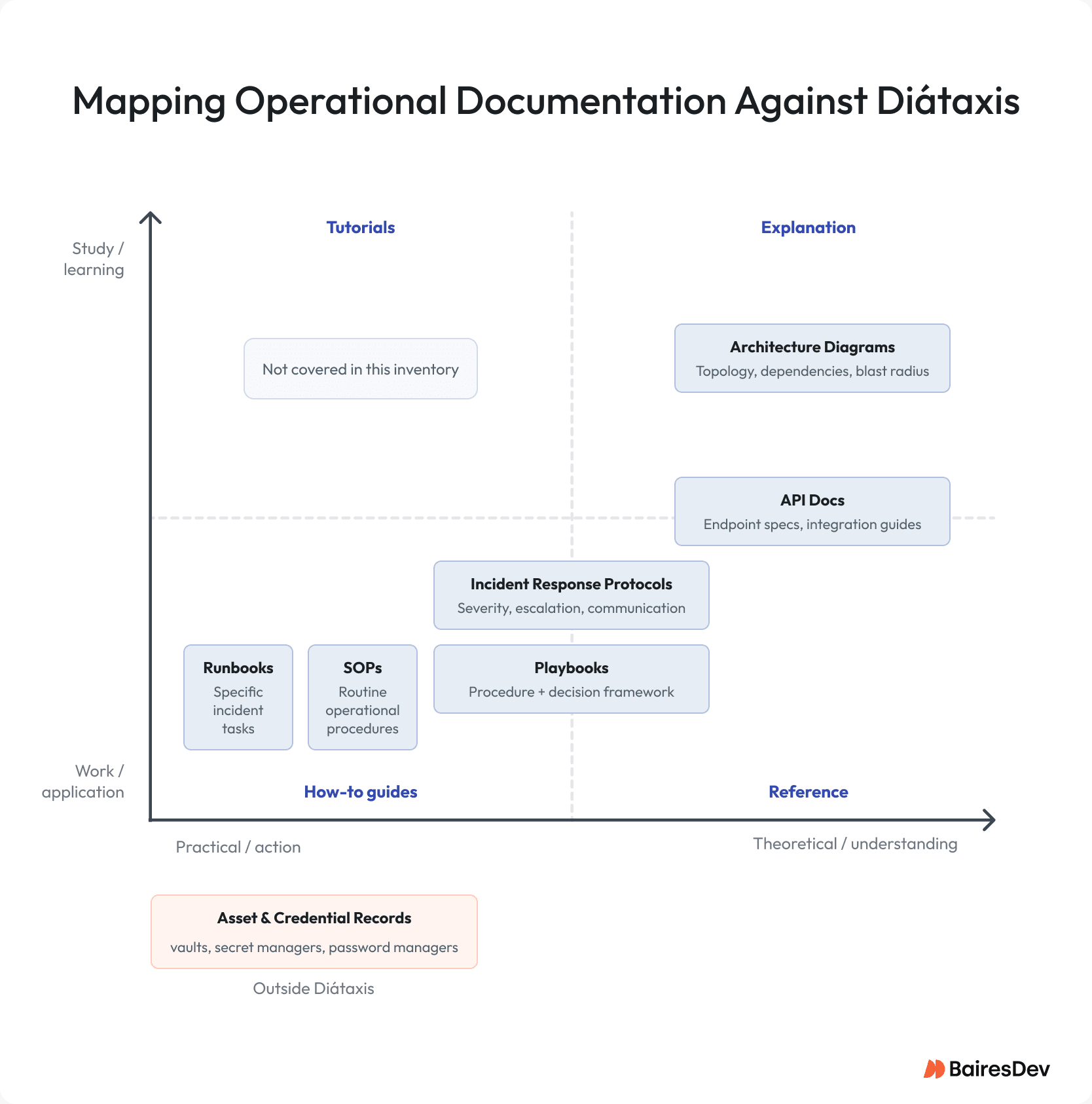
Mapping these categories to the table above: runbooks and SOPs are classified as how-to guides, designed to be followed sequentially during work in progress. IT infrastructure documentation, like architectural diagrams, is reference material.
API documentation is also reference material, though it sits closer to the codebase than to infrastructure. Incident response protocols include elements of both (e.g., reference data such as contact numbers and procedural steps).
Playbooks are better aligned with explanation, as they provide a rational basis for decision-making.
Asset and credential records fall entirely outside the Diátaxis classification: they reside in specialized systems (cloud secret managers or vaults, password management software) and therefore focus on ensuring secure access controls and adequate rotation policies rather than prose-based documentation.
The benefit of this categorization is that using multiple types within a single document negatively impacts all of them.
A runbook that includes explanatory content on architectural concepts becomes more difficult to follow under stress, and the instructional content gets lost amid procedural details.
Telling your team, “This runbook is a how-to guide! Keep the architectural context in a separate document,” helps structure documentation clearly and is a relatively simple decision that will save countless hours when someone needs to follow documentation during the dreaded 3 am call.
With the inventory defined, the next question is: where does all of this live?
Choosing the Right Documentation Tools
Organizational complexity is the defining axis of this decision. Your documentation system should reflect that complexity. A 200-person company using a single large-scale application will have a simpler IT environment to document than a 100-person company running 40 microservices across 3 cloud providers.
| Tool | Best For | Hosting | AI / Native Search | Notes |
| Confluence | Enterprise documentation with Jira integration | Cloud-first | Atlassian Rovo & Atlassian Intelligence | Server retired; Data Center sunset through 2029 |
| Notion | Flexible knowledge management | Cloud | AI capabilities available | Popular all-in-one workspace |
| GitBook | Developer documentation and docs-as-code | Cloud | Strong documentation search | Ideal for technical documentation |
| Docmost | Internal documentation with full data ownership | Self-hosted | Basic search | Open-source alternative for on-prem environments |
| XWiki | Enterprise knowledge management | Self-hosted | Extensible search | Highly customizable open-source wiki |
Teams that operate within their own codebase (regardless of whether they are 5 engineers or 50) tend to do well with Markdown files in their repository. Docs-as-code provides version control and pull request reviews, bringing documentation closer to the systems it represents. Discoverability decreases as repository size increases, and non-engineers may face challenges with Git workflows, but this trade-off tends to work well for organizations where all contributors are comfortable with Git.
Organizations with multiple teams that require cross-team discovery will typically move to a dedicated documentation platform. Documentation software like Confluence or workspace platforms like Notion provide search, permissions management, and a friendlier editing experience.
However, the platform only provides value if there is a defined owner of the information architecture. A Confluence instance where anyone can create pages without following taxonomy conventions becomes harder to search, not easier.
Organizations that require agent integration or must comply with regulations will need platforms with role-based access control, audit trails, and API access. At this level, the regulatory requirements and the need for programmatic access drive the decision more than the editing experience.
Why the Documentation Process Breaks Down
Documentation programs fail for two predictable, structural reasons: missing ownership and disconnected maintenance.
No clear owner
When a document states it is “owned by the team,” no individual maintains it. Each document requires a named owner.
Review cadence disconnected from change
A document describing a system should be reviewed when the system changes. The most effective trigger is linking documentation updates to pull requests: if a deployment pipeline changes, the PR template prompts the author to update the associated runbook.
Quality standards
The 4 C’s of technical writing serve as a practical benchmark: clarity, conciseness, correctness, and completeness. Treat them as acceptance criteria for documentation, the same way acceptance criteria work for feature stories. Teams building a standardized practice can also reference ISO/IEC/IEEE 26515:2018, which covers user documentation in Agile, DevOps, and CI/CD environments and establishes a recognized standard for the development workflows.
Documentation, Productivity, and Risk
A new team member’s first week follows one of two patterns. Either they read the documentation and ramp up independently, or they interrupt senior engineers with questions that the documentation should have answered. One of those scales.
Documentation directly affects time-to-productivity. Organizations that build a standardized training process through well-documented onboarding achieve faster knowledge transfer, with new employees contributing sooner.
If the setup process has been automated using scripting (e.g., a `./bootstrap.sh` that provisions the local environment), this dual quality is extremely valuable (and the value increases as it becomes an enabler for the next generation of automation). Some modern IT teams have gone further, using AI agents to automate the onboarding process across internal systems: provisioning accounts and guiding new team members through environment setup without a senior engineer present.
These effects get amplified for vendor engagements. When you bring on external engineers, the quality of your documentation determines whether they ship code in week two or week six. Companies spend significant effort selecting a vendor and finalizing the scope, then waste weeks because there is no documentation to help the vendor set up a development environment. Organizations working with engineering teams that document systems as rigorously as they build them are better positioned to maintain delivery momentum as teams evolve and projects grow.
Similarly, when your backend engineers are in one timezone, and your frontend engineers are in another, documentation becomes the primary vehicle for internal teams to communicate design decisions that would otherwise live only in a Slack thread. Design decisions that were never documented and API contracts that were never defined lead to gradual inconsistencies between teams.
Documentation also helps organizations meet compliance requirements. SOPs define the standard, while change logs and access records provide automated data collection for the audit trail. Incident postmortems document how the response was handled and what should change. Organizations with consistent processes can present auditors with a folder of relevant documentation, but organizations that don’t may find themselves wasting hundreds of engineer-hours recreating what should have existed in the first place.
Good documentation makes operations possible. The distinction between documentation that waits in a folder and documentation that enables operations is worth examining more closely, because it’s where AI agents change the equation.
Documents for Action: The Human-Machine Interface
Most engineering organization documentation resides in a knowledge base or collaboration tool, waiting to be found. This is cold knowledge: technically available, but practically inert.
Documentation written as part of an operational workflow operates differently. A “document for action” is a document that exists to make an operation happen, not to describe it afterward. Runbooks and SOPs are documents for action. So are incident-escalation checklists and vendor-onboarding workflows. What these documents share is a quality closer to executable scripts than to reference articles: they define a sequence of steps with expected outcomes that a human or a machine can follow to produce a result.
The ./bootstrap.sh from the onboarding section is a simple example. It is human-readable and directly actionable. But the concept of a document for action extends beyond scripts: any document structured to drive an outcome rather than merely describe one qualifies. And when a document is actionable enough for a human engineer, it turns out to be actionable enough for an AI agent.
Action-oriented documents can serve two audiences simultaneously.
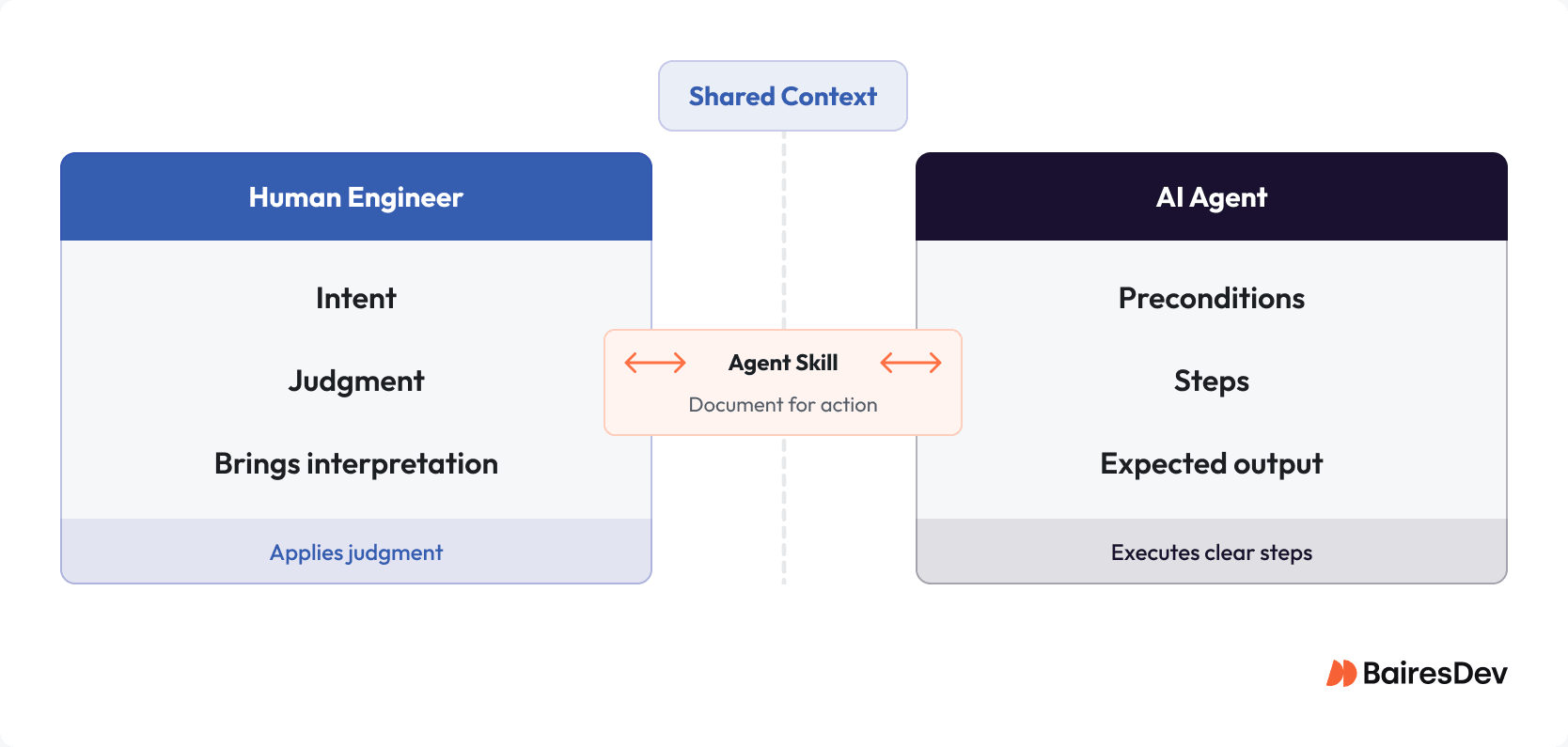
A human engineer reads the runbook for context: what does this step do, and what could go wrong? An AI agent reads the same document for precise, executable steps. The document becomes a shared interface between human interpretation and machine execution.
The quality bar rises because the ambiguity that a senior engineer can work around becomes a risk when an agent takes instructions at face value. Modern LLMs can infer some missing context, but precise documentation helps teams resolve issues faster and reduces the risk of human error during high-pressure incidents.
When a document for action is structured clearly enough for an AI agent to consume, it becomes an agent skill: a runbook or SOP in Markdown, with preconditions, numbered steps, expected outputs, and rollback procedures, consumed by an AI agent as a skill definition. The agent reads the natural language instructions and executes them.
In theory, no custom API or predefined schema is required: natural language is the interface. In practice, connecting the agent to internal systems (CI/CD pipelines, cloud providers, ticketing tools, secret managers) and managing permissions adds complexity. Still, the document itself is Markdown, the same format developers already use for code documentation.
Many software engineering teams already work this way. As teams supplement contributor guidelines (CONTRIBUTING.md) with files like CLAUDE.md or AGENTS.md, they follow this pattern: whether you are a junior developer or an autonomous coding agent, here is how to operate within this codebase.
Same document, two audiences, rapid onboarding for both. The AGENTS.md standard, now governed by the Linux Foundation’s Agentic AI Foundation, has been adopted by over 60,000 open-source projects.
How Does Documentation Now Feed AI Assistants and Copilots?
Most organizations do not connect the quality of their documentation to the value they receive from AI tools, and that disconnect is costly.
An AI-powered search tool will confidently surface relevant information when documentation accuracy is high. But feed it a mix of outdated runbooks and contradictory wiki pages, and it will return similarly confident but incorrect answers: plausible misinformation that appears polished like accurate information.
AI agents are being used to maintain consistency across abstraction layers, where humans have historically struggled to keep things in sync. Product requirement documents stay in sync with code comments, code comments stay in sync with code and tests, and releases stay in sync with runbooks.
Documentation automation tools that monitor repository activity and flag content that has drifted from the code already exist and are rapidly maturing.
This desire to keep documents alive and synchronized with the systems they describe has deep roots. In 1984, Donald Knuth published his ideas on literate programming, proposing that source code and its documentation be a single document, woven together so that the two would never become desynchronized. In 1988, Wolfram expanded upon this concept with Mathematica’s computational notebooks: a notebook combines prose and live code with interactive visualization in a single document, and when you change the inputs or update the controls, the outputs recompute, and the visualizations redraw. The document remains true to its data because it is the computation.
Emacs Org-babel (2009) and Jupyter notebooks (2014) brought this model to polyglot programming, allowing authors to mix executable code from multiple languages within a single document. Python’s doctest module (2001) took a different angle: examples embedded in documentation comments become executable tests, so if the code changes and the documentation drifts, the test suite catches it. Around 2000, Microsoft Visio Enterprise Network Tools applied a related principle to network documentation: Visio auto-discovered network topology and generated network diagrams that stayed in sync with the live infrastructure. D3.js, whose name stands for Data-Driven Documents, brought data-bound visualization to the web in 2011.
All of these innovations kept documents alive through direct computation or data binding. What AI agents add is another dimension of synchronization: they operate over natural language. An agent can detect when a code change makes a Markdown runbook outdated and rewrite the prose to match. This makes documentation easier to maintain at scale, extending the tradition of live documents into territory that was previously too unstructured for automation.
What You Need to Know Before You Build a Documentation Strategy
Documentation only works if it reflects how the system actually behaves today. Treating it as a static archive is the most common way it becomes a liability rather than an asset.
In the environments where AI tools query it directly, outdated content produces confidently wrong answers rather than no answer at all. On the tooling side, new documentation strategies should not be built around Atlassian Server or long-term Data Center deployments. Both are being retired on a fixed schedule.
And while AI can help generate and maintain documentation at scale, it cannot replace human review. Technical accuracy and governance still require someone who understands the system to read what was written and confirm it is correct.
Where This Is Heading
The argument through this article has moved from treating documentation as a transcription duty to treating it as an operational control surface. The shift toward AI agents makes that transition unavoidable. Good documentation increases the return on every AI investment; poor documentation increases the blast radius.
When a well-written runbook can be read by a human and executed by an agent, when AI can synchronize documentation across the entire software lifecycle, the document for action becomes the organizing principle. Every runbook and SOP, every onboarding script, should be written with the assumption that both a human and a machine will read it.
It does not have to be complicated. A working IT documentation strategy starts by identifying the critical documentation whose absence would cause the most damage during the next incident. Each document needs a named owner. Write them in plain Markdown, structured so they can be acted on by humans and agents alike. Create triggers for review cycles. After that, the rest follows.