



Engineering leaders feel backlog pressure most acutely when traditional hiring can’t keep pace with demand. Low-code and no-code (LC/NC) platforms offer a practical way to absorb that load and deliver business apps faster, without expanding headcount, provided governance keeps pace. This guide makes the case for LC/NC in enterprise environments and shows how to set up the operating model that keeps it from creating new problems.
Key Points
- Low-code and no-code platforms excel at departmental workflows, internal tools, and dashboards, where speed matters more than deep customization.
- Without governance, they quickly create shadow IT, duplicated effort, and maintenance debt.
- A Center of Excellence is the operating mechanism that makes LC/NC sustainable at enterprise scale.
Our guide focuses on outcomes: shortening the development process, raising developer productivity, and improving ROI. You’ll see where low-code app development fits, when no-code solutions make sense, how to set guardrails that avoid sprawl, and what to measure so the value shows up on your P&L.
Operating Model that Works
Internal tools, approval workflows, partner portals, task automation, case management, data capture forms, and simple dashboards are ideal candidates for low-code or no-code platforms. These tools let business users build with drag-and-drop interfaces while professional developers focus on high-value custom work.
High-throughput analytics, core systems of record, and latency-sensitive services should stay in traditional development. Low-code emphasizes speed with governance for known patterns. No-code empowers non-technical users to make rapid process changes without writing code.
Strategic Enterprise Use Cases
While LC/NC began with small departmental apps, today’s platforms are increasingly being used for enterprise-grade projects.
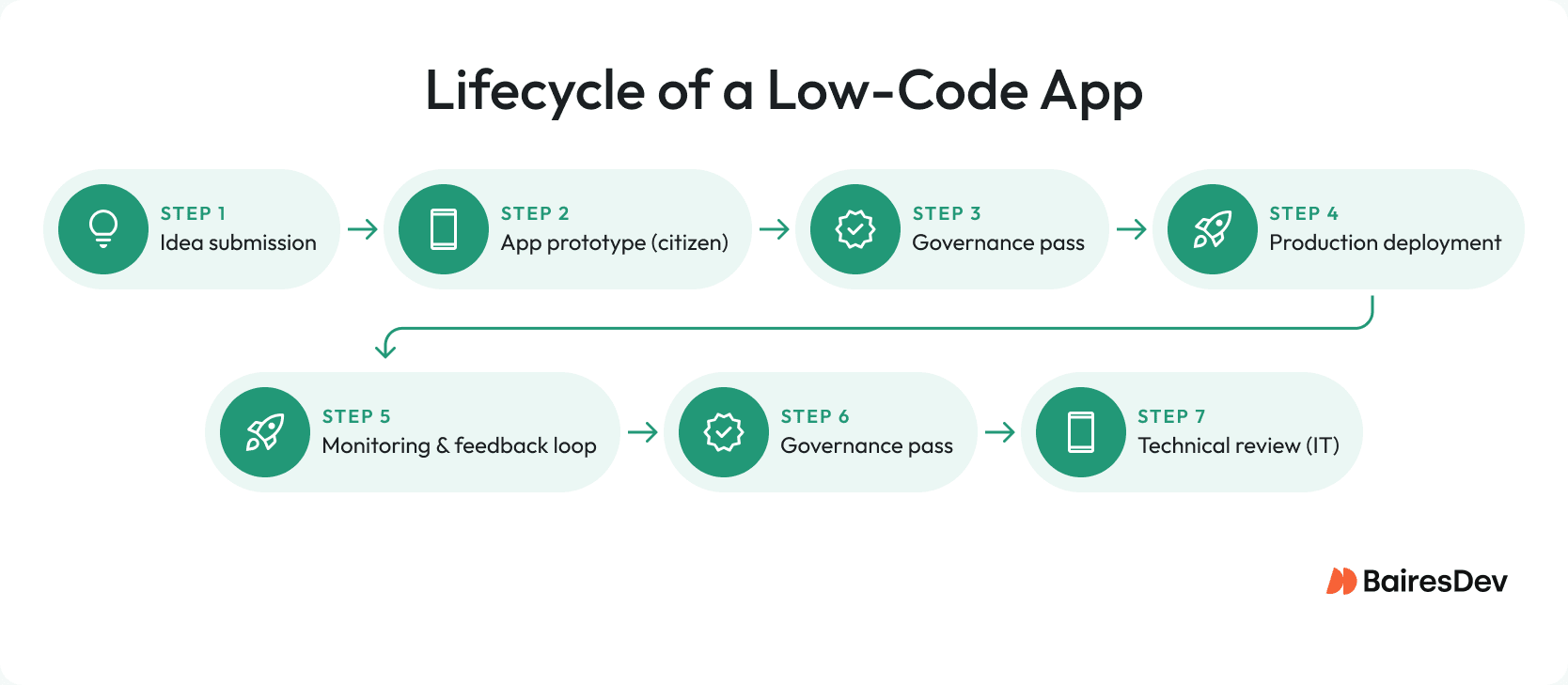
Across industries, organizations are integrating these tools into broader transformation efforts:
- Finance: Banks and insurers use LC/NC platforms to create regulatory reporting tools, loan origination workflows, and customer self-service portals, reducing dependence on legacy systems and accelerating deployment.
- Healthcare: Providers use LC/NC tools to digitize paper-based workflows (e.g., intake forms, appointment scheduling, symptom tracking) and integrate these front-end experiences with back-end EHR systems, often improving response times and compliance.
- Logistics and Supply Chain: Companies build internal tools for inventory tracking, delivery notifications, and asset management. In many cases, business analysts, not developers, lead the design and iteration process.
These use cases highlight LC/NC’s ability to address operational gaps where traditional development would be too costly or slow to justify, especially when speed and adaptability are paramount.
Benefits for Enterprise Environments
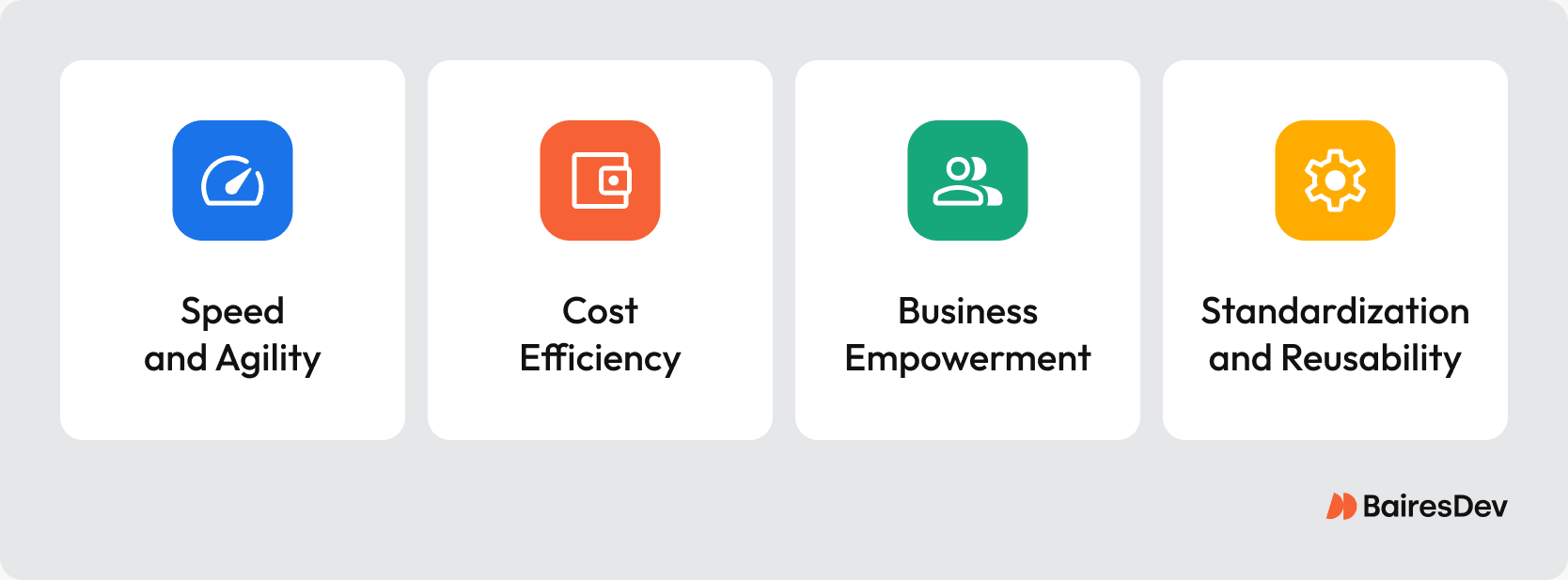
With low-code/no-code, you move from idea to release fast because visual models and pre-built components replace boilerplate. Teams validate a prototype in days, learn from real users, and iterate without waiting on scarce engineering cycles. The cost profile improves as commodity work shifts off your senior developers; you redeploy them to the differentiated services that drive revenue and margin.
Your business experts contribute directly, configuring workflows, data capture, and simple dashboards in tools that match how they think, so requirements friction drops and adoption rises.
At the same time, the platform enforces consistency: shared design systems, reusable components, and source-controlled assets give every app the same look, access rules, and deployment pipeline.
Governance, Security, and Platform Risk
Speed without guardrails is fragility. Governance is what turns LC/NC from a departmental experiment into an enterprise capability. Despite the advantages, LC/NC deployment in an enterprise context introduces critical risks that must be managed through governance and platform strategy.
Security Concerns
While most LC/NC platforms offer built-in security models, granular access control, and compliance features, applications developed without technical oversight can introduce vulnerabilities. Enforce role-based access, encryption policies, and API-level authentication at the platform level to ensure security parity with custom-developed apps.
Scalability and Performance
Many LC/NC tools are optimized for departmental use cases but may struggle with large-scale transactional workloads or complex data relationships. For example, applications requiring sub-second latency, real-time processing, or sophisticated backend logic may exceed the capabilities of most visual development platforms.
Shadow IT and Governance Challenges
Without a clear oversight model, LC/NC adoption can lead to shadow IT, duplicated functionality, and disconnected data silos. To counter this, adopt centralized governance models that sanction, monitor, and integrate LC/NC development into IT operations and architecture standards.
Long-Term Maintainability
While LC/NC tools allow rapid prototyping and short-term wins, long-term maintenance of these applications poses challenges, particularly if business developers leave or if the platform undergoes significant version changes. IT leaders must assess vendor lock-in, exportability, and long-term roadmap support as part of procurement.
Best Practices for Integration and Adoption
To realize the full value of LC/NC while avoiding common pitfalls, consider the following practices:
Adopt a Center of Excellence (CoE) Model
Establish an LC/NC Center of Excellence to define best practices, security guidelines, and approved use cases. The CoE can also provide training and technical support for citizen developers and evaluate new platforms for enterprise readiness.
Establish Guardrails for Citizen Development
Enable business users to build apps, but within a framework that enforces enterprise policies. This includes provisioning secure environments, managing identity and access controls, and integrating with corporate monitoring systems.
Ensure Integration with Enterprise Systems
LC/NC platforms should integrate seamlessly with critical systems such as CRM (e.g., Salesforce), ERP (e.g., SAP), data warehouses, and identity providers (e.g., Okta, Azure AD). A robust integration strategy ensures that apps created via LC/NC don’t operate in silos.
Monitor and Measure Outcomes
Use platform analytics to monitor usage, track app performance, and measure business outcomes such as cost savings, cycle time reduction, or improved customer satisfaction. Metrics like mean time to deployment, support ticket deflection, and app adoption rates help justify continued investment.
Evaluate Build-vs-Buy Strategically
For each use case, weigh the cost, flexibility, and performance of LC/NC versus custom development. While LC/NC is ideal for workflow automation and dashboards, it may not be suitable for core systems of record or high-throughput applications.
The Road Ahead
Low-code development and no-code platforms will continue to absorb more of the repetitive scaffolding required in developing software.
Professional developers spend more time on custom services, reusable components, and system design. Citizen developers spend more time refining business processes and user experiences for their teams.
Your development platforms orchestrate the flow between these roles so the organization delivers value faster with less friction.
Success comes from an operating model that blends accountability with empowerment. With the right guardrails, your company will rapidly develop functional apps that meet business needs, keep compliance happy, and give customers the responsiveness they expect. Low‑code and no‑code shrink backlog pressure, but governance determines whether that speed scales safely.