



VP of Engineering, CTO, and senior engineering leaders at mid-sized and large enterprises frequently hit the same wall: they’re overcommitted, hiring locally is slow, and the roadmap keeps growing. While the average time-to-hire for technical roles continues to be measured in months, a new imperative has emerged: the need to quickly access highly specialized skills (AI/ML, Cloud-Native, advanced data systems) that are scarce in local markets.
When the answer is to bring in an external group of full-time engineers who become a structural extension of your internal delivery capability, you’re talking about more than simply filling seats. It’s about setting up a blended engineering unit that can hit your timeline, uphold your quality standard, and integrate seamlessly with your existing in-house software development team.
In this paper, we walk through how to align the external team with your business goals, design communication flows that scale, track real delivery health, and maintain continuity in a fluid team composition. We include measurable data and concrete examples for senior tech leaders who prefer clarity over fluff.
Why Choose a Strategic Team Augmentation Model
For a VP of Engineering at a 1,200-employee firm, the decision to engage an IT staff augmentation services provider is not primarily about cost cutting—it’s about strategic throughput enablement. It’s the fastest lever to unlock capacity and bring in niche skills, directly impacting engineering velocity.
According to one projection, the global IT staff augmentation services market is set to grow from around $299 billion in 2023 to $857 billion by 2031 (CAGR ~13.2%). That accelerated growth underscores a critical shift: enterprises are moving from hiring bodies to engaging external dedicated development teams as strategic extensions of their core workforces.
When you bring in an external “engine” to supplement your internal team, you are targeting four core business drivers: speed, quality, specialized skills, and alignment with business objectives—not just ramping up headcount. A well-integrated remote development team becomes a true partner, not a bolted-on task vendor, maximizing software development potential.
The Critical Need for Specialized Expertise
The challenge of recruiting remains acute. In a 2024 analysis, 60% of engineering managers and executives reported a shortage of qualified candidates in the market for engineering roles, indicating that even after widespread tech layoffs, the specialized talent gap persists.
Key Benefits for Engineering Leaders:
- Access to Niche Skills: Immediately onboard expertise in areas like legacy system modernization, AI/ML implementation, or advanced cloud-native architectures when your in-house developers are saturated or lack domain-specific experience.
- Rapid Ramp-up: Achieve near-full productivity in weeks, compared to the months required for local recruiting, interviewing, and onboarding permanent hires. This significantly boosts engineering velocity.
- Flexibility and Scale: Scale dedicated development teams up or down efficiently and flexibly as project roadmaps and business priorities shift, avoiding the fixed overhead of permanent roles during periods of market uncertainty.
- Culture Preservation: By focusing IT staff augmentation on technical delivery within existing processes, you preserve the established culture of the in-house development team while still accessing a global talent pool.
Avoiding the Common Trap: The “Black Box” Outsourcing Model
Where many outsourcing arrangements fail is when the external group remains loosely tethered—performing tasks but not truly aligned with your product vision, sprint rhythm, or internal engineering ecosystem. This creates a technical and operational “black box.” A 2024 report found that distributed teams achieved 21% higher project completion rates when integrated into unified workflow tracking systems.
The successful shift is from “outsource a module” to “extend our team as one.” This integration is the bedrock of strategic team augmentation.
Aligning the External Team With Business Objectives
The transition from a vendor relationship to a strategic partnership requires embedding the external squad deep into your operational and business context, ensuring maximum return on your IT staff augmentation investment.
Embedding Strategic Alignment
Simply assigning tickets and tasks is insufficient. The external engineers must understand your company’s north-star metrics, roadmap direction, and how their software development work directly contributes to business outcomes. If an external team operates without this context, you will see silos forming, technical debt accumulating, and gated quality issues.
- Recommendation: Invite the external squad and their lead to your quarterly planning sessions, architecture review boards, and OKR workshops—just as you would your core in-house staff. This ensures they share the same context and language as your internal team.
Example: A high-growth SaaS firm brought in a remote QA squad and found defect detection plateaued until the external testers attended product demo reviews and joint sprint planning. Post-integration, test coverage expanded to more realistic user journeys and directly resulted in a significant reduction in production defects and incident response time.
Organizing Shared Ownership Via Joint KPIs
Define joint objectives that span both teams: e.g., “Successfully launch Feature X by Q3, while maintaining the change-failure rate under 5%.”
Do not use separate, proxy KPIs (like ticket count or hours logged) for in-house versus external teams. This fosters an adversarial environment and undermines the blended team concept.
- A Recommended Metric: Track deployment frequency, lead time for changes, and mean time to recovery (DORA metrics) uniformly across the entire blended team. This keeps the focus squarely on engineering outcomes and business value, maximizing engineering velocity.
Designing Collaboration and Communication for Hybrid Teams
Distributed team models inherently introduce potential friction: time-zone differences, cultural norms, informal chat gaps, and decision-making lag. Leadership must treat the remote communication infrastructure just like any other critical delivery tool for software development.
Addressing Inherent Asymmetries
Effective communication must be intentional, structured, and redundant.
| Ceremony | Purpose | Stakeholders | Communication Medium |
| Daily Stand-up / Scrum | Synchronize progress, surface blockers, clarify immediate dependencies. | In-house team, external team, Scrum Master/TLs | Video conference (Hybrid-first) |
| Asynchronous Updates | Share architecture changes, critical decisions, key dependencies, and non-urgent feedback. | Tech leads, project managers, remote developers | Shared chat channels (Slack/Teams), Central Wiki |
| Bi-weekly Sprint Review / Demo | Validate delivered work, gather product feedback, celebrate joint successes. | Product Owner, Internal and External Teams | Recorded Video Conference & Follow-up Notes |
| Quarterly Roadmap Sync | Re-align priorities, review key performance indicators, project resourcing needs. | VP Engineering, CTO, Outsourcing Partner Leadership | In-depth Presentation & Q&A (Recorded) |
Best Practices for Remote Collaboration
- Appoint a “Communication Owner”: On both sides (your in-house lead and the vendor’s lead), assign accountability for facilitating clarity, translating context, and neutralizing time-zone friction.
- Decentralize Decision Access: Give external engineers direct access to product owners and your internal decision-makers. Avoid bottlenecks where every clarification has to go through a single middle layer.
- Use a Shared Tool Set: Mandate a common, shared tool set (e.g., Jira, GitHub, Slack, Datadog) for all discussions and workflows. No separate private chat groups that obscure the external team’s progress or decision history from full visibility.
- Build Dual Time-Zone Loops: For significant time-zone differences (e.g., US/India), run a synchronous review in the early morning for one team, recording a wrap-up for the other team’s morning. This cuts decision latency while preserving visibility.
Tracking Outcomes—Not Just Activity
The flaw of relying solely on throughput metrics is that they incentivize activity over value. When the external group in an IT staff augmentation model is treated merely as a “task vendor,” you lose sight of strategic alignment. As an engineering leader, what matters most are outcomes that tie back to your business metrics.
Recommended Metrics for Blended Teams
- Outcome Alignment: Align the external team’s OKRs with your teams’ objectives—e.g., “Improve API response time by 30% by Q2,” or “Reduce customer-reported bugs by 15%.”
- DORA Metrics: Use Deployment Frequency, Change-Failure Rate, Lead Time for Changes, and Mean Time to Recovery uniformly across the full engineering organization (in-house and augmented). This provides an objective, holistic view of engineering health.
- Cycle Time Analysis: Analyzing cycle time specifically at handoff points between your in-house team and the external team. Where are delays (e.g., code review, QA sign-off) creeping in? Removing these handoff bottlenecks is a core strategy, and Gen AI tools alone are projected to boost developer productivity by 20% to 45%, providing massive leverage for eliminating manual steps.
Example (Principle-Focused): A global payments company onboarding an external frontend squad saw initial throughput (story points) high but a Change-Failure Rate 3 times the internal rate. By running joint post-incident reviews and aligning QA gates across both groups, the focus shifted from sheer activity to production stability.
Overcoming Integration Friction and Risk
Bringing external engineers into your system is a cultural and technical process, requiring more than just provisioning VPN access. It’s about aligning on your software development environment, your processes, your definition of done, and your quality standard.
Onboarding: The Technical and Cultural Alignment
A 2024 report highlighted that 65% of all engineering respondents experienced burnout in the past year, a problem exacerbated by short-staffed teams and high friction. A robust, structured onboarding process reduces this friction for all parties.
Checklist for Strategic Technical Onboarding:
- Tool-chain Parity: Ensure the augmented team uses the exact same IDEs, version control workflows (Git flow), observability platforms (Datadog/New Relic), and deployment pipelines (CI/CD) as your core team.
- This is a fundamental strategy for achieving “contextual leadership” and ensuring that AI-augmented teams can integrate seamlessly, as AI tools amplify existing systematic understanding (or expose its absence) and work best when connected to established, common infrastructure.
- Shared Rituals: Retrospectives, architecture reviews, and incident post-mortems should include both in-house and external engineers. This builds a single team accountability model for software development.
- Consistent routines and rituals are what actually shift behavior and trust faster than top-down initiatives. They create shared meaning and enhance organizational citizenship behaviors, which is essential for cohesive blended teams.
- Feature Ownership: Transition the external team beyond low-risk bug backlog to own entire features (from design to deployment). This increases accountability and integration depth. (This principle is supported by the overall context of the example below, promoting high-agency work.)
- Mandatory IP Protection: Ensure your legal agreement explicitly states that all work product from the external team is “work-for-hire” and that your company retains 100% IP ownership (source code, documentation, assets). This is non-negotiable for enterprise-grade engagements.
- Legal/Business Resource on IP Protection: In the US, the “work-for-hire” doctrine rarely applies automatically to custom software created by an independent contractor. To secure full ownership, your contract must include a specific, written Assignment of Rights that explicitly transfers the copyright, along with a Non-Disclosure Agreement (NDA).
Example: A 1,500-employee tech company onboarding an external backend team initially isolated them to the low-risk bug backlog. Pull requests kept bouncing due to style and dependency issues. After a one-day onboarding reset—including a design-system walkthrough, pull-request standards workshop, and a review of key historical retrospectives—they dramatically reduced rework and accelerated their time-to-contribution. Companies with a strong, formalized onboarding process improve new-hire productivity by 70% or more.
Ensuring Continuity in Dynamic Teams
Staff augmentation inherently means team composition may change. The risk for a senior engineering leader is not only productivity loss, but knowledge erosion and schedule slip.
Best Practices for Continuity:
- Anchor Accountability to Roles, Not Individuals: Define “Automation Lead,” “Data-Pipeline Owner,” or “QA Engineer Responsible for Platform Reliability.” If a person leaves, the role remains, minimizing the impact of personnel transitions within dedicated development teams.
- Implement Hand-off Playbooks: Create explicit, documented playbooks for vendor transitions, detailing open pull requests, critical unresolved technical debt, integration points, and a full access audit checklist.
- Maintain Documentation Coverage: Enforce documentation as a core part of the Definition of Done. Track documentation gaps, link all work to your central wiki, and assign rotating owners. Institutional memory cannot be the only source of truth.
Driving Long-Term Value Through a Strategic Augmentation Model
When you treat external teams as strategic enablers rather than tactical gap-fillers, you unlock maximum benefit: access to global talent, dedicated full-time engineers, and the ability to accelerate timelines without compromising your internal team’s culture or standards. The IT staff augmentation partner becomes an extension of your engineering leadership, not a separate vendor.
To fully capitalize on this model, senior engineering leaders must commit to the following steps:
- Integrate the external team into your strategic planning and roadmap context—not just sprint stand-ups.
- Design communication flows proactively to neutralize time-zone, language, and cultural friction.
- Track results by outcome metrics (DORA, business OKRs) rather than activity proxies (story points).
- Treat onboarding and integration as a high-priority investment—not a simple administrative afterthought.
- Build for continuity by decoupling roles from individuals and implementing detailed hand-off protocols.
When done correctly, a team augmentation strategy allows you to scale reliably, move faster, and maintain high quality while preserving the morale and bandwidth of your core internal team. The goal isn’t simply to add bodies—it’s to create a blended, high-velocity engineering organization that drives toward your business objectives.
Unpacking the Team Augmentation Model: Operational Flow
The following visual outlines the continuous lifecycle required to manage and maximize value from an augmented engineering team.
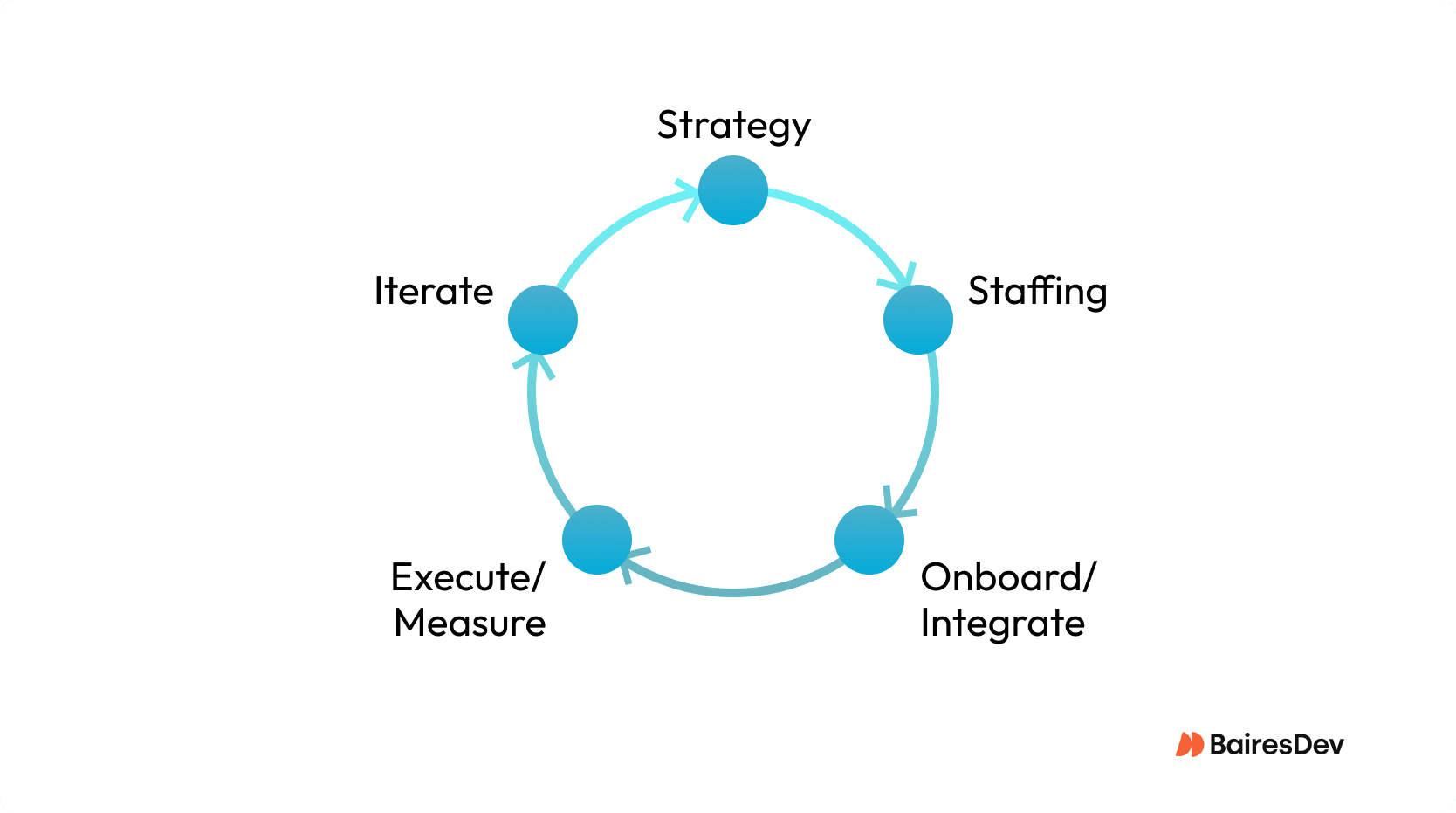
- Strategy: Identify skill gaps, define business OKRs, and scope the work for the external team.
- Staffing: Partner selection, contract and IP finalization, vetting of senior engineers.
- Onboard/Integrate: Tool-chain parity, cultural alignment, shared ceremonies, access provisioning, and role assignment.
- Execute/Measure: Shared DORA/OKRs tracking, joint sprint execution, continuous code review, and frequent demos.
- Iterate: Quarterly business reviews, performance feedback, scaling/downscaling decisions, knowledge transfer.
The Strategic Imperative: Shifting from Task Vendor to Velocity Partner
This transformation requires a clear commitment to integration, centered on four non-negotiable pillars:
- Contextual Ownership: Moving the external squad to full feature ownership and aligning their mandate directly with your business OKRs.
- Unified Accountability: Mandating shared performance metrics (DORA and cycle time) across the blended organization, prioritizing production stability over mere activity.
- Intentional Design: Proactively engineering communication flows, shared tool sets, and cultural rituals to neutralize time-zone and language friction.
- Risk Mitigation: Ensuring absolute IP protection and institutionalizing knowledge transfer to guarantee continuity regardless of personnel changes.
When executed with this strategic clarity, team augmentation delivers an elastic, high-velocity engineering organization. This shifts the executive challenge from struggling to staff to being able to reliably accelerate the entire product roadmap, turning a capacity bottleneck into a core competitive advantage.