


In many organizations, enterprise architecture (EA) has stopped being a bureaucratic checklist and become a strategic lever. As internal teams get stretched thin, enterprise architects increasingly act as the connective tissue between business objectives and technology capabilities. That shift lets businesses scale efficiently, avoid costly fragmentation, and move from theory to execution faster.
When companies treat EA as a rigid framework exercise, they end up with dusty diagrams and stalled projects. The leaders we work with—VPs of Engineering, CTOs, heads of Product—aren’t looking for perfect compliance. They need speed, clarity, and alignment between what the business needs and what engineering delivers. A modern enterprise architecture practice offers exactly that: a way to make architecture serve delivery rather than stall it.
The Strategic Shift: From Frameworks to Business Outcomes
Why EA Is No Longer Peripheral
Enterprise architects once spent their days building compliance diagrams and framework artifacts with little direct impact on day-to-day delivery. Today their role has evolved: they help design technology architecture that supports business objectives, define target operating models, and guide major decisions on infrastructure, data, and platforms. EA isn’t an afterthought—it’s strategic.
That evolution reflects a broader market reality. According to a 2025 survey, 94% of enterprises worldwide now run at least some workloads in the cloud. That widespread adoption of cloud-first and hybrid infrastructure paradigms forces EA practices to think in terms of business capabilities, cost models, resiliency, and scalability.
Business Pressures Driving the Shift
Leaders now demand that technology investments produce measurable business value—not just clean diagrams. Cost pressure, regulatory risk, compliance needs, security, and the need for agility all push EA to become more pragmatic and outcome-focused. The architectural decision can’t wait for long review cycles; it needs to align directly with product roadmaps and business goals.
Core Functions of Modern Enterprise Architecture
Technology Strategy and Platform Modernization
Modern EA helps organizations decide which platforms, tools, and infrastructure to build, buy or retire. That involves mapping business capabilities to scalable, maintainable technology infrastructure—whether that means cloud-native microservices, composable platforms, or a hybrid of on-prem and cloud.
With cloud adoption now nearly universal, many enterprises are standardizing on a multi-cloud or hybrid architecture strategy. In 2024, global cloud-spending was forecast to hit $723.4 billion—underscoring how critical the cloud is to delivery, scalability, and competitive advantage. EA teams play a central role in defining reference architectures, enforcing guardrails, and avoiding cloud sprawl or runaway costs.
Business Architecture and Process Clarity
EA doesn’t just map technology; it defines business capabilities and value streams. Translating business processes into clear, reusable capability maps helps leadership and engineering teams speak the same language—removing ambiguity about what systems or functionality support which business goals. When a VP asks “why is this system needed,” the answer should tie back to a capability in the business model, not technical inertia.
Data Architecture and Stewardship
As analytics, machine learning, and data-driven decision making scale, the importance of robust data stewardship and information architecture rises. A 2024 survey found that 71% of organizations now report having a formal data governance program—up from 60% the year before. That’s a strong signal that EA can no longer treat data as an afterthought. Instead, data architecture, lineage, retention, and access policies must live in the EA roadmap.
Enterprise architecture teams that embed information standards into platforms—through standards, modeling, and enforcement—help ensure physical data assets and analytic pipelines remain reliable, auditable, and aligned with business needs.
Risk, Compliance, and Resilience
For many organizations, especially in regulated industries, architecture decisions carry heavy compliance burdens. Modern EA helps define security, privacy, and compliance guardrails—including reference architectures that support GRC (governance, risk, compliance) needs—while enabling agility. Whether using a standard framework like the Open Group Architecture Framework, Federal Enterprise Architecture Framework (FEAF), or Zachman Framework, the goal isn’t adherence for its own sake. It’s about building architectures that align with business risk profiles and operational needs.
How EA Operates Today: Governance Without Gatekeeping
Advisory Guardrails Instead of Bottlenecks
Traditional architecture review boards often slow delivery—creating a bottleneck rather than enabling progress. Modern EA flips that model. Instead of acting as gatekeepers, enterprise architects offer advisory guidance, provide impact analysis, and define architecture principles teams can follow without needing prior approval for every decision.
That means engineering teams can move faster, while still aligned to strategic objectives and risk tolerances. Pattern libraries, reference architectures, and automated guardrails reduce subjective decision-making and speed adoption.
Embedding Controls in Platforms
Concepts like policy-as-code and integrated architecture tooling let EA teams bake governance directly into pipelines. Rather than manual checklists or document reviews, compliance, information controls, and best practices are enforced automatically as part of deployment or platform provisioning.
That approach reduces friction, enforces consistency, and scales across teams—especially valuable in large organizations with multiple independent delivery units.
Where to Start: Prioritizing EA Investment
EA Focus Portfolio
Start with the most material constraint the organization is facing—whether platform fragmentation, data chaos, delivery delays, or risk exposure—then build from there. A useful prioritization table looks like this:
EA Focus Portfolio
| EA Focus Area | Primary Value | Typical Artifacts | Time Horizon |
| Technology Strategy | Align platforms to business outcomes | Target-state architecture, capability maps | 12–36 months |
| Business Architecture | Clarify business processes and capabilities | Operating model diagrams, value streams | 6–18 months |
| Solution Architecture | Design technology solutions under constraints | Reference designs, architecture principles | 3–12 months |
| Data Architecture | Govern data assets and enable analytics | Data models, lineage diagrams, policies | 6–24 months |
| Risk and Compliance | Reduce business risks and increase resilience | Control frameworks, risk registers | Ongoing |
Measuring Impact
To ensure EA doesn’t become another overhead center, define clear KPIs: delivery velocity (cycle time), defect rate, cost-to-serve, cloud-spend efficiency, time to onboard new systems, risk/exposure metrics. Good EA transforms abstract governance into measurable business results.
Modern Pressures Demanding EA: Cloud, Data, Regulation
Cloud-first and Hybrid Strategies
With cloud computing now nearly universal, and hybrid or multi-cloud strategies becoming the norm, architecture needs to evolve beyond legacy on-prem premises thinking. Modern enterprises generally run mixed environments—leveraging public cloud for agility and innovation, private infrastructure for compliance or legacy workloads. EA becomes central in mapping which workloads go where, defining how data flows between environments, and ensuring consistent security and compliance across them.
Data Oversight and AI-driven Analytics
As organizations increase investments in analytics, machine learning, or data-intensive applications, governance becomes essential. Poor data practices can lead to quality problems, compliance risks, and lost trust—risks that grow as data use expands. EA teams must embed data governance into their architecture plans early, defining how data is modeled, stored, accessed, and reused across the business. The result: more trustworthy data, faster analytic delivery, and minimized regulatory risk.
If you’re a VP of Engineering or a CTO, modern enterprise architecture isn’t a luxury—it’s a strategic necessity. Consider these actions this quarter:
- Identify your biggest delivery constraint (platform sprawl, data inconsistency, slow onboarding), then build an EA pilot focused on that.
- Empower architects to own not just models, but outcomes—define KPIs, link architecture artifacts to business metrics.
- Replace heavy-handed review boards with advisory guardrails and automated policy enforcement.
- Treat data governance, compliance, and cloud strategy as shared concerns—not just infrastructure or security tasks.
- Use an EA framework (TOGAF, FEAF, or Zachman) only insofar as it supports your business structure, speed, and risk profile.
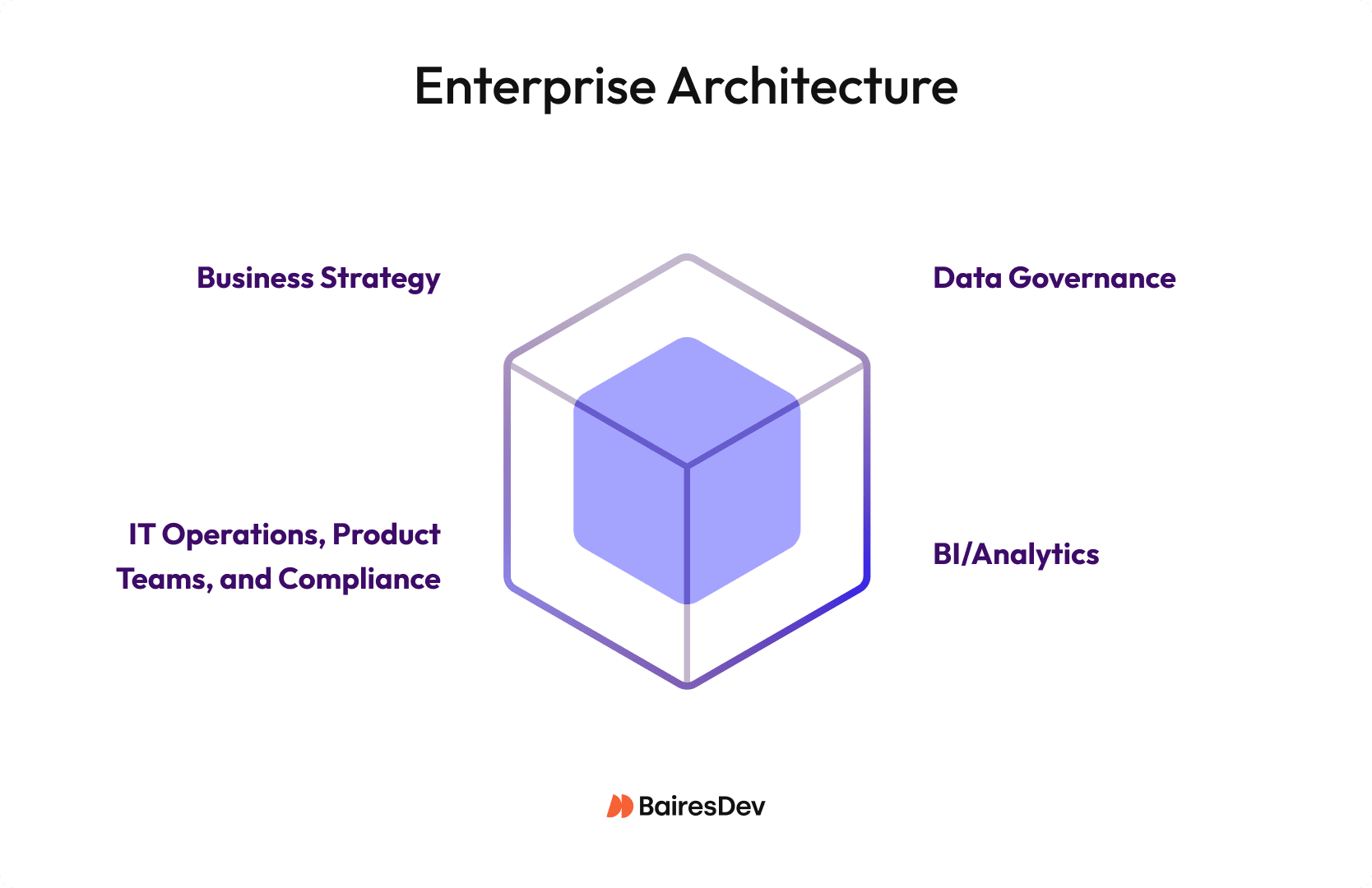
Treat EA as the bridge between business strategy and delivery. When done right, it turns architecture from a bottleneck into a competitive advantage.
What This Means for Your Digital Future
By positioning enterprise architecture at the intersection of strategy, delivery, and risk, you lay the groundwork for disciplined growth. You get a repeatable, scalable model for technology decisions, clearer alignment between business and engineering, and a resilient foundation for the next wave of transformation—cloud migration, data analytics, AI adoption, and beyond.
With EA integrated into decision-making, engineering becomes less chaotic, delivery becomes faster, costs become more predictable, and as new business demands arise, you have the architecture in place to respond—not just react.