



Building an effective Java testing stack is all about assembling a set of tools that solve real testing problems without unnecessary complexity. The right testing stack improves delivery confidence without creating tool sprawl, brittle suites, or maintenance headaches.
Key Points
- What your system is built from decides which testing problems matter most, so let the architecture drive your decisions.
- Most teams need a framework for each testing role and the gaps between roles are where coverage tends to break.
- BDD and collaboration tools only earn their keep when non-engineers actually participate.
- Every framework carries real maintenance and learning cost, so a smaller stack the team fully owns usually beats a larger one nobody does.
Choosing the Right Java Testing Framework
Every Java team needs a testing stack, but more frameworks rarely means more confidence. Choosing the right stack starts with understanding the environment in which it will operate:
- System composition indicates which testing problems matter most.
- System size and complexity influences how much orchestration and automation support is required.
- Staff composition plays a role because some frameworks assume only technical users, while others aim to involve product, QA, or compliance stakeholders.
- Skill level matters too, as tooling choices should align with the expertise already present in the organization.
Keep these criteria about your organization in mind as we explore the various testing frameworks and where they can be a good fit for your teams.
Java Test Frameworks Defined
Your teams use Java test frameworks to build automated test suites. Frameworks support different categories of automated testing commonly found in CI/CD pipelines:
- Unit Tests: Small pieces of code that test detailed logic, branching, and flow.
- Integration Tests: Larger test harnesses that penetrate deeper using real databases.
- Behavior-Driven Development (BDD): Plain-language test descriptions that get converted into executable artifacts.
- UI automation: Test flows that drive UIs using web interactions just like a user.
These four categories describe how tests are built and run. Functional, acceptance, and end-to-end testing describe what you’re verifying, and you reach them by combining the categories above. A functional test, for example, typically runs as an integration or UI test rather than as a separate framework type.
The industry has produced a selection of Java test frameworks for each category. You’ll choose based on the type of software your organization deploys and how the various teams interact while building out the automation suites.
Teams Use Framework Stacks to Cover All Test Roles
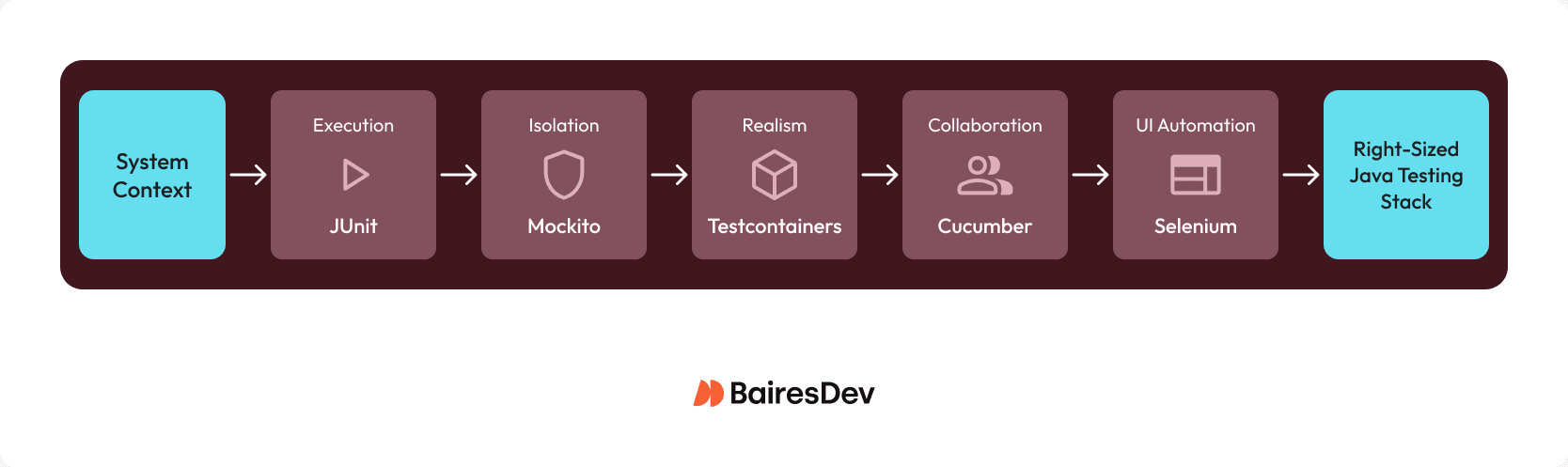
All frameworks serve a specific role in the testing ecosystem. Each role solves a crucial problem. You’ll need frameworks from most or all of these roles in your testing stack.
| Role | Go-to framework | Alternative | Choose it when |
| Execution | JUnit | TestNG, Spock | You want the default backbone; TestNG for large parameterized suites |
| Isolation | Mockito | Spock | You need fast mocks and stubs alongside JUnit |
| Realism | Testcontainers | (none mainstream) | You need real databases or queues, not simulated ones |
| Collaboration | Cucumber | Serenity BDD | Non-engineers will genuinely participate in test ownership |
| UI automation | Selenide | Selenium, Playwright | You want cleaner Java UI tests; Playwright if frontend is JS/TS |
Best fit clarifies when you compare frameworks by role.
The platform’s style in serving its role will lead you to recognize the most appropriate frameworks for your organization and how it works.
Comparing Java Test Frameworks by Role
Each role has several competing frameworks. They sort out by how they get the job done within their role.
Execution Role: Test Foundations
The foundation role of execution solves the problem of how the tests get orchestrated.
JUnit: Everyday Workhorse
JUnit is the default testing backbone for Java. Don’t get confused by the “unit” in its name. You can drive any type of test using this framework, from unit tests on up to full integration tests.
What JUnit does well:
- Simple to use
- Massive ecosystem support (IDEs, build tools, CI)
- JUnit 5 supports extensions and multiple engines
- Provides a lot of control for complex suite orchestration, groups, dependencies, and large, enterprise-style test runs.
Where JUnit falls short:
- Limited built-in features for data-driven testing
- Requires pairing with other tools (like Mockito and Testcontainers)
You can get going fast with JUnit and layer in other tools as needed. It works well for modern backend teams, especially for Spring-based microservices. Start here unless you have a specific reason to.
TestNG: Large-Scale Test Coordination
TestNG is an option for organizations that need large-scale, complex test suites. It helps to have a framework with built-in features to manage the complexity, so you don’t have to roll your own.
What TestNG does well:
- Built-in parallelism, dependency ordering, and support for data providers
- XML-driven configuration to manage large suites
Where TestNG falls short:
- Requires oversight to keep the test suites understandable
- XML configuration can become brittle
Give TestNG a look if your test suites need complex enterprise test suites that are heavily parameterized and require large-scale orchestration. Otherwise, you’ll end up managing a complex configuration that does not pay the rent.
Spock: Readable Behavioral Specifications
Test suites always benefit from transparency. Annotations dedicated to self-documentation are one way to achieve this. Spock emphasizes readable behavioral specifications using a structured testing style.
What Spock does well:
- Readable tests built around concepts like “given/when/then” directives
- Expressive for behavioral testing
Where Spock falls short:
- Spock runs on Groovy, an extra layer in the stack
- Groovy dependency may require additional tooling and governance
Spock is worth a look if your developers value self-documenting tests, but only if the organization can tolerate non-Java tooling in the test suite architecture. Evaluate the tradeoffs carefully.
Execution frameworks determine how tests run. Isolation frameworks address a different problem: limiting the scope of a test so specific behavior can be validated without exercising the entire system.
Isolation Role: Focused Testing
The isolation role enables your staff to focus testing on specific features and subsystems. Isolation testing requires that some parts of the functionality become non-playing characters while the tests exercise other parts.
Mockito: Behavior Stand-Ins
Like JUnit for the execution role, the Mockito framework is the go-to option for isolation testing. It allows the developer to define known signals to the functionality being tested so that its behavior can be validated.
What Mockito does well:
- Simple API for mocks, spies, and stubbing
- Integrations cleanly with JUnit
- Fast unit tests
Where Mockito falls short:
- Encourages over-mocking
- Can lead to tests that verify implementation, not behavior
Mockito is a staple for writing tests. Developers can easily build isolation tests and cover edge cases and error paths. Mockito and test containers solve different problems,i.e., Mockito is useful for external dependencies, various edge cases, and hard-to-reproduce failures. But even then, Mockito can be useful to mock or stub configurations and dependencies that would otherwise complicate the test suite.
Spock: Options Beyond Mockito
The Spock framework straddles the roles of execution and isolation. In its isolation role it offers capabilities above and beyond what Mockito can do.
What Spock does well:
- Built-in mocking
- Built-in data-driven testing
Where Spock falls short:
- Less standard in mainstream Java shops
- Smaller ecosystem/community than JUnit + Mockito
- Harder to adopt incrementally in existing Java test suites
Spock’s wider support for isolation testing compared to Mockito makes it attractive, as long as the Spock style of test composition fits your teams’ culture. If it has what you need out of the box, Spock is an attractive option.
Isolation testing improves speed and focus, but eventually teams need confidence that software behaves correctly against real dependencies. That’s where realism-oriented frameworks enter the picture.
Realism Role: Exercise Deeper Layers
The barrier to meaningful test penetration has always been how to give the code real back-end connections to use. Testcontainers has emerged as a widely-adopted approach for realistic integration testing in JVM-based systems.
What Testcontainers does well:
- Testcontainers exist for most back-end vendors (e.g., database, MQ)
- Ephemeral behavior supporting local and CI pipeline testing
- Production code requires no changes to support testing versus production
Where Testcontainers falls short:
- Complex orchestration across test suites
- Can be slow to spin up and shut down between test suites
- Tests must start/end with zero state to run containers across suites
- Increased CI complexity
Testcontainers enable automation to move past simulated dependencies to real back-end fixtures. Cost/benefit analysis favors using Testcontainers over building proprietary test fixtures. Plus, Testcontainers work identically in playpen test runs and CI/CD pipelines, so test suites can be validated locally before deployment. However, container-backed integration testing should complement fast unit tests rather than replace them. Teams still need fast unit tests for quick feedback, so the test suite won’t become too slow for day-to-day development.
Not every testing challenge is technical. Some organizations also need a way for product, QA, compliance, and business stakeholders to understand and participate in testing efforts.
Collaboration Role: Behavior-Driven Development (BDD)
Building and observing tests can reach beyond the development staff. The frameworks that address the collaboration role extend participation to the larger organization. Adding this role to the stack depends entirely on whether staff outside of IT have a desire to share test ownership.
Cucumber
Collaboration requires a shared vocabulary. Cucumber supplies this with its Gherkin language, suited to describing plain-language test scenarios. Both technical and non-technical staff can read the Gherkin documents to understand what the test scenarios do in a suite.
What Cucumber does well:
- Business-readable specs
- Shared language across teams
- Strong ecosystem
Where Cucumber falls short:
- Often ignored by non-engineers
- Scenarios can duplicate lower-level tests
Adopting a platform like Cucumber only adds value if non-engineers actually engage with it. Otherwise, you incur the cost of a ceremony that nobody cares about.
Serenity BDD
Collaboration is just the start with Serenity BDD. It has additional layers that involve more of the organization, if the need exists for visibility to a wider audience.
What Serenity BDD does well:
- Rich reporting
- Traceability
- Integrates with Selenium and Cucumber
Where Serenity BDD falls short:
- Heavyweight
- More setup and maintenance
The fact that Serenity BDD can integrate with Cucumber proves its wider scope. It’s an ideal pick for regulated environments and complex acceptance workflows where stakeholders need to be kept informed. It’s great for reporting, traceability and visibility, which is useful when warranted (e.g., for acceptance testing). But it’s not needed for most teams.
The previous roles focus primarily on internal behavior and system interactions. UI automation approaches the problem from the opposite direction by validating software through user-facing workflows.
UI Automation Role: Web User End-To-End Testing
The UI automation role in some ways is the easiest to approach. But it’s also the slowest-running and the most fragile. Organizations should use UI automation when the goal is truly to validate UX-specific behaviors. Because it’s an easier reach, some organizations make the mistake of looking to UI automation as a means to achieve deep penetration into the system stack. That is the proper territory of API-level test suites. Some of that coverage belongs in integration tests and service-level tests, too, depending on the risk. UI tests should validate user flows, but not carry the full regression strategy.
Selenium: Low-Level Browser Automation
There’s a certain comfort at knowing a framework has longevity and wide user adoption. Selenium is such a product. Its long history also means its APIs reflect an earlier generation of browser automation design, often requiring more low-level orchestration than newer frameworks.
What Selenium does well:
- Full control over browsers
- Massive ecosystem
- Cross-browser support
Where Selenium falls short:
- Low-level APIs mean tests become verbose
- Flaky if poorly implemented
- High maintenance cost
Selenium is a powerful tool for driving complex UI flows and shines at cross-browser validation. But it’s expensive to grow and maintain test suites, as well as to run them.
Selenide: Higher-Level Wrapper Around Selenium
Successful low-level frameworks attract tool-builders who want to harness the power while also making it easier to use. That’s the niche Selenide inhabits. It makes test-writing more efficient and wraps the gritty-detail Selenium APIs in a solid, stable fashion.
What Selenide does well:
- Cleaner syntax
- Built-in waits and stability
- Less boilerplate
Where Selenide falls short:
- Still tied to Selenium’s underlying model
- Less flexible at very low level
Java teams doing UI automation should evaluate Selenide before building directly on Selenium. The choice often comes down to whether developers need low-level browser control or prefer a higher-level abstraction focused on readability and stability.
Playwright: A Valuable Addition for JavaScript-Heavy Shops
During Java’s long dominance in enterprise backend development, UI automation often lived in Java-centric testing ecosystems alongside tools like Selenium. That landscape shifted with the rise of TypeScript-heavy frontend frameworks and increasingly complex single-page applications (SPAs).
As frontend architectures became more behavior-rich and JavaScript-centric, many organizations began reevaluating whether Java-based UI automation remained the best fit for browser testing.
Playwright emerged naturally within this newer ecosystem. Its JavaScript- and TypeScript-centric workflow aligns closely with modern frontend development practices, making it especially attractive for teams building complex SPAs.
For organizations heavily invested in JavaScript- and TypeScript-based frontend development, Playwright may align more naturally with the broader engineering workflow than Java-based UI automation stacks. That does not make Selenium or Selenide obsolete, but it does mean UI testing strategy increasingly follows frontend architecture and team ownership.
Scenario-Based Guidance
No stack fits every team. The right one depends on what you’re building, who’s testing it, and what you already run in production.
The combinations below cover the common starting points. Read them as defaults to adapt, not prescriptions: you need to match the stack to the system you have, then add a role only when an unsolved problem justifies the cost.
Recommended Stacks by Scenario
| Scenario | Recommended Stack | Why It’s the Right Choice | Watch Out For |
| Spring Boot microservice team | JUnit, Mockito, Spring Boot Test, Testcontainers | Strong ecosystem alignment and realistic integration testing | Over-mocking instead of integration tests; adding BDD without real need |
| Legacy enterprise application | JUnit or TestNG, Mockito, selective Testcontainers | Modernize gradually without rewriting the test estate | Large rewrites without ROI; mixing too many paradigms at once |
| Regulated environment | JUnit, Cucumber, Serenity BDD | Traceability, reporting, business visibility | Adopting BDD when stakeholders don’t actually engage |
| UI-heavy Java application | JUnit, Selenide, Selenium where needed | Cleaner browser automation with Java ecosystem compatibility | Excessive end-to-end tests; using Selenium where API tests suffice |
| Modern SPA with frontend ownership | Playwright (Java or TS), API-level tests underneath | Aligns with frontend workflow and team ownership | Treating UI tests as deep system coverage |
Common Anti-Patterns
Over-Mocking Internals
It’s straightforward to mock a small test slice. The bigger the slice, the more mocking becomes an exercise in discernment. How deep should the testing go? How many dependencies to stub?
If mocking gets odious, stop and review your goal. There’s a point where penetration via mocks is not worth the effort. Plus, it makes intent hard for others to follow. Testcontainers might be a more natural fit.
Using Selenium Too Much for Regression Testing
It’s tempting to use browser tests as a means to get complete system coverage. After all, it touches the entire stack, right? Well, not in all the ways needed. UI testing is mostly happy-path for the system as a whole.
Service API testing exposes error recovery flaws and keeps call variations safe that aren’t reached by the application. UI testing will never do that as well. Optimal coverage comes from using all available tools.
Adopting Cucumber Because it Looks “Business Friendly”
Watching readable scripts drive tests is inspiring. It’s something everyone can relate to. And in the right environment, where “everyone” has sufficient motivation, they will.
Without that motivation (think: FDA oversight) you’d be surprised how disinterested product and business people can be. They just want to know it works. Readable scripts are a liability to tech-only staff. You’re better off writing code.
Standardizing on More Frameworks Than the Team Can Support
Modern testing ecosystems offer frameworks for nearly every concern: execution, mocking, integration testing, browser automation, reporting, and collaboration. Some organizations believe more is better and adopt them all.
Realizing that every framework comes with a cost enables you to push back against this temptation. Learning curve, maintenance, troubleshooting, and establishing standards all factor into the total cost of ownership.
Assess your existing stack to be sure the new framework clearly meets unsolved problems. If you cannot do that, then pass. A smaller stack that everyone understands often delivers more value than a larger stack that nobody fully owns.
It’s All About Making Deliberate Choices
You should think of Java testing frameworks as specialized tools that solve different testing problems. There is no “best framework” to find. Instead, you assemble a stack that your staff operates with confidence, uses to create the test coverage the system needs, and does so with reasonable maintenance overhead and operational costs.
Organizations that choose frameworks deliberately tend to spend less time maintaining test infrastructure and more time delivering reliable software.
When you’ve created the right stack for your organization, you see a right-sized selection of frameworks and tools that exercise your system at every level. Your staff’s skills mesh with the frameworks’ capabilities, and all staff involved believe the results assure delivery of working functionality with every release.
The goal is not the largest testing stack or the latest tooling trend. The goal is building confidence efficiently and sustainably.