


Frontend framework choices have a long shelf life, and Angular keeps showing up on enterprise shortlists because it absorbs a lot of decisions teams would otherwise make individually. The framework’s strong conventions and TypeScript foundation pay off when codebases live for years and teams turn over. This guide reads Angular through what it removes from the maintenance column over a long horizon.
Key Points
- TypeScript surfaces many issues at compile time rather than in production, which lowers long-term maintenance cost over a five-year horizon.
- Angular’s batteries-included stack covers the framework decisions most large teams would otherwise debate for weeks.
- Component reuse compresses delivery timelines once internal libraries mature, since new projects build on existing pieces.
- Strong conventions make vendor and team transitions easier, because any experienced Angular developer can step into a familiar codebase structure.
Over 50% of global web traffic comes from mobile devices. That means any business looking to grow in today’s digital environment and competitive web development landscape needs to deliver consistent, high-performance experiences across devices.
But managing separate codebases for each platform is slow and hard to scale. Teams also face a steep learning curve when each stack uses different patterns and tools.
Angular gives teams a structured framework for building modern web apps across mobile and desktop. For organizations that care about predictable delivery and long-term maintainability, it’s a strategic choice for a front-end platform.
What Is Angular?
Angular is a Google-backed, open-source framework built in TypeScript, a typed superset of JavaScript. It compiles to efficient JavaScript that runs in any modern browser, so the same codebase serves all major browsers and device types.
The framework focuses on building single-page applications (SPAs) that feel like native software: one page load, then fast, fluid navigation driven by client-side logic and Angular’s rendering engine.
You can also extend it to progressive web apps, mobile applications, and desktop shells.
Angular began as a complete rewrite of AngularJS and has evolved into a mature enterprise framework with a stable release cadence. That rewrite introduced a component-based architecture, strong typing, improved dependency injection, and a more scalable rendering engine, backed by a growing angular ecosystem of tools and libraries.
Key Reasons to Consider Angular
| Feature | Details |
|---|---|
| Cross-Platform Development | Angular allows developers to write code once and deploy it across multiple platforms. Whether targeting web browsers, mobile devices, or desktop apps, Angular provides the flexibility and tools to reuse components, services, and logic without reinventing the wheel for each platform and target environment. |
| Type Safety with TypeScript | Built on TypeScript, Angular supports early error detection, improved code completion, and better refactoring. This makes large codebases easier to manage and reduces the likelihood of runtime bugs, especially important for teams building complex, long-lived applications. |
| Two-Way Data Binding & Declarative Templates | Angular’s two-way data binding automatically keeps the UI and application state in sync, while its declarative HTML templates make UI development more intuitive. |
| Built-in Tooling and CLI | The Angular Command Line Interface (CLI) automates routine tasks like project setup, testing, bundling, and deployment. It helps maintain consistency across teams and accelerates development. Angular also includes an official testing framework, strong IDE support (especially in VS Code), and extensive integration options with DevOps pipelines. |
| Optimized for Performance | Angular delivers excellent runtime performance thanks to features like ahead-of-time (AOT) compilation, tree shaking to eliminate unused code, and lazy loading to load modules only when needed. These optimizations help applications stay fast, even as they scale. |
Business Outcomes You Can Expect
From a business perspective, you want to know what this means for cost, speed, and resilience. An Angular app can influence these in several concrete ways.
Faster delivery of new features
Component-based architecture encourages teams to pack functionality into self-contained building blocks. Once a team creates a search box, a pricing table, or a notification center as custom components, those pieces can be reused across products. New initiatives launch on the shoulders of existing work instead of starting from scratch.
Angular CLI further compresses timelines. Automated generation of modules, components, and tests removes low-value work and reduces the variation that usually creeps into large multi-team projects. Your developers can focus on application data, server communication, and business logic rather than plumbing.
Lower long-term maintenance costs
A typical legacy stack mixes jQuery snippets, custom JavaScript code, and ad-hoc plugins. Every change risks breaking something obscure. Angular offers a structured alternative where components, services, and modules have clearly defined responsibilities.
Because Angular uses TypeScript, an easy to learn language for most web developers, many issues surface at compile time. Refactoring a payment flow or user onboarding wizard becomes safer and cheaper. Over a five-year horizon, this reduction in unplanned breakage translates directly into lower maintenance cost, especially when managing multiple angular versions over time.
Scalable teams and suppliers
Once your organization standardizes on Angular for building modern web applications, onboarding new Angular developers gets simpler. The framework’s conventions mean engineers moving between projects recognise the structure: modules, routing, Angular Material for UI, and the same patterns for user input and data binding.
That consistency gives you options. Work can be split between internal teams and external partners without constantly renegotiating the base architecture. Vendor change becomes less painful because any experienced Angular developer can step into a familiar landscape.
Better alignment with how users browse today
Mobile now dominates global web usage. Frameworks that were not built with mobile devices in mind often struggle with layout, performance or interaction patterns on smaller screens. Angular addresses that challenge directly through its component model, responsive Angular Material components and good support for progressive web apps.
Users experience fast, responsive single-page web applications instead of clunky multi-page forms. That improvement drives engagement, completion rates, and ultimately revenue.
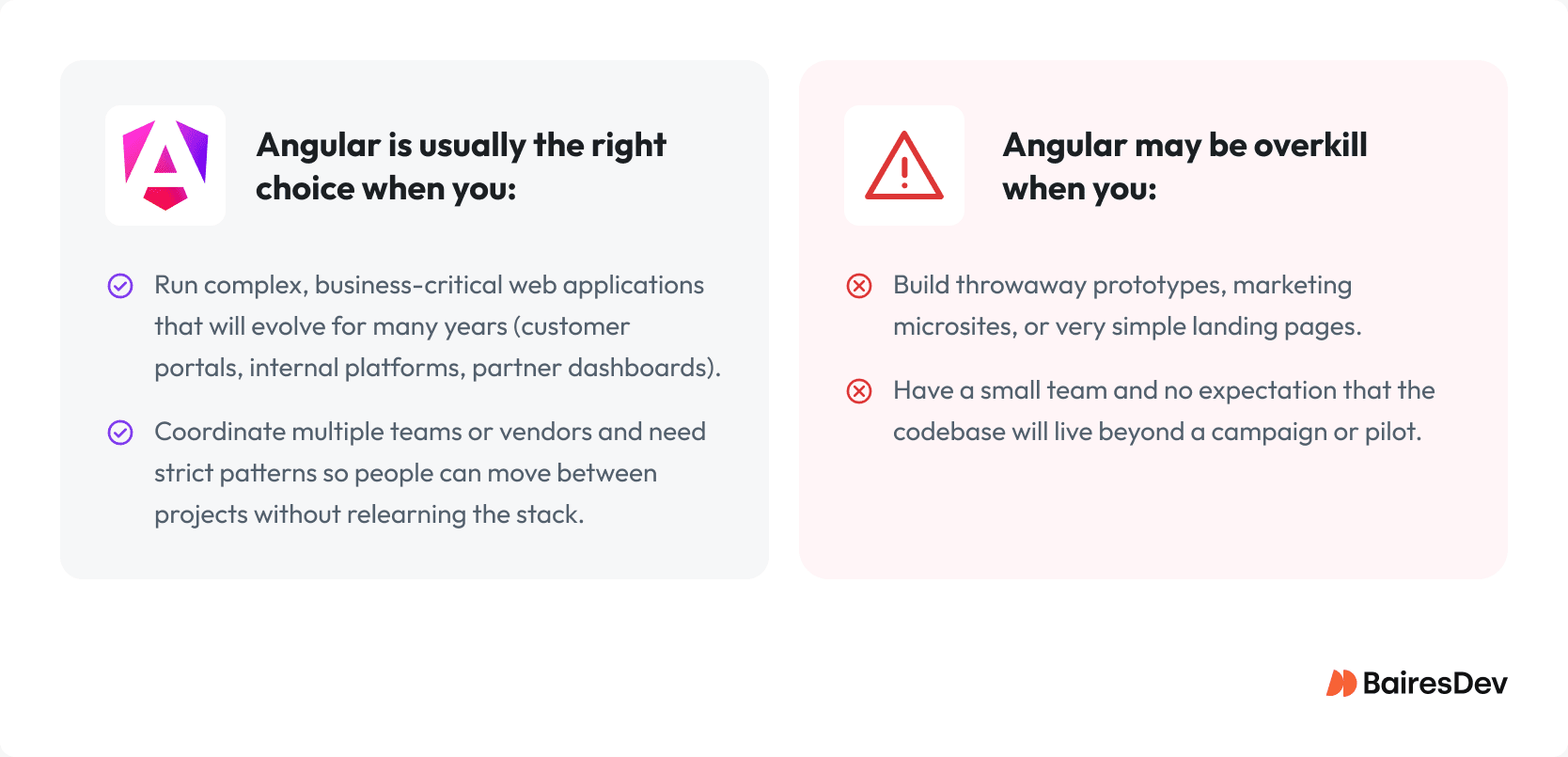
When to Choose Angular
Angular offers a comprehensive Angular platform: routing, forms, HTTP client, dependency injection, testing utilities, Angular CLI, Angular Material, and more. For many businesses, that holistic approach beats stitching together a stack from smaller libraries.
Next Steps
If you are considering Angular for developing single-page applications or modernizing existing web apps, a staged approach tends to work best.
Start small with a non-critical but real product: perhaps a new admin dashboard or a customer self-service area. Use Angular CLI to bootstrap the project, adopt Angular Material for consistent UI elements, and wire in standard services for logging, authentication, and analytics.
From there, build a shared internal component library so future applications reuse common UI and workflows. This library becomes a tangible asset that speeds up subsequent builds.
Encourage teams to adopt testing from day one. Angular includes strong support for unit tests and end-to-end tests; using these early reduces regression risk as the codebase grows.
Finally, bake deploying those applications into your existing CI/CD pipelines. Standard builds for dev, staging, and production environments, combined with server-side rendering where needed, give you a predictable path from commit to production release.
Handled this way, Angular becomes a baseline of your strategy to develop modern applications with a clear line of sight to business value.