

TL;DR
Scrum is the most widely adopted agile framework, structuring development into time-boxed sprints (1–4 weeks) with defined roles (Product Owner, Scrum Master, Development Team) and ceremonies (Sprint Planning, Daily Standup, Sprint Review, Retrospective). 71% of agile teams use Scrum or a Scrum hybrid. Its strength is predictable delivery through short cycles and continuous feedback — not rigid process.
If you’ve ever had the chance to be a part of a software development project, you have undoubtedly heard about Scrum. If you’ve ever talked to a software engineer, you might have heard it as well. What’s more – if you’ve ever visited a software development company’s website, chances are you’ve come across it. Scrum has become a vital part of most software development companies.
But – do you know what it is? Do you know why so many people in the software development world have embraced this methodology as their main framework? And do you know what it can do for your development project? Here are the answers to those questions and some other things you need to understand the Scrum software development methodology.
What is Scrum?
Have you ever watched a rugby game? If you have, then you surely are already familiar with the philosophy of Scrum. In rugby, a scrum packs together the members of a team to gain control of the ball. It’s all about a team effort to achieve a specific goal, one that can only be achieved through teamwork. That’s precisely what drives the Scrum methodology in the software development world – a way for teams to work together.
Scrum is an agile framework for software development that organizes work into short, time-boxed iterations called sprints (typically 2 weeks), forming the foundation of many agile development services. Three roles govern a Scrum team: the Product Owner (prioritizes the backlog), the Scrum Master (removes impediments), and the Development Team (delivers working software). Scrum ceremonies, Sprint Planning, Daily Standup, Sprint Review, and Retrospective, create a regular cadence for planning, execution, and improvement.
Though it’s not specific to software development (all teams in any organization or industry can use this framework), many people often associate Scrum with it because the industry has adopted this methodology virtually as a standard to guide the creation of digital solutions.
How Does the Scrum Framework Work?
One of the most common mistakes people make when approaching Scrum is believing that it is the same as Agile. It’s important for you to understand that’s not the case. Even when both are focused on continuous improvement, Scrum is a framework, and Agile is a mindset.
That means that Scrum is a set of tools you can start using to handle your work differently. Agile, for its part, implies a change of mentality: it means the adoption of a set of principles that modify the way you see your entire process.
With that confusion out of the way, we can focus on how Scrum works in a real-world scenario. As we said above, Scrum is focused on continuous improvement. It means that the team understands that they don’t know everything there is to be known about a particular project at its beginning. Since the team takes that stance, they are open to the things they’ll learn along the way and adapt the work (both the process and the product) to whatever discovery they might find.
Thus, the Scrum software development methodology allows for more flexibility during the creation of a digital solution. It will enable teams to get a better understanding of the product, the client, their requirements, and the audience, which ends up in re-prioritization of tasks and features that lead to better user experience and product as well as an offering more adjusted to the requirements.
Using that idea as support, Scrum organizes work in short phases or iterations that allow the team to work on specific parts of the project and close them. Once they are done with those short sprints, they can check the overall product and draw conclusions that can inform the next iterations, leading them to improve the process and work the new lessons into the software.
Understanding Scrum as a methodology that breaks down a project into little sprints can help comprehend its structure. However, you must remember that the structure is there to help teams better achieve their goals but flexible enough to accommodate new demands. That’s precisely what makes it great for software development, especially in projects where the product is aimed at a new audience or isn’t being built on a previous release or known idea.
Why Use Scrum in Software Development?
Through them, the methodology can easily organize work into more manageable bits. Thus, it provides a structure that’s rigid enough to provide certainty and predictability to the development process, but that’s flexible enough for each team and company to adapt it to their way of doing things.
That translates into a series of benefits, including:
- Higher productivity: Since teams work in iterations and very specific tasks, they can complete them without distractions and in a short amount of time.
- Better-quality products: Working in smaller pieces at a time allows for better control of all details in any given product.
- Reduced time to market: Scrum also lets teams address issues as quickly as they appear, reprioritize work at any given moment, and include new requirements at any stage without having to do significant overhauls to the whole product. This results in less rework and faster delivery.
- Better team dynamics: The quick-release cycle keeps teams motivated, as they work and close tasks fairly quickly and move on to the next iteration. It creates a momentum where continuous progress is a motivating factor that fosters more collaboration between team members.
It’s also important to highlight that, given that Scrum breaks down projects into smaller pieces, it’s an excellent methodology to develop complex software. That’s because it can reduce the ambiguities, limit the risks, and provide enough flexibility to change directions as needed.
Scrum vs Kanban vs SAFe: How to Choose
Choosing the right agile framework depends on your organization’s size, workflow complexity, and delivery goals. This SAFe vs Scrum comparison, alongside Kanban, highlights how each approach differs in structure, scalability, and planning cadence. While Scrum is ideal for small, iterative product teams and Kanban excels in continuous delivery environments, SAFe is designed for coordinating large-scale enterprise initiatives. The table below breaks down these differences to help you determine the best fit for your use case.
| Factor | Scrum | Kanban | SAFe |
| Iteration model | Fixed sprints (1–4 weeks) | Continuous flow | PI Planning (8–12 weeks) |
| Team size | 3–9 people | Any | 50–125 (ART) |
| Best for | Product development | Maintenance/ops | Enterprise scaling |
| Planning cadence | Sprint-by-sprint | On-demand | Program Increment |
| Complexity | Low–medium | Low | High |
| Adoption | 58% of agile teams | 7% | 3% |
When to use:
Scrum works best for product development with evolving requirements, a dedicated cross-functional team, and a Product Owner who can make rapid prioritization decisions. It delivers the most value when stakeholders actively participate in Sprint Reviews and adjust direction based on working software.
When NOT to use:
Scrum is a poor fit for operational/support work with unpredictable incoming tasks (use Kanban), for solo developers or very small teams where the ceremony overhead outweighs the benefit, or for fixed-scope contracts where the product is fully specified upfront.
What Are Scrum Artifacts?
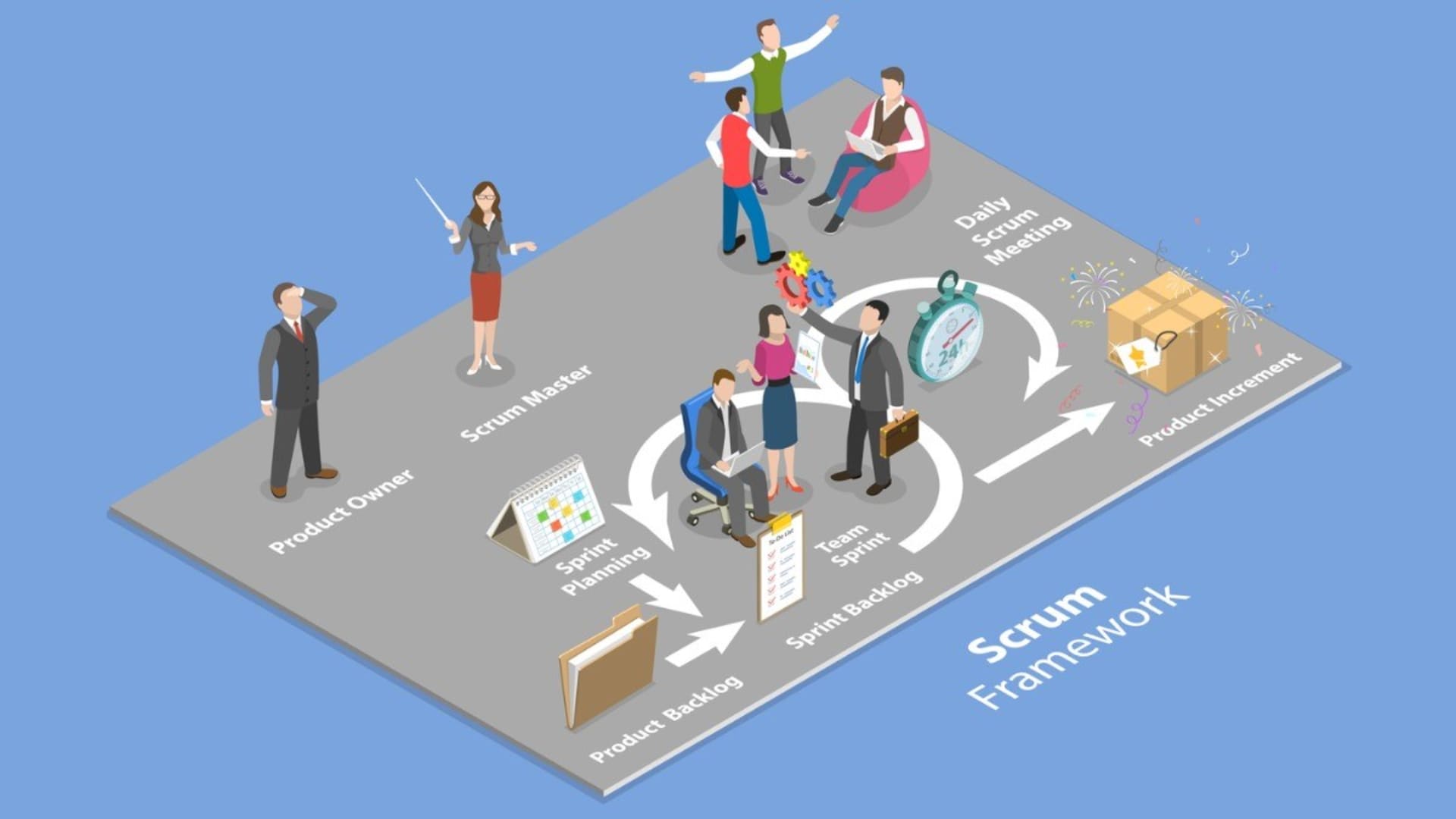
Now that you have all the basics about what Scrum is, it’s time to review its essential components. And there’s no better place to start than the so-called Scrum artifacts. Though that name sounds strange, artifacts are just the things the team makes with Scrum. There are three main artifacts:
Product Backlog
A list of things that need to be done throughout the project. In software development, this includes features, requirements, fixes, and any other task that needs to be completed before the product is finished. Scrum is dynamic by nature, so it’s the product backlog, which will be updated and changed depending on the knowledge gained throughout the different sprints of development.
Sprint Backlog
A smaller list of things that are related to a specific sprint. Each sprint (or small stage of development) includes a list of items from the backlog that the team will address. As it happens with the product backlog, the sprint backlog can also change during the sprint – as long as the final goal (adding a new feature, designing a new UI, etc.) stays the same.
Definition of Done
The result of a sprint. It’s whatever your Scrum team defines as a goal for any particular sprint. For instance, you could consider “done” the completion of a specific set of screens of an app’s interface during a sprint.
What Are Scrum Roles?
The Scrum roles encompass the people who work in any Scrum team and put it into action. It’s important that you know that Scrum teams are cross-functional. This means that a typical Scrum team won’t just have software engineers but also other experts, including testers, UX designers, ops engineers, and different roles needed for the project.
Now, let’s see the three leading roles in any Scrum team:
- Scrum Product Owner: Responsible for understanding the project requirements and managing the work that needs to be done. They are in charge of managing the product backlog, defining its items, prioritizing them to achieve the project goals, and ensuring that everyone in the team understands the backlog and has access to it.
- Scrum Master: Responsible for supporting Scrum within the team. They help everyone understand Scrum’s principles, practices, rules, and values. You can see this role as somewhat of a guard that tries to foster Scrum while ensuring to get the maximum value from the Scrum team. They do this by organizing resources, planning the sprints, and reviewing the sprints’ results.
- Scrum Development Team: The group responsible for delivering increments after each sprint. As said above, these teams are cross-functional, but they cross-train each other to ensure there are no bottlenecks. It’s often said that the Scrum software developer teams have to be self-organizing, so they can better tackle the sprint backlog and ensure successful completion of all sprints.
What Are Scrum Ceremonies?
Finally, we have the Scrum ceremonies that teams perform regularly. They are more or less flexible, as some teams might find them extremely useful to guide their work, while others might find them annoying and pointless. As a rule of thumb, all teams (especially new Scrum teams) should use them for a while to see if they fit with their approach. These ceremonies are:
#1 Backlog Grooming
The product owner handles the product backlog, ensuring that the items list is clean and understandable while also being mindful of feedback from the team, the users, and the client.
#2 Sprint Planning
A meeting where the Scrum team defines the product backlog items that they’ll address in the upcoming sprint. The Scrum master is the leader and helps the team decide on the sprint goal.
#3 Sprint
The moment where the Scrum teams work on the sprint backlog to produce an increment (or get to their definition of done). Sprints are typically two weeks long, although that varies depending on the complexity of the project.
#4 Daily Scrum or Stand Up
A daily meeting where the team briefly discusses the work being done, checks if they are aligned with the sprint goal, and maps out the tasks to be tackled during the day. The idea is to discover potential issues or bottlenecks that might affect the sprint and solve them immediately.
#5 Sprint Review
Once the sprint is completed, the team gathers to analyze the increment that resulted from it. This is often the moment to get feedback from teammates and stakeholders. The product owner also uses this review to rearrange the product backlog with the insights gathered here.
#6 Sprint Retrospective
Another meeting where the team discusses the Scrum process, be it a particular sprint, a project, the group dynamics, or even the ceremonies themselves. The objective of the retrospective is clear – to detect weak points that could be improved in the future.
Why Is Scrum Valuable for Software Development?
As you can see, Scrum has been designed with continuous improvement in mind. The main idea is to organize the work so that the whole development process can be quick, flexible, and smooth. Its main strength is that Scrum is aware that the only way to do so is to continually review the work to get feedback that could lead to further improvements. That’s why it is such an excellent framework for developing software: it can break down even the most complex projects into more manageable pieces and provide support in all stages.
The best thing about Scrum is how adaptable it is. That means that it can become the leading methodology during software development or can be combined with other methodologies to aid during specific moments of a project. In that sense, it’s safe to say that Scrum is a tool and a great one at that, as it can be used in a wide variety of situations and provide value in all of them. That’s why BairesDev uses Scrum for all of its projects and why we endorse it – because we know that there are few allies for software development as valuable as Scrum.
Key Takeaways
- Scrum is an agile framework that divides development into short, time-boxed sprints — typically 2 weeks — with each sprint delivering a working increment of the product and enabling continuous feedback and improvement.
- Sprint lengths range from 1–4 weeks, with 2-week sprints being the most common. Shorter sprints (1 week) increase feedback speed but add overhead, while longer sprints (3–4 weeks) reduce ceremony frequency but slow iteration cycles.
- The Product Owner is accountable for the product’s value — they define and prioritize the backlog, making decisions about what gets built and in what order to maximize business impact.