



Earlier this year, we ran a comprehensive survey across hundreds of software development projects active in 2025. Our goal was to understand the current state of quality assurance (QA). What we found wasn’t just the usual suspects like inconsistent testing or missing documentation. It was a deeper issue around how organizations prioritize and view QA in the first place.
Here’s what that 1 in 5 projects lacking QA headline really means. Sure, 13% of projects had zero formal QA team. But the bigger picture? Many others relied on a single, overworked QA professional. Other projects dumped critical quality tasks on developers. These approaches might look fine on an org chart, but they’re recipes for missed bugs, delivery bottlenecks, and mounting risk.
Quality ownership gaps showed up everywhere. Nearly half of all projects operated without structured testing processes. A staggering 72% weren’t even measuring test coverage. This isn’t about hiring more people. It’s strategic neglect.
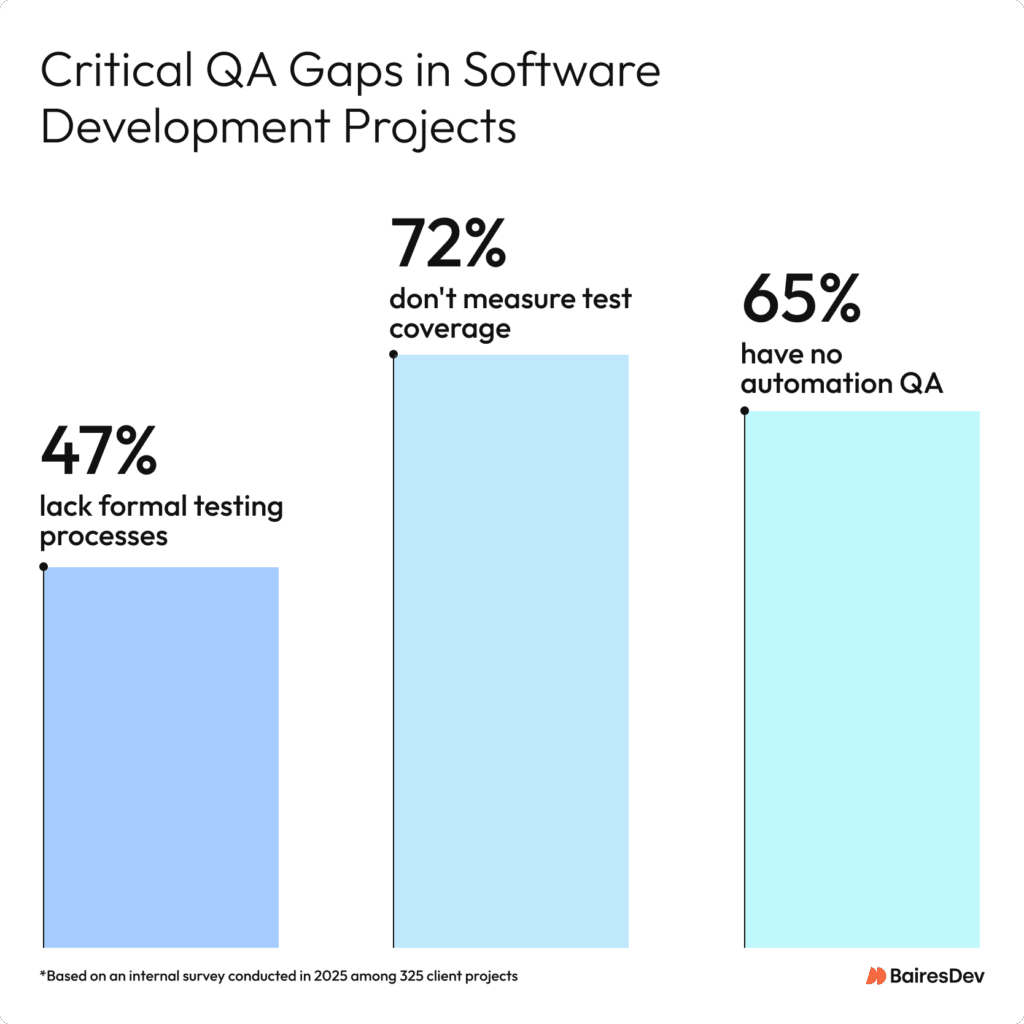
Here’s what the data shows. Technical debt devours up to 40% of the average IT budget. The U.S. sees an estimated $2.41 trillion annual hit from outdated systems, operational failures, and security incidents. Poor QA feeds directly into that massive cost pile.
Too many companies treat QA like a budget line item instead of a product-critical function. That approach doesn’t just slow releases. It kills customer trust and inflates costs over time. So here’s the real question. Can you really afford not to invest in QA?
Developer-Led Testing ≠ Quality Strategy
The most frequent problem we spotted was teams putting all their quality control eggs in the developer basket. Don’t get us wrong. Developer testing matters. But making it your only defense mechanism is playing with fire.
Why this strategy backfires comes down to basic human psychology: confirmation bias. Write the code, test the code, and you’ll naturally gravitate toward scenarios that prove your logic works. You’ll focus on the “happy path” while users find creative ways to “break” everything you built. Professional testers think differently. They’re wired to hunt for failure modes that would never cross a developer’s mind.
Our survey numbers back this up completely. Projects relying entirely on developer testing showed dev-to-QA ratios way beyond the recommended 3:1 to 5:1 sweet spot. This is how you end up with release delays, reactive bug fixes, and features going live without adequate coverage. Most teams weren’t even tracking test coverage, which means they had zero visibility into what was actually being tested.
The downstream effects hit hard with delayed releases, expensive bug fixes, and frustrated customers. If “let the developers handle it” defines your quality strategy, you’re essentially gambling with your product’s reputation and your brand’s.
Why QA Belongs in the C-Suite Conversation
This connects to a bigger problem. Most organizations still view QA as some tactical task you squeeze in at the end.But in today’s software-driven economy, quality assurance directly impacts delivery speed, customer satisfaction, security posture, and long-term cost efficiency. It’s not tactical anymore. It’s strategic.
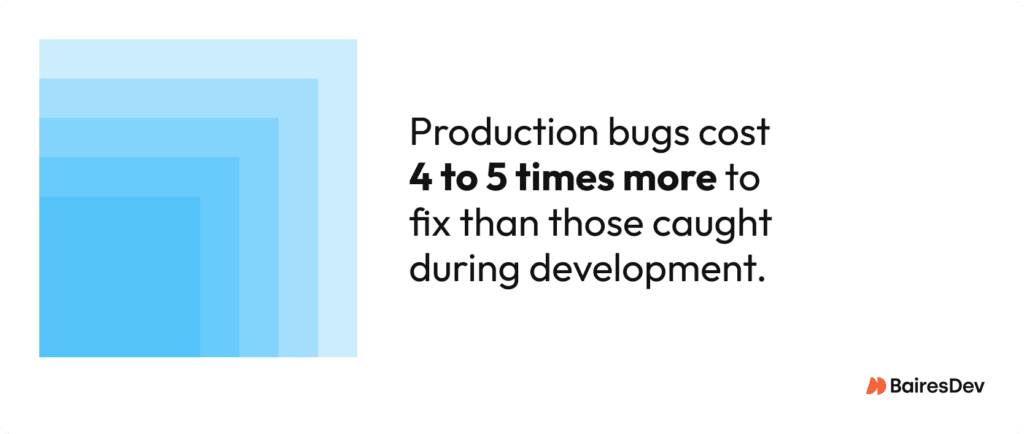
The math tells a compelling story. Production bugs cost 4 to 5 times more to fix than those caught during development. Early-stage bug fixes can be 30 times cheaper than production fixes. Flip the script with strategic QA investment (proper leadership, smart automation, solid governance), and projects typically see 3x ROI within 12 months. Quality-focused teams ship faster, keep customers longer, and prevent technical debt from snowballing.
Yet our survey revealed that only 53% of projects had formal testing processes. Translation: nearly half of development teams ship software without defined standards, structured oversight, or risk visibility. This goes way beyond missing tools. It’s a leadership gap.
QA needs equal standing with product, design, and delivery. It needs dedicated governance, proper tooling, and meaningful KPIs. Without leadership backing and clear ownership, quality improvements tend to fade when deadlines get tight.
What Strategic QA Investment Actually Looks Like
The good news is that you don’t need to hire an army of testers. You need smart and streamlined QA thinking. Most problems we uncovered weren’t about headcount or tooling. They stemmed from unclear oversight, misaligned priorities, and process confusion.
Whether you’re running a lean startup or managing a mid-size engineering team, these moves can make an immediate difference:
- Get your QA process on paper. Nail down how testing happens, who owns what, and your definition of “done.” Build clear handoff points and accountability measures that everyone understands.
- Distribute QA responsibility intelligently. Quality doesn’t require a massive testing department. Developers should absolutely test their work. But they shouldn’t fly solo. Pair them with dedicated QA resources or shared specialists across multiple teams.
- Approach automation strategically. Start with your highest-risk, most repetitive scenarios: smoke tests, user authentication, payment processing. Build your automation foundation piece by piece rather than trying to automate everything at once.
- Make test coverage visible. If you’re not measuring what gets tested, you’re essentially working blind. Simple tools and reports can illuminate testing gaps and help prioritize effort.
- Create a lightweight QA Center of Excellence. Establish a hub for standards, tools, and shared learning. A simple CoE can define best practices, align on test strategy, and track key quality metrics across teams. It gives QA a permanent seat in decision-making without extra overhead.
All you really need to establish effective QA processes is ownership, process clarity, and organizational commitment. Companies that skip quality assurance usually don’t realize their mistake until the fallout becomes too expensive and too visible to ignore.