



Artificial intelligence (AI) dominates the headlines. From generative AI breakthroughs to automation at scale, the conversation is everywhere. That visibility is a double-edged sword: while awareness is high, so is misinformation. Many organizations understand that using AI can lead to rapid gains, but remain unclear about how to get from experimentation to measurable impact.
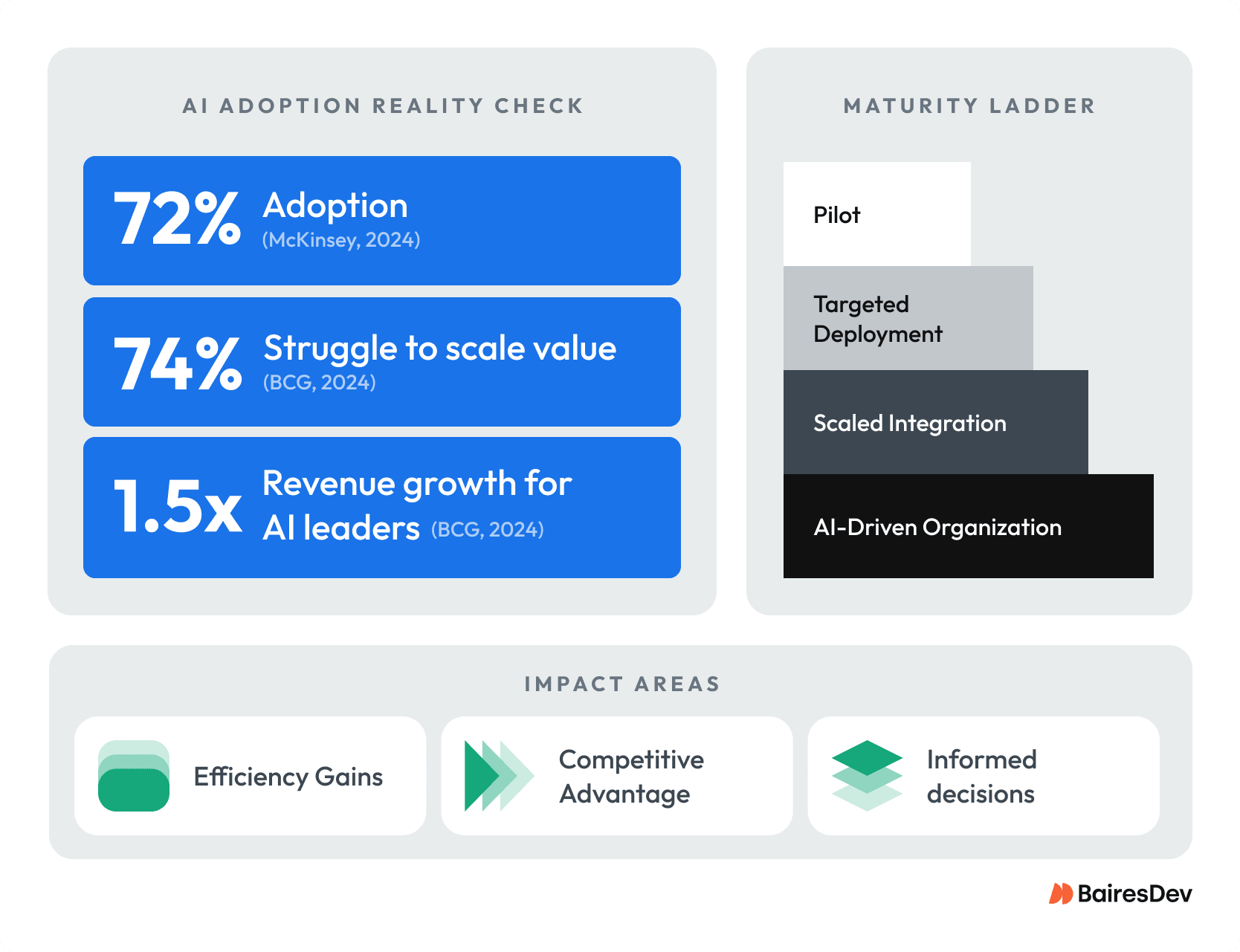
The stakes are high. In 2024, McKinsey reported that AI adoption rose to 72% of organizations, nearly doubling in just ten months. Yet Boston Consulting Group found that 74% of companies still struggle to achieve and scale business value from AI. The gap between excitement and results is often fueled by persistent misconceptions that distort decision-making.
For engineering leaders, AI myths are anything but harmless. They can stall adoption, misdirect investment, and erode their company’s competitive advantage.
This article addresses five of the most common myths, unpacks the truths behind them, and offers pragmatic takeaways for leaders tasked with implementing AI to facilitate better decisions, improve processes, and deliver reliable outcomes.
Myth 1: You Have to Adopt the Most Sophisticated AI
The myth: The assumption is that the latest, most advanced frontier AI models—built on deep learning, massive training data, and cutting-edge natural language processing—are the only way to get ahead. The belief mirrors a common bias in technology: that newer and more complex automatically means more capable.
The truth: Sophistication doesn’t equal suitability. Enterprise AI maturity is a progression, not a one-time installation. Many high-impact use cases can be solved with right-sized tools that integrate cleanly with existing systems and processes.
Example: A mid-sized SaaS provider might gain faster ROI from a pre-trained NLP model that categorizes customer tickets than from building a general system. The simpler approach saves resources while still producing better decisions for business users. The real question isn’t “what’s the most advanced AI model?” but “what AI solution aligns with my current systems, data quality, and business priorities?”
Takeaway: Start with targeted applications that solve problems already slowing your organization down. As your governance, infrastructure, and data culture mature, expand to more advanced AI algorithms where they make sense. Competitive advantage often comes from speed to value, not sophistication for its own sake.
Myth 2: AI Models Must Be Custom-Built to Deliver Value
The myth: Some executives assume that only a proprietary AI algorithm can achieve the precision or advantage they need. The thinking is that if it isn’t custom-made, it won’t fit the organization.
The truth: While bespoke models can be powerful, they’re not always necessary—or cost-effective. Off-the-shelf AI systems, from generative AI APIs to domain-specific machine learning models, can address many needs. These can be extended with more data or fine-tuned with your training data to improve relevance without the expense of building from scratch.
McKinsey’s 2024 survey found that half of all organizations reported using AI across two or more business functions, often starting with commercially available AI solutions before moving to custom builds.
Example: A financial services company seeking to improve fraud detection doesn’t need to invent an algorithm from zero. It can adapt an existing machine learning platform, layer on its unique data assets, and focus its resources on monitoring and governance.
Takeaway: Evaluate existing tools first. If they meet your accuracy, compliance, and integration requirements, adopting AI through proven systems can reduce risk and free resources for more strategic initiatives.
Myth 3: Building the AI Is the Hardest Part
The myth: There’s a widespread assumption that once an AI model is designed and deployed, the heavy lift is done.
The truth: AI is not a “set it and forget it” technology. The real challenge—and the real business advantage—comes from continuous improvement. Models drift. Data changes. Business conditions evolve. Sustaining value requires ongoing retraining with more data, close monitoring of outcomes, and regular adjustment to keep performance aligned with goals.
BCG’s 2024 research found that AI leaders invest twice as much as laggards in workforce enablement and ongoing scaling of AI solutions. The payoff: 1.5× higher revenue growth over three years.
Example: An insurance company that launched an AI to automate claims processing quickly realized that its accuracy declined when new claim types emerged. Continuous retraining with fresh data and a dedicated monitoring process restored accuracy and avoided costly misclassifications.
Takeaway: Budget for the lifecycle, not just the launch. Include funding and resources for monitoring, retraining, governance, and compliance. Sustainable value and business advantage depend on treating AI like a living system, not a one-off computer program.
Myth 4: A Small Team of Specialists Can Handle AI End-to-End
The myth: Some executives assume that a handful of elite engineers or data scientists can build, launch, and maintain enterprise AI. This view frames AI as primarily a technical challenge, solved by rarefied expertise.
The truth: Effective AI initiatives require cross-functional collaboration. Beyond machine learning engineers, organizations need product managers, domain experts, data engineers, UX designers, compliance specialists, and leaders with critical thinking and change-management capabilities. AI adoption isn’t just about the code—it’s about organizational integration.
Example: A healthcare provider deploying AI for diagnostics needed not just data scientists but also physicians to validate outputs, compliance experts to manage regulation, and UX designers to ensure doctors could use the tools in real workflows. Without that team, the AI solution would have failed to gain adoption.
Takeaway: Treat AI adoption like any other enterprise-scale program. Build multidisciplinary teams, define leadership and accountability clearly, and balance technical expertise with human capabilities such as communication, domain knowledge, and informed decisions under uncertainty.
Myth 5: Universal AI Adoption is Key
The myth: Another misconception is that if you’re not applying AI in every process, you’re already behind competitors. This reflects a “fear of missing out” mindset.
The truth: Blanket adoption leads to wasted resources. The most effective organizations focus first on specific, high-impact, low-risk use cases. Once measurable value is proven, they expand.
According to the US Census Bureau, generative AI is helping even small firms compete, but the benefits come from selective deployment in areas where AI technology clearly outperforms traditional methods.
Example: A logistics company might first apply AI to route optimization—reducing fuel use and delays—before extending into warehouse automation or predictive maintenance. Starting small delivers credibility and proof points that justify further investment.
Takeaway: Don’t confuse breadth with maturity. Start by identifying the repetitive tasks or bottlenecks where AI can deliver tangible ROI quickly. Scale only after success is demonstrated. That’s how most organizations build durable competitive advantage.
| Myth | Truth |
|---|---|
| You need the most advanced AI. | Start with targeted, right‑sized AI solutions that integrate with current systems. |
| You must use a custom AI model. | Off‑the‑shelf tools can solve many problems and serve as a foundation for growth. |
| Once the AI’s built, the heavy lifting’s over. | Ongoing iteration, retraining, and governance are the real challenges. |
| A small team can handle AI. | Effective AI requires a cross‑functional team with diverse skills. |
| Implement AI everywhere | Focus on high‑impact, low‑risk use cases and scale strategically. |
Beyond the Myths: What Enterprise Leaders Should Plan For
Addressing common myths is only the first step. To turn AI from hype into lasting value, executives must prepare for two realities: the changing nature of human labor and the need to focus on ROI-driven AI solutions.
The Impact of AI on Human Labor
AI won’t replace the human brain or eliminate human thought in business. Instead, it will automate repetitive tasks, augment human thinking, and create new responsibilities in AI oversight, ethics, and integration.
For leadership, this means redeploying human labor toward higher-value activities: problem-solving, innovation, customer relationships, and critical thinking. AI platforms handle the pattern recognition and heavy data processing; humans handle judgment, creativity, and human interaction.
AI Tools That Deliver ROI for Business Users
Not every solution is worth your budget. The highest returns typically come from:
- Predictive analytics platforms that forecast churn, demand, or risk.
- Natural language processing APIs that classify, summarize, or translate text at scale.
- Generative AI models that accelerate content creation, code generation, or design ideation.
- AI-powered analytics dashboards that improve informed decisions by surfacing patterns in real time.
These tools are most effective when integrated into existing systems, supported by high-quality training data, and aligned with a clear AI strategy.
Smarter AI Adoption: The Strategic Edge
The reality is more practical—and more valuable—than the popular myths suggest. By focusing on business-aligned use cases, leveraging off-the-shelf AI models where possible, and committing to continuous improvement, leaders can turn AI from a marketing buzzword into a durable strategic asset.
In 2025, the organizations that win won’t be those that adopt AI technology the fastest, but those that adopt it with discipline, clarity, and sustained execution.