

The functional gap between AWS, Azure, and GCP has largely closed. The difference now lies in the operational tax they levy on your teams. If you treat your cloud computing platform like a generic commodity, you will lose control of both your architecture and your budget—an issue many organizations address through specialized AWS development services and cloud governance practices.
Cloud strategy today is about reversibility and fit. You need to select cloud service providers that align with your specific engineering culture, not just the one with the best marketing. The goal is to build cloud solutions that prove compliance and support forecastable cloud costs—often enabled through Azure development services.
This article helps technology leaders compare AWS, Microsoft Azure, and Google Cloud Platform in 2025/2026 through a strategic lens. Learn how trends in AI infrastructure, data sovereignty, and hybrid control reshape your cloud decisions and find resources like a decision matrix and a reversibility checklist.
Assessing Your Cloud Platform
Cloud strategy focuses on control, reversibility, and fit with your delivery model.
Choose the platform that proves compliance, supports forecastable spending, and adapts under shifting priorities. You want policies you can audit, budgets you can defend, and a path to change direction without rewriting your platform.
You are reassessing prior choices under new pressure. AI demand, data sovereignty, and stricter FinOps disciplines change provider selection. New priorities include defensible economics, documented audit trails, and credible exit paths as you modernize and retire legacy systems.
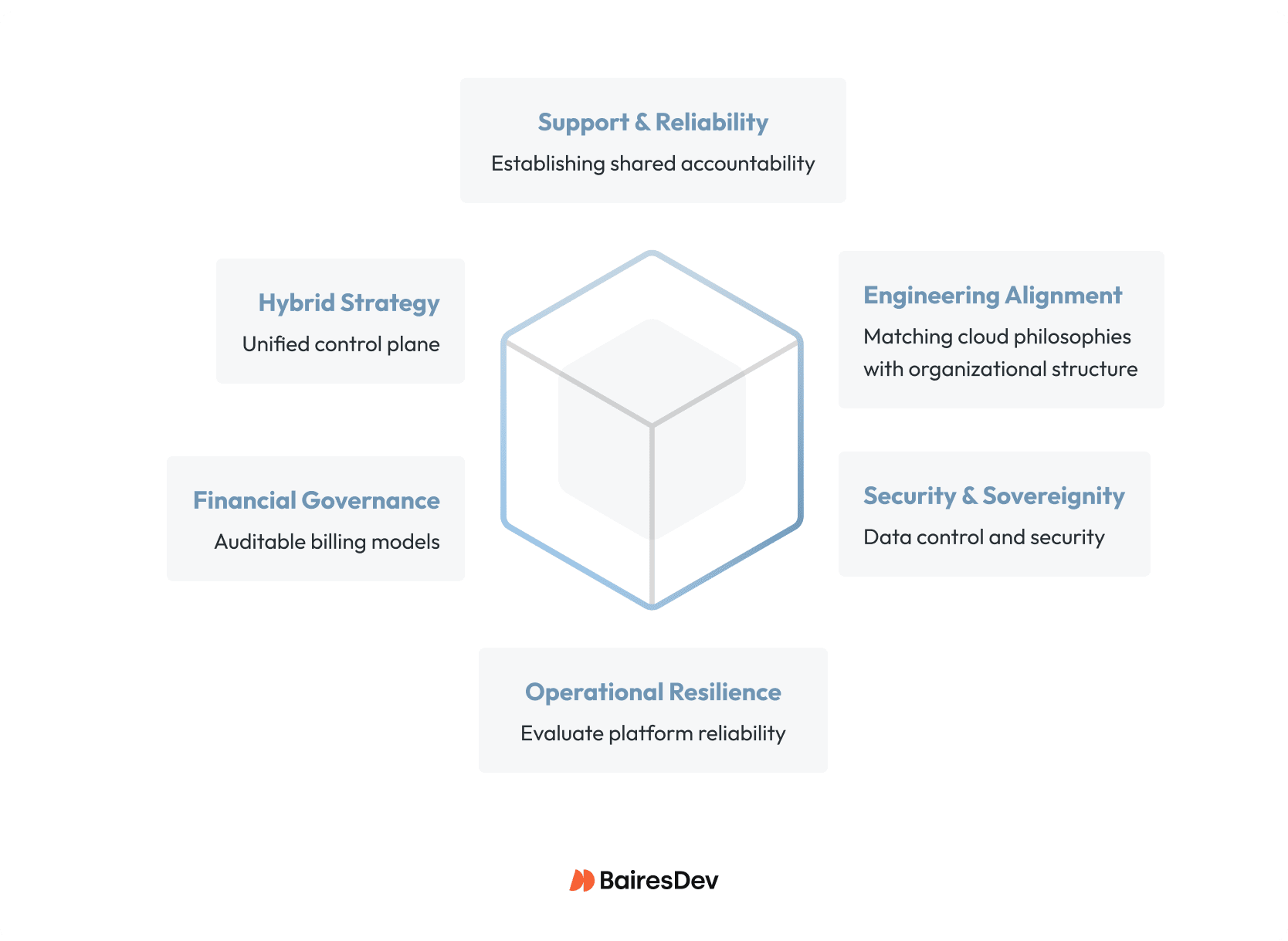
All three CSPs are mature. The difference is philosophy. AWS favors autonomy and breadth, Microsoft Azure reinforces enterprise governance and integration, and Google Cloud Platform optimizes for data, machine learning, and efficiency. Use our six cloud pillars to judge fit, focusing on alignment, resilience, compliance, cost stability, hybrid options, and long-term support.
Pillar 1: Engineering and Workload Alignment
Every provider runs enterprise workloads. What separates them is alignment with your engineering culture, team structure, and risk appetite. The right fit reduces friction, protects SLOs, and preserves reversibility. Decide which operating model your team needs to ship safely and quickly, then consider the platforms against that standard.
- AWS: Aligned around autonomy. You get strong isolation with multi-account landing zones and a broad service choice for modular teams. Your platform group and product teams move independently. Graviton ARM instances improve the price for compute. AWS fits if you value service ownership and varied pipelines across business units.
- Microsoft Azure: Aligned around standardization. You get central governance with Entra ID, Azure Policy, and fleet services that suit uniform pipelines. Cobalt 100 ARM-based VMs are GA in many regions for efficiency gains on compute. Azure fits if you anchor delivery to Microsoft tooling and need transparent control surfaces for audit-heavy environments.
- Google Cloud: Aligned around data-led delivery. You get projects, labels, and reporting that support platform engineering and FinOps. Your analytics and machine learning paths shorten with managed data services and global networking. TPU v5e supports TensorFlow, JAX, and PyTorch. Google Cloud fits if your teams move from model work to production services with tight feedback loops.
Pillar 2: Security, Compliance, and Data Sovereignty
Security looks similar across the three cloud providers. Sovereignty is where things start to diverge.
Ask yourself how governance, identity, and operations map to your compliance scope and audit rhythm. Audit readiness depends on how identity, logging, locations, and regional operations turn policy into evidence.
As sovereignty frameworks mature, compare how providers turn compliance promises into operational guarantees. You want proof of control ownership, enforced policy at scale, and auditable evidence across regions and operators without a drag on delivery.
- AWS: You can align decentralized ownership with centralized guardrails using accounts, IAM, Organizations, and service control policies with AWS. Your evidence flows through baseline policies and logging that map to residency, key management, and operator access boundaries. The AWS European Sovereign Cloud is launching its first Region in Germany by 2026. Keep an eye on the launch of this sovereign AWS region operated by EU-based personnel with independent operations and billing.
- Microsoft Azure: You can anchor controls in a single tenant with Entra ID, management groups, and Azure Policy with Azure. Your subscriptions inherit standards, budgets, and labels cleanly, so governance, certification scope, and audit trails align with your org chart and change process. Azure’s EU Data Boundary processes and stores customer data in the EU with explicit lists of excluded and partially transferring services.
- Google Cloud: You can shape perimeters with Sovereign Controls for EU using the resource hierarchy, Organization Policies, IAM Conditions, VPC Service Controls, and Google Cloud zero trust boundaries. Your data flows and operator actions stay within declared contexts, supporting residency, least privilege, and clear evidence across analytics and ML services.
2025 European Union Sovereignty Snapshot
| Sovereignty Option | Primary Assurance | Best Fit |
| AWS European Sovereign Cloud (Germany, 2026) | EU-based operations, governance, and staffing, with independent cloud control | Enterprises standardizing on AWS that require EU-operated services and strict residency assurances |
| Azure EU Data Boundary | Customer data for major enterprise services is processed and stored in the EU with documented coverage | Regulated enterprises needing tenant-wide enforcement and clear documentation for audits |
| Google Cloud Sovereign Controls (EU) | EU-operated controls via local partners, data residency in the EU, external key management, and encryption controls | Public sector or finance teams prioritizing zero-trust boundaries and documented EU controls |
Pillar 3: Global Reach and Operational Resilience
Cloud resilience outweighs region count. You need cloud architectures that absorb failures and keep promises under global pressure. Compare providers by redundancy depth, failover orchestration, and interconnect design. Focus on how quickly you regain a steady state and how smoothly traffic shifts during incidents.
- AWS: You can design around multi-AZ and cross-region recovery, then use Route 53 health checks and failover policies to shift traffic predictably. Application Recovery Controller adds controlled routing during events to cap blast radius and speed restoration.
- Microsoft Azure: You can align paired regions, availability zones, and Azure Site Recovery with identity-scoped governance. ExpressRoute and Virtual WAN stabilize connectivity across campuses and partners so failover respects policy and RTO/RPO targets.
- Google Cloud: You can use the external Application Load Balancer’s global control with health-based failover, using Google’s Premium-tier backbone to minimize detours during regional incidents. Regional managed instance groups slot under the LB to evacuate traffic cleanly.
Pillar 4: Cost Predictability and Financial Governance
We hear you, you need forecastable spend. Good governance works when commitments, allocation, and reporting translate into budgets you can defend. Compare how each provider structures agreements, tags spend to owners, and exposes the data your finance and audit partners expect.
- AWS: Treat AWS as your flexibility-first finance model. You segment spend with Cost Categories and Organizations, monitor with Budgets and Cost Explorer, and shape chargebacks with Billing Conductor. Savings Plans and RIs offer depth, so forecasting depends on your coverage and utilization views.
- Microsoft Azure: Treat Azure as your governance-embedded finance cloud. You anchor identity, policy, and budgets in one tenant and roll standards down to management groups and subscriptions. Reservations and Savings Plans sit inside Cost Management for consistent reporting, amortization views, and EA alignment.
- Google Cloud: Treat Google Cloud as your transparency and unit economics view. You track costs in Cloud Billing, model trends and budgets, and lean on Committed Use Discounts and automatic Sustained Use Discounts. Per-second billing and carbon reporting improve clarity for all of your workload-level decisions.
Consider how AI silicon and usage-based pricing shifts can alter your unit economics and budget accuracy. Plan for the rise of first-party accelerators and ARM-based compute for AI and high-compute cloud workloads across all three providers.
The availability of AWS Graviton, Microsoft Azure Cobalt, and Google Cloud TPUs points to the appeal of better price-performance for your targeted workloads.
Pillar 5: Hybrid, Multicloud, and Reversibility Strategy
Hybrid cloud gives your roadmap leverage. You want one control plane to project identity, policy, and networking across data centers, edge, and other clouds. The provider that delivers consistent governance everywhere gives you credible vendor options without rewrites or fractured operations.
Compare how natively each provider extends beyond its regions and how reliably your policies follow. Use this lens to gauge how easily you can pivot vendors, place workloads near data, and keep your audit story intact.
- AWS: Your native extension model. You run AWS infrastructure and services on premises with AWS Outposts, using the same APIs and tools for local latency and residency needs. Your teams operate on familiar constructs while staying integrated with regional AWS services.
- Microsoft Azure: Your tenant-wide governance option across estates. You project Azure control to on-prem and other clouds with Azure Arc, attaching servers and Kubernetes so Entra ID, management groups, and Azure Policy apply uniformly across subscriptions and locations.
- Google Cloud: Your portable stack for edge and data centers. You extend GCP into your facilities with Google Distributed Cloud, bringing a managed software and hardware portfolio that keeps a unified operational model for colocation and edge sites.
Pillar 6: Support, Reliability, and Cultural Fit
You buy shared accountability with cloud. The right partner matches your operating tempo and gives your teams clear paths from incidents to steady state. Compare each provider’s support models, escalation routes, and reliability practices that your engineers and finance leaders stand behind.
- AWS: For operational discipline and predictable recovery. You pair Enterprise or Enterprise On-Ramp Support and TAM guidance with Well-Architected reliability and operations practices to standardize response, testing, and runbooks across accounts.
- Microsoft Azure: For enterprise partnership and structured escalation. You align Entra-anchored governance with ProDirect or Unified Support, using defined response targets and coordinated account management to track issues across subscriptions and programs.
- Google Cloud: For a collaborative, SRE-informed model. You combine Enhanced or Premium Support with Google’s SRE principles, adopting SLOs, postmortems, and automation to improve reliability while keeping engineers in the feedback loop.
Cloud Provider Fit at a Glance
Use this matrix to map your priorities to each cloud provider’s posture. Focus on your delivery speed, compliance evidence, and forecastable spend.
If one provider leads on the rows that matter, that’s your default. Use the rest of the information to guide exceptions and leverage for renewal.
2026 Executive Decision Matrix for Cloud Providers
| Strategic Pillar | AWS | Azure | Google Cloud |
| Engineering and Workload Alignment | Best if you run independent product teams and modular services. | Best if you operate a central platform with Microsoft identity and policy. | Best if you are data-led with standard toolchains and ML workflows. |
| Security, Compliance, and Data Sovereignty | Best if you want decentralized ownership with strong guardrails. | Best if you need a tenant-wide policy and audit consistency. | Best if you need zero-trust perimeters and strict data boundaries. |
| Global Reach and Operational Resilience | Best if you prioritize deep multi-AZ patterns and proven cross-region failover. | Best if you depend on enterprise interconnect and coordinated recovery. | Best if you want global load balancing on a low-latency backbone. |
| Cost Predictability and Financial Governance | Best if you want flexible commitment paths and granular allocation controls. | Best if you need finance integrated with governance and EA constructs. | Best if you value clear unit economics with automatic discounts and carbon reporting. |
| Hybrid, Multicloud, and Reversibility Strategy | Best if you extend native AWS services on premises with consistent APIs. | Best if you need tenant-wide control across on-prem and other clouds through Arc. | Best if you prioritize portability with Distributed Cloud and Kubernetes foundations. |
| Support, Reliability, and Cultural Fit | Best if your teams favor operations discipline and predictable runbooks. | Best if you want structured enterprise escalation and account management. | Best if you pursue SRE-style collaboration and co-innovation cycles. |
Future-Forward Scenarios for AWS, Azure, and Google Cloud
Let’s examine three scenarios that determine which cloud provider best fits your needs. Each example highlights different strengths and trade-offs that impact your specific architecture decisions.
Scenario: AI-Intensive Applications
Your cloud platform needs to train models weekly and serve millions of inference requests daily. Whether you’re building a recommendation engine, processing documents at scale, or running computer vision workloads, you need reliable access to specialized hardware and the ability to scale without breaking the budget.
What matters is chip availability during spikes in demand, actual cost per inference at scale, and how easily our ML pipeline moves between hardware options. Decide how locked-in you’ll be to a provider’s hardware ecosystem. What are the risks?
- AWS: Trainium and Inferentia chips promote big cost savings over comparable GPUs. The trade-off requires adapting your code to the AWS Neuron SDK. AWS guarantees capacity through reserved instances, though on-demand availability varies significantly. The learning curve is real. Plan a runway for your team to optimize existing PyTorch models for these chips.
- Microsoft Azure: The latest NVIDIA H100 instances work with your existing CUDA code and MLOps pipelines without modification. Microsoft improved availability compared to other providers early by securing significant H100 allocations through its OpenAI partnership. The premium pricing reflects this advantage, so expect higher costs than previous generations.
- Google Cloud: TPU v5e is competitive on price-performance for large-scale training of LLMs and high-throughput workloads, and supports committed-use pricing. PyTorch is supported via XLA, but the ecosystem and community around PyTorch on TPUs is less mature than on GPUs. You should factor in integration effort, talent readiness, and tooling maturity in this scenario.
Scenario: European Compliance Requirements
You’re handling EU citizen data with strict sovereignty requirements under GDPR, the Digital Markets Act, or sector-specific regulations. In this scenario, you’re not checking compliance off. You’re shaping your architecture by anticipating which services you can use and how data flows through systems.
What matters is data residency, who can access it (including CSP support staff), and if you can prove audit compliance.
- AWS: European Sovereign Cloud in Germany is scheduled to launch by 2026 with complete operational independence from AWS’s global infrastructure. Until launch, you’re working with standard EU regions and existing compliance commitments that may not satisfy strict sovereignty requirements.
- Microsoft Azure: The EU Data Boundary, completed in 2024, means customer data stays in the EU for processing, storage, and support operations. Microsoft’s two-decade presence in Europe demonstrates operational maturity and a comprehensive understanding of compliance certifications. Its EU-based support teams can resolve issues without data leaving the region.
- Google Cloud: Sovereign Controls for Europe provides client-side encryption with external key management and Assured Workloads for compliance automation. Partner-hosted options provide additional isolation but limit you to Google Cloud’s service availability to core compute and storage services, trading functionality for sovereignty.
Scenario: Hybrid Infrastructure
You’re managing legacy systems you can’t migrate, equipment at the edge that needs local processing, or regulations that require on-premises data storage. You’re looking for consistency to manage security, monitor, and deploy apps regardless of where your workloads run.
What matters is how authentication and permissions work across environments. You need unified DevOps pipelines that deploy anywhere and still maintain visibility across distributed infrastructure.
- AWS: Outposts brings native AWS services to your data center with rack-scale deployments. ECS and EKS Anywhere enable container orchestration on your existing hardware. You can keep compute local, but both require periodic connectivity to AWS regions for control plane operations and updates. It’s a mature ecosystem that requires a team with strong AWS expertise and deep IAM and VPC knowledge to properly secure hybrid deployments.
- Microsoft Azure: Arc extends Azure’s control plane to your servers, other clouds, or edge locations with a consistent management experience. Microsoft’s enterprise heritage shows up here. Arc integrates with Active Directory integration and provides strong support for Windows Server workloads.
- Google Cloud: The Distributed Cloud ranges from software-only Anthos to complete hardware solutions for edge locations. Everything centers on Kubernetes and service mesh, which appeals to cloud-native teams. If your teams already think in containers and YAML, this is a natural fit. If they’re coming from more traditional VM-based infrastructure, expect a steeper learning curve.
These scenarios don’t exist in a vacuum. You might need AI capabilities while meeting European compliance requirements or a hybrid infrastructure with strict data sovereignty. Identify non-negotiable requirements versus nice-to-haves and map them to verified provider capabilities.
The best choice isn’t always the most feature-rich option, but the provider whose roadmap and philosophy align with your organization’s direction.
The Cloud Reversibility Checklist
Use this quick-reference cloud reversibility checklist to demonstrate that you can change your cloud direction. It centers on portability, data exit, contract flexibility, and a workable fallback, giving you credible options during renewals, reorganizations, or strategy shifts.
- Portable runtime: A portable orchestration interface and declarative infrastructure definitions ensure services deploy consistently across environments. You’re reinforcing recognized interoperability standards with this step:
- Specify versions
- Test in multiple locations
- Maintain reproducible builds
- Data exit plan: Document where data resides, who controls keys, and how large-scale exports run. You’re aligning with portability concepts defined in cloud standards and reference guides with this step:
- Include schemas, formats, and validation steps
- Test representative extracts on a schedule and record timings
- Contract levers: Align commitment depth and term length with roadmap certainty. Use recognized FinOps practices for commitment-based discounts. You’re supporting predictable spending and flexibility at renewal with this step:
- Maintain an inventory of active commitments with conditions for expansion or reduction.
- Hybrid fallback: Maintain a minimal platform capable of running in a data center or a secondary cloud. Use the same orchestration interface and declarative definitions, consistent with portability guidance from standards bodies and industry groups in this step.
- Prove the path with lightweight drills
- Track the time and cost to set up
Choose Cloud Fit Over Familiarity
AWS will not fix a broken deployment pipeline. Azure will not organize a messy identity hierarchy. GCP will not clean your chaotic data schema. The cloud is just a magnifier for your existing operational habits, good or bad.
Stop looking for the “best” provider in a vacuum. The right choice is usually the one that fights your engineering culture the least. If you choose a platform that requires a level of discipline your team doesn’t have, you’re financing technical debt.
Choose the cloud that fits the team you actually have, not the one you wish you had.