



CIOs are no longer just IT strategists, they’ve become business leaders in their own right. They’re expected to act as educators for senior management, set realistic expectations for artificial intelligence, and manage tech risk while still keeping the lights on.
With the C-suite demanding competitive advantage through innovation, many chief information officers need to identify and solve challenges before they cause issues. This year’s priorities reflect both continuity and change. Longstanding issues like legacy systems, patch setup, and technical debt remain unresolved in many organizations.
At the same time, new pressures around generative AI tools, data governance, and hybrid work demand urgent action. CIOs who balance execution with future-facing strategy will secure a competitive edge—not just for their companies but also for their own credibility inside the executive team.
Scaling Generative AI Initiatives
Generative AI is changing how organizations operate, but most are still early in the adoption curve. Pilot projects are everywhere, yet scaling AI across the enterprise remains one of the biggest hurdles for IT leaders. The real risk? Letting hype outpace measurable value, or worse, introducing additional threats that create compliance concerns.
Key Challenges
- Unpredictable ROI from generative AI
- Data quality issues that undermine AI models
- Lack of governance around AI agents and automation
According to CIO.com’s 2025 survey, CIOs are expected to act as “educators and expectation setters” on artificial intelligence, ensuring execs understand both the opportunities and the limits of AI tools.
Action Plan
- Build an AI governance framework covering ethical use, risk management, and compliance.
- Standardize on AI orchestration platforms that integrate with existing infrastructure, reducing one-off tools.
- Shift success metrics beyond ROI to include Return on Employee Efficiency (time saved across processes) and Return on Future Growth (how adoption of AI accelerates innovation).
The CIO role here is not just to experiment but to create practices that can scale across various departments without exposing the company to unnecessary risk.
Modernizing Legacy Systems Without Breaking the Business
Most large organizations still rely on legacy and existing systems that can’t integrate with modern cloud-based services, AI projects, or connected devices. For CIOs, modernizing without disrupting core business processes is one of the most visible tests of leadership.
Key Challenges
- Technical debt accumulated over the past decade
- Managing patching across fragmented systems
- Resistance from other execs tied to legacy workflows
Action Plan
- Take an incremental approach, replace in phases rather than attempting massive, high-risk cutovers.
- Use cloud-based services to reduce infrastructure cost while creating a wider range of options for scalability.
- Bring leadership into planning early, so modernization aligns with strategy instead of appearing as “just an IT upgrade.”
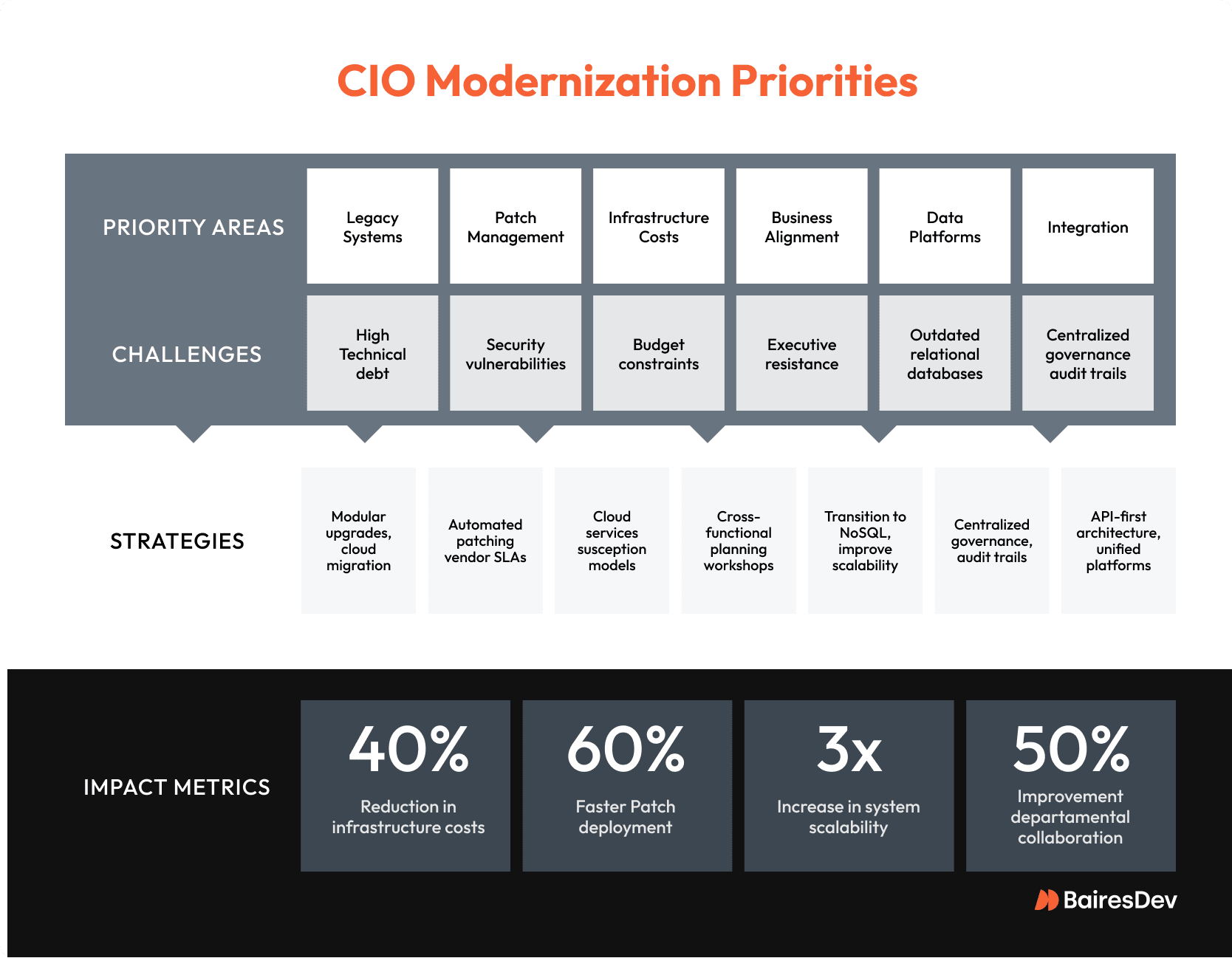
Below is a quick summary of where CIOs are focusing modernization efforts.
CIO Modernization Priorities
| Priority Area | Challenge | CIO Strategy |
|---|---|---|
| Legacy Systems | High technical debt | Incremental upgrades, cloud migration |
| Patch Management | Security vulnerabilities | Automated patching, vendor SLAs |
| Infrastructure Cost | Budget constraints | Cloud services, subscription models |
| Business Alignment | Executive resistance | Cross-functional planning workshops |
Many CIOs struggle to win support for modernization because leaders see infrastructure as a cost center. Framing the work as enabling competitive advantage can shift the conversation.
Strengthening Cybersecurity in an AI-Driven World
Cybersecurity remains a main challenge, but the threat landscape is shifting. Generative AI is already being used to craft new threats that bypass traditional defenses. Looking ahead, quantum computing looms as a future risk. CIOs need to anticipate rather than react.
Key Challenges
- AI-powered threats that bypass legacy defenses
- Expanded attack surface due to hybrid work and connected devices
- Growing compliance demands from GDPR, HIPAA, CCPA, and new state-level rules
Gartner’s 2025 CIO report highlights cybersecurity as one of the five most urgent issues for engineering leaders this year.
Action Plan
- Implement zero-trust architecture across systems and processes.
- Use artificial intelligence for threat detection and automated response, but validate results with human expertise.
- Ensure regulatory compliance through regular audits, with centralized ownership for risk management.
Cybersecurity is also a credibility test for CIOs with the C-suite. A breach not only mucks up the works but undermines trust in your overall strategy.
Managing Hybrid Work Without Sacrificing Productivity
Hybrid work is no longer a temporary adjustment or novelty, but supporting employees across distributed environments remains difficult. CIOs must balance flexibility, security, and productivity in ways that satisfy both executives and employees.
Key Challenges
- Inconsistent access to internal tools
- Security risks from unmanaged endpoints
- Employee expectations for seamless support
Action Plan
- Standardize on secure identity and access management across all cloud services.
- Deploy AI-powered IT help desk agents to help employees resolve issues quickly.
- Monitor productivity data carefully, but avoid intrusive practices that erode trust.
Aidoos reports that CIOs integrating AI into hybrid work strategies are better positioned to sustain productivity and lower costs while keeping employees engaged.
Solving the Talent Shortage Before It Stalls Innovation
The tech talent shortage is now one of the most visible CIO challenges. Emerging technologies require skills in AI, cloud services, and cybersecurity that most organizations lack internally. Meanwhile, attrition rates remain high, and training programs often take too long to close gaps.
Key Challenges
- High turnover among IT professionals
- Skills mismatch for artificial intelligence, cloud, and security roles
- Limited internal capacity to support business transformation
Action Plan
- Build internal AI Centers of Excellence to attract and retain top employees.
- Partner with universities and bootcamps to expand the hiring pipeline.
- Offer cross-training to reskill staff for new technologies.
- Leverage external engineering partners to close urgent gaps—especially for AI models and security projects that can’t wait for long hiring cycles.
CIO Talent Strategy
Unlike ad hoc contractors, strategic partners provide stability and scale. CIOs who supplement internal staff with experienced teams can move faster on critical initiatives without sacrificing governance or long-term consistency.
Aligning IT Strategy With Business Models
A central test for CIOs is ensuring that strategy keeps pace with the company’s evolving business model. Many organizations struggle here, as technology leaders get caught in operations instead of shaping innovation.
Key Challenges
- Disconnect between CIOs and other execs
- Slow adoption of emerging technologies
- Lack of clarity around business value
Action Plan
- Run joint planning sessions with the C-suite and senior management to clarify priorities.
- Use AI models and scenario tools to forecast business outcomes and set realistic expectations for new investments.
- Develop KPIs tied to company growth and competitive edge, not just IT performance metrics.
CIOs who succeed here don’t just “align IT with business”—they help define business models for the future.
Navigating Tech Risk and Regulatory Complexity
As companies adopt emerging technologies, CIOs must manage risk while ensuring regulatory compliance. This requires a centralized, proactive approach rather than scattered efforts across various departments.
Key Challenges
- Unclear regulations around generative AI tools
- Data governance inconsistencies between teams
- Risk exposure from third-party vendors and systems
Action Plan
- Establish a compliance office focused on technology oversight.
- Deploy AI agents to monitor for risk anomalies in real time.
- Standardize data stewardship practices across the enterprise.
This is no longer just about checking boxes. Strong governance builds trust with executives, investors, and regulators—helping CIOs position IT as a source of stability instead of risk.
Lead With Clarity
To succeed, CIOs must deliver value across every layer of the organization, from infrastructure and security to innovation and strategy. The challenges are real, but so are the opportunities.
By focusing on AI adoption, data quality, cybersecurity, and talent development, CIOs can help their companies gain a competitive advantage while managing risk and lowering costs. The future belongs to those who can lead with clarity, collaborate across departments, and deliver solutions that scale.