



In 2024, the global artificial intelligence (AI) market for call centers was valued at $1.6 billion and is projected to exceed $4 billion by 2027. Salesforce notes that automation is becoming central to how enterprises manage customer interactions, shifting from an optional efficiency tool to a competitive requirement.
For leaders under pressure to scale service and control costs, the trend is clear: automation is no longer a future bet, it’s part of today’s operating model.
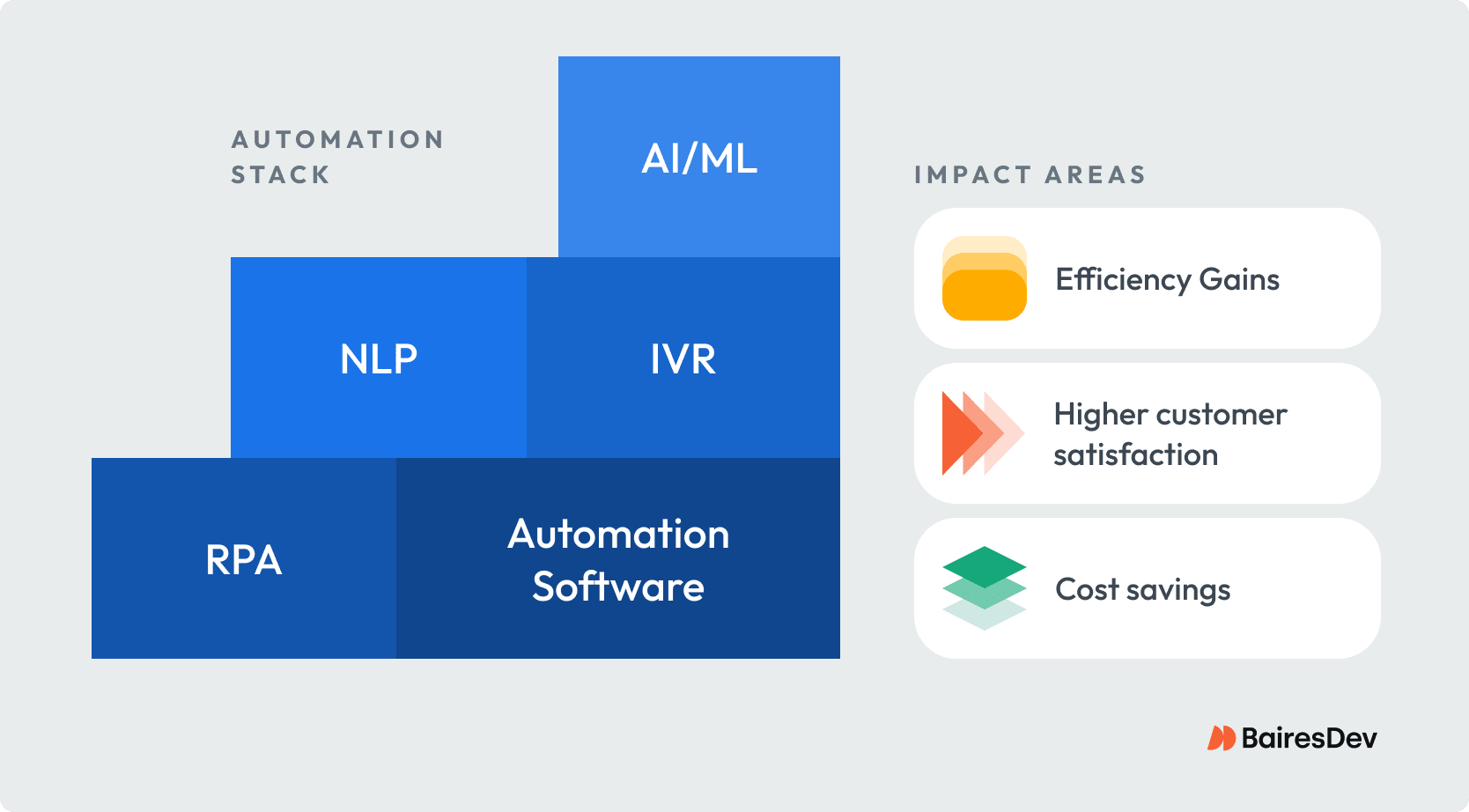
Contact center automation combines AI, robotic process automation (RPA), natural language processing (NLP), and other automation tools to optimize customer interactions.
These technologies reduce operational costs, improve first-call resolution, and free agents to handle complex issues. When deployed effectively, they deliver consistent customer service across channels while maintaining the human touch where it matters most.
Understanding Contact Center Automation
In practice, automation routes interactions, captures and updates customer data, and resolves common requests through self-service channels such as IVR and virtual agents.
These tools can route calls, capture and update customer data, and resolve common requests through self-service channels such as interactive voice response (IVR) and virtual agents. The result is more efficient handling of routine interactions, leaving human agents available for issues that require judgment, empathy, and problem-solving.
Enterprise Impact
Industry adoption is accelerating. ICMI’s 2024 State of the Contact Center report found that 66% of leaders are actively supporting AI integration, and 71% believe automation increases agent productivity rather than replacing jobs. Contact centers already using automation report 20–40% faster resolution times.
For enterprise engineering and operations leaders, these numbers translate into direct business value: higher customer loyalty through faster, more consistent service; improved agent performance; and measurable gains in efficiency that scale across thousands of daily interactions.
Key Benefits for Enterprise Operations
| Benefit | Impact on Operations | Leadership Relevance |
|---|---|---|
| Efficiency | Automates repetitive, low-value interactions | Increases throughput without growing headcount |
| Cost Savings | Shifts routine volume to self-service and virtual agents | Frees budget for higher-impact initiatives |
| Customer Experience | Delivers faster, more consistent responses | Improves CSAT/NPS and customer retention |
| Accuracy | Reduces manual data entry and process errors | Lowers rework, complaints, and follow-up contacts |
| Scalability | Absorbs demand spikes without last-minute staffing | Protects SLAs during peaks and seasonal surges |
| Data & Insights | Captures interaction data for real-time analytics | Enables better decisions on staffing and process changes |
| Compliance & Risk | Enforces standard workflows and audit trails | Reduces regulatory exposure and audit findings |
AI Capabilities Driving Automation
AI is at the core of modern contact center automation. Instead of working as abstract technologies, these capabilities directly enable business outcomes:
- Machine Learning — Improves call routing and forecasting by learning from historical customer interactions.
- Deep Learning — Powers advanced speech recognition and intent detection in complex conversations.
- Natural Language Processing — Understands sentiment and intent to deliver more natural self-service and escalation.
- Predictive Analytics — Anticipates potential churn or service issues, enabling proactive engagement.
Automation Technologies and Tools
- Robotic Process Automation — Automates back-office processes like data entry, lead management, and reporting.
- Interactive Voice Response — Automates call routing and provides self-service options to customers.
- Intelligent Virtual Agents — AI-powered bots that handle customer inquiries across voice, chat, and messaging channels.
- Automation Software — Streamlines workflows, schedules, and reporting, integrating with existing systems to optimize processes.
Implementation Best Practices
1. Define Clear Objectives
Identify the KPIs you want to improve, such as first call resolution rates, customer satisfaction scores, or operational efficiency.
2. Integrate with Existing Systems
Ensure your automation tools work seamlessly with your CRM, call center software, and analytics tools.
3. Prioritize Quality Assurance
Use testing platforms like STAMP (System Test and Monitoring Platform) to validate performance, accuracy, and usability before full deployment.
4. Train and Support Human Agents
Automation should augment human agents, not replace them. Provide training to help agents work effectively alongside automated systems.
Risk and Mitigation Strategies
Even the best automation solutions can fail if risks aren’t managed:
- Customer Frustration — Mitigate by offering easy escalation to human agents.
- Data Privacy Concerns — Ensure compliance with GDPR, CCPA, and industry-specific regulations.
- Integration Challenges — Use APIs and middleware to connect automation tools with existing systems.
- Over-Automation — Avoid removing the human touch from complex or sensitive interactions.
Real‑World Case Study: Strategic Transformation of Contact Centre Operations
Background: A traditional contact center, heavily reliant on voice interactions, struggled with seasonal peaks, high operational costs, and declining customer satisfaction. Many calls were routine inquiries that could be resolved through self-service.
Approach:
- Primary Channel: Conversational AI to handle routine inquiries instantly.
- Secondary Channel: Live chat for more complex issues, preserving a personal touch.
- Tertiary Channel: Voice reserved for high‑complexity or customer‑requested interactions.
Outcomes:
- 50% reduction in operational costs (net, after platform investment).
- Improved alignment with customer preferences for digital channels.
- Higher employee satisfaction as agents focused on complex, value‑adding work.
This multi-tiered approach demonstrates how automation can simultaneously improve service quality, reduce costs, and enhance both customer and employee satisfaction.
While efficiency gains are critical, compliance and risk management are equally important in heavily regulated industries.
Real-World Case Study: Automation in a Regulated Industry
A Fortune 500 insurance provider implemented contact center automation to address strict compliance requirements and rising operational costs. The company handled millions of annual interactions across voice and digital channels, many of which involved sensitive financial and personal data. Manual processes not only slowed resolution times but also increased the risk of errors that could trigger regulatory penalties.
Approach:
- Integrated robotic process automation (RPA) to handle policy lookup, claims data entry, and verification against regulatory checklists.
- Deployed natural language processing (NLP) to monitor sentiment in real time and flag conversations with potential compliance risk.
- Used predictive analytics to forecast call volumes during open enrollment, enabling proactive staffing adjustments.
Outcomes:
- 30% reduction in compliance-related escalations through automated verification and audit trails.
- 20% faster claims resolution by eliminating manual data entry steps.
- Improved audit readiness, with regulators citing complete, standardized reporting across thousands of cases.
This example demonstrates how automation not only drives efficiency and expense reduction but also strengthens risk management—critical for enterprises operating under strict industry regulations.
Future Trends to Watch
Looking ahead, several trends are shaping the next wave of contact center automation.
- Hyper-Personalization — Using AI to tailor every interaction based on customer history and sentiment.
- Omnichannel Orchestration — Seamless transitions between voice, chat, email, and social channels.
- Proactive Engagement — Predicting customer needs before they reach out.
- AI-Driven Coaching — Real-time feedback to agents during live calls.
Measuring Success
Track KPIs to measure ROI:
- First Call Closure/Resolution Rates
- Customer Satisfaction Scores
- Average Handle Time
- Agent Performance Metrics
- Operational Cost Reduction
Continuous improvement is essential. Use analytics to identify trends, optimize processes, and adapt to evolving customer needs.
The Strategic Payoff
Contact center automation offers more than cost savings—it’s a strategic lever for improving customer loyalty, agent effectiveness and performance, and operational efficiency.
By automating repetitive tasks, analyzing customer interactions, and delivering personalized service, you can meet customer needs faster, reduce operational costs, and maintain consistent service quality.