


Teams that embed ITIL 4 practices into automated delivery workflows often recover faster from incidents and spend less time on manual governance. For many engineering leaders, this challenges the old image of ITIL as slow approvals and endless tickets.
The ITIL 4 framework is built for agility, continuous delivery, and faster recovery. Automated governance turns ITIL 4 from a compliance burden into an engineering advantage.
Context and Problem Framing
Cloud-native systems have erased boundaries between development and operations, but enterprise scale still demands structure. Engineering leaders must prove that every deployment, incident, and recovery action follows a predictable, auditable service delivery process.
The Information Technology Infrastructure Library (ITIL) defines that structure. ITIL 4 unites service design, design, and transition activity, and service operation under a single service value system.
The framework aligns with DevOps principles, such as automation, collaboration, and continual feedback, to keep teams compliant and fast. These service management processes connect reliability with repeatability across the platform lifecycle.
Misapplied, ITIL can still feel bureaucratic. The modern goal is different: weave governance into engineering workflows so it’s invisible, reliable, and measurable. For deeper guidance, see the Atlassian ITIL Overview and HappyFox 2025 ITIL 4 Guide.
Guiding Principles as Platform Guardrails
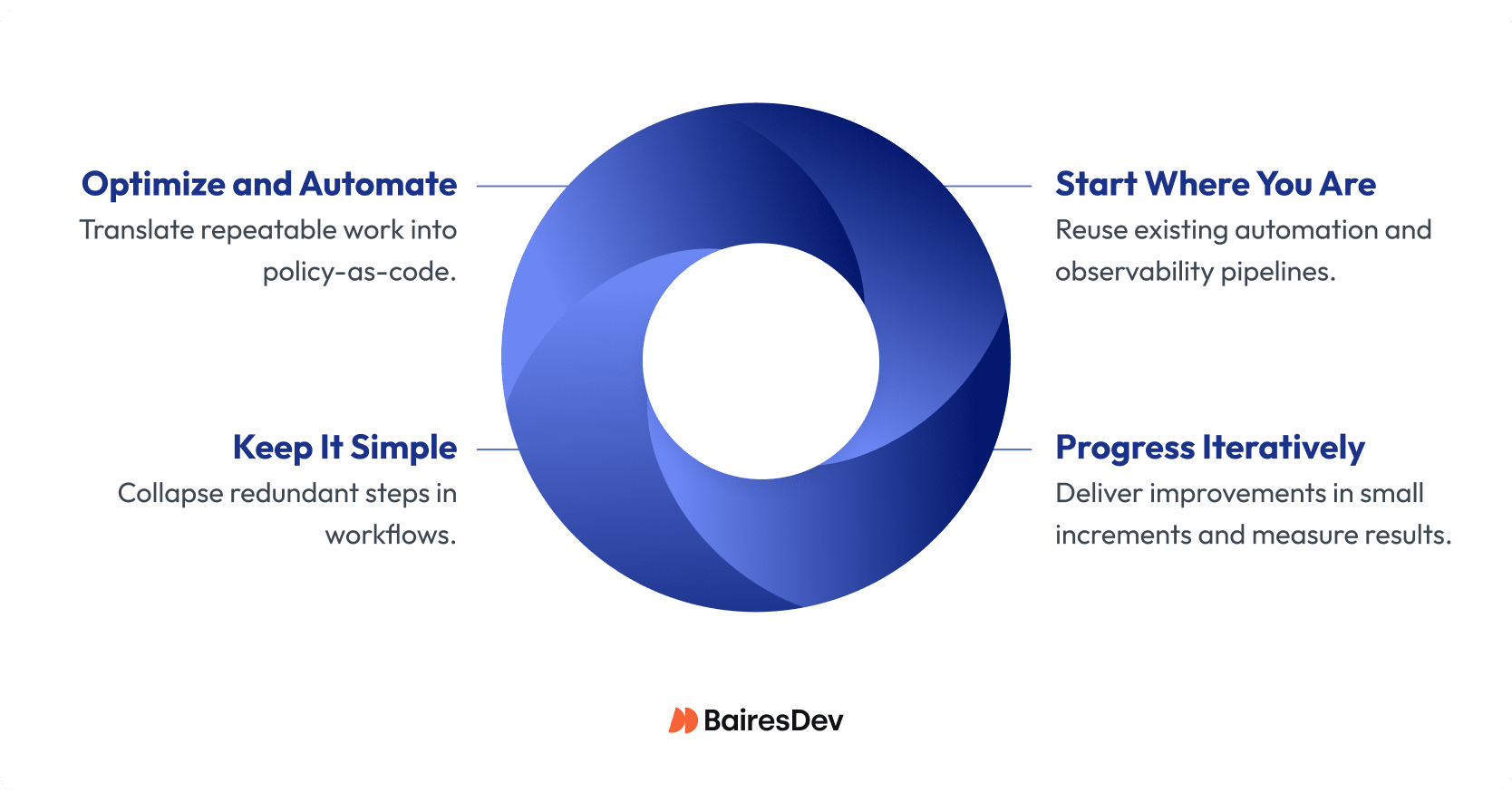
The ITIL 4 guiding principles—start where you are, progress iteratively, feedback and collaborate, keep it simple and practical, optimize and automate—fit naturally in DevOps culture.
- Start where you are: reuse existing automation and observability pipelines before adding complexity.
- Progress iteratively with feedback: deliver platform improvements in small increments and measure results through SLOs and incidents.
- Keep it simple and practical: collapse redundant steps across change, testing, and release workflows.
- Optimize and automate: translate repeatable work into policy-as-code.
These principles convert service management practices into engineering norms. The same telemetry that drives reliability also provides audit evidence. Governance becomes part of the delivery pipeline, not a separate process. The ITSM.Tools continual improvement guide illustrates how this approach closes the feedback loop effectively.
Service Value Chain in Action
The service value chain within ITIL 4 includes Plan, Improve, Engage, Design & Transition, Obtain/Build, and Deliver & Support, each mapping directly to today’s continuous-delivery cycle.
These stages align with familiar CI/CD activities such as backlog grooming, retrospectives, sprint demos, build automation, and production support. This mapping reinforces the service improvement process and connects ITIL directly to platform management and software development workflows.
| Value Chain Activity | Platform / DevOps Responsibility | Leadership Outcome |
| Plan | Define service strategy, SLOs, and capacity forecasts aligned with business objectives | Predictable budgets and measurable reliability |
| Improve | Feed post-incident reviews into automation and service design updates | Continuous, data-driven improvement |
| Engage | Operate service catalogs and feedback channels | Clear ownership and stronger user satisfaction |
| Design & Transition | Standardize IaC baselines and transition testing | Safer releases and consistent environments |
| Obtain / Build | Reuse platform modules and APIs | Faster delivery with controlled risk |
| Deliver & Support | Centralize observability, incident response, and knowledge bases | Reliable operations and audit-ready traceability |
Embedding these technical management practices in CI/CD replaces reactive troubleshooting with proactive reliability.
Change Enablement Without Drag
Classic change boards created bottlenecks. Modern ITIL 4 change enablement preserves risk awareness but automates approval. Modern change management integrates these guardrails directly into the pipeline.
- Low-risk, standard changes deploy automatically.
- Medium-risk changes trigger peer review and policy validation.
- High-risk changes get human review supported by test data and rollback plans.
Each release generates immutable evidence for auditors, supporting evidence collection for controls aligned with ISO 27001:2022 and SOC 2.
Incident, Problem, and Request Management
Most SRE and platform teams already apply ITIL’s intent. For example, incident management restores service, problem management prevents recurrence, and request fulfillment handles routine tasks.
ITIL 4 formalizes accountability across service operation roles, clarifying shared ownership across the lifecycle.
| Process | Product Teams | SRE | Platform Team | Service Desk |
| Incident Response | C | A/R | C | I |
| Post-Incident Review | C | A/R | C | I |
| Service Request Automation | C | I | R | A |
| Change Policy Definition | C | C | A/R | I |
| Knowledge Base Maintenance | C | R | C | A |
A = Accountable, R = Responsible, C = Consulted, I = Informed
This clarity accelerates recovery and reinforces shared ownership across the service lifecycle.
Reliability, Capacity, and Continuity
Under ITIL 4, availability management, capacity management, and service continuity management tie resilience directly to business outcomes.
Each metric should connect to a customer promise. For example, asking “Which SLA would users notice first if capacity falters?” turns internal targets into measurable user impact. Availability metrics align with SLOs, capacity forecasts manage demand, and continuity tests validate disaster-recovery plans per NIST SP 800-34.
Mature organizations integrate these tests into delivery pipelines, producing compliance evidence automatically.
Asset and Configuration Management
Modern service asset and configuration management uses automation instead of spreadsheets. Tagging and discovery keep the CMDB synchronized with the service catalog. Every deployment, asset, and dependency becomes traceable. This is a critical control for audit-ready operations.
Planning and Governance
The ITIL 4 Direct–Plan–Improve model closes the loop between technology decisions and business strategy.
- Direct: set priorities and governance goals.
- Plan: align capacity and financial management with demand and organizational resources.
- Improve: measure performance and update controls continuously.
This is the core of organizational change management under ITIL: small, measurable adjustments that reduce risk while enabling growth. ITIL’s general management practices connect these disciplines into a consistent governance framework.
Metrics like change-failure rate, MTTR, and customer satisfaction become executive KPIs, showing that compliance supports velocity.
Cultural Integration: Shifting Teams Toward Service Thinking
ITIL succeeds when culture changes alongside process. Service ownership becomes part of engineering identity. Teams fold reliability metrics into sprint planning, and post-mortems turn into improvement sprints.
By embedding continual improvement discussions in regular Agile ceremonies, ITIL becomes an engineering mindset.
A mature culture takes time. Leaders who connect ITIL 4 outcomes to customer value create a sense of shared purpose. Engineering organizations that communicate this link clearly find adoption easier and retention stronger because reliability becomes everyone’s job.
Visible leadership drives change. When executives celebrate uptime gains and smoother audits, service thinking takes root.
Business Impact and ROI
Adopting ITIL 4 in DevOps pipelines improves both delivery performance and trust. One enterprise saved more than $2 million annually after reducing failed changes by 45% through automated change workflows, a result consistent with the Puppet State of DevOps Report 2024.
Outages drop, audits simplify, and enterprise buyers gain confidence that governance is engineered in. These outcomes reflect growing service management maturity across teams.
Automated change and incident workflows reduce costs, strengthen oversight, and accelerate ROI.
| Maturity Level | Operational Characteristics | Typical Metrics | Business Impact |
| Ad hoc | Manual approvals, no standardization | MTTR > 6 h, > 20% failed changes | Frequent outages, poor visibility |
| Defined | Documented processes, service catalog management | MTTR 4–6 h, 10–15% failed changes | Improved predictability, audit readiness |
| Managed | Automated approvals, CI/CD evidence capture | MTTR 1–3 h, < 10% failed changes | Reliable delivery, faster procurement |
| Optimized | Policy-as-code, integrated observability | MTTR < 1 h, < 5% failed changes | Customer trust, continuous compliance |
Operational Efficiency and Governance ROI
As organizations scale, operational efficiency becomes a financial lever. ITIL 4 helps leaders quantify that value by linking incident metrics and service availability to the cost of downtime.
Each point of MTTR improvement translates directly into regained capacity and reduced overtime spend. The framework’s emphasis on clarity and accountability also streamlines governance. Finance, legal, and compliance teams can validate evidence faster, cutting audit cycles and review time.
Metrics That Matter
Metrics transform the ITIL framework into a management system that links technology performance to business results.
These indicators help leaders assess whether their service management practices and continual improvement cycles are producing measurable value. These key processes define how reliability and governance evolve together.
| Metric | Definition | Why It Matters |
| Change Failure Rate | Percent of changes that cause incidents | Connects deployment discipline to stability |
| MTTR | Mean time to recover from incidents | Gauges operational resilience |
| Audit Preparation Time | Hours to collect evidence for audits | Shows automation efficiency |
| SLO Attainment | Percentage of periods meeting targets | Demonstrates customer reliability and trust |
Compliance as a Commercial Differentiator
Procurement teams now treat ITIL alignment and certification as proof of maturity. Gartner notes that more than 60 percent of enterprise RFPs reference ITIL or related standards. Providers that apply ITIL 4 principles and structured service operation practices close deals faster and inspire confidence among regulated clients.
For software and platform providers, ITIL best practices compound in value: fewer disruptions, quicker recovery, and faster time-to-market for enterprise accounts.
What “Good” Looks Like
A mature ITIL-aligned organization shows measurable control and continual refinement.
- Service management practices are visible and automated.
- Change enablement uses data-driven risk scoring.
- Logs and evidence remain immutable.
- Continuity plans are tested regularly.
- Improvement cycles feed directly into service design and delivery.
Here, IT service management becomes an invisible layer of quality rather than an external audit requirement.
Implementation Realities
ITIL implementation unfolds in three stages. Each phase builds maturity and connects operational goals with business value. The ITIL certification scheme provides a structured path for professional and organizational validation.
- Assessment (4–6 weeks) – Evaluate how existing processes map to ITIL 4 practices. Identify automation opportunities and clarify service ownership across teams.
- Integration (8–12 weeks) – Embed change enablement, incident management, and service transition into CI/CD pipelines. Replace manual approvals with policy-as-code and connect deployments to the CMDB and service catalog. Integration ensures governance becomes part of everyday engineering. Teams pursuing ITIL certification often complete this stage alongside internal training or alignment with the Invensis ITIL Certification Renewal Guide.
- Optimization (Ongoing) – Measure, refine, and expand automation. Use service metrics, audit data, and performance trends to guide investment decisions and continual service improvement.
ITIL projects fail when isolated from delivery. Integrate governance with DevOps workflows early and capture evidence automatically to avoid audit fatigue.
Strategic Takeaways
ITIL 4 works best when it’s invisible, embedded in every release and every conversation about risk and reliability. Leaders should treat metrics as truth and governance as a shared engineering capability. The challenge is simple: what single control will you automate this sprint?
Key practices to reinforce:
- Align the ITIL framework with Agile and DevOps delivery.
- Automate governance to maintain compliance without slowdowns.
- Use data instead of documents to prove control effectiveness.
- Treat continual service improvement as a constant, not a phase.
- View reliability and service delivery as business growth drivers. ITIL 4 directly supports digital transformation initiatives that connect governance to customer trust.