


Key Points
- PHP remains the dominant server-side language in 2026, powering approximately 71.8% of websites with a known server-side language.
- Node.js, Python, Go, and Rust are the leading alternatives, each suited to different workloads.
- HHVM has not supported PHP since 2019 and is not a viable alternative.
If you are about to start a web development project, then chances are that you will think of PHP as the language that you should be using for server-side coding. And that makes sense. After all, PHP is a wildly popular language.
It powers approximately 71.8% of websites with a known server-side language, down from figures between 77% and 79% cited a few years ago. That gradual decline shows growing adoption of Node.js and Python, but not at all a collapse in PHP’s relevance.
That said, market share is not the same as fit. Plenty of developers have good reasons to consider other programming languages or choose between available web development services for specific project needs.
What Is a PHP Alternative?
PHP began as one of the earliest web template systems, designed to let developers embed code directly inside HTML pages for creating dynamic content on the web. Today it is a full server-side language, but its origins as embedded code in HTML still shape how it works and where it works best.
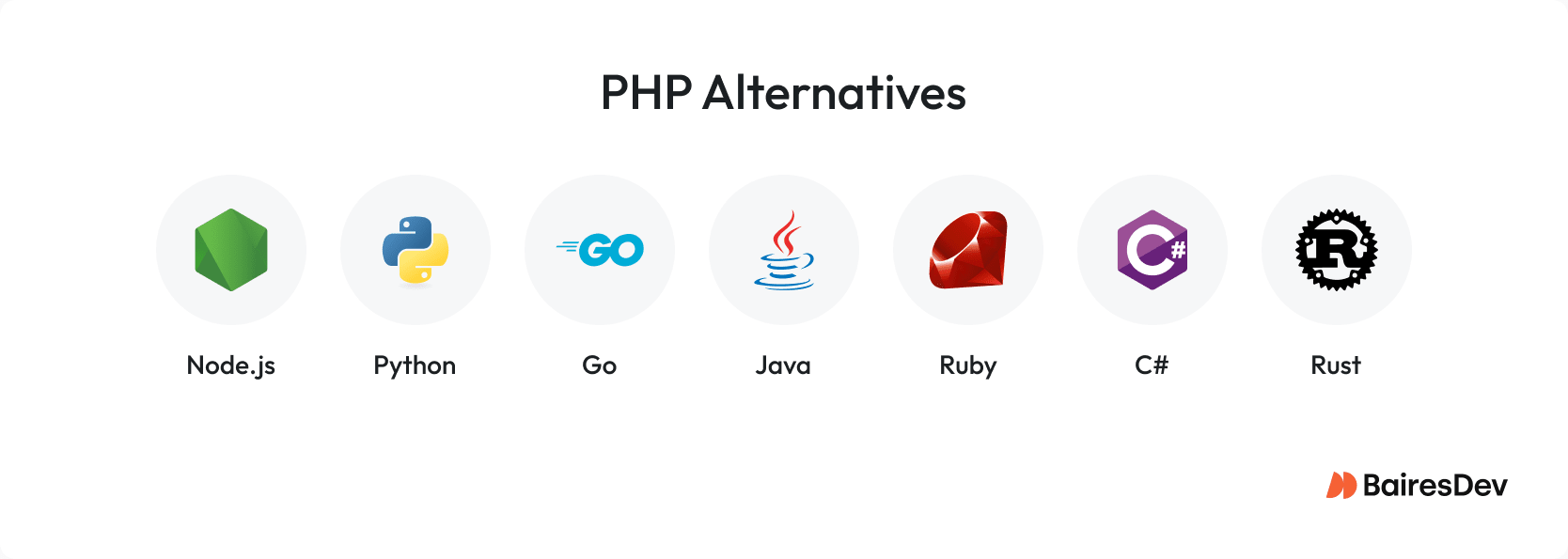
A PHP alternative is any server-side programming language or runtime used instead of PHP to build web apps, content management systems, APIs, or backend services. In 2026, the leading alternatives include Node.js, Python, Go, Java, C#, Ruby, and Rust.
Should You Consider an Alternative Programming Language?
Sure, it is extremely popular, but the best choice depends on your workload. Node.js excels at real-time and full-stack JavaScript applications. Python, with FastAPI, Django, or Flask, is the strongest option for AI and data-intensive systems.
Go powers highly concurrent services. Rust delivers maximum performance for systems-level work. Modern PHP, now at version 8.5 with Laravel 12, remains a highly capable platform for web apps and content-driven sites.
Why Wouldn’t You Use PHP?
PHP has a lot to offer, and it has shown that it is a great choice over its many years of existence.
That said, some reasons lead developers to consider whether better options exist. Personal preferences aside, some of the recurring reasons why developers and companies look beyond PHP include the following:
- PHP is a forgiving language. This might sound like a good thing at first, but in practice it means the language is quite flexible about variable types, which can quietly introduce errors.
- It can be slow. Though some developers might argue that PHP’s out-of-the-box performance is decent enough, the reality is that PHP is fairly slow in execution. That same forgiveness can also cause problems with loops and cache usage, and as any developer will tell you, bad performance has a way of derailing a whole project.
- There is a lack of a clear philosophy. For developers who love flexibility, this is actually one of PHP’s appeals. For others, the absence of strong conventions can become an obstacle, leading to a more complicated development process than it needs to be.
Modern PHP has addressed many of these criticisms directly, with features like a JIT compiler, union types, and fibers now part of the standard distribution.
Which PHP Alternative Fits Which Workload?
Here, let’s look at some of the best PHP alternatives to consider for any web development scenario.
| Language | Typing | Performance Profile | Best-Fit Workload | Key Frameworks (2026) | Learning Curve | Notes vs PHP |
| PHP 8.5 | Dynamic | High (JIT improvements) | Content management systems, web apps, APIs | Laravel 12, Symfony | Low | Largest web ecosystem and fastest path for content-driven applications |
| Node.js | Dynamic | High for I/O workloads | Real-time apps, APIs, full-stack JS | Express, NestJS, Next.js | Low-Medium | Most-used backend JavaScript runtime |
| Python | Dynamic | Moderate | AI, ML, data platforms, APIs | FastAPI, Django, Flask | Low | Richest AI and data ecosystem |
| Go | Static | Very High | High-concurrency services, cloud infrastructure | Gin, Fiber | Medium | Excellent performance with simple concurrency model |
| Java | Static | High | Enterprise platforms | Spring Boot | High | Mature enterprise ecosystem |
| C# | Static | High | Enterprise apps, Microsoft environments | ASP.NET Core | Medium | Strong .NET ecosystem and cloud integration |
| Ruby | Dynamic | Moderate | Rapid prototyping, web apps | Ruby on Rails | Low | Mature but gradually declining adoption |
| Rust | Static | Extremely High | Systems programming, performance-critical services | Axum, Actix Web | High | Memory safety without garbage collection |
One commonly seen option that you no longer see on this list is HHVM. Originally developed by Meta as a faster runtime for PHP applications, HHVM dropped PHP support entirely with version 4.0 in 2019. It now runs only Meta’s Hack language.
The 7 Most Powerful PHP Alternatives In Detail
#1 Node.js
If your team is already working in JavaScript on the front end, Node.js is the natural next step for the back end. It is the most widely used backend JavaScript runtime around. The same codebase running on both server and client cuts a lot of the overhead that comes with switching between languages.
Express, NestJS, and Next.js are the main frameworks worth knowing, covering everything from simple APIs to full-stack development. Node.js 22 is the current LTS release. The one area where it struggles is CPU-intensive work, where the single-threaded default can slow things down considerably. Worth keeping in mind when scoping your project.
#2 Python
Python is a highly powerful alternative to PHP for a wide range of web development projects. It tends to come up whenever the conversation turns to AI or data, and for good reason. Python has a vast ecosystem of external libraries built specifically for those workloads, and the language itself was designed to be readable and quick to iterate on.
FastAPI has joined Django and Flask as a go-to framework for Python backends, particularly for AI-focused applications. It is not the fastest language at runtime, but for data-heavy or machine learning work, the tradeoff is well understood, and the ecosystem more than compensates. And Python covers a lot of ground beyond web development, from automation scripts to scientific computing.
#3 Java
The other big contender in the programming world, Java is a strongly typed language that provides the discipline developers lack with PHP. In other words, Java gives you the ability to build cleaner and more structured code, which, at the end of the day, reduces the possibility of introducing the errors that PHP is more prone to introduce (especially when it’s in the hands of inexperienced engineers).
Highly portable and cross-platform, Java also has impressive performance, thanks to its parallel task execution and its support for concurrency. What’s more, the language is better positioned for modularizing your web applications, which ultimately affects how easy it will be for you to create and update them. Finally, it is worth mentioning that Java has plenty of powerful frameworks that make developing projects easier and quicker.
#4 Go
If you prefer to pick a newer option than Python or Java, you can always choose Go, also called Golang. Created and supported by Google, this programming language has a simple goal: to provide you with efficient tools and features to build highly scalable applications in the easiest way possible.
To achieve that goal, Go boasts a streamlined syntax that nonetheless supports task concurrency and parallelism. This is especially useful when you are building distributed applications, which are perfectly suited for optimal performance in cloud-based environments and corporate networks.
#5 Ruby
Ruby is an excellent choice for beginners given how user-friendly and easy to understand it is. Despite its simplicity, it is a powerful language that can make your web pages dynamic. It is also a highly productive language.
Of course, anyone familiar with Ruby has heard of Ruby on Rails. It is by far the most popular Ruby framework and has dramatically extended the capabilities of the language over the years. Its development speed is a genuine advantage when time to launch matters. Overall adoption has declined gradually compared to Node.js and Python, but Rails remains a solid choice when the team knows it well.
#6 C#
C# is an object-oriented programming language that was developed by Microsoft and built on the .NET ecosystem. Logical, well-designed, and versatile, it has been growing steadily in popularity thanks to its user-friendliness and the sheer range of projects it can be applied to. It does not hurt that it is backed by one of the largest tech companies in the world.
ASP.NET Core is the framework of choice for building web APIs and full-stack applications in C#, and it performs well at both. The language is especially popular in enterprise environments and benefits from Microsoft’s investment in Azure cloud services. If you already know C++ or Java, picking up C# is a relatively smooth transition.
#7 Rust
If performance is at the top of your list and memory errors are simply not an option, such as in high-throughput APIs, Rust is hard to beat. Unlike interpreted languages, it compiles directly to machine code, which means you get C-level speed without the memory management issues that usually come with it.
Web frameworks like Axum and Actix Web make it a viable choice for backend work. Yes, the learning curve is steeper than the other languages on this list, and it takes a little longer to get up and running. But once you do, very few languages can match what it delivers.
Should You Migrate an Existing PHP App or Upgrade It?
In most cases, migrating a mature PHP application to another language is not the most efficient path. Code written for PHP 8.5 with a well-structured Laravel or Symfony application benefits from years of ecosystem maturity, and a well-executed upgrade is often faster and lower risk than a full rewrite in one of the most robust programming languages available today.
Before committing to a rewrite, it is worth evaluating whether modern PHP already addresses the underlying technical challenges. Organizations working with teams that maintain large PHP codebases in production often find that upgrading to PHP 8.5 and improving architecture delivers faster, lower-risk results than adopting an entirely new technology stack.
Migration makes more sense when there is a clear technical or business reason behind it, such as a fundamental shift in what the application needs to do or a team that is better equipped to work in a different language.
Emma White, Senior Software Engineer at BairesDev:
“In practice, the question is almost never ‘PHP or not PHP,’ it is ‘which problem am I actually solving?’ I have watched teams burn months migrating a perfectly healthy PHP app to Node or Go chasing a benchmark, when upgrading to PHP 8.5 and bringing in engineers who know the language would have fixed the real bottleneck far faster.”
Picking the Right Alternative
PHP has a lot to offer, and even when you take its drawbacks into account, it is worth attempting to work through them. Before choosing the best PHP alternative, you should have a clear understanding of which issues are driving you to it. The issues you have with PHP might be easily solved with the right PHP development team by your side. Experts in the language can help you navigate through the challenges and show you that the things pushing you toward alternatives are not as complicated as they may seem at first.
After doing so, you might still want to go with another programming language, and that is perfectly fine. You have some powerful options available. It could also simply be the case that you do not always want to rely on PHP, and that is certainly a reasonable position too.
Key Takeaways
- PHP remains the dominant server-side language in 2026, powering approximately 71.8% of websites with a known server-side language. The “PHP is dying” claim is inaccurate.
- The strongest PHP alternatives each serve different needs: Node.js for real-time applications, Python for AI and data workloads, Go for high-concurrency services, and Rust for performance-critical systems.
- HHVM is no longer a PHP alternative. Since HHVM 4.0 in 2019, it supports only Meta’s Hack language and cannot run PHP applications.
- Modern PHP at version 8.5 with Laravel 12 addresses many historical criticisms. Upgrading is often lower-risk and more cost-effective than migrating to a new language.
- Choose based on what your workload actually requires, not on which language is currently generating the most conversation.