



Do you know who gained access to systems, services, files, or platforms your organization relies on? For large organizations, this is often a difficult question to answer, and one that demands attention.
Without full control over access, you leave the business open to security risks, insider threats, and compliance failures. When employees gradually accumulate more permissions than they need, the result is privilege creep. It happens more often than most leaders realize, and it quietly undermines security programs.
An employee might receive access to certain servers or applications. Later, their role shifts and more privileges are added without reviewing or revoking the existing ones. Over time, a single account can hold far more authority than necessary, and that surplus access is exactly what attackers look for.
Privilege creep is a direct threat to security. Unchecked, it becomes a systemic risk capable of undermining even the most mature security programs.
What is Privilege Creep?
Privilege creep is the gradual accumulation of unnecessary access rights. It typically occurs when employees change roles, take on new responsibilities, or are granted temporary access that isn’t revoked. Over time, these permissions open paths to sensitive data, enabling insider threats, unauthorized access, and compliance violations.
Recognizing privilege creep is the first step to effective access management. Organizations must regularly review permissions and ensure they match current job responsibilities. Only then can enterprises maintain a defensible security posture.
Why Is It a Security Risk?
Privilege creep exposes organizations by giving too many people access to assets they don’t need. The result: expanded attack surfaces, increased risk of breach, and operational disruption.
Consider this: Olivia in PR needs temporary access to a database with client information. Once that project ends, if access isn’t revoked, she still retains access. A compromised account at that point exposes confidential financial or personal data.
This is a common oversight that attackers are keen to exploit.
Revoking access sounds simple, but competing priorities often push it down the list. Admins may also assume the user will probably need access again. That mindset, multiplied across hundreds or thousands of employees, is how privilege creep becomes a company-wide liability.
Access Management
Access management is central to preventing privilege creep. Role-based access control (RBAC) and the principle of least privilege (PoLP) help ensure users only receive what’s required for their roles.
Effective programs include:
- Regular access reviews
- Automated privilege revocation
- Clear, enforceable policies
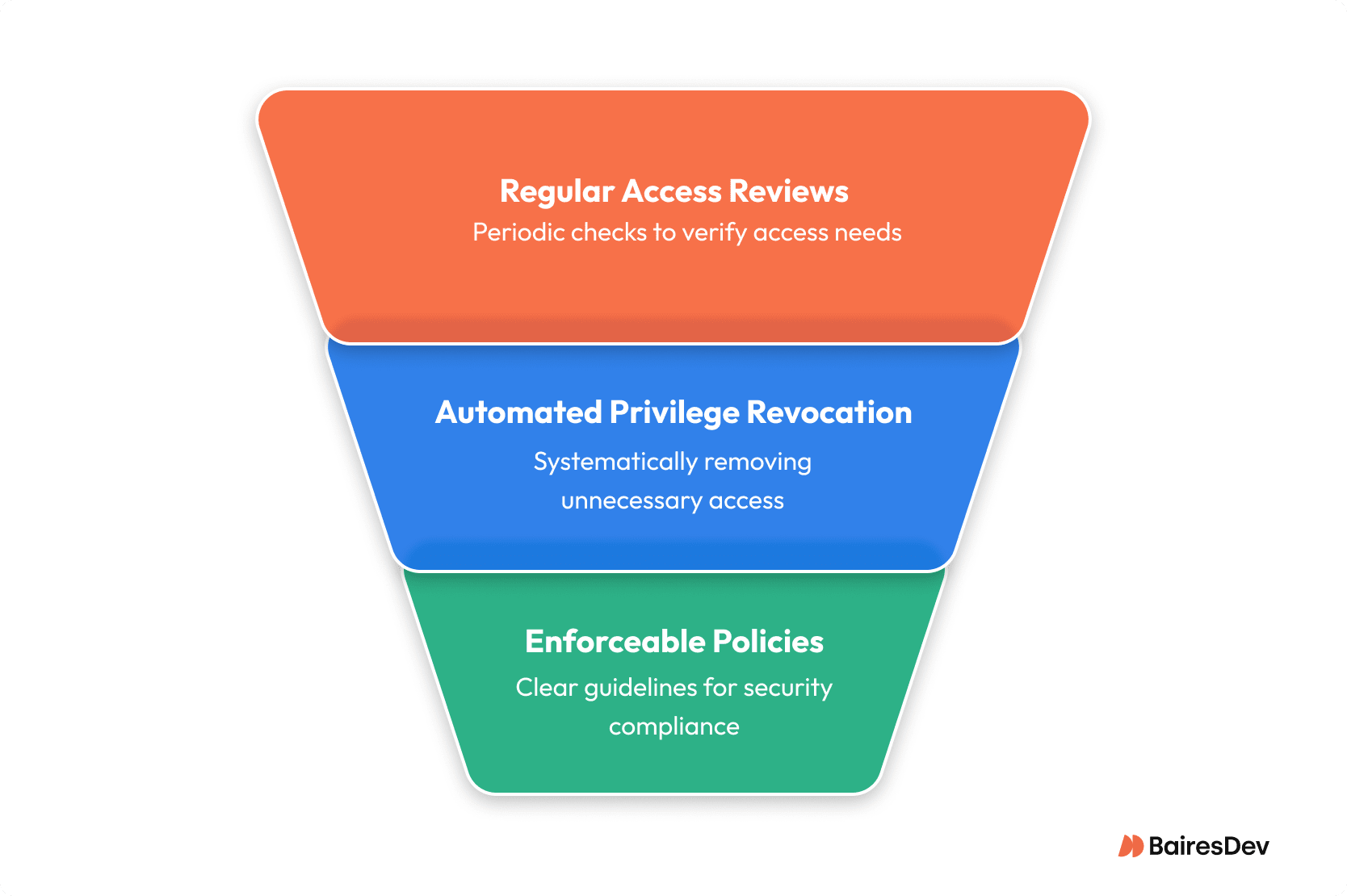
These measures reduce the attack surface, prevent breaches, and support compliance. Prioritizing them allows leadership to safeguard data while avoiding regulatory and reputational fallout.
How to Avoid Privilege Creep
There are a few things you can do to ensure privilege creep doesn’t come back to haunt you. Using automated tools can help in regularly auditing and managing access rights.
The first thing you should do is create an access policy that clearly defines which employees have access to which assets. This helps in mitigating security risks associated with privilege creep.
Yes, it might make extra work for them, but they must regularly check privileges (referring to the chart you’ve painstakingly created!) and revoke any privilege that is not needed.
For example, you could create access policies based on roles, such as developers, HR, management, staff, and upper management.
Create a Strict Access Policy
According to Satoricyber, the average organization uses approximately 315 SaaS apps, and most of those apps have multiple accounts with access to sensitive company data.
The first thing you should do is create an access policy that clearly defines which employees have access to which assets.
This should be an easy-to-read chart that makes it obvious which departments and employees should have access to specific systems/accounts/assets.
Follow the Policy to the Letter
Next, you need to make certain your admin teams are following the new policy. Yes, it might make extra work for them, but they must regularly check privileges (referring to the chart you’ve painstakingly created) and revoke any privilege that is not needed. Failure to do so can pose a significant threat to your organization’s security.
Employ Role-Based Access
Instead of thinking about this on a per-user basis, it’s best to look at it from a role standpoint. For example, you could create access policies based on roles, such as developers, HR, management, staff, and upper management.
Each role (or group, if you’re looking at it via a computer system) will have specific privileges for specific assets. Once you have role-based policies, all you have to do is plug users into roles.
Work with Identity Governance and Administration
If you’re an enterprise business, you need to consider implementing Identity Governance and Administration (IGA), which serves to regularly check on access and privileges held by each employee. This team should be separate from your regular admins or security teams, so it can function independently.
If you’re not an enterprise business (but are still of the larger size), you might get away with a single employee taking care of IGA. If that’s the case, do not burden that employee with other tasks, because IGA will be enough to keep them busy. On top of that, having centralized management of user privileges will greatly reduce complications and mistakes.
Implementing multi-factor authentication can further enhance security by adding an extra layer of protection. Your IGA team will be far less likely to overlook a change in privileges than an already overworked admin or security team.
The Principle of Least Privilege
Privilege decisions can go two ways: granting more access than an employee needs, or granting only what’s essential. The latter is the safer, more sustainable approach.
This requires not just limiting initial permissions, but actively revoking outdated ones. A least-privilege model keeps accounts tightly scoped and significantly reduces breach potential.
Make Use of a Specialized Tool
If your company employs thousands of people, managing privileges manually can be next to impossible.
In such a case, consider using an Identity and Access Management (IAM) tool such as SPHEREboard, CyberFOX, Auth0, or SpectralOps. Such tools can function faster and more reliably to keep your business safe from privilege creep.
Data Protection
Privilege creep can lead to unauthorized access, data breaches, and compliance violations, which can result in significant financial and reputational losses.
Implementing data protection regulations, such as GDPR and HIPAA, requires organizations to ensure that access to sensitive data is strictly controlled and monitored.
By enforcing the principle of least privilege and implementing role-based access control, organizations can minimize the risk of privilege creep and protect their sensitive data.
Regular access reviews and automated access revocation can help prevent privilege creep and ensure that sensitive data is only accessible to authorized personnel.
Best Practices
To prevent privilege creep, your business should focus on the following actions:
| Why It Matters | |
|---|---|
| Conduct regular access reviews | Identifies outdated or excessive privileges before they become risks. |
| Enforce access management processes | Reduces attack surface by limiting access to only what’s necessary. |
| Apply RBAC consistently | Simplifies management by aligning privileges with defined roles. |
| Automate privilege revocation | Ensures access is removed promptly, reducing human error and oversight delays. |
| Use PAM solutions for critical systems | Protects high-risk accounts like administrators with stronger controls and monitoring. |
| Run security audits and risk assessments | Provides leadership with visibility into vulnerabilities and validates access governance programs. |
Privilege Creep Can Happen Anywhere
Even the most mature enterprises experience privilege creep. Left unchecked, it compounds quickly, making remediation costly and time-consuming. Starting early and maintaining discipline about access privileges keeps the problem manageable.
Organizations that prioritize access permissions management, enforce clear policies, and monitor privileges not only reduce risk but also ensure audit readiness and operational resilience. In today’s environment, proactive control over privilege creep is a baseline expectation for secure, compliant enterprises.