

The question is not whether to build software. The question is how to structure the team that builds it. For VPs of Engineering, CTOs, CPOs and Heads of Platform, this decision shapes your ability to iterate on core features, your burn rate, and whether your product reaches market before your runway ends.
Most guidance on software development for startups falls into generic lifecycle advice or vendor-driven sales pitches. This article provides a decision framework for choosing among four models: building an in-house development team, hiring freelancers, offshore outsourcing, or partnering with a nearshore team. Whether you’re navigating your first software development journey or restructuring development for startups entering their next growth phase, the framework applies.
The core principle: match your development model to your stage, your product complexity, and your tolerance for coordination overhead. There is no universal answer, and anyone claiming otherwise is selling something. But clear patterns separate startups that scale from those that stall.
Strategic Framework
- Early-stage validation favors speed and flexibility over control
- Post-PMF scaling demands knowledge retention and team continuity
- The right model evolves as your startup matures
- Switching costs are real; plan transitions deliberately
Why Development Model Decisions Matter
Startups operate under constraints that more established companies do not face. Runway is finite. Requirements and sometimes strategy shift frequently as you learn from real users. The difference between shipping in eight weeks versus twelve weeks can determine whether you capture a market window or miss it entirely.
Here’s the thing: approximately 90% of startups fail. The leading cause is lack of market need (42% of closures). Running out of cash contributes to 29% of failures. Both failure modes connect directly to how you structure development. Building the wrong thing too slowly accelerates both risks.
What distinguishes successful startups is their ability to validate ideas quickly, iterate based on user feedback, and preserve capital for pivots. Your development model either supports that ability or undermines it. A coherent startup software development process must prioritize learning speed over process perfection.
Understanding your target audience before committing to a team structure helps ensure your development efforts align with actual user needs rather than assumptions. Market research during the development process, and not just before, keeps you calibrated.
The Four Primary Models
In-House Development Teams
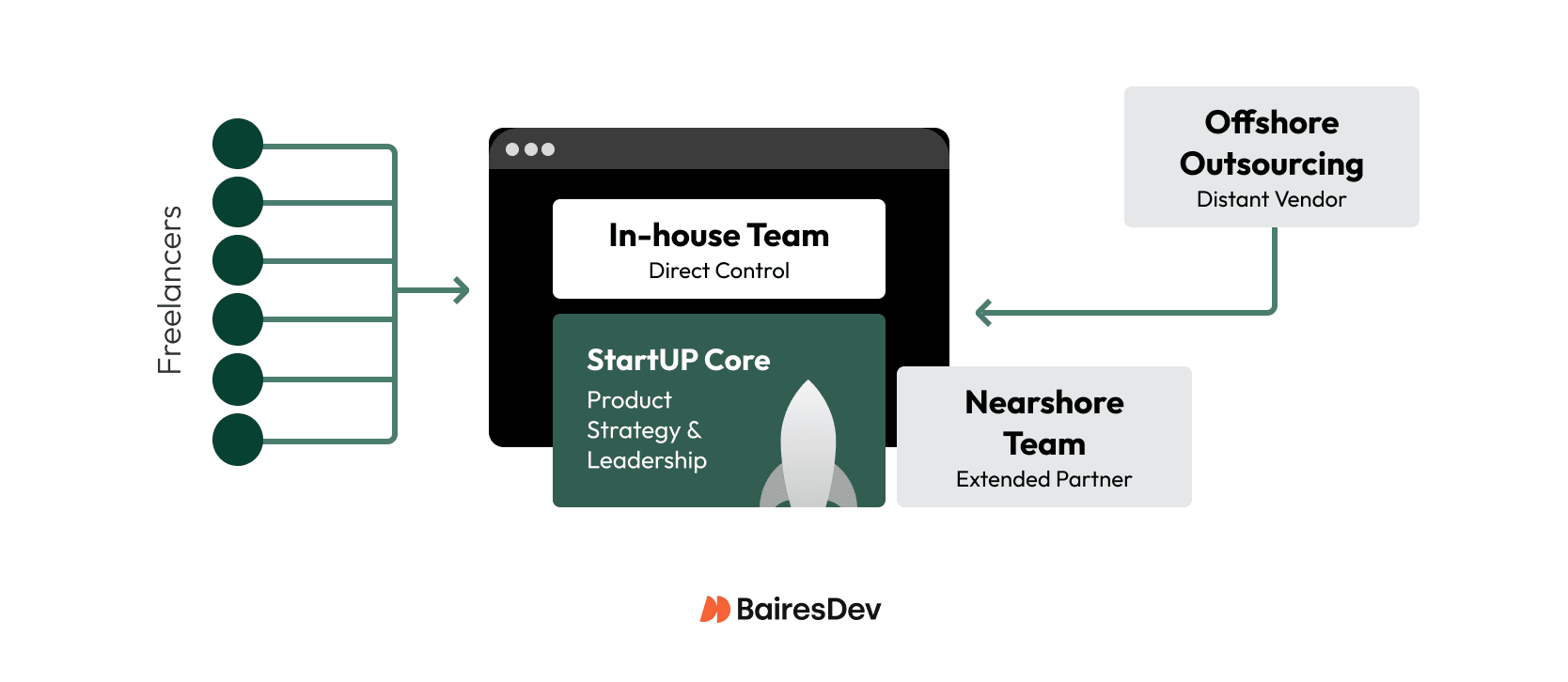
Building an internal development team means hiring full-time employees working exclusively on your product. You control the tech stack, technical standards, and priorities. Your in-house developers own the codebase completely and accumulate institutional knowledge that compounds over time.
The advantages: deep alignment with your startup’s vision, direct accountability, and knowledge retention. For core product leadership and proprietary systems, in-house is often right.
The disadvantages: recruiting typically takes three to six months for senior roles. If product requirements change, lack of flexibility may become an issue. I’ve seen Series A companies lose entire quarters due to a single critical hire that fell through. Salaries and benefits create fixed overhead regardless of changing needs. The Bureau of Labor Statistics projects 15% employment growth for software developers through 2034, which means competition for talent isn’t easing anytime soon.
Freelancers and Contractors
Freelancers offer flexibility at lower rates for specific tasks or bounded projects. For well-defined, low-risk assignments, they can be efficient.
Challenges emerge in complex work. Freelancers typically juggle three to five clients simultaneously, limiting availability. Quality varies widely, as does managerial overhead. Most freelancer platforms don’t and can’t deeply vet software developers. Quality assurance becomes your responsibility. When a freelancer finishes and moves on, continuity disappears. Post-launch support is typically not part of the engagement. IP protection requires careful contracts.
Traditional Offshore Outsourcing
Offshore outsourcing software development engages teams in distant locations where labor costs are 40-60% lower. Attractive for budget-constrained startups building software on tight timelines.
The tradeoffs involve coordination overhead, lack of flexibility, and overall comms challenges. Research on global software teams found that teams separated by more than six time zones experience coordination costs 2.5 times higher and task completion 50% longer. Questions asked at 9 AM get answered at 9 PM. For startups practicing agile development, this lag fundamentally changes what’s possible. The process must account for handoff delays co-located teams avoid.
Nearshore Teams
Nearshore partners are located in adjacent regions sharing your time zone: Latin America for US companies, or Eastern Europe for Western European companies.
The model offers significant cost savings combined with the collaboration advantages of a minimal time zone difference. Daily standups, real-time problem-solving, and rapid feedback loops work as intended. Agile methodologies function without communication lag.
The critical distinction: a nearshore team can function as a long-term collaborative extension rather than a vendor executing discrete projects or components. The best partnerships involve dedicated engineers who learn your codebase, understand your product vision, and provide continuous support alongside internal teams. This ongoing support model enables iterative development startups require. Think distributed team-building, not outsourcing.
Large nearshore partners often bring experience across multiple tech stacks and can advise on software solutions you haven’t considered. This technical breadth complements your strategic focus on core product decisions.
Nearshore isn’t without tradeoffs. It costs more than offshore, so if budget is the primary constraint at your stage, the math may not work in its favor. It also requires real technical leadership on your side: someone who can define architecture, review code, and give direction. And it’s not plug-and-play. Onboarding a nearshore team requires investment in documentation, tooling, and context-setting that teams often underestimate.
Model Comparison: Tradeoffs at a Glance
| Factor | In-House | Freelancers | Offshore | Nearshore |
| Cost | Highest (salaries + benefits + overhead) | Low hourly; can escalate | Lowest (40-60% savings) | Moderate (20-40% savings) |
| Speed to Start | Slow (3-6 months) | Fast (days) | Moderate (4-8 weeks) | Moderate (2-6 weeks) |
| Control | Maximum | Variable | Limited by distance | High with dedicated teams |
| Managerial Overhead | Low | High | High | Low to Moderate |
| Knowledge Retention | Strongest | Weakest | Moderate | Strong with partnerships |
| Communication Overhead | Minimal | High | Highest | Low |
| Quality Assurance | Direct control | Your responsibility | Requires formal processes | Integrated |
| IP Risk | Lowest | Highest without contracts | Moderate | Low with established partners |
| Best For | Core product, proprietary systems | Bounded tasks | Cost-driven, clear specs | Complex products needing iteration |
Decision Framework: Matching Model to Context
Stage-Based Guidance
| Stage | Recommended Model | Rationale |
| Idea Validation (0-6 months) | Freelancers or Nearshore | Speed matters most; avoid fixed costs until signal from real users |
| MVP Development (6-12 months) | Nearshore or Small In-House Core | Iteration speed with continuity; focus on essential features and core features only |
| Post-PMF Scaling (12-36 months) | In-House Core + Nearshore Extension | Protect core IP in-house; use nearshore for capacity and specialized skills |
You need to validate ideas cheaply and quickly. The minimum viable product approach demands focus on core features testing your central hypothesis, probably three to five features, not thirty. Building a full team before knowing anyone wants your product wastes capital.
Once entering serious MVP development, continuity becomes valuable. A small in-house core combined with a nearshore team of four to eight engineers provides knowledge retention and flexibility. Your software product development process should emphasize essential features proving value. Customer feedback shapes which new features warrant investment.
After achieving product-market fit, core architecture warrants in-house ownership. But demand spikes unpredictably – that enterprise deal requiring SOC 2, that partnership requiring API integration. A hybrid model balances control with flexibility.
Complexity and Capability Considerations
Product complexity influences model choice significantly. Systems requiring tight integration, frequent changes based on user feedback, and ongoing architectural decisions need high-bandwidth collaboration, favoring in-house or nearshore. Systems with technical debt or complex dependencies require team members who understand history: why that service exists, what broke last time someone refactored it.
Your technology stack choices also influence model selection. If you’re building software on a common tech stack, finding qualified development team members is straightforward regardless of model. Specialized or emerging stacks may require partners able to deliver niche software development services.
If a startup needs specialized technical expertise, building in-house rarely makes sense. Nearshore partners provide access to specialized skills without adding headcount.
Your internal capabilities matter equally. A strong technical leadership who can define architecture and conduct code reviews can direct external teams successfully. Otherwise, prioritize partners providing senior engineering guidance.
Process Implications
The development process looks different across models. Startups often underestimate how much the development process itself, not just the people, determines velocity and quality outcomes.
With in-house teams, communication happens naturally. With freelancers, you bear the coordination burden. Good project management tools and processes become essential.
With offshore, process formality increases substantially. Clear specifications and structured handoffs are essential. This overhead is manageable for well-specified work but can be painful for exploratory development.
With nearshore partnerships, you can run agile sprints with real-time collaboration. Continuous integration and automated testing practices work because engineers coordinate in real-time. Agile software development translates naturally.
When part of your work is external, maintaining a coherent software development process requires shared tooling: common repositories, unified CI/CD pipelines, and integrated communication. This investment pays for itself fast.
Myths to Ignore
- “Outsourcing always means losing control” – Structured partnerships preserve control
- “In-house is always better for quality” – Quality depends on people and process, not location
- “You need everything in-house before Series B” – Many successful companies scale with hybrid models
- “Nearshore is just more expensive offshore” – Time zone alignment fundamentally changes collaboration
The 24-36 Month Playbook
Months 0-6 (Validation)
Keep minimal. One to two technical co-founders own architecture. Use freelancers or small nearshore engagement for velocity. Focus on validating your hypothesis with real users – probably twenty to fifty paying customers before expanding.
Months 6-12 (MVP to Traction)
Expand deliberately. Hire one to two senior engineers in-house for critical systems. Engage a nearshore partner – four to eight dedicated engineers who become genuine team members. MVP development should reach a market-ready product.
Months 12-24 (Scaling)
With product-market fit confirmed, expand in-house for leadership roles. Scale nearshore for feature development. Establish post-launch support processes.
Months 24-36 (Optimization)
Evaluate structure against actual needs. Plan deliberate transitions rather than reactive changes.
Readiness Checklist: Are You Prepared to Partner?
Before engaging external development partners:
- Requirements clarity: Can you articulate what you need built and why?
- Technical leadership: Can someone evaluate code quality and provide direction? If not, fix this first.
- Communication infrastructure: Are project management tools ready for distributed collaboration?
- IP protection: Have you consulted counsel on contracts and NDAs?
- Quality standards: Have you defined coding standards and testing requirements?
Skipping this step is how partnerships fail.
The Team You Need Today Is Not the Team You Need Tomorrow
If there is one constant in startup engineering, it is that the structure that got you to Seed will break you at Series B. The freelancers who moved fast during validation will struggle with the governance needed for scale. The in-house team that is perfect for deep architecture will eventually become too expensive to use for routine integrations.
Don’t try to build the perfect final org chart early on. Instead, try to optimize for the next 18 months. If you need speed now, prioritize flexibility. If you are entering a scaling phase, prioritize continuity.
The best technical leaders view their team structure as a fluid resource that expands and contracts as the market dictates. The goal isn’t to pick the right model forever, but to recognize when you’ve outgrown the current one.