

Executive Summary:
This article explores how software development is shifting from code-centric execution to intent-centric design. As intelligent systems synthesize implementations, value moves into context: specifications, policies, models, and evidence. Teams that operationalize intent gain speed, auditability, and trust, while systems-level coding becomes a high-leverage specialization rather than the default mode.
For years, I adored the craft of source-level engineering. I started in compiler backends, where a trained eye could spot a mis-scheduled instruction buried in a waterfall of disassembly. It felt like a superpower: seeing the machine through the code itself.
That superpower isn’t disappearing. But it is about to specialize.
Within this decade, most software teams will stop treating source code as their primary working medium. Instead, teams will work primarily in context: specifications, policies, workflows, data models, constraints, and measurable outcomes. Intelligent systems will assemble, reason over, and validate implementations against that context.
A smaller cohort of engineers will still operate at the systems layer—dropping into Java, Python, Rust, or C++ when the stack truly needs it. If you are one of them, your value will rise. But that won’t be the everyday work of most “developers.” If we embrace it, we will build faster, safer, and more auditable systems, while pulling more people into the development conversation who previously sat on the sidelines.
What follows breaks this shift down: what programming at the level of intent actually means, how work reorganizes around it, and how teams execute, govern, and scale once context becomes the primary medium.
1) What programming at the level of intent means
Programming at the level of intent shifts the focus from writing code to clearly defining outcomes, constraints, and conditions up front. Instead of relying on syntax to carry meaning, teams state what must be true and let systems synthesize and validate implementations within those boundaries.
For decades, we have treated syntax mastery as the gateway to impact. The next decade flips that ladder. The center of gravity moves from authoring code to authoring intent: articulating the why, the constraints, the acceptance criteria, the business implications, and the model of the world we are operating in. From there, systems synthesize implementations within those boundaries and prove they satisfy the constraints.
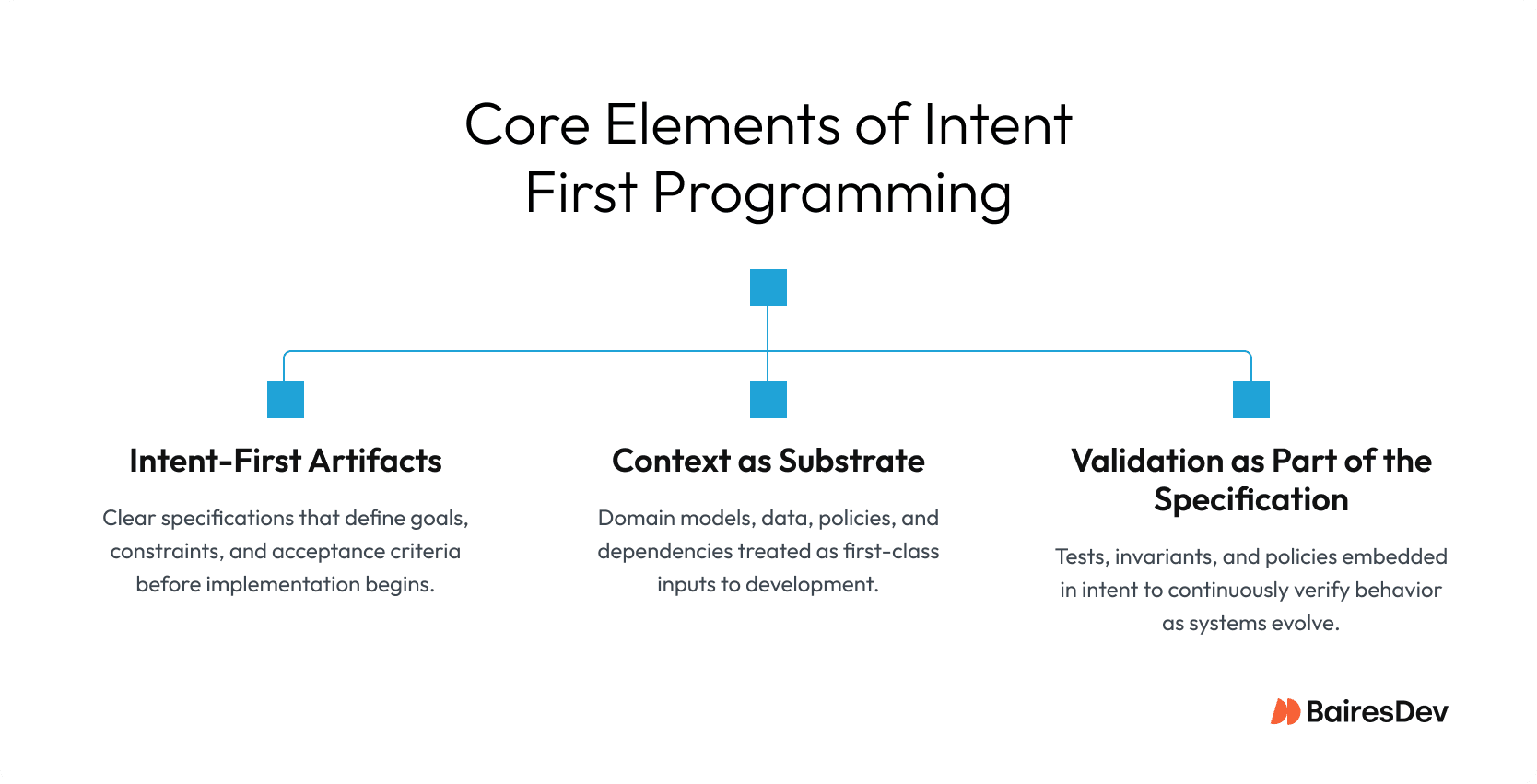
There are three core elements to this shift:
- Intent-first artifacts
Outcomes are described explicitly as executable specifications, with models of business rules, service level agreements (SLAs), risk policies, and performance budgets that can be evaluated, not merely read. - Context as substrate
Everything that shapes the answer becomes a first-class input. Data dictionaries, domain models, historical decisions, process maps, upstream dependencies, and compliance boundaries are versioned, validated, and reasoned over as part of development. - Validation as part of the specification
Tests are no longer a postscript to coding. Property tests, invariants, and policy-as-checks are woven directly into intent, following every requirement as the system evolves.
In this model, the hard part becomes intent-first artifacts. It forces teams to resolve ambiguity about users, risks, and outcomes before investing in implementation. Teams stop guessing and start engineering intent with discipline.
I’ve seen the cost of skipping this step firsthand. In one case, a team was asked to build an AI-driven supplier score-carding system with a simple requirement: “Score suppliers based on performance.” Performance was assumed to mean on-time delivery. Only later did stakeholders clarify that it also included quality compliance, sustainability ratings, and responsiveness. By then, the system had to be reworked at significant cost. Intent-first engineering forces those questions to surface early—what defines performance, how metrics are weighted, and which trade-offs matter before implementation locks in assumptions.
When you do drop to code, you do so with focus. You are not aiming for cleverness in syntax; you are solving a bounded, well-understood problem with clear acceptance criteria. That is a healthier loop for everyone involved.
2) Java, Python, C# as the “New Assembly”
General-purpose languages will remain indispensable, but for most product builders, they are becoming lower-level tools. They will be reached for only when orchestration, performance, or security demands drop beneath the intent layer. Just as assembly didn’t vanish but specialized, expect the same evolution for mainstream languages.
In practice, day-to-day development settles into three distinct layers of work.
1. The Intent Layer
This is where product leaders, domain experts, and engineers align on what must be true before any implementation begins.
It includes:
- Business narratives: “Why” articulated as machine-checkable constraints.
- Domain DSLs: Lightweight, task-focused languages or schemas that describe processes, data, formulas, and policies unambiguously.
- Executable specifications: Models and tests combined to reflect real-world rules, such as “no label may claim X unless Y” or “a transaction must fail if risk score crosses a threshold.”
2. The Orchestration Layer
This layer turns intent into running systems.
It includes:
- Workflow and integration models: Visual representations of events, approvals, integrations, and execution paths.
- Intelligent tooling: Agentic or pipeline-based systems that scaffold code, generate interfaces, wire integrations, and expose telemetry.
- Cross-cutting capabilities: Observability, access control, and policy enforcement instrumented early and reused across systems.
3. The Systems Layer
This is the specialization tier. A smaller cohort of engineers operates here, implementing and hardening the guts: libraries, frameworks, performance-sensitive paths, memory safety, concurrency, and infrastructure reliability. They extend platforms, repair leaky abstractions, and ensure that “just works” actually does.
If you thrive in the systems layer, your work becomes more critical, not less. But for most teams, the locus of value moves above source code, into intent and orchestration. That is the point. Developers spend less time wrangling glue and more time ensuring outcomes.
3) Communities form around outcomes, not syntax
For a generation, developer communities organized around syntax and frameworks. Language and tool preferences often became proxies for identity, sometimes more cultural than technical. As intent and orchestration move upstream, that organizing principle weakens.
In the next decade, communities begin to form around outcomes: the domains, missions, and constraints teams are accountable for delivering.
Healthcare builders, for example, align around patient safety, throughput, and clinician experience. Their shared artifacts aren’t libraries or frameworks. They are care pathways, risk policies, and evidence chains that demonstrate compliance and outcomes.
Supply chain spec engineers center on traceability, sustainability, and cost. Their shared artifacts are packaging specs, formulation rules, and compliance matrices, not libraries or syntax.
Fintech teams converge around transparency and resilience. Their common language is rules of engagement, portfolio constraints, audit trails, and incident playbooks.
As this shift takes hold, syntax debates narrow while outcome debates expand—and that is healthy. Intent becomes the shared language that allows engineers, domain experts, operations, compliance, and customers to collaborate as peers.
What emerges from this shift is a clear direction of travel: intent moves upstream, orchestration becomes central, and systems expertise concentrates where it matters most. The remaining question is practical rather than philosophical: how these ideas translate into day-to-day delivery. That is where execution models matter, and where choices about autonomy, structure, and control begin to shape real systems.
Before diving into execution details, it helps to ground this shift in a concrete starting point. Below these lines you’ll find an orientation for teams to begin experimenting with intent-first delivery and a Context OS, without treating it as a prescription or a full implementation plan.
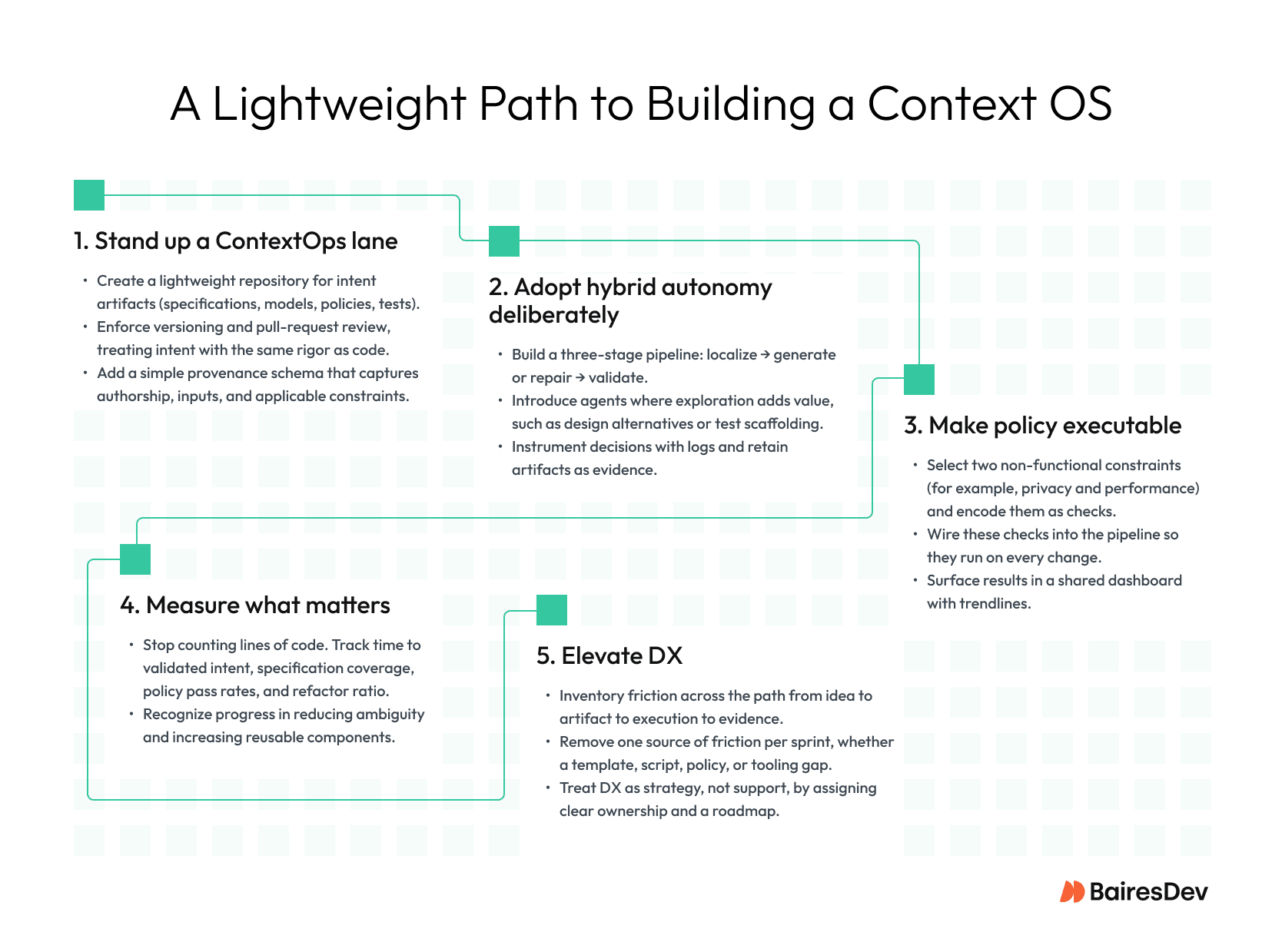
Now that you have a sense of the starting shape, let’s unpack how execution choices actually play out.
4) Agents vs. Pipelines: Clarity over Cleverness
There is a surge of excitement around autonomous agent teams—PM agents, architect agents, coder agents, tester agents—collaborating their way through the software lifecycle. These systems are not a gimmick. They have real value. But cleverness alone does not produce reliable, auditable delivery.
For systems that matter, execution needs a stable spine.
- Pipelines: The backbone of delivery should be composed of interpretable, repeatable stages: localize the issue or outcome, generate or repair, validate, and deploy. Pipelines are testable, cost-controllable, and explainable. When something fails, you know which stage to fix.
- Agents: Insert them where they add unique value. They are well-suited to tasks like exploring design alternatives, simulating cross-role conversations, surfacing trade-offs, or generating scaffolding that accelerates work. Keep their decisions traceable with logs and artifacts human reviewers can follow.
- Hybrid autonomy: Blend pipelines and agents. Pipelines provide structure and determinism; agents provide breadth and creative search. Wrapped together with semantic tests, policies, and telemetry, this hybrid model makes failure modes visible and recovery predictable.
We don’t need lab-grade autonomy everywhere. We need auditable acceleration. The more interpretable your system, the faster it evolves under real-world conditions.
5) Why Developer Experience Becomes the Context OS
Developer experience becomes the Context OS because, when context is the primary substrate of development, DX is what holds intent, execution, and evidence together. The systems that matter most are the ones that make it easy for you to move from what you mean, to what runs, to what can be proven.
I’ve seen this happen repeatedly in practice. In advising multiple companies—and internally as well—teams rarely rely on a single AI tool anymore. They work across several, from Copilot to Claude and others, depending on the task and context. Where the surrounding developer experience is coherent, we’ve seen productivity gains of up to 30% in getting work done. It isn’t because any one tool is magical, but because the system around them reduces friction between intent, execution, and validation.
That path looks like this:
- Intent → Artifacts: Frictionless creation of specifications, models, data dictionaries, risk policies, and service level agreements (SLAs). Templates should encode best practices. Guardrails should surface ambiguity early, while it is still cheap to fix.
- Artifacts → Execution: Orchestration engines turn intent into running systems—UI, workflows, APIs, data pipelines, and integrations—while laying down observability and policy hooks as they go.
- Execution → Evidence: Semantic test suites check properties and behaviors. Runtime traces show why decisions were made. Dashboards surface coverage, risk posture, and drift over time.
The old developer operating system was your editor and compiler. The new one is your Context OS: the end-to-end platform that holds intent, builds systems, and proves outcomes.
The productivity gains here aren’t just about speed. They come from alignment. These will result in fewer “what did we mean?” meetings, fewer post-hoc clarifications, and fewer rewrites due to mismatched expectations.
The real payoff is trust. Executives stop treating engineering as black magic. Compliance stops treating it as a black box. And users feel the difference because features ship faster with fewer surprises.
6) Compliance as a Moat, Not a Burden
Most teams treat governance like paperwork. They collect documents, staple them to a release checklist, and hope audits go smoothly. That mindset guarantees slowness. Worse, it hides risk until late. Treat compliance as design instead, and your speed improves.
Such approach looks like this:
- Provenance as a feature: Track where specifications, data, and decisions come from as part of normal delivery. When someone asks why a system behaved a certain way, the answer is structured evidence like inputs, policies, tests, and traces, not anecdotes.
- Policy as code: Encode non-functional constraints, such as performance, privacy, fairness, safety, and sustainability, as executable checks. They live next to specifications and models, not buried in documents or slide decks.
- Traceability by default: Build delivery paths so that every artifact—intent, model, code, test, and deployment—carries a clear chain of custody. When incidents occur, root cause analysis takes hours instead of weeks.
When governance is woven into your Context OS, compliance stops rewriting plans at the last minute. It becomes a moat (and your differentiation) because customers can see how outcomes are achieved and regulators can inspect how controls are enforced. And teams move faster because expectations are explicit and continuously verified.
What Changes—and What Doesn’t
We are still here to build things that matter. We will simply use a broader palette.
The craft moves from typing perfect loops to framing clear intentions and proving they hold under reality. Code does not disappear, but it stops being the only place where engineering happens. Context becomes the conversation, and code becomes the precision tool we reach for when we must.
The payoff is clear. Delivery gets faster and more confident. Systems become easier to reason about and audit. Fewer expectations are lost between idea and implementation because intent is explicit and continuously validated.
When we stop treating source code as the primary medium, we gain clarity. Clarity of intent, clarity of context, and clarity of evidence. Coding won’t die. It will specialize, and it will be better for it.
Key Takeaways
- Software development is moving from code-first to intent-first. Context and constraints now drive how systems are built.
- Coding becomes a specialization. Most teams operate above the code layer, while systems engineers focus on performance and reliability.
- Engineering communities will organize around outcomes, not languages. Domain context replaces syntax as the common ground.
- AI-assisted development needs structure. Pipelines provide reliability; agents add exploration where it helps.
- Developer platforms are becoming “Context OS.” Systems that link intent, execution, and evidence will define modern software delivery.