



Changing a core outsourcing vendor can feel risky. Leaders worry about disruption, knowledge loss, and operational instability. That fear often pushes organizations to stick with the status quo—even when their current outsourcing provider repeatedly misses deadlines, struggles with quality control, or shows poor alignment with business priorities.
This hesitation is understandable, but it’s often based on misconceptions. A vendor transition doesn’t need to be chaotic or expensive. With the right process, the switch becomes a controlled upgrade to your delivery capability, not a gamble. For engineering leaders facing pressure to increase velocity and efficiency, making the change is often the more responsible business strategy.
Recognizing the Red Flags: When a Switch Makes Sense
No company decides to replace a core outsourcing partner without reason. The decision-making process starts with problems in the current vendor relationship, and those signals are often visible long before executives act.
Industry research confirms that most outsourcing projects begin with cost objectives. According to ISG, cost optimization drives 72% of new managed services contracts. If your vendor is failing to deliver measurable value, efficiency, and cost savings, it may already be failing to meet market expectations.
The most common warning signs include:
- Declining Delivery Velocity: Sprint commitments slip, releases slow down, and the development process feels increasingly sluggish. Instead of accelerating output, the vendor is holding the team back.
- Persistent Quality Issues: A rising volume of bugs, regressions, and technical debt points to weak practices. When in-house employees spend more time on rework than new features, quality control is failing.
- Poor Communication: If your PM is constantly chasing the vendor for updates, that’s a sign of reactive rather than proactive relationship management. Little subject matter expertise or strategic input shows they’re functioning as ticket-takers, not partners.
- Strategic and Cultural Misalignment: A good outsourcing vendor should operate as an extension of your team. If they lack industry expertise, ignore user needs, or misalign with your business goals, they limit innovation and create friction.
- Inability to Scale or Adapt: Your project needs evolve. If the vendor can’t provide talent for new technologies, lacks flexibility, or can’t respond to market shifts, the risk compounds over time.
When these problems repeat, staying put becomes the bigger risk. The total cost—in delayed launches, missed opportunities, and burned-out employees—usually outweighs the perceived disruption of change.
A Four-Phase Framework for a Low-Risk Transition
Once the decision makes sense, the challenge is execution. A chaotic handover can damage confidence and validate every fear executives have about transitions. A structured process, however, makes the move predictable and manageable.
The following four phases form a proven framework for transitioning outsourcing services while maintaining control and continuity.
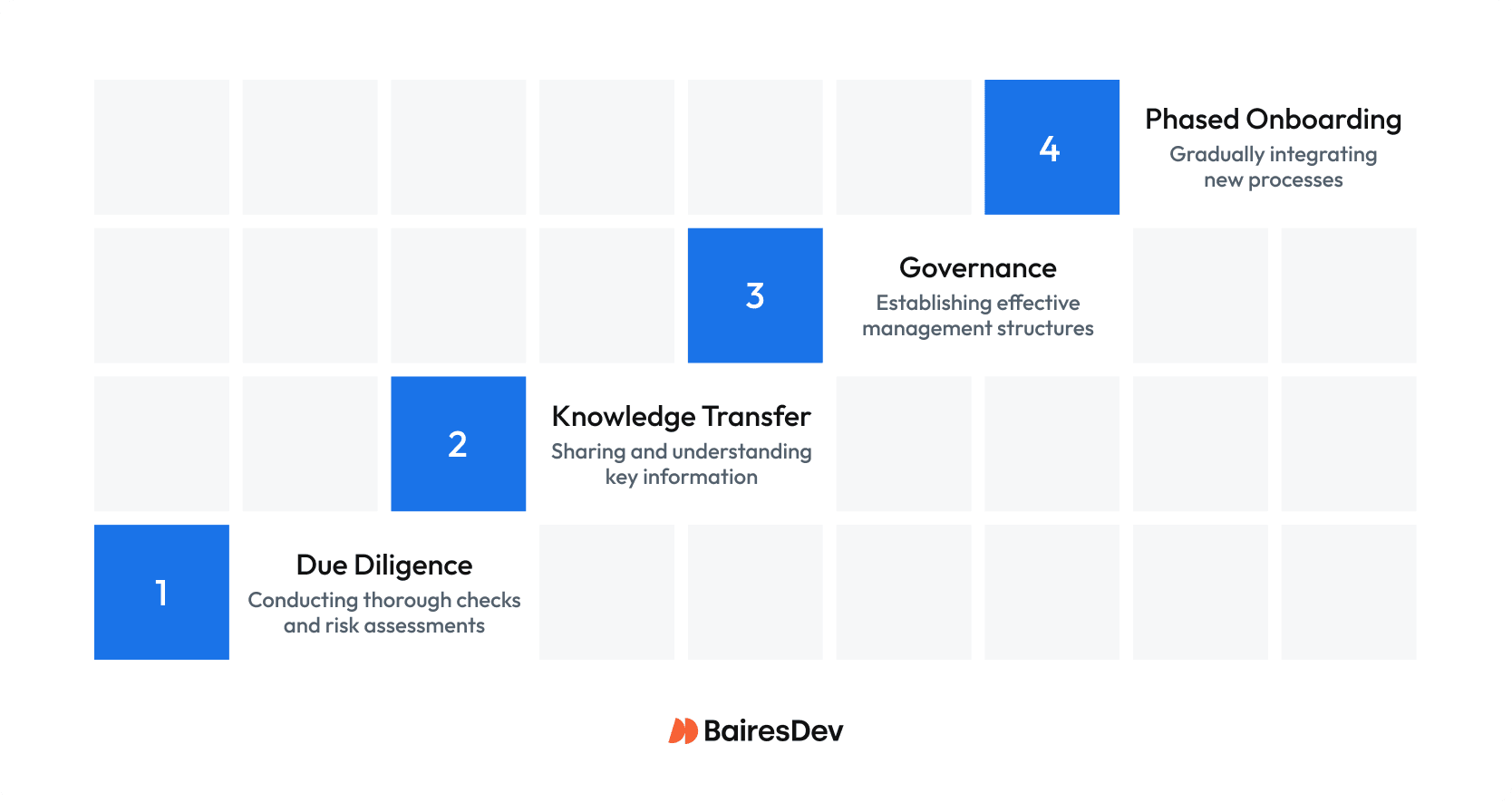
Phase 1: Pre-Transition Due Diligence and Risk Management
Before engaging potential vendors, organizations must secure their own house. This first phase ensures business continuity regardless of how the outgoing vendor responds.
The focus is on control—of code, infrastructure, documentation, and contracts. Without this foundation, every later step carries unnecessary risk.
Key focus areas include:
| Area | Action Item | Why It Matters (Success Metric) |
|---|---|---|
| Code & IP Control | Confirm full administrative access to all repositories (GitHub, GitLab). Audit permissions and remove unnecessary accounts. | You can lock out the previous vendor instantly while maintaining complete IP control. |
| Infrastructure Access | Secure admin credentials for all cloud services (AWS, Azure, GCP), databases, and hosting environments. | Ensures operational continuity. Deployments and changes remain under your company’s control. |
| Documentation | Centralize technical documentation, architecture diagrams, wikis, and notes. | Reduces dependency on the outgoing vendor and accelerates onboarding of the new team. |
| Contractual Review | Examine contracts for clauses around termination, transition support, and IP ownership. Consult legal counsel on NDAs. | Prevents financial or legal surprises and clarifies obligations. |
Failure here can be costly. One cautionary case is Knight Capital Group. In August 2012, the firm deployed new trading-system code that inadvertently reactivated dormant “Power Peg” logic on one of its servers. That server began executing millions of errant trades, causing the company to incur ~$440 million in losses within 45 minutes, deplete its liquidity, and destabilize operations.
The incident highlights transition and deployment risks: lack of uniform deployment across servers, reusing deprecated code without adequate safeguards, absence of a kill switch or rollback protocol, and weak oversight of automated processes.
Phase 2: Discovery and Knowledge Transfer
With assets secured, the next step is preparing the incoming outsourcing vendor. This phase focuses on knowledge transfer—ensuring the new vendor understands the current system, project specifications, and user requirements before taking ownership.
Some organizations call this the “system review” stage. It’s a mix of documentation analysis, technical deep dives, and backlog preparation.
Key activities include:
- Documentation & Requirements Review: The new team, led by technical leads and a project manager, reviews the documentation gathered in Phase 1. They clarify project needs, strategic goals, and specific requirements with internal stakeholders.
- Technical Assessment: Engineers conduct a read-only review of repositories, infrastructure, CI/CD pipelines, and system architecture. This identifies undocumented dependencies, security gaps, and opportunities for efficiency.
- CI/CD Validation: The new vendor often replicates or builds a parallel CI/CD pipeline. This ensures they can deploy independently and establishes modern agile methodology practices early.
- Backlog Definition: The team works with your product owner to prioritize an initial backlog, covering urgent fixes, technical improvements, and near-term features. This prepares them to deliver value immediately after handover.
This phase provides confidence that the new outsourcing partner has the right expertise and alignment to begin active development.
Phase 3: Governance and Relationship Management
Even with technical preparation, outsourcing services fail without strong governance. Phase 3 establishes the operating model—how the new vendor relationship will be managed day to day and over the long term.
Best practices include:
- Defined Roles: Assign clear points of contact on both sides. The vendor should provide a PM for daily oversight and a delivery lead for escalation. Your organization should designate an internal owner to maintain accountability.
- Regular Communication: Set a cadence for stand-ups, sprint reviews, and executive check-ins. Early on, over-communication is better than silence.
- KPIs and SLAs: Agree on service level agreements and measurable success metrics. These might include delivery velocity, defect rates, uptime, or deployment frequency.
- Escalation Pathways: Establish clear procedures for resolving issues quickly.
While some outsourcing companies bring their own layered management structure (delivery managers, technical managers, account directors), what matters is accountability. Governance isn’t bureaucracy; it’s the mechanism that ensures the development process stays aligned with business goals.
Phase 4: Phased Onboarding with a Crawl-Walk-Run Approach
Vendor transitions rarely succeed when done overnight. A phased approach reduces risk and ensures the new outsourcing vendor is ready to operate independently.
A proven model is Crawl-Walk-Run:
| Stage | Approach | Purpose |
|---|---|---|
| Crawl | New vendor shadows the outgoing team, gaining visibility into infrastructure, reports, and workflows. | Knowledge absorption without disruption. |
| Walk | New team takes ownership of a low-risk component or feature, testing their pipeline and practices. | Validates competence in a controlled scope. |
| Run | After demonstrating readiness, the new vendor assumes full responsibility. Outgoing vendor is offboarded. | Seamless transition with minimized risk. |
This staged process allows leadership to manage costs, control overlap, and protect continuity. Short-term duplication of services should be seen as insurance against failure, not waste.
Turning Risk Into Advantage
Switching outsourcing vendors isn’t easy, but it doesn’t have to be reckless. With structured due diligence, clear governance, and phased onboarding, many organizations find the transition strengthens—not weakens—their delivery capability.
For engineering leaders, the key principle is ownership. Development tasks can be delegated, but accountability for product vision and business outcomes cannot. Retaining that responsibility while bringing in the right outsourcing vendor turns a perceived risk into a long-term strategic advantage.
Ultimately, the benefits of outsourcing are unlocked when the right partner is in place: faster velocity, stronger quality control, flexibility to scale, and cost-effective growth. The short-term effort of transition pays off when the company regains control of its roadmap and establishes a vendor relationship that supports—not hinders—its business strategy.