



Outsourcing isn’t just about cost arbitrage anymore. If you still treat it purely as a rate play, you’ll miss most of its value. That’s the old playbook.
Today, successful teams use software outsourcing services to solve a physics problem: Velocity vs. Capacity.
Let’s assume you have a roadmap that requires 20 engineers. You have the budget for 15. You can spend six months recruiting the gap, or you can plug in an outsourcing partner to close the distance immediately.
Done right, this isn’t “sending work away” to the lowest bidder. It is acquiring a high-velocity software development team that operates as a seamless extension of your own culture and stack.
What Is Software Development Outsourcing?
Outsourcing is not about extra hands or affordable rates. It’s about adding velocity. If you’re using outsourced software development services to clear a backlog of low-value tickets, you are missing out.
In a modern context, outsourcing is the strategic acquisition of a complete engineering capability. It is the practice of integrating an external software engineering unit that operates with the same rigor, tooling, and architectural standards as your internal core team.
When done right, this isn’t about “contracting.” It is about plugging in a high-performance module to handle complex work streams:
- Core Product Engineering: Designing and building custom software solutions that drive revenue, not just internal tools.
- Integrated Quality: Moving beyond manual testing to build automated suites and CI/CD pipelines that define your delivery standards.
- Scalable Architecture: Ensuring the outsourced team doesn’t just write code, but manages the infrastructure-as-code and security protocols required for enterprise scale.
The magic happens when the external team takes ownership of the outcome, adhering to your security protocols, signing strict IP assignments, and challenging your architectural assumptions to build a better product.
The Triggers: When to Pull the Outsourcing Lever
Hiring is slow, but roadmaps are fast. The math rarely works out in your favor.
Most CTOs don’t start projects with the intention of outsourcing. They end up there because internal recruiting creates a bottleneck that threatens project success.
You usually hit this decision point in one of three scenarios:
The “Keep the Lights On” Trap
Your internal team is bogged down with maintenance and bug fixes. They are bored and threatening to leave. You need to free them up for high-value R&D.
- The Play: Use an outsourced team to handle maintenance and sustaining engineering. This improves retention for your in-house staff and ensures responsibilities are met on legacy systems.
The Skill Gap
You need to migrate to a microservices architecture or implement a blockchain component, but you don’t have that technical expertise in-house. Hiring a full-time specialist for a six-month initiative is bad math.
- The Play: Leverage specialized skills from a partner. You get the expert for the duration of the build, then scale down without severance packages or HR headaches.
The Velocity Spike
You have a hard deadline—a conference launch, a board commitment, or a competitive threat. You need to double your software development team for three quarters, but you cannot justify the permanent headcount (CapEx) to the CFO.
- The Play: Shift to OpEx. Use staff augmentation or a dedicated team to burst capacity. You get the operational efficiency of a larger team without the long-term liability.
Engagement Models: Defining Accountability
The delivery model answers “where,” but the engagement model answers “how.” Getting this wrong is the primary reason outsourcing relationships fail. You need to decide exactly how much management overhead you want to retain versus how much accountability you want to transfer to the partner.
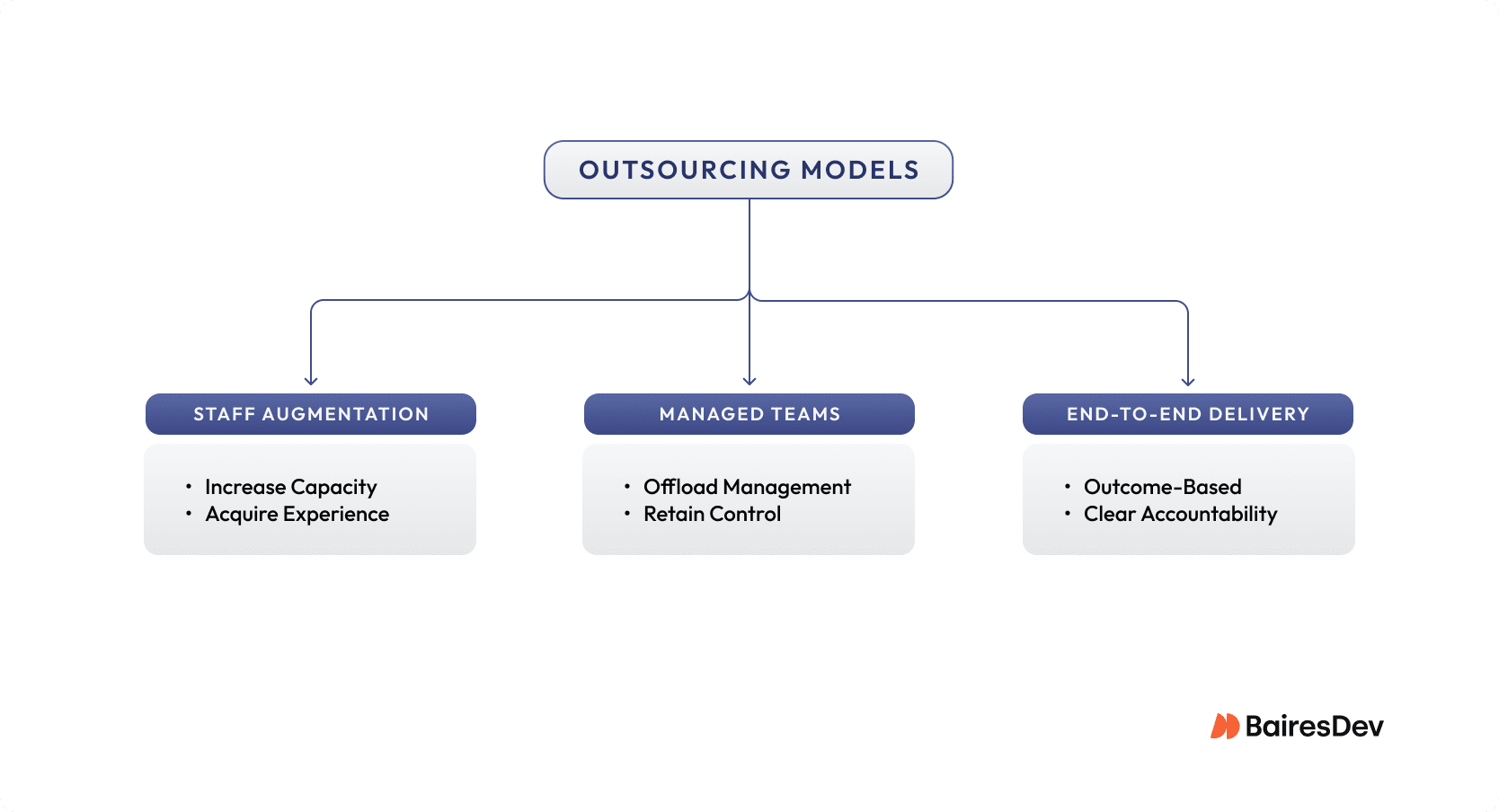
Team Extension (Staff Augmentation)
This is the lightest model. You add external engineers directly into your existing squads to increase capacity or acquire specific technical expertise. They join your ceremonies, use your tools, and report to your engineering leaders.
This works best when your internal operating model is already solid, your roadmap is clear, and you simply need more senior hands to execute. If your internal teams are already stretched thin on leadership or process, pure staff augmentation might amplify that constraint — in those cases, a Managed Team or Delivery Team model is a safer choice.
Managed Teams
Delegate the delivery, keep the direction. Here, the outsourcing partner provides a cohesive unit—including a lead and a Scrum Master—that owns a specific stream of work. They are accountable for the output quality and day-to-day delivery, while you define the priorities and outcomes. This is the ideal model when you want to offload the line management and coordination burden for a product area while retaining control over the strategic direction.
End-to-End Delivery Teams
Outcome-based execution. This is a full handoff of a custom software development project or product line. The partner covers everything from product management and architecture to QA and DevOps for a defined scope. You govern through milestones and acceptance criteria, but you do not run the team. This model is highly effective for bounded initiatives, spin-off products, or modernization projects where you need clear accountability without distracting your core internal teams.
| Feature | Staff Augmentation | Managed Team | End-to-End Delivery Team |
| Primary Driver | Speed / Capacity Gap | Scale / Product Roadmap | Outcome / Specific Scope |
| Management Overhead | High (You manage them) | Low (Partner manages) | Minimal (Governance only) |
| Delivery Risk | Client (You own the fail) | Shared | Partner (Vendor owns the fail) |
| Knowledge Retention | Low (Transient) | High (Long-term context) | Medium (Shared repos, transition plans) |
| Cost Structure | Time & Materials | Monthly Retainer | Fixed Price or Time & Materials |
| Best For… | “We need 3 Java devs now.” | “We need to build this product for 2 years.” | “We need an MVP by Q3.” |
The Hybrid Reality
In practice, mature organizations rarely pick just one. You might use Team Extension to bolster your core platform team while simultaneously using a Managed Team to build a new mobile app. The goal isn’t to pick a “favorite” model, but to map the right engagement structure to the specific risk profile of each work stream.
Delivery Models: The Physics of Collaboration
The delivery model isn’t just about geography or cost. It is also about the physics of communication. If you optimize solely for the lowest hourly rate, you often pay it back in communication latency and delayed cycle times. Most organizations eventually settle on a mix of three standard models, but the choice should always come down to how much real-time interaction your architecture requires.
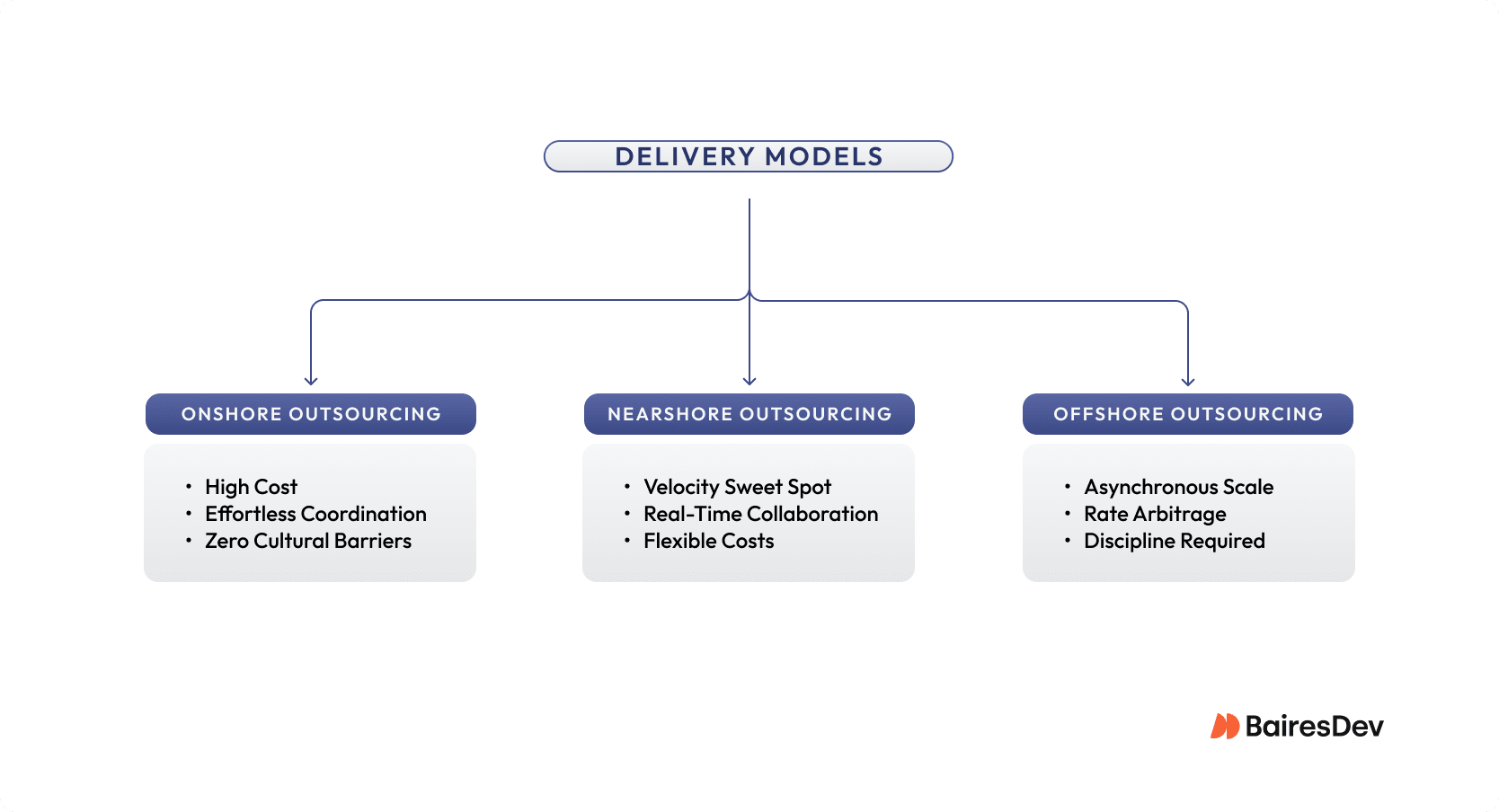
Onshore Outsourcing: High Bandwidth, High Cost.
This keeps the external team in your home country or time zone. It is the most expensive option, but coordination is effortless. There are zero cultural barriers and fewer concerns regarding regulatory complexity. Use this model for highly sensitive domains or early-stage discovery work where the communication overhead of a remote team is a bigger risk than the budget.
Nearshore Outsourcing: The Velocity Sweet Spot.
Nearshore outsourcing places teams in neighboring time zones (e.g., Latin America for US companies, or Eastern Europe for Western Europe). The goal is simple: real-time collaboration. A dedicated team in a compatible time zone can pair program, attend stand-ups, and debate architecture during your working day. It offers the best balance of a broader talent pool and flexible costs without sacrificing the synchronous communication required for complex, high-velocity product development.
Offshore Outsourcing: Asynchronous scale
Offshore outsourcing pushes work to distant time zones, usually leveraging significant rate arbitrage. This makes sense for well-defined, steady-state work where requirements are static and documentation is robust. However, it requires extreme discipline around handoffs and specifications. If your process relies on tacit knowledge or frequent iteration, the time zone gap will introduce delays. Use this for maintenance or isolated modules, not for core product innovation.
| Factor | Onshore (US/EU) |
Nearshore (LATAM/Eastern Europe) | Offshore (Asia) |
| Hourly Cost | $$$$ (Premium) | $$ (Optimized) | $ (Lowest) |
| Time Zone Overlap | 100% (Real-time) | 80–100% (Real-time) | 0–20% (Asynchronous) |
| Communication Lag | None | None | High (24h feedback loop) |
| Cultural Proximity | Identical | High | Variable |
| Ideal Use Case | Security-critical / IP-heavy discovery | Core Product Engineering / Agile | Maintenance / Isolated Tickets |
Cost Structure Overview: The “Hourly Rate” Trap
The most expensive engineer on your payroll is the one you have to correct every morning.
When leaders evaluate software development outsourcing, they often make a fatal error: they obsess over the hourly rate card. But in software engineering, the rate is a vanity metric. The only metric that matters is Total Cost of Ownership (TCO) per delivered feature.
If you hire a $30/hour developer who takes three weeks to ship a buggy feature, you haven’t saved money. You have burned time, incurred development costs in management overhead, and created future technical debt.
The Geography of Value: Why Nearshore Wins
Cost drivers are usually a function of seniority and location. This creates three distinct tiers of value:
- The “Cheap” Trap (Traditional Offshore): Rates in South Asia or far-flung time zones are seductive on paper. However, they often come with a “hidden tax”—the lag time of asynchronous communication and the management overhead required to bridge cultural or context gaps. If your senior leaders spend their mornings re-explaining requirements, those operational costs obliterate your savings.
- The “Premium” Burden (Onshore US/Western Europe): Keeping teams local guarantees alignment, but it caps your scalability. You are paying top-tier market rates for capacity that doesn’t always require physical proximity.
- The Strategic Sweet Spot (Nearshore): This is where the math works best. Nearshore outsourcing offers cost efficiency without the quality or communication penalty. You get senior engineers in your time zone—capable of real-time collaboration and architectural autonomy—at a rate that makes scaling a dedicated team financially viable. You are paying for high-quality software development and velocity, not just “hours.”
Pricing Models: Aligning Incentives
Most engagements fall into one of three buckets. Choosing the right one is critical to cost control.
- Time and Materials (T&M): The standard for Agile development. You pay for the effort spent. It is flexible and honest.
- Dedicated Team (Retainer): The best model for long-term value. You pay a monthly flat rate for a set capacity. This creates stability for the partner (allowing them to assign their best talent) and predictable forecasting for you.
- Fixed Price: Beware of this model for complex products. It incentivizes the vendor to do the bare minimum to meet the contract, rather than the best thing for the user. Use this only for small, rigid, well-defined scopes.
The Real ROI Calculation
When calculating cost savings, don’t look at the salary difference. Look at the opportunity cost.
- How much is it costing you to not have this product in the market?
- What is the cost of your internal team’s burnout?
- What is the risk of delaying your roadmap by six months to hire locally?
The real comparison isn’t “Hourly Rate vs. Internal Salary.” It is “The cost of getting it done now with a partner who creates no friction, vs. the cost of waiting.” In that equation, the nearshore model usually emerges as the highest-value option.
| Scenario | Recommended Model | Why? |
| Scenario A: Internal team is burning out, backlog is growing. | Staff Augmentation | Immediate relief. Plugs directly into existing rituals. No ramp-up time on process. |
| Scenario B: You have a roadmap for a new module but no internal team to own it. | Managed Dedicated Team | You buy a “pod” (Devs + QA + Lead). They own the delivery, you keep strategic control. |
| Scenario C: You have a fixed-budget legacy migration project. | End-to-End (Project) | Caps the cost. Moves the distraction off your core team’s plate. Outcome is clear. |
The Final Verdict: Optimization over Arbitrage
Ultimately, the decision to outsource is about acknowledging the reality of the market. If your competitors are shipping features while you are still screening resumes, you are falling behind.
Speed matters, but so does quality. Don’t fall into the trap of optimizing for the lowest hourly rate. That is a race to the bottom that ends in technical debt and communication breakdown. The goal is to find a partner that offers the efficiency of an external team with the engineering rigor of an internal one.
When you find the right outsourcing partner that challenges your specs and assumptions, and cares as much about the release as you do, lock them down.