



The default question in enterprise AI has been “which LLM?” For many production workloads, the better answer is a small language model running on internal infrastructure. This guide explains where SLMs belong in your stack and how they coexist with larger models.
Key Points
- SLMs can run on on‑prem infrastructure or edge devices, removing the massive GPU requirements of LLMs.
- They train and run inference on internal data, keeping sensitive information inside your perimeter.
- Narrow scope delivers more deterministic outputs and lower hallucination risk.
- The optimal pattern uses SLMs for routine tasks and routes ambiguous cases to a central LLM, balancing capability and cost.
The industry spotlight still tilts toward massive LLMs, but smaller models change the economics. Large language models (LLMs) with hundreds of billions of parameters attract the spotlight, and swallow most of the available GPU capacity.
Small language models (SLMs) give you another path. They trade raw size for fit, opting for smaller models, narrower training data, and behavior tuned for specific tasks and domains.
In many real-world applications, focus matters more than having a model trained on a broad range of internet text.
What Are Small Language Models?
A small language model is a compact AI trained for a constrained set of tasks using high-quality, domain-specific data from your own systems. Compared to LLMs, SLMs use far fewer parameters (millions to low billions), require much less compute, and deliver more predictable results within their focused domains. Fine-tuning and knowledge distillation let them often outperform expectations on specialized work.
Enterprise Use Cases
In enterprise settings, precision and control often matter more than raw power. Small language models bring both, fitting neatly into regulated, data-sensitive environments.
Healthcare: Efficiency Without Compromise
Healthcare already relies on language models: clinical notes, triage forms, discharge summaries, and complex reasoning surrounding symptoms and treatments. A large language model can handle medical text, but you pay for capabilities far beyond your use case and assume greater privacy risk.
With a healthcare-specific small language model, you can deploy a smaller model on hospital infrastructure, trained only on your electronic health records, internal guidelines, and approved medical literature.
That model supports triage and intake, generates structured summaries, and flags missing information. You shorten appointment time while improving documentation quality, and you do it using less computational power than a typical LLM deployment.
Education: Scalable, Inclusive Academic Support
The education sector faces persistent staffing shortages and unequal access to support resources. SLMs address these gaps through narrowly trained models that handle routine academic tasks while keeping data secure.
AI-Powered Tutors
SLMs can be trained on curriculum-specific content to deliver personalized tutoring experiences aligned with school standards. This empowers students who lack access to human tutors and supports those catching up after absences.
Automated Grading Assistants
SLMs offer efficient grading support for standardized subjects. Constrained data boundaries improve consistency and fairness, and unlike human graders, they don’t fatigue or drift over time.
NGOs and Nonprofits: Scaling Impact, Not Infrastructure
Nonprofits often lack the budget or technical staff to deploy advanced AI. Yet their work, from crisis response to donor engagement, can benefit greatly from automation. SLMs offer a middle ground between functionality and feasibility.
Volunteer and Support Line Augmentation
NGOs operating dispatch lines or volunteer coordination networks face unpredictability in call volume and staff availability. An SLM trained on logistical protocols, resource directories, and disaster response documentation can step in to parse incoming requests and route them to the correct field teams, ensuring operational continuity without bottlenecking human coordinators.
Donor and Fundraising Operations
Fundraising requires constant outreach, reporting, and relationship management, tasks well-suited to automation. SLMs can handle donor segmentation, communications, and event follow-ups using the organization’s existing CRM and donor data. For smaller teams, this means increased engagement capacity without adding headcount.
Just as importantly, donor data stays internal. With no need to transmit sensitive information to external AI APIs, SLMs enhance security posture and reassure compliance-conscious funders.
SLM vs LLM: A Strategic Comparison
The differences show up clearly when you compare scope, compute, and governance side by side.
| Feature | Large Language Models (LLMs) | Small Language Models (SLMs) |
|---|---|---|
| Scope | General-purpose, broad knowledge | Task-specific, domain-focused |
| Compute Requirements | High (cloud-intensive, GPU-dependent) | Low (edge or lightweight infrastructure) |
| Data Privacy | Risk of external API data exposure | Often runs on-prem or with minimal data sharing |
| Response Governance | Prone to hallucination, less predictable | Deterministic within narrow bounds |
| Cost Efficiency | Expensive to run and scale | More affordable for narrow applications |
| Security Footprint | Broad attack surface | Easier to audit and secure |
For many enterprise functions, the trade-off is clear: where precision, predictability, and internal data governance matter more than breadth, SLMs win.
Implementation Considerations
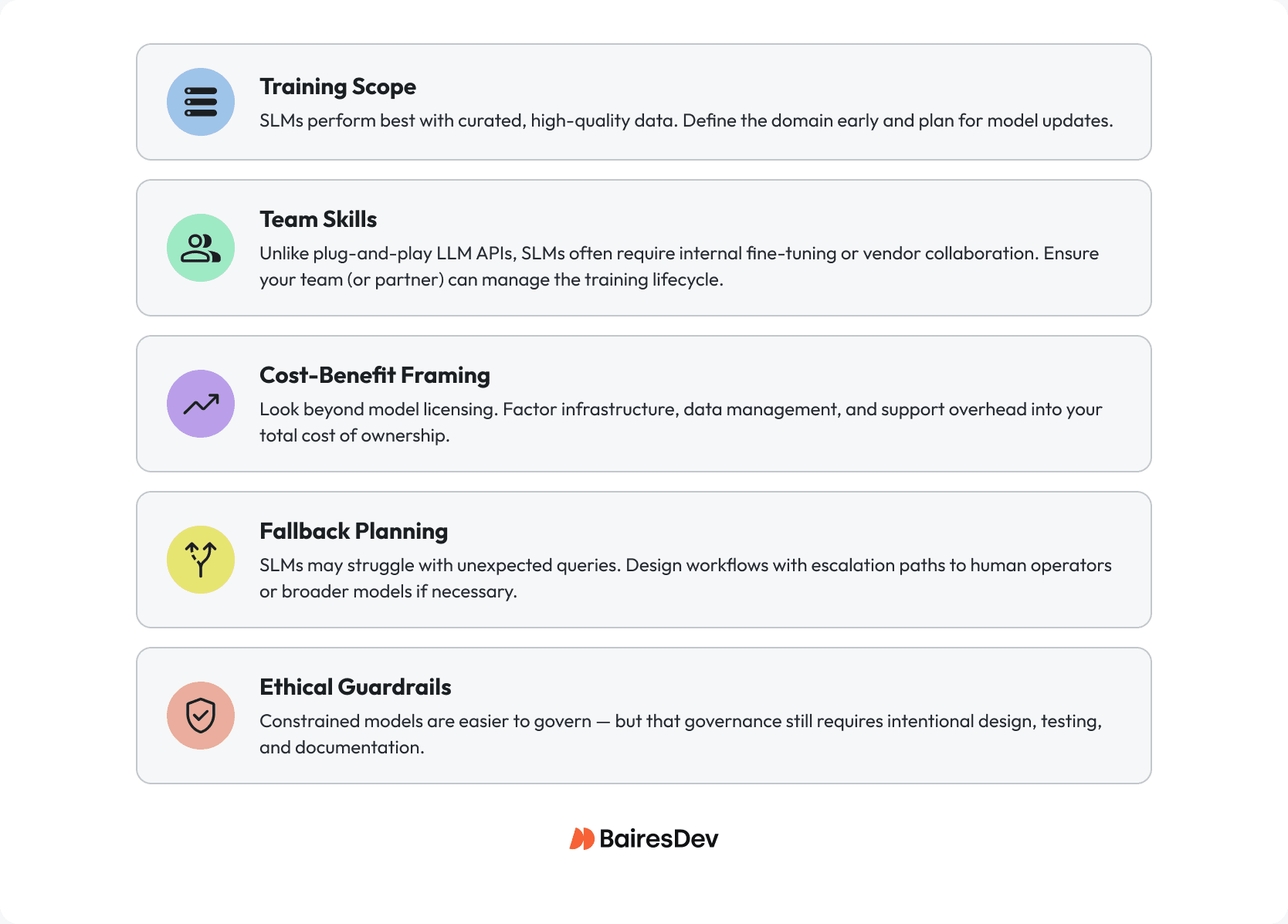
Deploying SLMs successfully requires alignment across technical, operational, and governance functions. While evaluating adoption, you should consider:
The Case for Specialized AI
Small language models won’t replace LLMs, since they complement them. For many day-to-day enterprise workloads, SLMS are the better fit: more controllable, more affordable, and easier to align with your data, compliance, and infrastructure constraints.
The strongest AI strategies deliberately use both models where each delivers the most value. In a crowded market, the real decision isn’t “AI or not,” but which language model belongs in your stack. Often, the smartest choice is the smaller, focused one.