



The Fourth Industrial Revolution (4IR) is upon us, and it’s no longer theoretical. 4IR is actively redefining how organizations design, build, and deliver products.
For engineering leaders under pressure to close talent gaps and accelerate delivery, the implications are profound. What makes this moment unique isn’t just the speed of technological innovation but the way multiple new technologies, such as artificial intelligence, cyber physical systems, and quantum computing, are converging to reshape global supply chains and the job market.
This article summarizes the evolution of industrial revolutions. We also examine the technologies driving today’s mammoth transformations from a business perspective.
From Steam Engines to Smart Factories: Tracing the Industrial Revolutions
Every industrial revolution has shifted the way people work and the ways companies create value. The First Industrial Revolution was powered by the steam engine, which replaced manual labor with mechanized factory systems and pulled workers into growing cities.
The Second Industrial Revolution brought electricity and the assembly line, making mass production possible and driving global trade to new heights.
The digital revolution was the Third Industrial Revolution. It gave us computing power, software, and the internet, transforming how businesses operated and how people connected.
The Fourth Industrial Revolution builds on its predecessors but moves faster and reaches deeper. What sets it apart isn’t just another breakthrough, but the fusion of digital, physical, and even biological worlds. For example, smart factories combine IoT sensors with AI-driven analytics to make decisions that previously required teams of people. The result is a step change in industrial processes—greater efficiency, new capabilities, and new pressures on leaders to adapt.
Timeline of Industrial Revolutions
| Revolution | Era | Key Technologies | Impact |
| First | 1760s–1840s | Steam engine, mechanization | Factory systems, urbanization |
| Second | 1870s–1910s | Electricity, assembly lines | Mass production, global trade |
| Third | 1960s–2000s | Computers, digital tech | Automation, digital revolution, internet |
| Fourth | 2010s–present | AI, IoT, quantum, cyber physical systems | Smart factories, digital transformation, new markets |
Key Drivers of the Fourth Industrial Revolution
Emerging Technology Breakthroughs
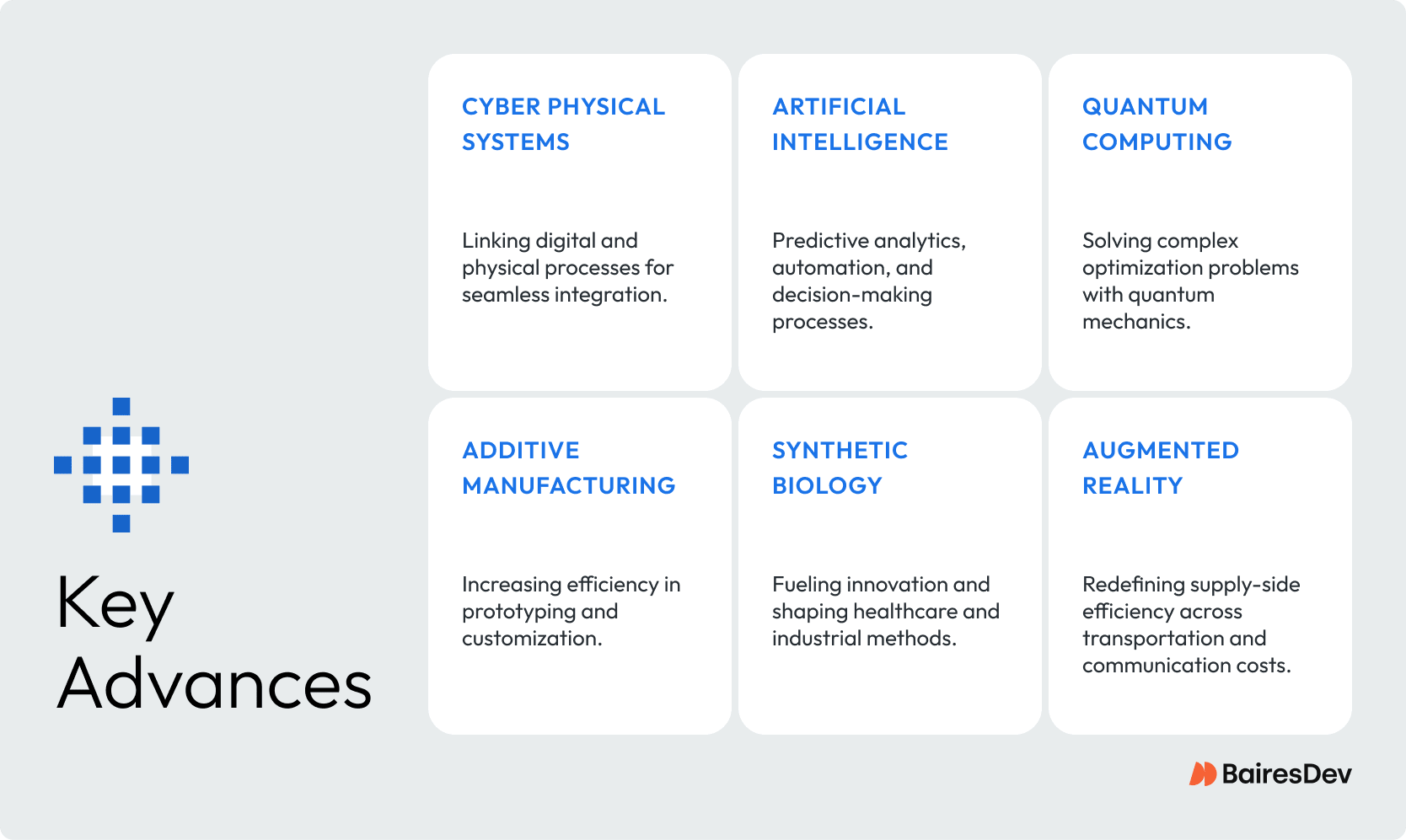
The Fourth Industrial Revolution is powered by emerging technology breakthroughs that are altering industrial production and disrupting labor markets. Key advances include:
- Cyber physical systems linking digital and physical processes
- Artificial intelligence for predictive analytics, automation, and decision making processes
- Quantum computing for solving complex optimization problems
- Additive manufacturing to increase efficiency in prototyping and customization
- Synthetic biology and materials science fueling innovation and shaping healthcare and industrial methods
- Augmented reality and autonomous vehicles redefining supply-side efficiency across transportation and communication costs
Each innovation is powerful, but together they represent a technological revolution that will change how you operate. According to McKinsey, Industry 4.0 could generate $3.7 trillion in economic value for manufacturers and suppliers by 2025, yet fewer than a third of organizations are capturing that value at scale.
Digital Infrastructure as the Foundation
Cloud computing, mobile devices, and the industrial internet reinforce transformation. According to the World Economic Forum, these digital technologies and infrastructure are essential to drive economic growth and encourage innovation.
Investments in digital technology and infrastructure allow companies to:
- Scale artificial intelligence across business models
- Enable real-time decision making processes
- Encourage innovation with smart factories and autonomous systems
- Unlock new markets through digital-first channels
But to scale advanced technologies, enterprises must invest in storage capacity, connectivity, and processing power. Engineering leaders must treat these technologies and infrastructure as core business priorities, not just technical details.
Implications for Engineering Teams
Talent Gaps and Skill Shifts
The Fourth Industrial Revolution is reshaping the labor landscape by creating demand for digital skills that far outpaces supply. You and your executive peers face dual challenges: retaining experienced engineers while developing new skills in emerging areas.
Examples of shifting needs include:
- Expertise in integrating AI models into digital tech stacks
- Cloud-native architecture and DevOps fluency for continuous delivery
- Cybersecurity capabilities in increasingly automated cyber physical systems
- Applied knowledge in augmented reality, synthetic biology, and energy storage
Gartner believes that 70% of industrial manufacturers may face serious challenges filling advanced technical roles—unless they turn to external partners. For engineering leaders, this isn’t just a hiring issue. It’s a strategic bottleneck that threatens delivery velocity and long-term competitiveness.
Outsourcing as a Strategic Lever
Outsourcing in the context of 4IR is about accelerating delivery, bridging talent and skills gaps, and enabling innovation to shape the next wave of digital transformation. Engineering leaders evaluating outsourcing partners typically ask:
- Speed: Can you onboard senior engineers in days—not months?
- Reliability: Are your engineers full-time, vetted, and experienced in large-scale industrial systems and processes?
- Integration ease: Will you act as full-time team extensions, not freelancers with split focus?
- Risk management: Do your engagement terms include SLAs, delivery accountability, and governance protocols?
- Long-term value: Can you support innovation and resilience, not just project-by-project execution?
Outsourcing Decision Factors for Engineering Leaders
| Decision Factor | Why It Matters |
| Speed | Roadmaps can’t wait for 3-month hiring cycles |
| Reliability | Senior engineers reduce onboarding friction |
| Integration Ease | Full-time extensions outperform freelancers |
| Risk Management | SLAs, governance, and delivery guarantees reduce potential peril |
| Long-Term Value | Retention and continuity sustain long-term returns |
In the context of 4IR, outsourcing becomes a strategic lever to drive innovation. By tapping into external expertise, you can maintain resilience even as labor and workforce disparities widen across markets and regions.
Business Models and Delivery Velocity
Rethinking How Value Is Created
The Fourth Industrial Revolution is not only about technology adoption—it’s about shifting operational frameworks. Platform ecosystems, subscription services, and AI-driven personalization are replacing traditional value creation approaches.
Implications for engineering leaders include:
- Shorter release cycles through increasing automation
- Greater integration with third-party ecosystems
- Higher reliance on data infrastructure and analytics for customer expectations
- Demand for transparency and personalization across digital-first markets
Meeting Executive Expectations
Technology adoption is never the end goal—results are. Senior executives care about whether a team can deliver faster, operate at lower cost, and support growth. That puts engineering leaders in the position of translating new technologies into business impact.
The expectations are straightforward but demanding: shorten release cycles, improve reliability, and support new markets. Doing this requires more than just tools; it takes teams that can adapt quickly and partners who can deliver at scale. Executives don’t want to hear that quantum computing pilots are promising—they want to see how automation can cut testing cycles in half this quarter. They don’t want theoretical benefits of IoT—they want measurable improvements in customer experience and operations.
The leaders who succeed are the ones who keep their eyes on outcomes, not just the technology itself.
Risks, Governance, and Resilience in a Fourth Industrial World
Managing Systems Impact
Every industrial revolution has created both long-term returns and gains and near-term disruption. The Fourth Industrial Revolution, with its interconnected physical worlds and digital technology, multiplies the systemic impacts for you to consider:
- How are you managing data governance across digital and physical processes?
- Are your teams aligned with GDPR, CCPA, and industry-specific compliance mandates?
- Have you considered the ethical implications of artificial intelligence and synthetic biology in your operations?
- Is your infrastructure prepared for the security demands of industrial internet platforms and connected devices?
Building for Resilience
The Fourth Industrial Revolution introduces new risks alongside new opportunities. More automation and interconnected systems mean failures can cascade faster, and recovery becomes more complex. You can’t assume stability—you need to design for volatility.
Resilience in this context means having systems and teams that bend without breaking. Modular architectures that can be updated or swapped out without taking everything offline. Cloud-based infrastructure that scales up under load instead of collapsing. Vendor relationships that ensure continuity even if one provider stumbles.
This isn’t just about disaster recovery. It’s about building organizations that can evolve as new technologies mature, regulations shift, and customer expectations rise. Those who invest in resilience today are better positioned to capture long-term gains while competitors struggle to keep up.
Leading Through the Fourth Industrial Revolution
The Fourth Industrial Revolution isn’t just a technological revolution—it’s a leadership test. Decision makers who succeed will be those who:
- Align digital transformation with the organization’s operating framework
- Build teams that adapt, learn, and reskill at pace with emerging technology breakthroughs
- Choose partners that reduce risk while accelerating delivery velocity
- Balance innovation shaping with governance, compliance, and resilience
This is not a distant future. The Fourth Industrial Revolution is already reshaping job markets, industrial methods and processes, and customer expectations. The question for engineering leaders isn’t whether to engage—it’s how to lead responsibly while driving economic value.