


Key Points
- Angular (v2 and later) and AngularJS (1.x) are two different products. AngularJS reached end of life on December 31, 2021, and no longer receives security updates, while Angular is actively developed at angular.dev.
- Angular 22, released June 3, 2026, is the signal-first release. Signals are the core reactivity model, zoneless change detection is the default, and standalone components have replaced NgModules.
- Angular’s business value comes from enterprise structure, strong typing, Google backing, and long-term maintainability. Overall popularity is a different story: React remains the clear leader there.
Most businesses today run on web applications, whether that means a customer portal, an internal dashboard, an e-commerce platform, or a combination of all three. Choosing the right framework to build and maintain those applications is a long-term decision that affects developer productivity, development time, and your ability to deploy Angular applications safely into production environments.
If you’ve finally decided to take the plunge into the world of mobile and web applications, Angular may be the right call. This guide covers what Angular actually offers businesses in its most current version and where it fits best.
Angular Framework
Angular is an open-source, TypeScript-based web application framework maintained by Google at angular.dev. It is a complete rewrite of the original AngularJS (1.x) and is used to build single-page applications, progressive web applications, mobile applications, and cross-platform interfaces using a component-based, modular architecture.
Each Angular component bundles its HTML template, CSS styles, and TypeScript logic into one self-contained unit that handles a specific piece of the user interface. The framework includes routing, form handling, an HTTP client, dependency injection, and a command-line interface (the Angular CLI), all without requiring third-party packages.
Angular Material extends this with a library of accessible, responsive design components ready for use in any new Angular app.
The Angular ecosystem covers everything a large team needs for web development out of the box: routing, state management, testing tools, lazy loading, server-side rendering, and ahead-of-time (AOT) compilation.
Angular Components
The building blocks of every Angular application are component classes. Each component class handles business logic and application data, while an HTML template controls the user interface, and property binding connects the two.
Angular’s modular architecture is structured around these components. Historically, this used a Model-View-Controller (MVC) pattern, though modern Angular has moved to a component hierarchy instead. The MVC model is described here for context:
- Model: manages application data and business logic.
- View: the HTML template that renders the user interface.
- Controller: the layer that handles user input and connects the view to the model.
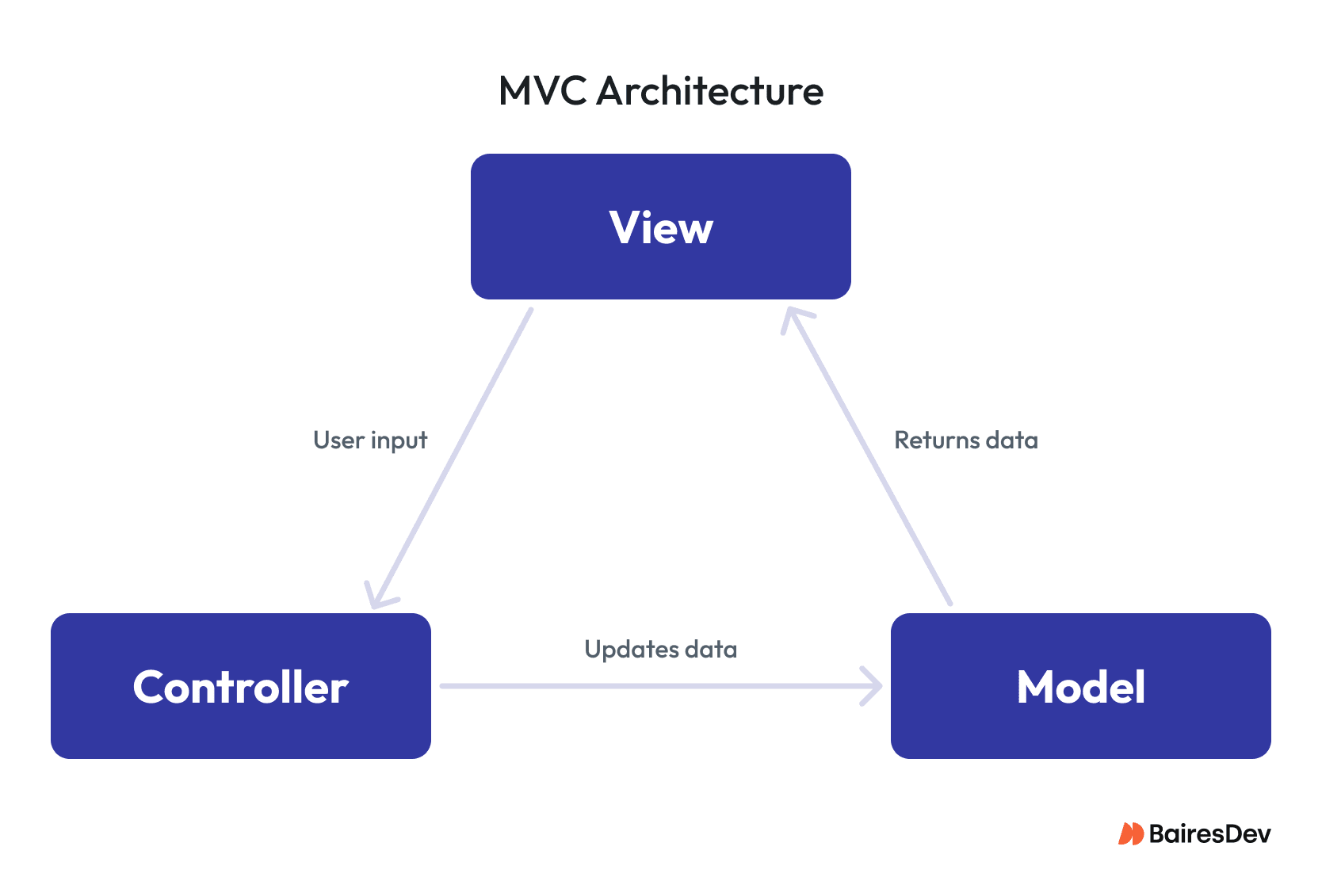
In modern Angular development, signals have replaced the controller-and-scope pattern for managing reactive state.
Component classes now use signal(), effect(), and linkedSignal() to track application data changes directly, without relying on Zone.js.
What Is the Difference Between Angular and AngularJS in 2026?
Angular and AngularJS are not the same product. They share a name and a lineage, but that is where the similarity ends.
AngularJS (1.x) was the original framework released by Google in 2010. It used a Model-View-Controller architecture, two-way data binding driven by a “digest cycle,” and a scope-and-controller pattern. AngularJS reached end of life on December 31, 2021, and has received no security patches since.
Angular (v2 and later) is a separate, ground-up rewrite released in September 2016. It dropped MVC entirely in favor of a component hierarchy, introduced TypeScript as the primary language, and has been actively developed through 22 major versions since.
Angular remains an actively maintained product. The project now lives at angular.dev, not angular.io.
Angular for Business
Angular’s architecture gives development teams several practical advantages.
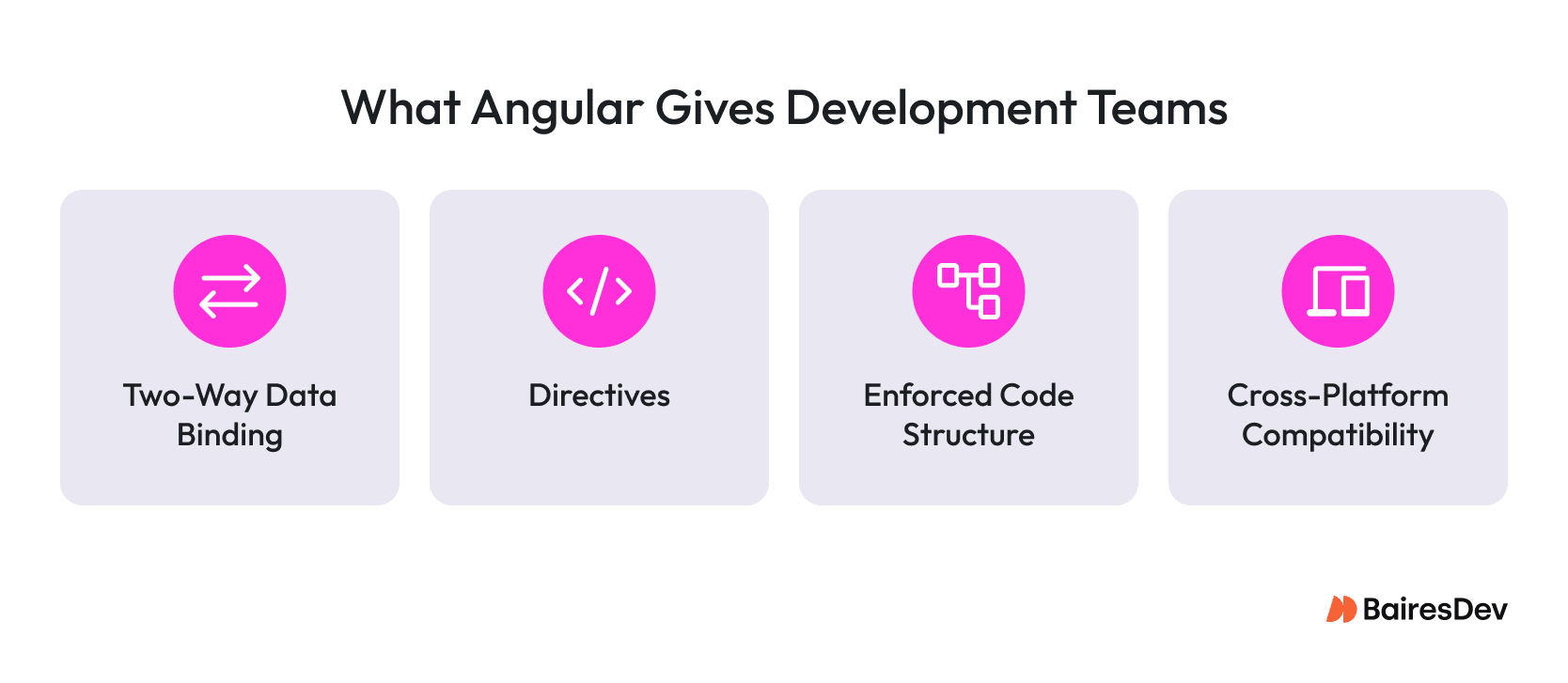
Two-way data binding automatically keeps application state and the user interface in sync. When data changes in the logic layer, the view updates and user input is reflected immediately.
Directives extend standard HTML by attaching specific behaviors to DOM elements, letting Angular developers build reusable UI patterns and keep templates readable without burying business logic in markup.
Enforced code structure means two developers from different enterprise projects can open the same Angular codebase and navigate it without a lengthy handover. The framework’s conventions around component classes, services, and modules make large codebases more predictable for anyone joining the team, whether that’s an internal dashboard, a customer relationship management platform, or a regulated line-of-business application.
Cross-platform compatibility comes built in. The same Angular codebase can target web browsers, mobile devices, progressive web apps, and server-side rendered pages without rewriting core application logic for each environment.
Why Do Enterprises Choose Angular over React?
React gives teams maximum flexibility and expects them to assemble the rest, while Angular ships with every major piece already decided.
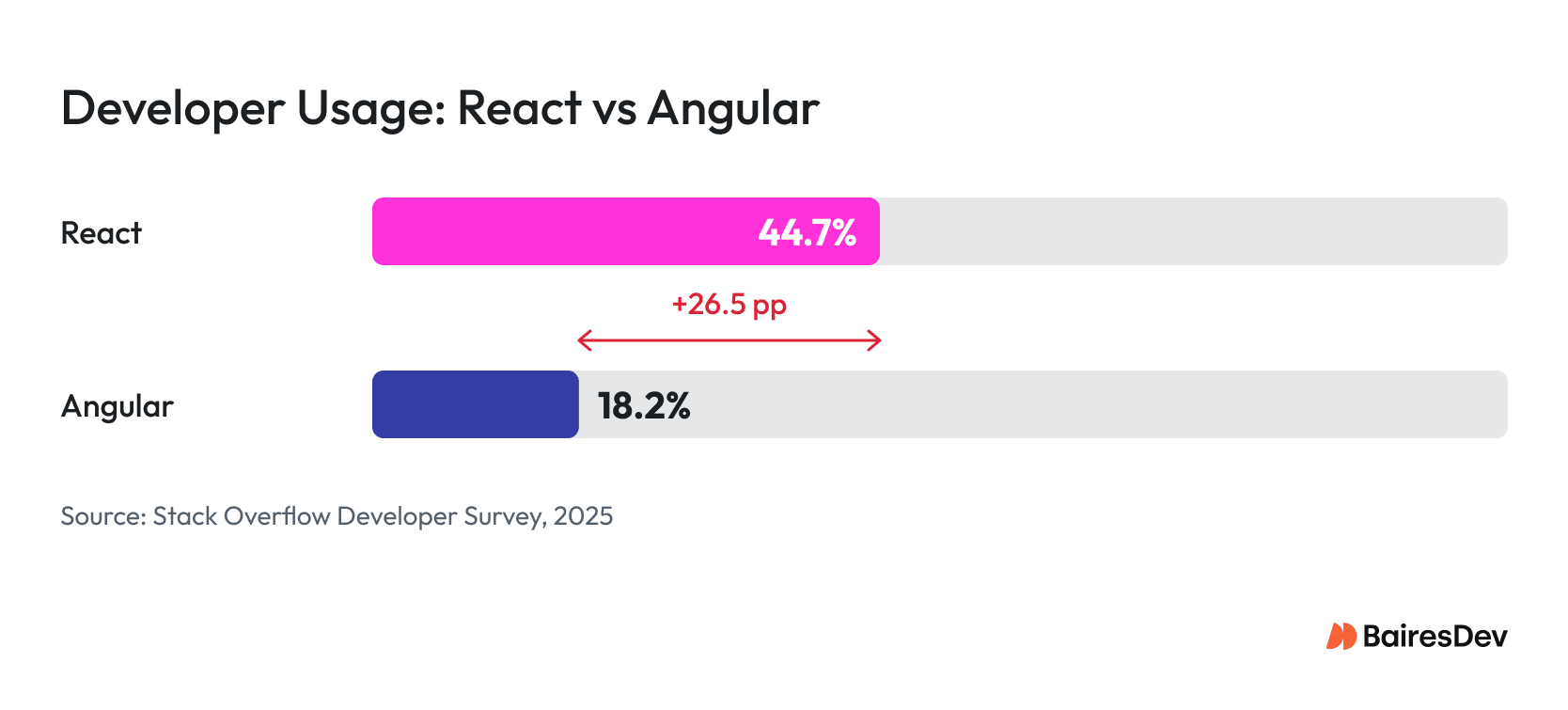
React leads developer usage at approximately 44.7% versus Angular’s 18.2%, per the Stack Overflow 2025 Developer Survey.
Framework Comparison
| Framework | Type | Best Fit | Architecture | Backed By | Release Cadence |
| Angular | Full framework | Large enterprise, finance, healthcare, government | Opinionated all-in-one: routing, forms, HTTP, DI, CLI, TypeScript-first | Annual major release, 24-month support | |
| React | UI library | Startups, agencies, flexible product teams | Unopinionated; ecosystem assembled from libraries | Meta | More flexible release schedule |
When Should a Business Choose Angular, and When Should It Not?
Angular fits best when your team values structure and long-term code consistency over rapid initial setup.
Use Angular when you are building:
- Enterprise dashboards and internal line-of-business tools where consistent structure and dependency injection reduce onboarding time across large teams.
- Regulated finance, healthcare, or government single-page applications that require predictable support windows and strong typing throughout.
- Progressive web apps or server-side rendered applications using Angular’s built-in SSR and incremental hydration via @defer.
Avoid Angular when:
- You are prototyping something small or shipping a marketing site. Lighter tools like React or even a static site generator will get you there faster with less setup.
- Your team cannot commit to TypeScript. Angular’s TypeScript-first design is non-negotiable. Trying to work around it creates friction that removes most of the framework’s benefits.
- You need to deliver fast, and your team has no prior Angular experience. The learning curve for Angular’s concepts (dependency injection, decorators, module structure even in standalone mode) is steeper than React’s entry point.
Angular Release and Support Schedule for Your Roadmap
Angular follows a predictable release rhythm. Each major version receives 24 months of support: 12 months of active support with regular updates and new features, followed by 12 months of long-term support (LTS) with critical fixes and security patches only.
As of mid-2026, Angular 20, 21, and 22 are under active or LTS support. Angular 19 and earlier are no longer supported.
For roadmap planning, this means your team can adopt a new major version within its 12-month active window, then hold on LTS for another 12 months while scheduling the next upgrade.
How Do You Staff an Angular Project for Long-Term Maintainability?
Migrating a legacy AngularJS application or upgrading an older Angular project is not a simple task because standalone components, signals, and zoneless change detection have fundamentally changed the framework’s architecture. For enterprise teams modernizing large Angular codebases, the most practical strategy is to introduce the new patterns in new modules first, then modernize older NgModule-based areas incrementally as part of the regular release cycle.
At the team level, Angular development benefits from the framework’s enforced structure. Because Angular dictates how routing, forms, HTTP calls, and dependency injection work, Angular developers from different enterprise projects navigate each other’s codebases with far less friction than they would across two React projects using different state management approaches.
Other developers joining mid-project spend less development time getting oriented, and the consistent code patterns mean less code is needed to accomplish the same outcomes.
Long-term maintainability depends on a few essential practices:
- Stay within two major versions of the current release to remain within the 24-month support window.
- Adopt standalone components and signals in any new code written today, regardless of whether the rest of the application has been migrated yet.
- Migrate Karma and Jasmine unit tests to Vitest on any project that is actively receiving new features.
- Treat any NgModule-based section as technical debt with a migration target.
Key Takeaways
- Angular and AngularJS are not interchangeable. AngularJS reached end of life on December 31, 2021. Any production AngularJS application is a security and compliance liability right now.
- Angular 22 (June 3, 2026) is the signal-first release. Signals, standalone components, and zoneless change detection are the defaults. Zone.js and NgModules are no longer part of new project scaffolding.
- Angular’s business case is its structure, not its popularity. React leads developer usage by a wide margin, but Angular’s built-in tooling, predictable annual release cadence, and 24-month support windows reduce long-term maintenance risk for large enterprise systems.
- The release cadence changed. Angular now ships one major release per year rather than two. Each version is supported for 24 months total.
- Vitest replaced Karma as the default test runner for new Angular projects.