

Key Points
- There is no universally best programming language. The right choice depends on a couple of factors: the project type, performance requirements, team experience, ecosystem maturity, and long-term maintainability.
- Python ranks #1 on the TIOBE Index (2026), JavaScript remains the most-used language according to the Stack Overflow 2025 Developer Survey, and TypeScript reached #1 on GitHub for the first time in over a decade.
- Swift is now Apple’s default language for new iOS development. Objective-C can be treated as a legacy and maintenance technology.
This is a question many devs hear every time they take on a new project. Clients typically want a magic answer and to know which language is the ideal one to help turn their development projects from mere ideas into reality.
This is, of course, a valid and fair question, as choosing the best fit of technology stacks, programming languages, and libraries is essential to successful development. However, it isn’t as simple as merely making a choice and sticking to it.
Many factors must go into determining which programming language (or languages) to use in certain projects. The right language for one project can be entirely wrong for the next, and it’s best to go through a structured set of questions every time before committing to a stack.
What It Means to Choose the Right Programming Language
In computer science, a programming language is the formal syntax and toolchain used to build software, with each option offering different trade-offs in performance, ecosystem, tooling, and learning curve.
Choosing the right language means selecting the language, or combination of languages, whose strengths best align with the project’s environment, performance goals, team capabilities, and long-term maintenance needs.
Languages designed for a broad range of tasks are called general purpose programming languages. Python, Java, and JavaScript are the most widely used. Others serve narrower purposes: SQL for data querying, HTML/CSS for web structure and styling, or Rust for systems-level performance.
No single language wins across every category. The practical question is always which trade-offs are acceptable for a specific project.
Which Programming Languages Lead the 2026 Rankings, and Do Rankings Matter?
Rankings are useful as a signal of ecosystem health and community momentum, but they measure different things and should not be the sole basis for any decision.
Python holds the #1 position on the TIOBE Index in 2026. JavaScript remains the most-used language in the Stack Overflow 2025 Developer Survey, with 66% of developers reporting they work with it regularly. TypeScript reached #1 on GitHub, the first time any language has held that position in over a decade. Rust continues to be the most-admired language, with a 72% admiration rating in Stack Overflow’s 2025 data.
These surveys answer different questions. TIOBE measures search activity and web mentions. Stack Overflow measures what developers use on the job. GitHub measures what is being actively pushed to repositories. A language can rank differently on each and still be the right choice for a given project.
Matching a Programming Language to Your Project Type
The target environment narrows the candidate list faster than any other factor. Different programming languages suit different environments, and different languages frequently coexist within the same system. Here is a current language list for 2026, along with the most common use for each:
| Project Type | Recommended Languages (2026) | Notes |
| Mobile (iOS) | Swift | Apple’s default for new development. Swift-first frameworks include SwiftUI, SwiftData, and RealityKit. |
| Mobile (iOS legacy) | Objective-C | Maintenance and legacy integration only. |
| Mobile (Android) | Kotlin, Java | First-class Android support. |
| Web front-end | JavaScript, TypeScript | TypeScript now #1 on GitHub. |
| Web back-end and tooling | TypeScript/Node.js, PHP, Ruby | TypeScript natively supported in Node.js. |
| Enterprise | Java (JDK 25 LTS), C#, C++ | C# named TIOBE Language of the Year. Mature enterprise ecosystems. |
| ML, data science | Python (3.14), R | Python #1 on TIOBE. Dominant AI/ML ecosystem. |
| Distributed systems | Go (1.24) | Optimized for concurrency. |
| Systems and performance | Rust (2024 Edition), C, C++ | Maximum performance and memory safety. Rust is the most-admired language per Stack Overflow 2025. |
Once the environment is established, the remaining factors separate the final candidates.
Use Cases
The right language choice looks different depending on the project. Some common examples:
- A fintech building a native iOS application should default to Swift while treating Objective-C as a legacy integration technology.
- A data platform focused on AI or machine learning should center on Python 3.14.
- A distributed service with high-concurrency requirements is a strong fit for Go 1.24, while a performance-critical systems component favors Rust.
Multi-language Delivery at Scale
BairesDev’s engagement with Pinterest illustrates the value of selecting languages based on project requirements rather than forcing a single stack. The engineering team, working across Python, Go, Java, Node.js, and React, scaled from 5 developers in 2019 to 233 developers in 2023, demonstrating how a deliberate multi-language strategy can support sustained product growth.
Does AI-assisted Coding Change How You Choose a Language?
Not fundamentally. AI coding tools improve developer productivity across many languages, but they do not change the underlying trade-offs that make one language a better fit than another.
Project environment and team expertise remain the primary selection criteria. AI assistance can accelerate onboarding to an unfamiliar language, but it does not replace the institutional knowledge and debugging instincts that come with real experience. A team using AI tools with a language they know well will consistently outperform a team using AI tools to compensate for a language they do not know at all.
Questions to Ask When Selecting a Programming Language
Before any language comparison starts, teams need answers to a basic set of questions as the ones below. This applies to new developers choosing a first stack as much as it does to senior engineers evaluating options for a production system.
- What is the intended environment: mobile, web, enterprise, data, or distributed?
- Does the client have a preference based on previous projects or internal standards?
- Can the team program in this language, or would there be a significant learning curve?
- What performance requirements exist? Does execution speed or development speed matter more?
- Does the language have adequate ecosystem support, vendor backing, and an active release cadence?
- Is there an active community available for resources, libraries, and long-term support?
- How well does the language integrate with third-party tools the project depends on?
- What are the security and compliance requirements?
While this is by no means a comprehensive or total list of questions meant for immediate decision-making, these questions help developers weed out the languages that are absolutely not a fit for the project.
Swift vs. Objective-C: The Current Default for iOS Development
Swift is Apple’s default language for new iOS development. Frameworks like SwiftUI, SwiftData, and RealityKit are Swift-first. Objective-C is not deprecated, but it is no longer the starting point for new work on any Apple platform.
For any new iOS, iPadOS, macOS, tvOS, or watchOS project started today, Swift is the correct default. Objective-C remains relevant for maintaining existing codebases and projects with deep legacy integrations, but it should be treated as a maintenance technology.
Teams inheriting an Objective-C codebase do not need to rewrite everything immediately. A practical approach is to write new features in Swift and migrate incrementally, since both languages can coexist in the same project.
TypeScript
TypeScript has expanded well beyond front-end development. Node.js now supports TypeScript natively, and TypeScript ranks #1 on GitHub as of 2026.
The most significant recent development is TypeScript 7.0, released in July 2026, which ports the compiler from TypeScript to Go. The new compiler delivers approximately 10x faster compilation through native code speed and shared memory parallelism. This shift treats TypeScript as serious infrastructure, not just a type layer sitting over browser JavaScript.
Teams building web front-ends, back-end services, and developer tooling should treat TypeScript as a cross-stack option rather than a web-only choice.
Step-by-step Process to Choose a Programming Language
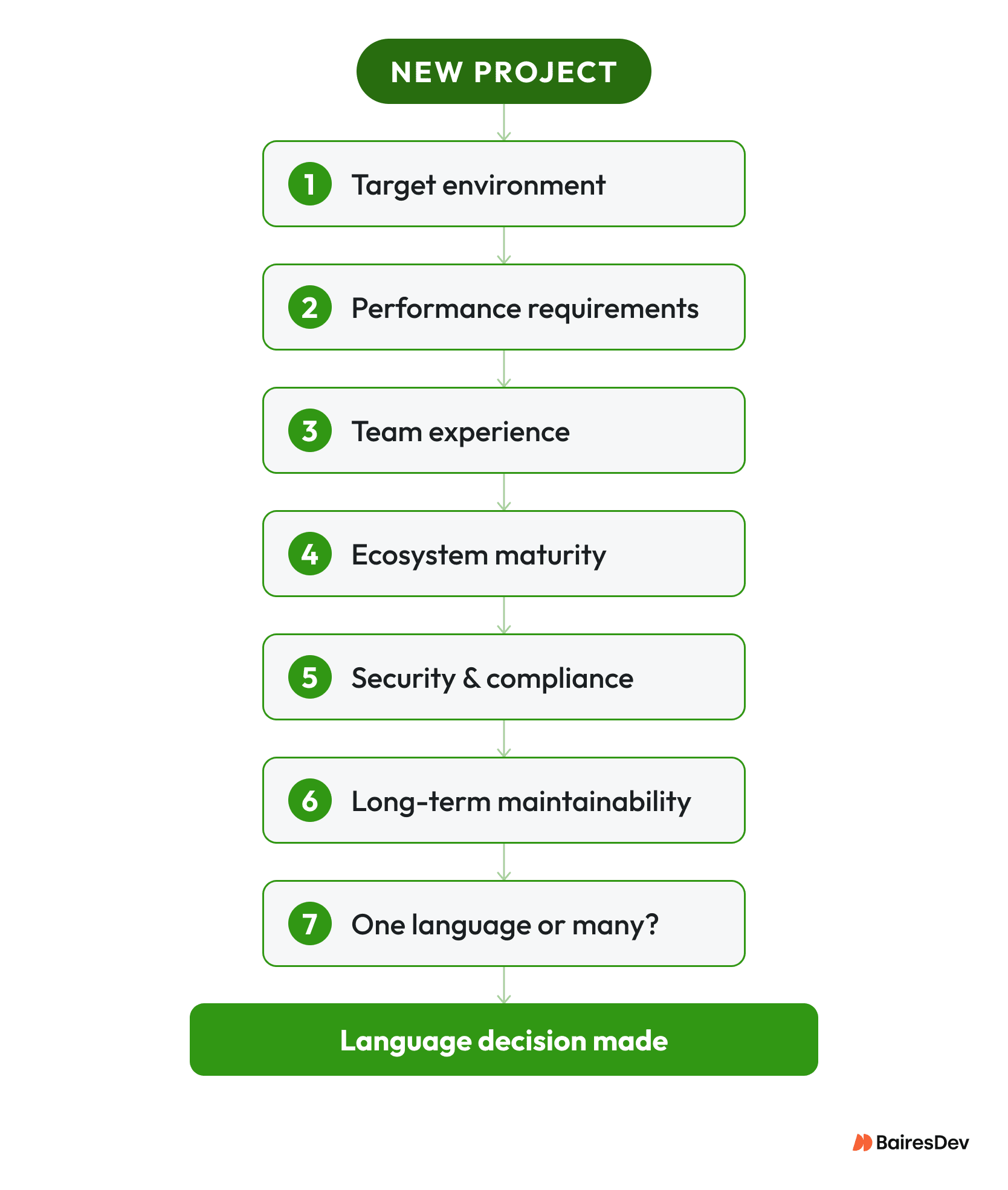
- Define the target environment. Mobile, web, enterprise, data, distributed systems, or some combination. This is the first filter and eliminates the most candidates fastest.
- Identify performance requirements. Establish whether the project needs maximum execution speed, rapid development iteration, or a balance of both.
- Evaluate team experience. Map what the team already knows against the candidate languages. Weight familiarity heavily in the final decision.
- Assess ecosystem maturity. Check active release cadences, library availability, vendor support, and community size for each remaining language.
- Review security and compliance requirements. Some projects require languages or frameworks with specific safety characteristics. Memory-safe languages like Rust reduce entire classes of vulnerabilities at the compiler level.
- Validate long-term maintainability. Favor languages under active development with healthy hiring markets and stable major frameworks.
- Decide on a single best language or a deliberate multi-language stack. Not every project needs one language. A planned multi-language architecture is sometimes the most practical answer.
Choosing the right programming language is only part of the decision. The long-term success of a project also depends on having engineering teams that match the stack to the problem instead of the trend, balancing technical requirements with maintainability, staffing, and future growth.
Key Takeaways
- Match the language to the project. Consider environment, performance, team experience, ecosystem support, security, and maintainability together rather than in isolation.
- Update your defaults for 2026. Swift is the default for new iOS development, not Objective-C. TypeScript is a cross-stack language, not a front-end-only tool.
- Use rankings as context, not as decision criteria. Python leads TIOBE, JavaScript is the most-used language per Stack Overflow 2025, and Rust is the most-admired language for systems programming.
- A deliberate multi-language strategy is sometimes the right answer. Forcing a single language onto a project with diverse requirements adds unnecessary constraints.