



One of the more challenging aspects of Kubernetes and cloud-native development is simply deploying a cluster that your teams can start using to build apps and services.
This can be time-consuming and taxing, especially for developers without much experience in the field. And once you get the cluster up and running, you might then want to have a user-friendly GUI tool to manage everything.
The complications keep piling up. Very soon, small and underresourced teams find out that managing Kubernetes can be very time-consuming and complex. If that sounds familiar, it might be time for you to make use of a managed, web-based platform that can do much of the heavy lifting for your teams.
Container Management Process
Container management is the process of deploying, scaling, monitoring, and securing containers. Containers are lightweight, portable environments that package an application with its dependencies. They have become a foundation of modern software development because they offer speed.
Effective container management leads to applications running smoothly across environments. It involves:
- Building and storing container images.
- Build container images consistently for deployments
- Deploying and scaling workloads.
- Monitoring resource usage.
- Enforcing security and compliance.
As container adoption grows, management has become critical. Without proper tooling, maintaining clusters and applications at scale is inefficient and risky.
The challenge isn’t running individual containers, it’s keeping hundreds or thousands of them consistent, secure, and predictable across environments. Container management at scale is about enforcing standards, automating the boring but critical work (provisioning, updates, rollouts, rollbacks), and giving teams reliable patterns so they don’t reinvent infrastructure every time they ship.
Done well, it turns containers from a source of operational drag into a stable platform your engineers can build on.
Container Platforms
Let’s talk container platforms. They offer comprehensive solutions for creating, deploying, and managing containers. What does it mean for you?
Such a platform takes much of the complexity out of running containers. Instead of building and maintaining clusters manually, your teams can get started in minutes with preconfigured environments.
This reduces risk by ensuring consistent, compliant infrastructure and fewer manual errors. Developers have the flexibility to use either a command line or a graphical interface, and the platform handles automated scaling as your needs grow.
Ultimately, these solutions let engineers focus on delivering products and not managing application infrastructure.
Enterprise-Grade Kubernetes
Kubernetes has become the standard for container orchestration platform, but it’s also notorious for its complexity. Platforms like Google Kubernetes Engine (GKE), OpenShift, and Portainer simplify operations with features like automatic scaling, self-healing, and centralized security policies:
Managing Kubernetes Clusters
Kubernetes cluster management covers infrastructure setup, container deployment, workload monitoring, and resource allocation. Many enterprises use managed Kubernetes services like Google Kubernetes Engine (GKE) to simplify operations and provide secure, scalable clusters.
Cluster management platforms automate all your routine tasks, so developers can focus on building applications instead of maintaining infrastructure.
Google Kubernetes Engine (GKE)
GKE, part of Google Cloud Platform, is a managed Kubernetes service offered for deploying and scaling containerized workloads. It offers:
- Automatic scaling to adjust resources based on demand.
- Load balancing for reliability.
- Integrated storage configuration and networking with other Google services.
With GKE, organizations can deploy multiple clusters across regions. This supports large-scale enterprise use cases where uptime and compliance are critical.
By offloading infrastructure management, GKE lets development teams spend more time coding and less time configuring. For enterprises, this translates into faster releases and lower operational risk.
Container Management Solutions: Portainer
Platforms like Portainer simplify Kubernetes adoption even further. Portainer can deploy clusters or connect to existing ones. It offers a web-based management interface where teams can handle:
- Application deployments.
- Resource scaling.
- Configuration management.
This approach mirrors common development workflows. Just as developers use test cloud environments before production, Portainer provides accessible Kubernetes clusters for development and staging. Teams can test and refine services before deploying them into production environments.
Enterprise editions of Portainer add features such as:
- Role-based access control.
- Compliance monitoring.
- Support and integration with enterprise tools.
While licensing introduces cost, the time saved on cluster setup and troubleshooting usually outweighs these expenses.
MicroK8s
MicroK8s is a lightweight, easy-to-install Kubernetes distribution. It works on most operating systems, either directly on hardware on premises or inside virtual machines. With a few commands, teams can enable services and deploy a Kubernetes cluster with Portainer for management.
MicroK8s provides:
- Fast deployment of test environments.
- Integration with Helm charts, namespaces, applications and service deployments, and secrets
- Compatibility with both community and enterprise editions of Portainer.
Because MicroK8s clusters can be deployed in minutes, developers spend more time coding and less time managing infrastructure. For enterprises, this accelerates onboarding and reduces bottlenecks in the delivery pipeline.
CI/CD Pipeline Automation
Continuous Integration and Continuous Deployment (CI/CD) pipelines are essential for containerized applications. Automation tools like Jenkins, GitLab CI, and CircleCI streamline builds, testing, and deployments.
Benefits include:
- Faster delivery cycles.
- Reduced human error in deployments.
- Built-in security checks and vulnerability scanning.
- Consistency across multiple environments.
By integrating container management with CI/CD pipelines, enterprises can ensure applications move seamlessly from code commit to production deployment. This increases both developer productivity and system reliability.
Container Security
Containers can introduce security risks that you need to be aware of. To reduce exposure, it’s important to use only trusted container images, apply network policies, encrypt sensitive data, and enforce strict authentication and authorization.
Regular vulnerability scans and timely patching are also essential.
Kubernetes and similar platforms offer built-in security tools, and combining these with third-party scanners helps maintain compliance and minimize risk
Limitations and All the Benefits
Kubernetes is powerful. As all powerful tools, it comes with complexity. Not every developer is comfortable using command-line tools like kubectl. Some prefer GUI-driven workflows.
Container management platforms like Portainer offer both approaches. Teams can choose the interface that fits their workflow while still benefiting from Kubernetes orchestration.
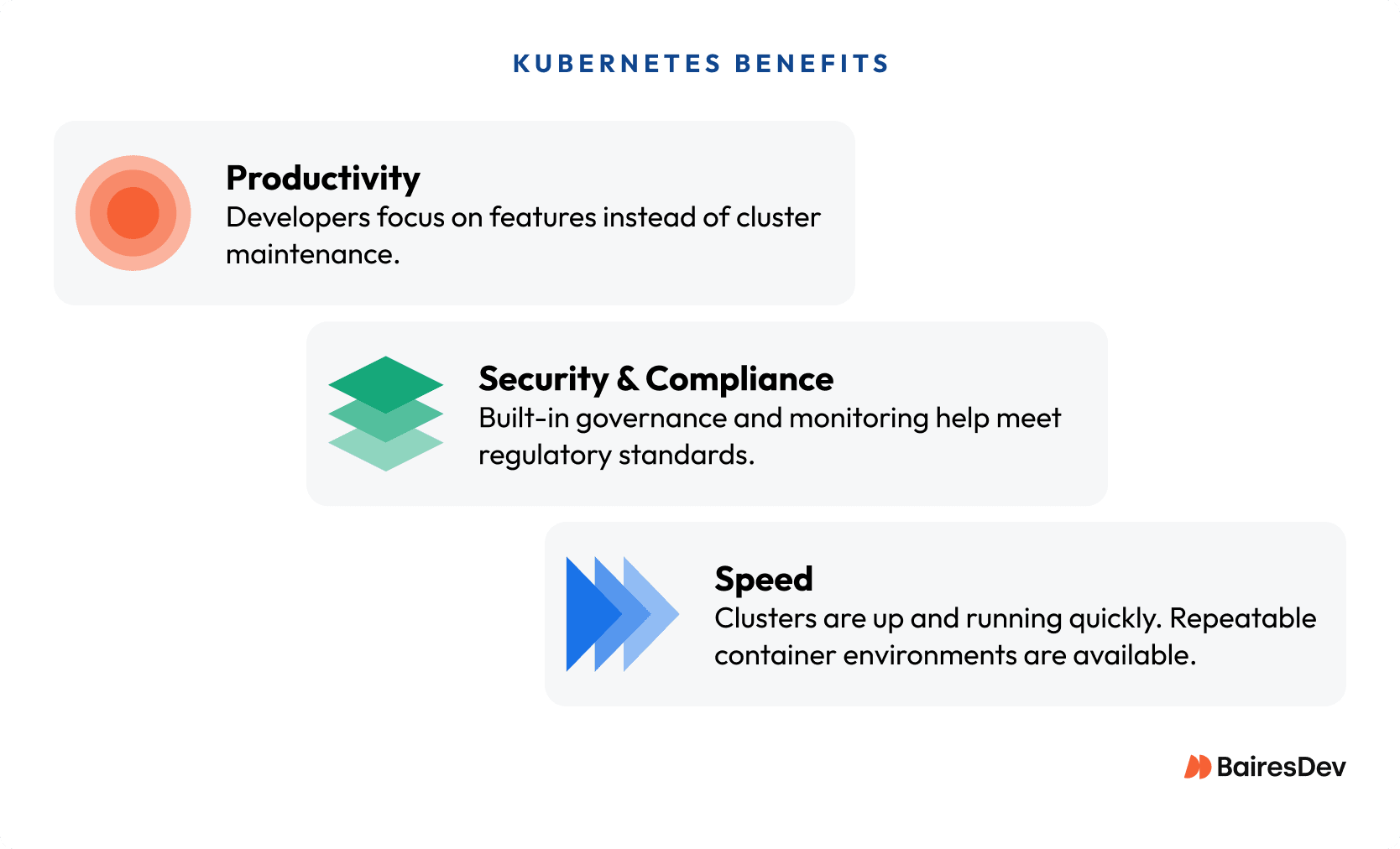
The result is improved collaboration and higher productivity. Your engineers spend more time delivering features and less time wrestling with infrastructure.
For your business, that translates directly into cost savings, shorter release cycles, and improved reliability.
Where BairesDev Fits In
At BairesDev, we help engineering leaders adopt and scale container management without adding operational burden. With 4,000+ senior engineers across LATAM, we’ve supported large-scale enterprise deployments in finance, healthcare, and other regulated industries.
Our teams can:
- Stand up Kubernetes clusters and management platforms quickly.
- Integrate with your CI/CD pipelines and security policies.
- Provide ongoing support so your internal teams can focus on product delivery.