



Cybersecurity risk is defined by where attackers gain footholds and how quickly security teams can respond. Stolen or compromised credentials were the initial access vector in 22% of confirmed breaches in 2025, underscoring the shift toward identity misuse and session abuse as primary attack tactics.
Meanwhile, ransomware appeared in 44% of confirmed data breaches in 2025, continuing its rise as an extortion-driven disruption model rather than just a file-encryption problem. Phishing and broader social engineering attacks remain dominant entry points across reported incidents.
For security leaders and engineering executives, the question isn’t “are we secure,” it’s: Where will we fail first and what can we change this quarter so we don’t?
This guide outlines ten cybersecurity trends reshaping the cybersecurity landscape, each tied to a concrete failure mode and a 30-day action. These emerging trends reflect the rapid evolution of cyber threats, artificial intelligence adoption, and the widespread integration of cloud services into core business infrastructure.
Where the Exposure Concentrates
Most of these trends orbit the ID control plane (SaaS admin consoles, cloud services, vendor access tokens) because that’s where control resides and where the blast radius hides. A compromised session or overly broad integration usually looks normal right up until it doesn’t.
| Trend | What changed | Typical failure mode | First move |
| AI-amplified social engineering | Higher-conviction impersonation across channels | Helpdesk bypass or payment-change fraud | Verified callbacks + recovery proofing |
| Data as control plane | Security policy shifts to data use, movement, and sensitivity | Sensitive data crosses SaaS, AI, cloud, and vendor workflows without consistent controls | Classify critical data; map access, movement, and usage |
| Ransomware shifts to disruption | Theft + sabotage over encryption | Backups exist, restore fails at scale | Restore-at-scale exercise; isolate admin tiers |
| Supply chain risk expands | Vendors, SaaS, dependencies, build systems, and integrations create risk | Trusted suppliers or dependencies expose systems before security sees it | Map critical suppliers, dependencies, access paths, and data exposure |
| Cloud/SaaS permission drift | Over-permissioning is the root cause | CSPM alerts with no owner | Guardrails + centralized logging baseline |
| Shadow AI tests data boundaries | AI use exposes whether controls follow the data | Sensitive data is used in tools or workflows outside approved policy | Define data classes and enforce AI usage rules by data type |
| Automation becomes mandatory | Humans can’t match alert volume | SOAR bought, response still manual | Automate 5 repeatable actions with approvals |
| Reporting pressure expands | Timelines compress mid-incident | No severity taxonomy, no evidence trail | Pre-build taxonomy + evidence retention |
| IoT/edge grows surface | “Not IT” devices become footholds | Flat networks, unknown owners | Inventory + segment with allow-lists |
| Talent scarcity forces simplification | Complexity rises faster than hiring | Exceptions pile up, controls bypassed | 2–3 paved roads; reduce tool sprawl |
10 Shifts That Change How Cyber Risk Manifests in 2026
Most of these issues look separate on paper. In practice, they converge around durable access and blind spots created by convenience or complexity.
1. AI-Amplified Social Engineering Gets Cheaper and More Convincing
Artificial intelligence is making social engineering attacks more effective by increasing credibility and scale at the same time. Attackers now blend email, chat, voice phishing, and short video into coordinated campaigns that feel internally consistent.
Picture a Friday morning Slack message that appears to come from your CFO, followed by a phone call that sounds believable. The urgency feels plausible and the language matches previous conversations.
The failure mode is no longer “Oh, someone clicked a bad link.” It’s entire business workflows that assume identity is obvious under time pressure. Helpdesk recovery, vendor onboarding, payroll updates, and payment-change approvals are optimized for speed.
Under stress, employees default to helpfulness.
Unfortunately, this helpfulness often results in a credential compromise, leading to cases of fraudulent payments, unauthorized consent grants, lateral access, and loss of sensitive information before detection.
Action: Enforce verified callbacks to known numbers for high-risk changes. Strengthen recovery proofing so familiarity doesn’t equal authorization. Block high-risk OAuth consent grants by default to prevent durable access from a single successful impersonation. These controls reduce conversion rates without relying solely on employee vigilance.
2. Security Decisions Based on Correlated Context
Zero Trust is often reduced to identity, but that often misses the point. While strong identity controls matter, identities themselves are still vulnerable, e.g., credentials can be stolen, sessions can be hijacked, tokens can be abused, and privileged accounts can be misused.
This means the identity-first model is being phased out in favor of a context-first approach.
Access decisions should correlate signals from the user, device, application, network, and data layer. Who is requesting access? From what device and through which application? What’s the network context? What data is being accessed, and does this request match expected behavior and policy?
The failure mode is treating one signal as authoritative. A valid login from an unmanaged device, an unusual location, an over-permissioned application, or an attempt to access restricted data should not be allowed just because authentication succeeded.
The obvious risk is that attackers can operate inside normal workflows once a single layer (e.g., identity or network) is trusted too much. In a mature Zero Trust model, no single pillar carries the decision alone.
Action: Define access policies that combine identity, device posture, application context, network conditions, and data sensitivity. Prioritize high-risk workflows first: administrative access, financial approvals, source code repositories, customer data, and production systems.
3. Ransomware Shifts Further Toward Extortion and Business Disruption
Ransomware in 2026 rarely resembles a simple encryption event. Modern groups run extortion campaigns that combine data theft, privilege escalation, and operational sabotage. Encryption is often just one pressure tactic.
Attackers steal sensitive information, compromise administrative access, disable security controls, corrupt backup catalogs, and threaten regulatory exposure or public leaks. If they can create operational and reputational pressure, they don’t need perfect encryption.
The failure mode is assuming backups guarantee recovery. Backups restore files. They don’t fix compromised admin accounts, altered backup indexes, untrusted identity systems, or attackers who remain authenticated.
If your IdP or Active Directory is compromised, restoring data does not restore trust. You may be operational—but still exposed.
Action: Run restore-at-scale exercises that include identity infrastructure. Shift toward proactive and automated security testing (pen testing and red teaming), and chaos engineering. Separate administrative tiers so one account doesn’t control backups, production, and security systems. Make backups immutable and maintain them in offline storage. Predefine your extortion response plan with legal and communications leadership to avoid improvisation under pressure.
4. Third-Party Compromise Becomes a Default Entry Path
Organizations now rely on dozens or hundreds of third-party integrations, support vendors, and external administrators. Each connection introduces standing trust.
Attackers increasingly target vendors because it scales. Compromising one provider with broad permissions can expose multiple organizations at once. Supply chain concerns are worth considering as well, as virtually all software includes some level of open-source solutions. There was no shortage of incidents involving FOSS libraries in 2025 and 2026, so this attack vector is definitely worth keeping an eye on.
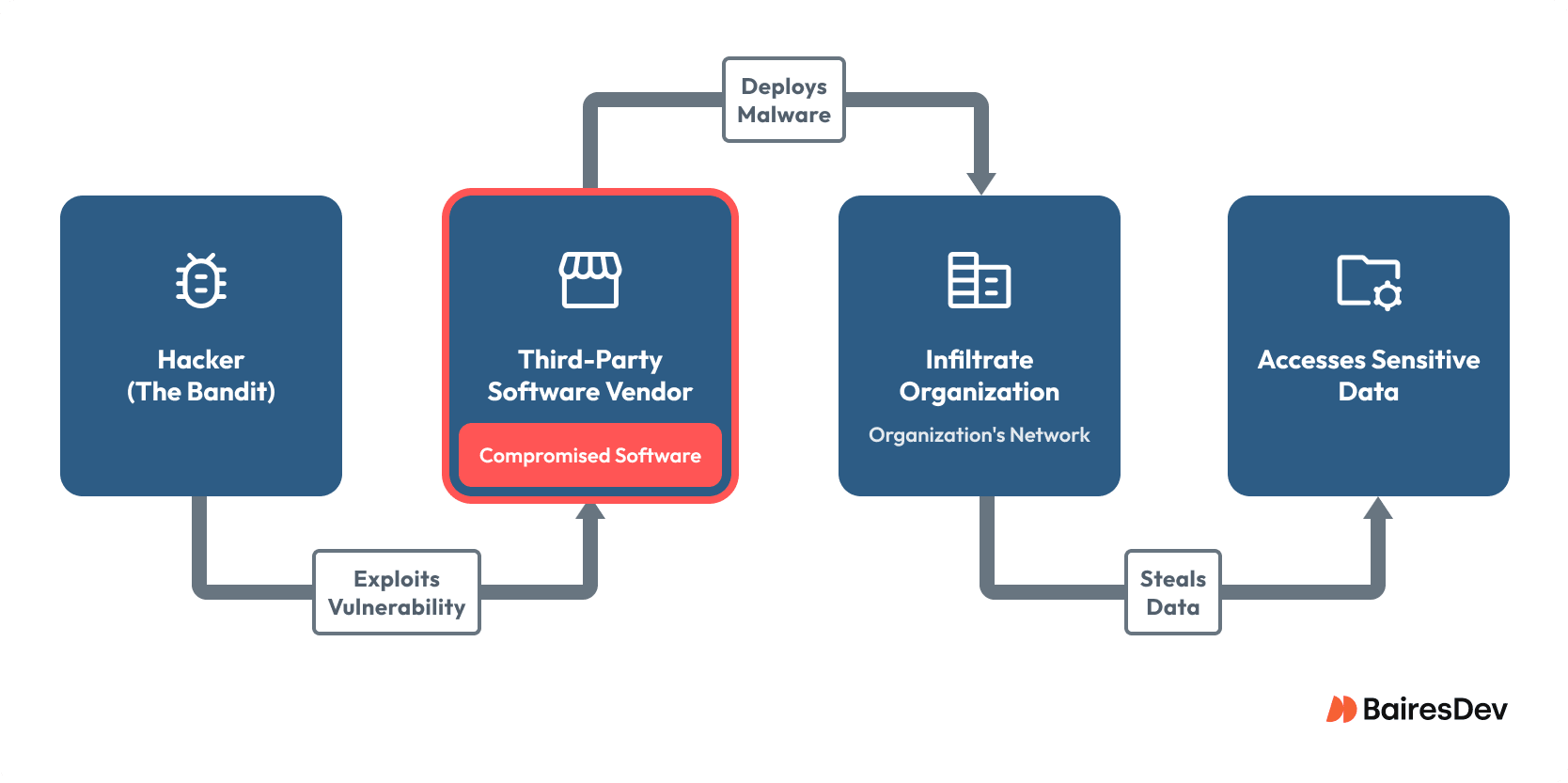
The failure mode is equating compliance documentation with real security. A SOC 2 report does not prevent credential misuse or excessive privilege. Standing vendor access expands blast radius quietly.
The business risk is asymmetrical. A vendor compromise can bypass hardened endpoints and land directly inside privileged workflows.
Action: Tier vendors by privilege level. Eliminate standing administrative access where possible. Require time-bound sessions and scoped permissions for high-impact support. Trust should be session-based, not permanent.
5. Cloud and SaaS Permission Drift Expands Exposure
Most cloud-related breaches don’t begin with advanced exploits. They begin with permissions that made sense during an outage three quarters ago.
Temporary admin access becomes permanent. Service accounts receive broad scope “just to get it working.” Storage remains exposed longer than intended. None of it feels critical in the moment.
Over-permissioning accumulates. Roles are copied. Token scopes expand. Alerts fire without ownership. Audit logs exist but aren’t centralized.
The failure mode is no longer a single misconfiguration, but rather a normalization of misconfiguration.
The risk here is asymmetric. One broadly scoped CI/CD credential or SaaS admin role can expose more data than a compromised laptop. Unfortunately, because activity occurs through legitimate APIs, it often looks normal.
Action: Centralize logging across cloud services. Reduce privileged sprawl deliberately. Focus remediation on high-impact exposure categories: storage, CI/CD permissions, and broad SaaS roles. Fix patterns, not just individual alerts.
6. Shadow AI Increases Data Leakage and Compliance Risk
AI tools are widely used in daily operations. Engineers paste code, support pastes customer conversations, while legal pastes draft agreements. It happens because it’s fast and convenient.
This newfound convenience is the risk. Sensitive information moves into external AI systems without clarity around retention, contractual limits, or regulatory compliance.
Once the genie is out of the bottle, banning AI outright doesn’t work. Asking teams to avoid AI without providing a safe alternative is like banning spreadsheets without offering accounting software.
The failure mode is assuming policy alone controls behavior.
The business risk includes data leakage, regulatory friction, and erosion of customer trust, often without a clear “incident” moment.
Action: Define what data classes may be used in AI systems. Also, make sure your teams understand ontologies and semantics in order to have a good understanding of data classes. Provide an approved AI assistant integrated with SSO and audit visibility. Place guardrails around customer data, regulated data, and source code. Make the secure path the most convenient one.
7. Security Automation Becomes Mandatory
Attackers move laterally in minutes. Many organizations still contain incidents manually.
An analyst pivots between consoles, revokes sessions in one system, disables accounts in another, and rotates keys elsewhere. If incident response relies on individual memory and manual navigation, you’ve built fragility into the one moment you can least afford it.
The failure mode isn’t a lack of detection but slow containment.
When your response takes hours, the blast radius inevitably grows. Data exposure increases and recovery costs compound. The gap between attacker speed and defender coordination becomes the real vulnerability.
Action: Automate the most repeatable containment actions, such as session revocation, account suspension, key rotation, privilege removal, with defined approval gates. Measure time-to-contain as a core metric. Speed is now part of your security architecture.
8. Regulatory and Reporting Pressure Shrinks Decision Time
The industry consensus is that reporting timelines will start tightening over the next year or two, as regulatory bodies usually take a lot of time to respond to emerging risks. Customers expect transparency. Boards expect clarity earlier. Regulators expect defensible evidence.
During active cyberattacks, organizations often debate severity while attackers are still inside. Is it material? Is it reportable? Do we have enough proof?
That compresses decision-making at the exact moment you have the least information.
The failure mode is discovering mid-crisis that severity definitions and decision authority are unclear.
The risk isn’t just penalties. It’s a loss of credibility through delay and inconsistency.
Action: Predefine severity levels tied to objective triggers. Assign a RACI that includes legal and communications leadership. Ensure logging and access trails support reconstruction of events. Tabletop with real decision-makers—not just technical teams.
9. IoT and Edge Expansion Increases Unmanaged Attack Surface
Many organizations claim they “don’t run IoT.” What they mean is engineering didn’t purchase it.
For example, facilities deploy cameras and procurement installs badge systems. These systems live on your networks whether security approved them or not.
They are easily overlooked or treated as irrelevant, but they often run outdated firmware, default credentials, and unclear patch cycles. The failure mode is assuming a VLAN equals isolation.
If segmentation rules aren’t explicit and monitored, edge systems become quiet footholds for lateral movement.
Action: Build a complete inventory of connected devices and assign ownership. Isolate edge networks using explicit allow-lists. Remove default credentials. Monitor traffic moving from edge segments into core infrastructure.
10. Cyber Talent Scarcity Forces Simplification and Standardization
Security complexity continues to grow while the global supply of qualified talent doesn’t scale at the same rate.
As environments sprawl, exceptions accumulate. Teams bypass controls to maintain delivery speed. Workarounds become permanent.
The accumulated complexity that exceeds human capacity and becomes the failure mode.
The risk is structural fragility. Controls exist, but enforcement depends on tribal knowledge and manual intervention. That’s where talent scarcity comes into play. Even now, when demand for engineering talent is soft, security specialists are in short supply. Good talent commands high rates, provided you can even find the right person for the job on your local market.
Action: Keep it simple! Define two or three golden paths for identity, CI/CD, and service deployment. Consolidate overlapping systems where deep integration improves visibility. Measure success by reduced exception volume and fewer recurring remediation cycles, not policy count.
Actionable Investment Buckets
Four focus areas help security leaders manage risk in the year ahead without chasing every headline:
- Access management hardening
- Cloud governance
- Third-party constraint
- Response automation
Prioritize based on exposure and implementation speed. Assign clear ownership with a 90-day timeline.
The safe path should be the fast and convenient path. Fund the engineering required to make that true, and you can measure the difference in weeks.