

Key Points
- The internet of things works when connected devices trigger accountable actions inside core business systems, not when they just collect data.
- Industrial IoT requires long-term fleet ownership, including identity, patching, and lifecycle control of many IoT devices.
- Edge and cloud computing decisions determine how your IoT system behaves during network partitions and operational stress.
- IoT delivers business value when sensor data shortens the time between physical-world events and auditable decisions.
In the latest season of Clarkson’s Farm, Jeremy and Kaleb visit the LAMMA Show, the UK’s largest agricultural machinery event, and they’re blown away by the impressive machinery. They’re inspired to travel to the Netherlands to visit a high-tech potato farm. The Dutch super-farm operated decades beyond riding around in tractors and dousing crops in pesticide.
Behind Jacob van den Borne’s pioneering approach to agriculture, which he calls Precision Farming, is a textbook example of IoT architecture at work.
His fields had been mapped digitally, segmented into soil-quality zones. Farm machinery connected to his data knew what each patch of ground needed. Driverless tractors and sprayers steered along guided lines while drones flew the same mapped zones overhead. As the equipment moved, nozzles automatically opened and closed, giving every square meter of land precisely what it needed, cutting supply costs and increasing yield at the same time. Operational data from each pass then flowed back into the software, sharpening the next decision.
Instead of backbreaking manual labor, Clarkson was discovering a distributed system tying together countless sensors and heavy machinery through an invisible data plane that automated and orchestrated the whole operation, leaving him free to enjoy a cup of tea.
IoT is More Than Connected Devices
This is a useful way to think about the internet of things. IoT is more than just connected devices. It’s a system that ties physical equipment and its working state to software-driven decisions and outcomes you can measure to iterate and improve each cycle.
The internet of things (often shortened to IoT) is where software meets operations and architecture decisions become business incidents.
In practical terms, an IoT system connects IoT sensors and other physical devices to applications through IoT networks and cloud computing. But what matters at your level isn’t the gadgetry. It’s the long-term operational commitment behind devices connected across sites, vendors, and wireless networks you don’t fully control.
With well over 20 billion IoT devices connected worldwide, IoT Analytics projects continued growth across industrial and consumer environments. That scale changes the risk profile. You’re not evaluating a pilot. You’re deciding whether to operate a distributed fleet of internet-connected devices for years longer than a typical software lifecycle.
Industrial IoT: When Software Owns the Physical World
In enterprise contexts, industrial IoT isn’t a category of smart objects. It’s a distributed operational capability. The moment you move beyond a proof of concept, you’re committing to run industrial IoT devices across sites, contractors, and network protocols you can’t standardize overnight.
Consider a multi-site manufacturer rolling out vibration IoT sensors for environmental monitoring and predictive maintenance. The challenge isn’t just ingesting sensor data. It’s keeping device-to-asset mapping accurate after maintenance teams swap hardware between motors. It’s ensuring buffered uploads during degraded internet connectivity don’t create duplicate alerts. And it’s having a recovery plan when a firmware rollout bricks 0.5% of deployed units.
Security and reliability also shift at fleet scale. According to the 2026 IBM X-Force Threat Intelligence Index, manufacturing was the most attacked industry for the fifth consecutive year, reflecting the exposure of industrial devices and electronic systems in connected environments.
At that prevalence, vulnerability isn’t an exception. It’s an operating assumption. IoT security must be built around patchability, segmentation, device identity, and inventory discipline, not hope.
Before funding “industrial internet” initiatives, pressure-test whether you’re building an operational capability:
- Can you prove which device is attached to which asset, running which firmware, with which credentials?
- What happens when wireless networks degrade? Does the system buffer, compute locally, or stall?
- What action occurs in which system of record when thresholds break?
- Who owns IoT device management and carries the pager when gateways fail?
Enterprises succeed with IoT deployments when they budget for long-term fleet management, not just initial integration.
A Four-Part Model for Enterprise IoT Systems
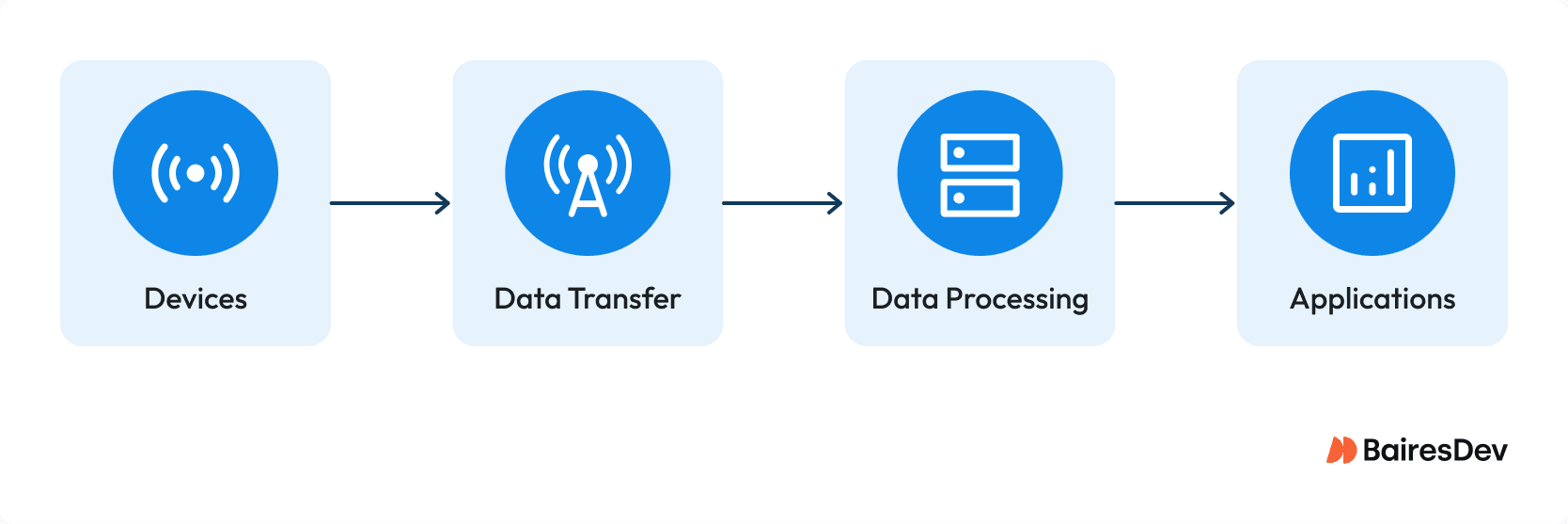
To evaluate IoT technology at production scale, break the IoT system into four parts with explicit contracts and owners. This includes network architecture, not just applications.
Four-Part Enterprise IoT System Model
| Layer | What It Does | What It Must Guarantee | Typical Primary Owner |
|---|---|---|---|
| Devices & Sensors | Measure/control; sample, buffer, timestamp; local behavior | Identity, basic data integrity, safe behavior when offline | Embedded/Device engineering + Field ops |
| Connectivity | Move data (gateway/direct); manage loss/duplication/intermittence | Defined QoS, retry/idempotency stance, coverage assumptions | Network/Infra + IoT platform |
| Data Processing | Ingest, normalize, contextualize; rules/analytics; state | Versioned schemas, consistent time/unit semantics, single “truth” model | Data/Platform engineering |
| Industrial IoT Applications & Interfaces | Dashboards, alerts, APIs, tickets/control; audit trails | Actionable outputs tied to systems of record; traceability | App teams + Operations owners |
If a team can’t name an owner and a measurable success metric for each layer, the IoT work will stall after the pilot phase.
From Sensor Data to Defensible Decisions
In production, failures rarely start with faulty IoT sensors. They begin when the same physical event turns into two different stories as it moves through interconnected devices and applications. One team sees an alert; another sees clean telemetry. Trust erodes.
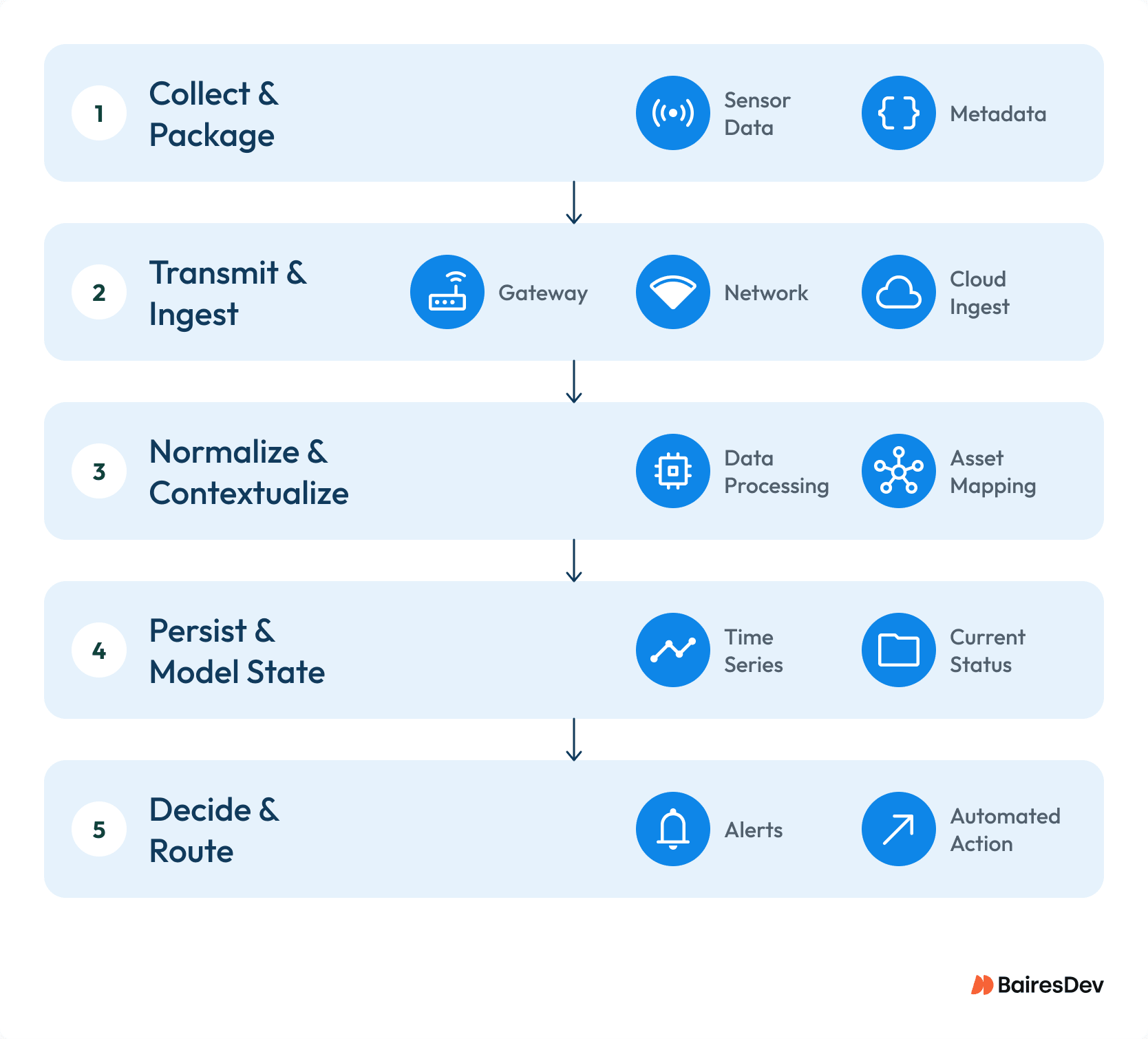
Reduce that risk by defining IoT data flow as a decision pipeline:
Stage 1: Collect and Package
At the edge, devices connected to the physical world define sampling rate, batching, metadata, and clock quality. If you don’t specify what metadata is mandatory (firmware version, device identity, calibration state), you inherit whatever the vendor chose.
Stage 2: Transmit and Ingest
Connectivity layers decide how to exchange data under loss. What’s your position on retries, duplication, and backpressure? Is idempotency enforced so replays don’t create downstream confusion? Many IoT networks fail not because they drop packets, but because downstream systems interpret retries as new events.
Stage 3: Normalize and Contextualize
Raw IoT data must be bound to asset context: which site, which industrial devices, which maintenance history. Schema drift across vendors can silently corrupt analytics. At scale, data management is governance, not storage.
Stage 4: Persist and Model State
Separate historical data storage from trusted “current state.” Applications shouldn’t reconstruct truth independently. Define where authoritative state lives.
Stage 5: Decide and Route
An IoT application earns its budget when it reduces human intervention. Alerts must route into existing business processes: CMMS tickets, dispatch queues, home security systems, healthcare workflows. Not into standalone dashboards.
Edge vs. Cloud Computing: A Continuum, Not a Binary
You don’t choose edge computing or cloud computing because you prefer one architecture. You decide based on how the system must behave under stress.
If you default to cloud-only logic, you’re putting internet connectivity inside the control loop. In industrial settings and transportation systems, that can create operational risk.
Edge vs. Cloud Decision Lens for Enterprise IoT
| Decision Factor | Cloud-Leaning (Central) | Edge-Leaning (Distributed)
|
|---|---|---|
| Latency to act | Depends on backhaul + cloud path | Low; local decisions possible |
| Behavior during partitions | Limited; “act” can stall if network is in the loop | Resilient; can keep operating and reconcile later |
| Bandwidth/cellular cost | Higher if shipping raw/high-frequency data | Lower via filtering, batching, event detection |
| Update/governance | Easier centralized rollout and model governance | Harder: many runtimes/hardware variants to patch and observe |
| Failure domain | Mostly inside your cloud blast radius | Field failures: power, swaps, drift, site variance |
| Best fit workloads | Aggregation, cross-fleet analytics, long-term data storage | Safety/compliance interlocks, local alerts, closed-loop control |
| Operational burden | More centralized SRE/platform | More distributed device/gateway ops and tooling |
| Security posture | Strong centralized controls; still needs device auth | Requires strong identity/segmentation; assumes imperfect endpoints |
| Common pitfall | Assuming wireless networks are reliable enough for control | Underestimating fleet lifecycle + observability needs |
A simple test: what must remain true during a 30-minute outage? What can reconcile later without harming compliance, safety, or customer behavior? That lens clarifies which IoT applications belong at the edge and which fit centralized cloud computing.
Where IoT Delivers Measurable Business Value
IoT enables measurable outcomes when it shortens the time between a physical-world change and an action inside core systems.
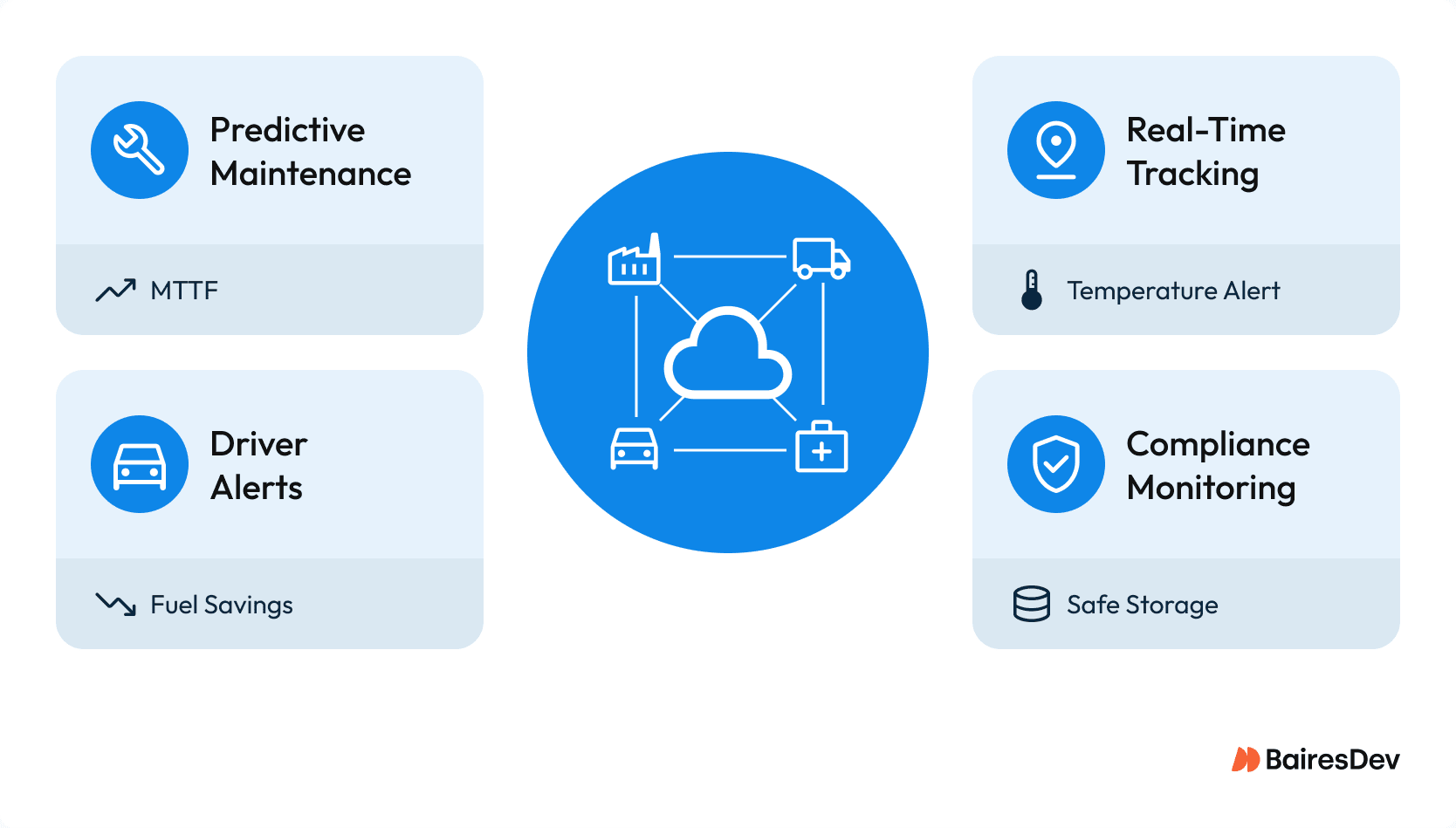
Across industrial IoT applications, high-leverage patterns include:
- Manufacturing and utilities: Manufacturing and utilities: Condition monitoring that reduces unplanned downtime and improves energy management. The measurable shift is fewer emergency shutdowns, tighter maintenance windows, and lower cost per operating hour because degradation is detected early enough to schedule intervention.
- Logistics and fleet management: Connected devices in transportation systems reduce “unknown status” time and improve routing decisions. Connected cars and telematics systems cut fuel waste and improve driver safety when integrated with coaching workflows.
- Healthcare industry: IoT devices that monitor patients remotely or track temperature-sensitive medications only create value when integrated into compliance workflows and audit-ready records.
- Smart buildings and smart cities: Smart thermostats, security cameras, and other internet-connected devices drive energy consumption reductions when tied to automated control systems, not just visualization.
A useful executive test: can you name the downstream system of record and the KPI that moves because IoT data arrives? If not, you’re funding visibility.
What Makes IoT Hard at Scale
At scale, IoT deployments resemble asset operations with software attached. The core failure mode isn’t choosing between network protocols. It’s losing authoritative control over identity and change.
Common failure clusters:
- Device identity and asset binding: You can’t prove which physical devices are installed where, so every incident starts with manual reconciliation.
- Provisioning and lifecycle control: Activation depends on tribal knowledge, creating variance across sites.
- Over-the-air updates: You can’t stage or roll back firmware safely across hardware variants.
- Interoperability: Schemas drift across vendors and other IoT devices, silently breaking integrations.
- Observability: You don’t measure drop rates, clock skew, or version drift as first-class signals.
- IoT security: Segmentation and least-privilege access are deferred until an audit forces redesign.
If you postpone standardization, most IoT solutions won’t scale beyond pilot programs.
Architecture Is the Control Plane
A single compromised endpoint can become a lateral movement problem across interconnected devices and shared services. The difference between a contained incident and a multi-site breach usually comes down to boundaries defined in the network architecture.
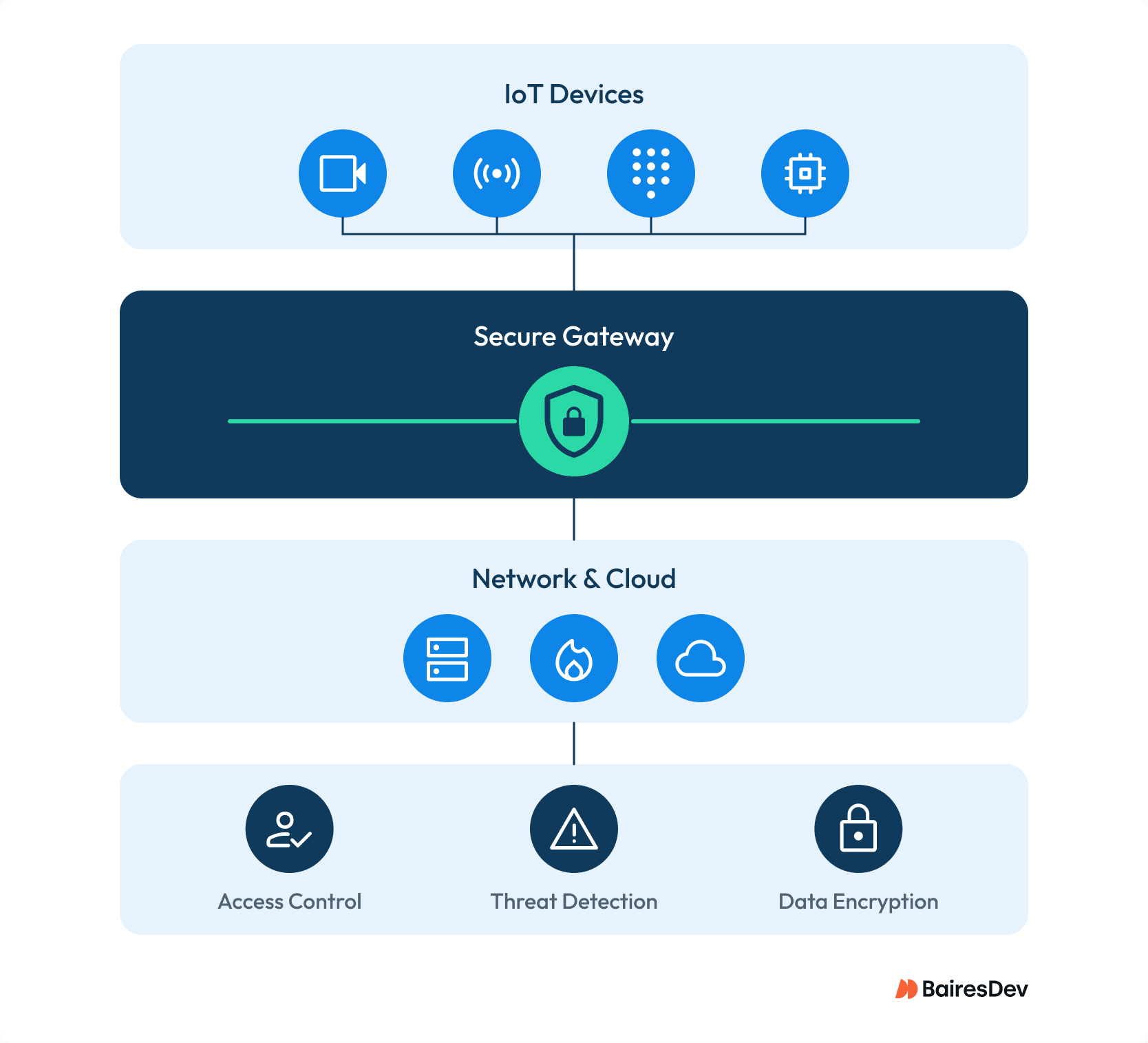
Enterprise-grade IoT platforms require:
- Per-device credentials and strong identity
- Broker or gateway tiers that terminate device protocols
- Signed firmware updates
- Segmentation aligned with least privilege
- Monitoring for drift across fleet management systems
Artificial intelligence and machine learning can assist with anomaly detection, but they don’t replace identity-first architecture. In enterprise IoT, control planes matter more than dashboards.
Running IoT Like Infrastructure
IoT work isn’t an innovation lab. It’s infrastructure with physical consequences. The internet of things IoT model works when ownership is explicit, failure modes are rehearsed, and devices connected across environments are treated as long-term assets.
If you’re evaluating IoT services or internal programs, start with ownership and failure modeling before selecting tools. Architecture decisions will surface later as operational incidents. Design accordingly.