



For years, sustainability was treated as a public relations checkbox. Companies wrote about recycling or LED lighting in annual reports, but it wasn’t a factor in core business strategy. That has changed.
Today, sustainable technology sits alongside cost management, security, scalability, and climate action as a strategic priority for companies. Investors expect it. Regulators are tightening rules. Customers are watching vendor footprints. And inside engineering organizations, the inefficiencies sustainability highlights—waste, high energy consumption, duplication—are the same ones inflating operating costs and slowing delivery.
For engineering leaders, the question is how to weave sustainability into software development, infrastructure, and operations in a way that drives business results.
The Cost of Inefficiency
A lot of attention goes to manufacturing, supply chain emissions, or water usage in data centers. Important, yes—but not the whole picture. Hidden inefficiencies inside digital operations may carry equal weight over time.
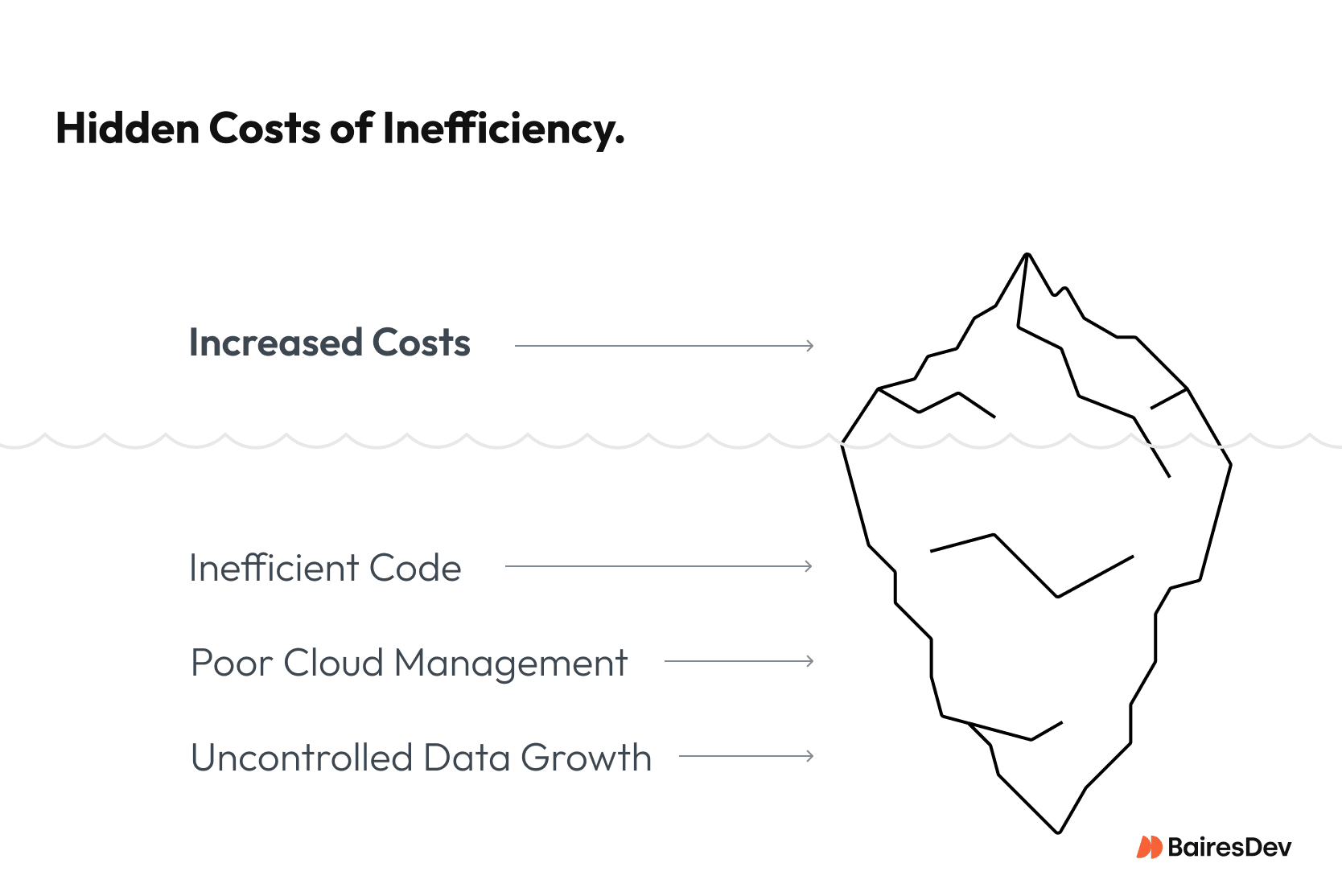
- Inefficient code creates more compute cycles than necessary, inflating costs, driving up power demand, and adding to a company’s overall environmental impact.
- Poorly managed cloud solutions leave instances running idle, increasing spend and carbon footprint.
- Uncontrolled data growth means more storage, more processing, and more electricity generation to support it.
Every extra cycle translates into higher consumption, more emissions, and higher bills. These are real costs—not abstract ESG metrics.
Case Anchors: Proof in Practice
Executives don’t need promises—they need proof. Several enterprises have already shown how operating efficiently and sustainability overlap:
- Pinterest and AWS Graviton: Pinterest migrated one of its busiest workloads to AWS Graviton-based EC2 instances and cut compute resources by 38%, infrastructure cost by 47%, and carbon emissions per request by 62%.
- Salesforce cloud optimization: When Salesforce restructured workloads on AWS, it improved operational efficiency and reduced its carbon footprint by 18%, all while maintaining uptime at four nines. It proved sustainable tech can strengthen, not compromise, resilience.
- Two Sigma compute project: Investment firm Two Sigma instrumented servers to measure actual power usage, then used that data to re-architect code and refresh hardware. The outcome: lower emissions, reduced costs, and better capacity planning across its data centers.
These examples aren’t side projects. They demonstrate that sustainable technology can enhance resilience, reduce costs, and improve financial performance, making a strong case for integrating sustainability into business strategies.
A Playbook for Engineering Leaders
Before talking execution, it helps to see how sustainability reshapes the basics. The table below shows how typical IT practices stack up against sustainable approaches.
| Step | Traditional Approach | Sustainable Technology Approach |
|---|---|---|
| 1. Architect for Optimization | Build for speed, often ignoring waste | Optimize algorithms and frameworks to cut energy demand while improving scalability |
| 2. Apply AI-Powered Solutions | Over-provision resources “just in case” | Use models to forecast demand and reallocate resources in real time |
| 3. Manage Cloud Migration and Operations | Lift-and-shift workloads with little governance | Rightsize, automate shutdowns, and align workloads with renewable-powered data centers |
| 4. Establish a Green Tech Working Group | Leave sustainability to ad hoc initiatives | Cross-functional teams set standards, track KPIs, and scale successful practices |
| 5. Fund Sustainable Innovation | R&D budget goes entirely to product features | Dedicate part of R&D to sustainable performance, new compression methods, and internal sustainability tools |
| 6. Evaluate the Supply Chain | Select vendors mainly on cost | Factor in renewable resources, sustainable manufacturing, and long-term resiliency |
1. Architect for Optimization
The design phase is where performance gets locked in—or wasted. A small algorithmic improvement can save thousands of compute hours at scale. Serverless functions that shut down when idle keep costs predictable. Even framework choice matters: lighter options often run faster and burn less energy. Sustainable design isn’t just a side benefit here; it’s the foundation for scalability and lower emissions.
2. Apply AI-Powered Solutions
AI isn’t only for customer-facing features. Used internally, it’s one of the best levers for sustainability. Models can predict when demand will spike, shift resources automatically, and cut over-provisioning. This kind of automation lowers cloud spend while reducing your carbon footprint. It’s smart resource management that pays twice.
3. Manage Cloud Migration and Operations
Simply moving to the cloud doesn’t guarantee optmization. In fact, unmanaged workloads often balloon costs. Rightsizing instances, scheduling dev environments to sleep after hours, and running workloads in renewable-powered data centers are practical ways to trim waste. The dashboards from AWS, Azure, or Google Cloud now make both costs and carbon visible—a shift that turns sustainability into an operational metric, not a side note.
4. Establish a Green Tech Working Group
Sustainability stalls when it’s nobody’s job. A small cross-functional team can set internal standards, measure progress, and share wins across the org. Simple KPIs—like energy usage per transaction—give leaders hard data to track improvements. The point isn’t to slow teams down; it’s to make sustainability part of normal engineering practice.
5. Fund Sustainable Innovation
Every R&D budget has room for green tech. Maybe that’s experimenting with data compression to shrink storage needs, or testing edge computing to lighten the data center load. Internal dashboards that track energy usage can spark healthy competition between teams. Investments like these pull double duty: they advance sustainable performance and move you toward your sustainability goals.
6. Evaluate the Supply Chain
Engineering leaders can’t ignore the upstream. The APIs, frameworks, and vendors you choose either reinforce or undermine your sustainability strategy. Prioritizing suppliers who use renewable resources or sustainable manufacturing makes the entire operation more resilient. These decisions ripple outward, amplifying your own efforts.
Even with a clear roadmap, execution isn’t always straightforward. Competing priorities, legacy systems, and overcommitted teams can slow momentum. Many leaders find that while the vision for sustainable development is strong, the internal bandwidth to deliver it consistently is limited. That’s why the role of external partnerships becomes so important.
Overcoming Challenges with Partnerships
We’re all familiar with the resistance to moving to a more sustainable future. Teams are already stretched, and “green” projects can look like extra work compared to urgent product deliverables.
That’s where external partners create value.
- Specialized expertise: Re-architecting systems for energy efficiency or deploying AI powered optimization requires niche skills. A partner with a proven track record accelerates delivery.
- Faster outcomes: While your teams focus on core features, a partner can handle cloud infrastructure tuning, data center projects, or sustainability dashboards in parallel.
- Reduced risk: Instead of recruiting hard-to-find talent, you can onboard dedicated teams in weeks. That reduces overhead and keeps momentum strong.
For executives under pressure to achieve sustainability goals without slowing delivery, partnerships provide a pragmatic route forward.
The Strategic Upside
Sustainability has moved beyond compliance or branding—it’s now tied directly to efficient performance, supply chain resilience, and sustainable development goals that impact the bottom line. For engineering leaders, the advantages are tangible:
- Reduced operating costs: Lower energy, fewer idle resources, lower cloud spend.
- Improved resilience: Energy efficient systems are more scalable and less brittle.
- Better talent retention: Engineers increasingly want to work at companies aligned with sustainable development goals.
- Investor confidence: Companies that can show progress on climate action attract favorable capital.
The overlap between profitability and sustainability isn’t coincidental—it’s structural.