

Data should be central to any retail strategy. Why? The ability to capture and analyze patterns in customer behavior unlocks new opportunities and promises to change the way the retail industry operates.
As retail operations expand, so does the complexity of data. The line between e-commerce and brick-and-mortar operations is becoming blurred, at least from a data perspective. Higher customer data volume, variety, and velocity demand scalable analytics platforms capable of integrating inputs from multiple channels.
Done well, these systems improve profitability, operational efficiency, and customer loyalty — all while keeping pace with the evolving demands of the retail industry.
This article looks at where big data delivers the most value in retail, how to analyze data, operationalize it, and the tools that can accelerate your results.
Big Data Analytics
Retailers generate enormous datasets every day, including transactions, loyalty interactions, supply chain movements, online browsing histories, and more. Through big data development services, organizations can operationalize big data analytics, applying advanced techniques such as predictive analytics and machine learning to identify patterns, forecast demand, and guide decisions.
At an enterprise level, the objective is execution. For example, predictive models can help avoid costly overstocks and stockouts across hundreds of locations, ensuring efficient inventory management. Pricing algorithms can adjust in real time based on market trends, historical sales data, competitor activity, and margin targets. Customer analytics can surface microsegments for targeted customer segmentation, enabling marketing spend to flow where it produces the highest return.
Big Data In Retail
At the heart of every business is a wide variety of decisions about inventory, vendors, locations, floor plans, e-commerce, and, of course, your customers.
Historical and real-time datasets — when properly integrated — reveal patterns in customer preferences that would otherwise be missed. For instance, foot traffic analysis might show that customers respond better to proactive staff engagement than previously assumed. Acting on that insight can change service training, staffing patterns, and ultimately, revenue per visitor.
The challenge is integration. Enterprise retail data often lives in silos — POS, e-commerce platforms, CRM, supply chain systems — with inconsistent formats. A unified data architecture, supported by automated ETL processes and robust governance, is crucial for high-confidence analytics.
What You Can Gain
Following the BairesDev blog post, “There are many use cases for predictive analytics in retail, which give companies a competitive edge in the market.”
When analytics is fully incorporated into retail operations, your business can:
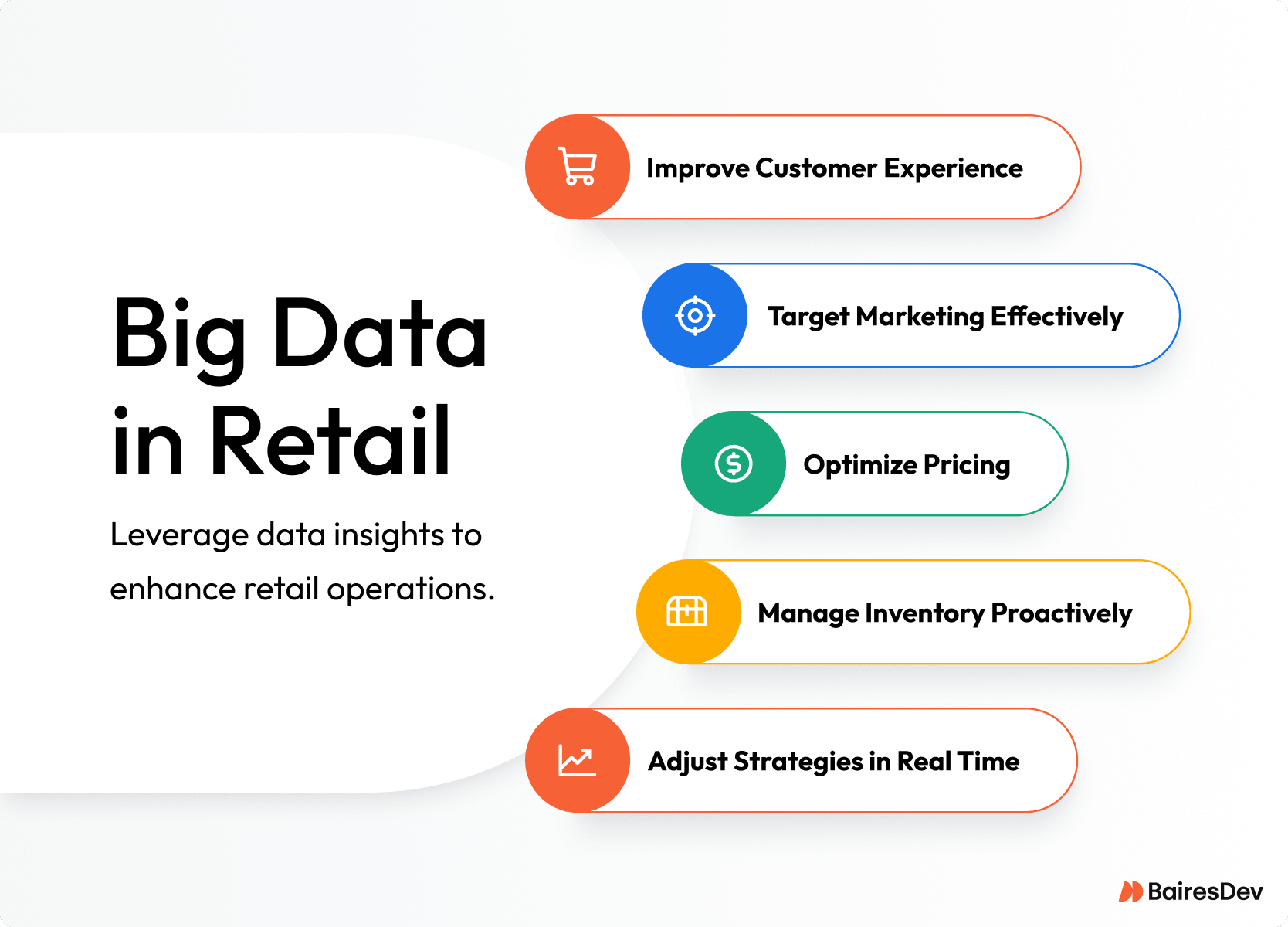
- Improve customer experience by combining in-store and online interaction data to deliver relevant offers and services.
- Target marketing more effectively through microsegmentation, tailoring campaigns by behavior, geography, and channel.
- Optimize pricing with models that balance margin and volume using real-time data, purchase history, inventory levels, and competitive data.
- Manage inventory proactively with forecasts that reduce markdowns and prevent out-of-stock losses.
- Adjust strategies in real time as market signals and customer behaviors change.
Implementation
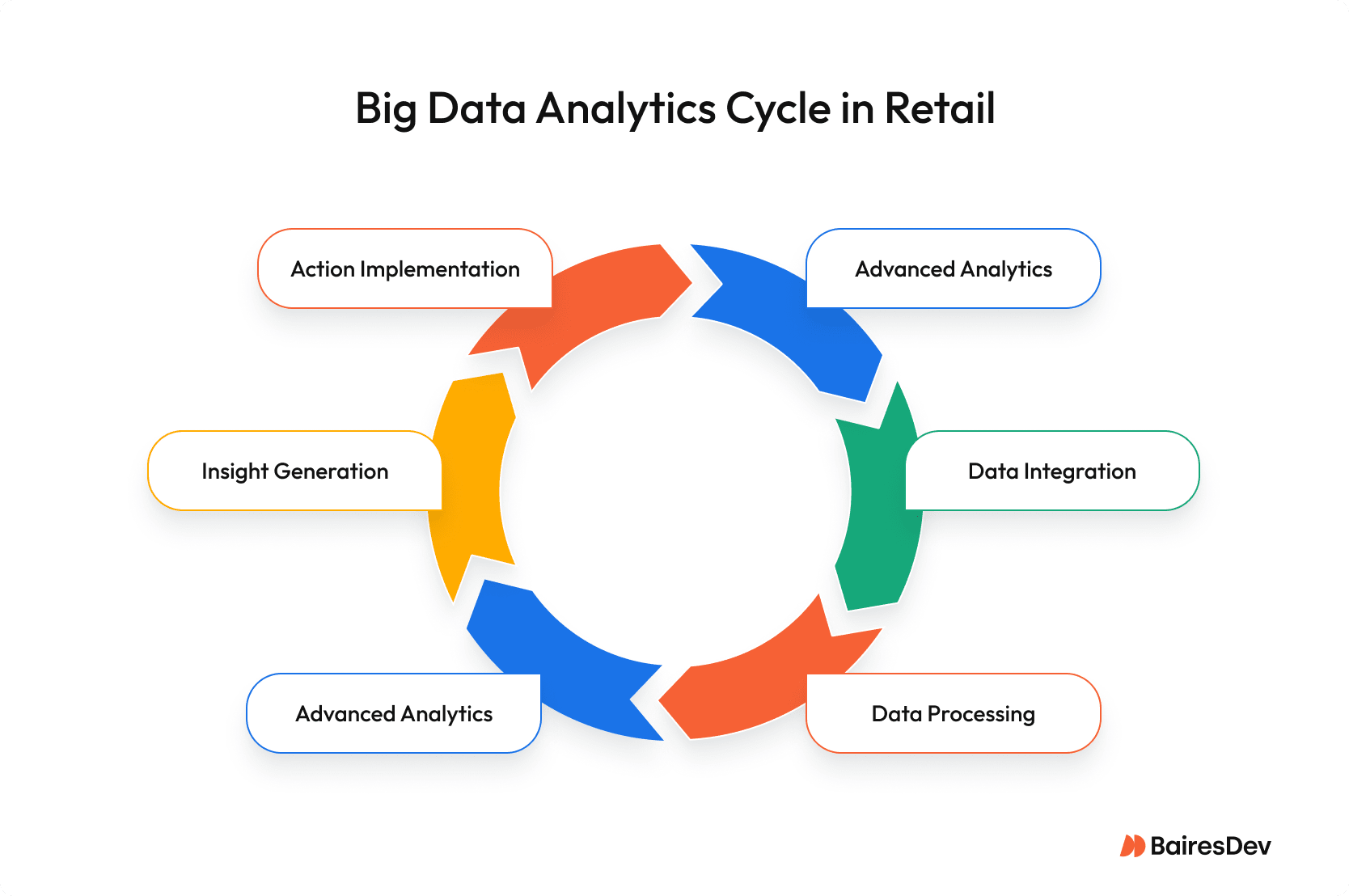
Implementing big data analytics in retail requires a strategic approach. Retail companies must identify goals and objectives, such as improving customer satisfaction or optimizing inventory management. Then it’s time to start collecting and integrating historical data from various sources, including customer interactions, sales data, and supply chain management.
The data is processed using advanced analytics techniques, such as predictive analytics and machine learning algorithms. You also need to ensure that your data is accurate, complete, and up-to-date.
Your Big Data Strategy
But where should you start? It’s actually not nearly as difficult as you might think.
- Integrating diverse data sources — POS, ERP, e-commerce, marketing platforms, and logistics systems — into a centralized architecture.
- Applying advanced analytics such as predictive modeling, clustering, and natural language processing to surface insights.
- Maintaining data quality through governance, validation, and cleansing processes that scale across all channels and locations.
- Ensuring security and compliance with regulations such as PCI DSS, GDPR, and CCPA.
Partnering with individual data scientists and teams experienced in high-volume retail analytics can shorten the time from implementation to measurable ROI, especially when in-house bandwidth is limited.
How Big Data Drives Retail Performance Long Term
Beyond immediate operational gains, big data in retail also enables long-term strategic planning. If you combine market trend analysis with customer lifetime value models, you can identify which segments are most profitable to retain and which markets to expand into.
This forward-looking approach relies on integrating retail analytics with broader business intelligence platforms, giving executives a single view of performance drivers across sales, marketing, and supply chain. For large enterprises, aligning these insights with capital planning and product roadmaps ensures that data-driven decisions translate into sustainable growth rather than short-term wins.
Big Data Applications
Big data is used across different functions in the retail industry. Organizations must consider how to effectively manage data from multiple sources, often with varying degrees of quality and reliability.
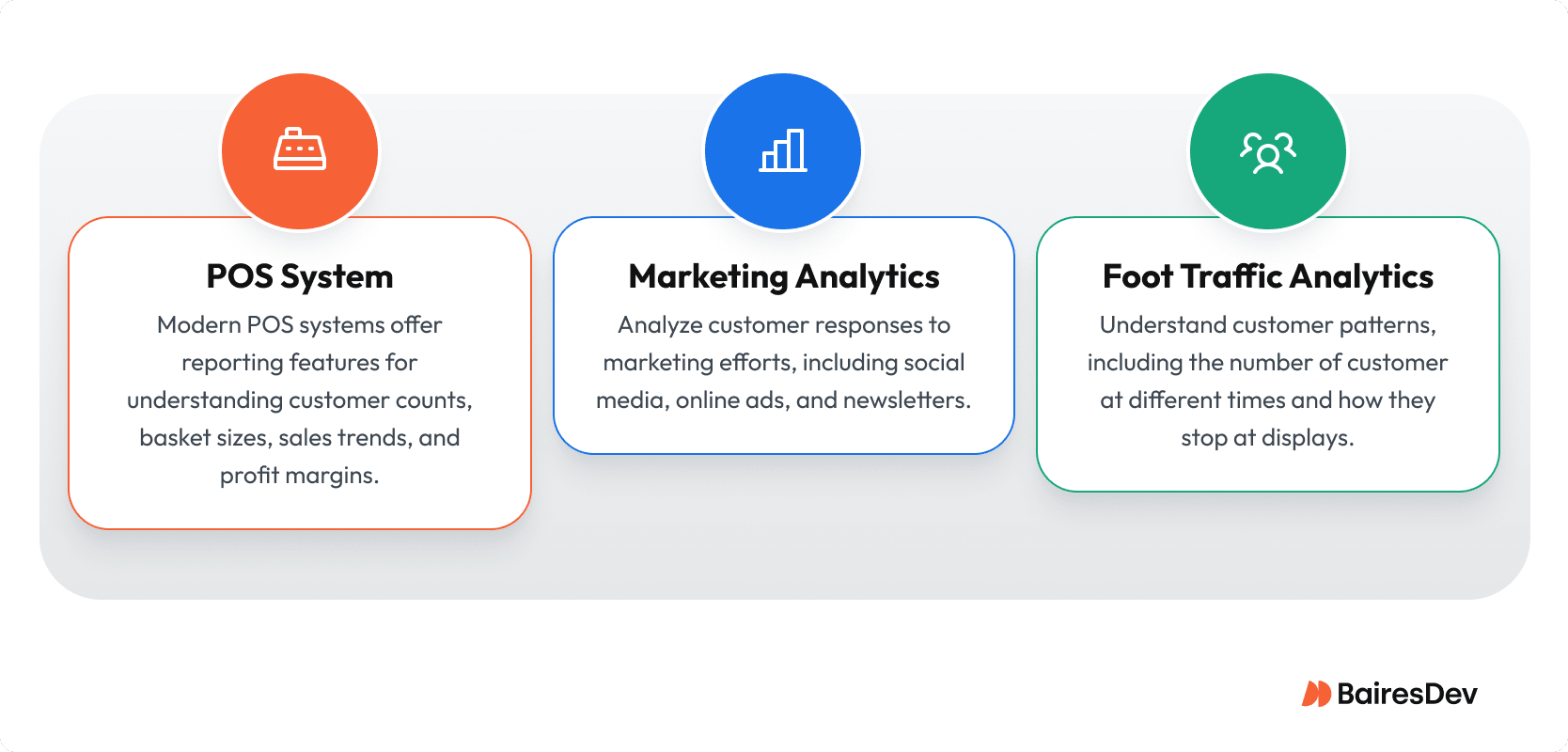
- POS systemCertainly, you’re very familiar with point of sale (POS) systems. Data collected by POS systems can be used for much more. Modern systems include reporting features that can help leaders understand things like customer counts, basket sizes, sales trends or profit margins. Interpreted correctly, POS data can deliver valuable insights that tend to be overlooked.
- Marketing analyticsYou can analyze customer responses to marketing efforts, including social media, online ads, and newsletters. For example, newsletter platforms can calculate helpful metrics like open rates, average engagement time, and number of clicks. These data points can be used for customer sentiment analysis, allowing companies to improve brand loyalty and enhance customer satisfaction.
- Foot traffic analyticsFoot traffic is another area that can provide valuable data that can help you understand customer patterns, including the number of customers at different times of the day, week, month, and year, as well as how long they stop at certain displays. This information is useful for making staffing decisions and determining which products to continue selling. The rise of IoT and video processing capabilities allows retailers to optimize operations easier than ever.
The Future of Retail Analytics
As we have seen, the amount and speed of data have increased. So have the abilities of computers to process that data. Artificial intelligence (AI) and machine learning (ML) solutions are getting better at data mining for useful insights and will continue to get smarter.
In addition to being able to summarize past activity and evaluate what’s happening now, these technologies are helping companies predict what’s to come. Historical sales data now helps predict demand. CCTV footage is no longer used solely for security, but to track traffic and customer behavior.
What will such insights enable companies to do? For one, it will help them make their services more personalized. For example, if a business can predict what a customer will buy, it can offer it to them in advance, perhaps with a special discount.
If a company can determine the likelihood of a competitor’s next marketing campaign, it can counteract it with its own. Predictive analytics enables retailers to anticipate changes in consumer behavior and stay ahead of future trends.
The bottom line is that the future of retail is based on relevant predictions and the ability to act on them in effective ways.