

XaaS stands for “Anything as a Service” (or “Everything as a Service.”) It’s the delivery of products or resources over the internet, typically on a subscription basis or pay-per-use. XaaS covers cloud providers and a wide range of scalable services.
Instead of buying technology outright, XaaS uses models like software as a service (SaaS) and infrastructure as a service (IaaS). It can meet vertical market demands like artificial intelligence or public cloud services to scale computing power or storage on demand. The general idea is to cut down on waste and optimize spend.
XaaS lets business leaders fit technical execution to rapid market shifts. Amazon CTO Werner Vogels has repeatedly stressed that AWS adoption can unburden developers, eliminating heavy-lifting tasks so they can innovate more. The API economy lets organizations build and launch disruptive products faster, with a single pane of glass across their services.
While XaaS solutions promise increased operational efficiency, it’s no mere buzzword. Leaders committed to cloud-based services must understand XaaS so they can correctly evaluate their partnership options and design for resilience and security. Approached strategically, the benefits of XaaS can provide significant competitive advantage.
Why XaaS Matters
There are 32,000 SaaS companies, serving billions worldwide. Put another way, the average company uses 254 SaaS apps.
The SaaS market size grows by roughly 150% each year. This surge in cloud service models is creating massive opportunities for startups. At the same time, it’s making scalable disaster recovery both easier (because of cloud infrastructure resilience) and harder (because of third-party risk).
Let’s break down what this trend looks like for your business model, and why leaders from Marc Benioff to Satya Nadella are doubling down on XaaS offerings. It’s tempting to treat the SaaS app explosion as just a tech stat, but choosing the right mix can determine your business’ future.
XaaS Models
More XaaS does not mean more simplicity. In fact, the explosion of service models has made strategic oversight tougher for most tech leaders. For instance, each abstraction from bare metal to software applications can introduce both efficiency and complexity.
Below, you’ll find a representation of the XaaS abstraction stack. Use it to help visualize where different service models do and what they hide.
| Model | Stack Layer | Abstracted Components | Core Problem Solved | Example Providers |
| SaaS (Software as a Service) | Application | App logic, runtime, data, infrastructure | Fast access to apps without dev or ops overhead | Salesforce, Google Workspace |
| PaaS (Platform as a Service) | Platform | Runtime, OS, infrastructure | Speeds up app development without managing infrastructure | Heroku, Google App Engine |
| IaaS (Infrastructure as a Service) | Infrastructure | Virtualized servers, storage, networking | Scalable infrastructure without buying hardware | AWS EC2, Microsoft Azure |
| FaaS (Function as a Service) | Function | Server, runtime, scaling logic | Run code on-demand without managing servers | AWS Lambda, Azure Functions |
| DaaS (Desktop as a Service) | Application | Desktop OS, app hosting, device management | Secure remote desktops, simplify endpoint control | Citrix, Amazon WorkSpaces |
| CaaS (Containers as a Service) | Application | Container orchestration, deployment pipeline | Consistent environments for scalable deployment | Azure AKS, Google Kubernetes Engine |
| AaaS (Analytics as a Service) | Application | Data platform, analytics stack, visualizations | Enable big data insights without building full analytics infra | IBM Cognos, AWS QuickSight |
Benefits of XaaS
Firefighting infrastructure runs counter to sustainable operations. XaaS lets your team shift from reactive to strategic. It allocates talent to delivery instead of server maintenance. Below are the benefits engineering leaders get when they adopt XaaS solutions.
- Faster delivery cycles: XaaS compresses provisioning windows, enabling faster time-to-market for software applications that support cloud based services and evolving business needs.
- Elastic scaling: Dynamically match infrastructure resources to real-time market demands without over-provisioning or relying on fewer servers.
- Improved cost visibility: Transition from capital expenditures to subscription basis billing, exposing hidden fees and surfacing total cost across different services.
- Operational agility: XaaS enables users with remote access and secure cloud computing from any internet connection, enhancing disaster recovery readiness.
- Talent leverage: Free teams from maintaining underlying infrastructure, allowing focus on creating apps and increasing operational efficiency.
Risks
Imagine flipping through your business dashboard and counting over a hundred subscription apps. The hair-raising truth is that you don’t need to stretch your imagination too far. Most companies’ tech estate sprawls across shadow IT, with disparate teams buying their own Google Apps or specialized tools. Compliance reviews spark nail-biting sessions over whether any of those could trigger a data breach.
Security isn’t the only risk. vendor lock-in and hidden costs can wreak more havoc than a DDoS attack. Leaders must balance the resources that enable agility with structured governance.
- Loss of Control: Reduced visibility and ownership of cloud service models is common. Establish centralized access management policies and use monitoring tools to regain oversight of underlying infrastructure.
- SaaS Sprawl: Shadow IT and unapproved web services fragment your stack. Perform regular audits and centralize procurement to align with core business processes.
- Hidden Costs: Hidden fees can derail budgets. Use cost dashboards and enforce spend control. Clarify total cost of ownership (TCO) with each XaaS provider before committing.
- Security & Compliance: Patchwork security leads to compliance drift. Embed security into procurement workflows and apply guardrails for technical support and data storage.
- Vendor Lock-In: Switching costs are high when using various services. Prioritize open APIs, negotiate exit terms, and multi-source critical workloads to stay flexible and cost effective.
XaaS Use Cases
A healthcare CIO uses healthcare as a service (HaaS) to unify patient analytics and reduce response times, all without a hospital expansion. Strategic XaaS categories aren’t just futuristic ideas. They’re the drivers behind transformative results for every industry. Here’s how real companies deliver measurable value by embracing the broader concept of “anything as a service.”
Healthcare
Hospitals facing pressure on capacity migrated medical analytics to HaaS, gaining rapid internet reliability and secure access to patient data from any location. This eliminated silos while supporting regulations like HIPAA. You could see a dramatic improvement in cross-site collaboration without racking up undue technical debt.
Finance
Major banks have used SaaS to simplify front-end services. Capital One shut down all its data centers and migrated to the cloud to improve innovation and fraud detection. SaaS-based controls helped them stay ahead of regulatory landscapes.
Retail
Large retailers that adopted IaaS solutions scaled up infrastructure to handle holiday traffic. For example, Kohl’s migrated its ecommerce platform to Google Cloud, letting it meet holiday demand spikes more efficiently.
Application Development
SaaS startups can reduce application development cycles by adopting a PaaS model that frees engineers from managing infrastructure. Snap Inc. migrated core services to Google App Engine and Cloud Spanner. The move let them iterate faster and reduced operational overhead. The shift allowed teams to focus on features over firefighting.
XaaS Implementation Checklist
You could walk into your next board meeting ready to present a modernization strategy that delights every C-level peer. You’ve mitigated legacy drag and checked every governance box. You’ve also mapped your workloads to the right XaaS models. Cloud-first mentality can give your roadmap traction.
- Strategic Alignment: Leadership can articulate how XaaS adoption directly supports core business or transportation services objectives.
- Governance and Compliance: Policies and guardrails are in place before service expansion.
- Right-Sized Workloads: You’ve analyzed where consumption-based pricing makes sense versus legacy on-prem spend.
- Technical Readiness: Teams have XaaS skills with security ready for prime time.
- Cultural Buy-in: Organization is prepared for process agility, not just picking tools.
- Vendor Risk: Contracts address exit plans and minimize lock-in.
XaaS Best Practices
Their rollout was smoother than slipping into Allbirds Wool Runners before a keynote. Every department stayed two steps ahead. Teams avoided major rework—and thanks to staged rollouts, nobody lost sleep over always-on services. Here’s how to get to that holy grail of adoption.
- Pilot Programs: Start with a small, representative workload to validate integration paths, identify edge-case performance issues, and surface unexpected costs. Use results to harden architecture before scaling across business operations.
- Framework Adherence: Align with NIST or equivalent security frameworks to preempt gaps in access control. This is especially critical when adopting cloud computing models that span multiple service providers.
- Centralized Monitoring: Implement a single dashboard with alerting and audit trails across your full stack. This helps correlate issues between application layers and underlying infrastructure.
- SLA Rigor: Define SLAs that include uptime targets and support response windows. Insist on contractual clarity from XaaS providers to ensure accountability in critical paths.
- Multi-Provider Strategy: Source similar capabilities from multiple service providers. Adopt a cloud-agnostic deployment model using containers to retain flexibility.
- RBAC: Enforce role-based access controls (RBAC) to uphold least-privilege principles. Tight integration with identity providers reduces risk in complex service chains across public and private cloud environments.
- Cost Review: Schedule quarterly reviews of total cost of ownership. Flag services with cost growth that outpaces usage, especially in areas with metered pricing and fluctuating workloads.
- API Economy: Favor platforms with clean documentation. Seamless integration helps teams stay on the same page. That cuts down on rework and avoids brittle point-to-point connections.
KPIs to Track XaaS Adoption
For engineering leaders, KPIs validate whether the shift to a service model is unlocking operational gains.
In the XaaS market, consumption-based pricing gives every decision a measurable impact. Tracking the right metrics lets you demonstrate value and adjust course based on performance. These five KPIs reflect whether your service investments are delivering all the benefits your exec team expects.
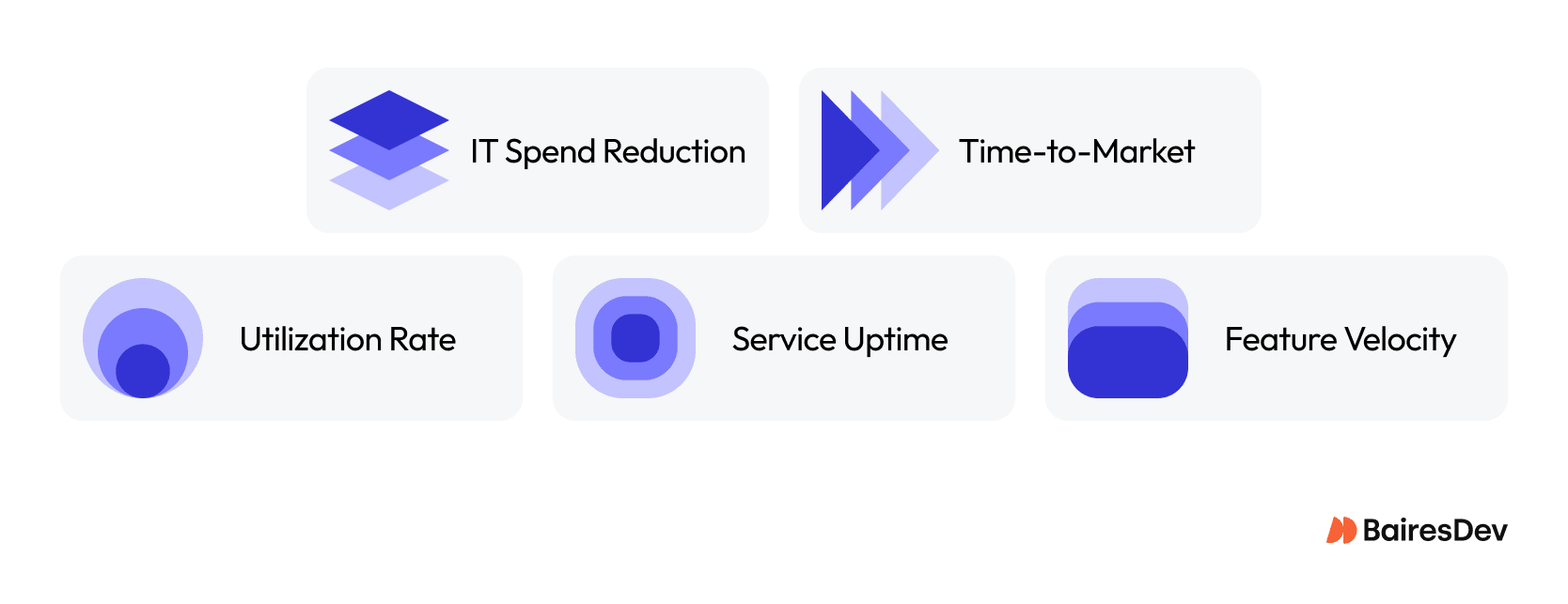
IT Spend Reduction
Compare OpEx run rates to legacy CapEx costs. This reveals tangible savings tied to infrastructure decommissioning and workload migration to platforms like Google Compute Engine.
Time-to-Market
Track delivery cycle time from feature request to production. Reduced provisioning overhead means faster deployment and a tighter feedback loop with users.
Utilization Rate
Calculate actual resource consumption vs. provisioned capacity. This KPI flags overprovisioning and helps optimize scaling strategies.
Service Uptime
Measure uptime improvements after adoption. Enhanced reliability from XaaS providers often translates directly into stronger SLAs and reduced user impact during peak loads.
Feature Velocity
Monitor feature releases per sprint or quarter. Technological advancements help teams ship faster by removing infrastructure maintenance bottlenecks.
The Future of XaaS
The next decade of XaaS is architecture-first. Firms that design for modularity will outpace those tied to legacy thinking.
As AI and other technological advancements reshape expectations, XaaS lets teams absorb change without rewriting entire systems. The ability to experiment and scale with service providers will separate the fast movers from the followers.
To stay competitive, treat your XaaS stack as a strategic asset. Start by auditing your SaaS portfolio to find redundancy. Pilot a team to test next-gen workloads like real-time analytics using platform as a service. Building this muscle now helps ensure you capture all the benefits XaaS models offer before your competitors do.