



In today’s fast‑evolving enterprise landscape, agility isn’t optional. It’s a prerequisite. Digital transformation programs, regulatory shifts, M&A activity, and global disruption all demand that large organizations adapt quickly while minimizing operational risk. Change management—once treated as a procedural back‑office discipline—now requires intelligent tooling to keep pace. For senior technology leaders such as CIOs, CTOs, and heads of IT strategy, change management software has become a critical enabler of structured, scalable, and trackable transformation.
The complexity of orchestrating change across vast IT infrastructure and multiple business units can be paralyzing. Traditional, manual processes—email threads, spreadsheets, siloed documentation—fail to provide the real‑time oversight and coordination necessary. Enterprise change is no longer episodic; it’s continuous. Whether rolling out infrastructure upgrades, shifting to new service providers, restructuring workflows, or overhauling ERP platforms, the ability to manage change at scale is vital for maintaining operational control and momentum.
This article explores how modern change management software supports enterprise initiatives, what to look for in a platform, and the essential steps for successful implementation.
Why Modern Change Management Is an Enterprise Imperative
Change management software equips organizations with structured tools to minimize operational disruptions, mitigate compliance and security risks, align cross‑functional teams around shared transformation goals, and accelerate delivery by standardizing and automating approval flows. Just as important, these platforms bring transparency and traceability to change. Manual processes rarely achieve either—especially at enterprise scale.
The Velocity–Stability Trade‑Off in Complex Organizations
The primary strategic challenge in enterprise IT is balancing the need for rapid feature delivery with the absolute necessity of stability. Every change request introduces potential instability. In complex, interconnected environments, the fallout from a poorly managed request can cascade across systems, affecting thousands of end users.
Modern change management shifts the focus from merely documenting changes to actively predicting, controlling, and enabling them. The goal is change enablement: giving IT teams the ability to execute standard updates and requests quickly, with minimal friction.
The Unseen Costs of Manual Change Processes
Manual change processes are incubators for human error. And in a global enterprise, even a single misstep can ripple across thousands of users. These processes rely on individuals to complete risk assessment forms, notify the right stakeholders, and update multiple systems—all by hand. The result is slow approval cycles and a high frequency of failed changes.
According to research from Culture Partners, organizations that invest in structured change management typically see ROI ranging from 3:1 to 7:1. Projects with strong change management are about seven times more likely to meet objectives than those with weak practices.
Here’s a comparison summarizing the difference between manual and automated approaches:
| Feature | Manual Change Process | Automated Change Management Software |
| Risk Assessment | Subjective, spreadsheet‑based | Automated risk scoring using historical data and dependencies |
| Approval Flow | Sequential emails, slow decisions, human error | Rule‑based routing, simultaneous approvals, automatic for standard change |
| Audit/Compliance | Labor‑intensive, often incomplete post‑facto | Comprehensive, real‑time logging; auditable trails across the organization |
| Productivity Impact | High administrative overhead for stakeholders | Lessening manual effort allows IT teams to focus on value delivery |
Core Pillars of Enterprise‑Grade Change Management Software
Effective enterprise change management software is more than just a ticketing system. It’s a platform designed to embed governance and control into the delivery lifecycle.
Automation and Workflow Control
The defining feature of modern management software is the ability to automate repetitive tasks. This includes auto‑categorizing a request, calculating a preliminary risk score, and routing it to the appropriate stakeholders. Platforms should offer customizable, rule‑based workflows that streamline the lifecycle—from initiation and impact assessment through to approval, implementation, and post‑change review.
This capability allows organizations to manage and promote change efficiently, reducing administrative load and speeding up time‑to‑decision. A major gain is the auto‑approve function for standard and low‑risk changes. By defining a standard change (for example, patching a non‑critical server), the platform can confirm it instantly. That drastically improves efficiency while maintaining strict control.
Advanced Risk Assessment and Impact Analysis
For large‑scale, complex environments, simple checklists are insufficient for risk management. Top‑tier change management tools utilize automated dependency mapping to help teams evaluate downstream effects of proposed changes, significantly minimizing the risk of cascading failures or unexpected outages.
The risk assessment should be quantitative and data‑driven, factoring in source code history, configuration items affected, and previous change failure rates. This is vital for identifying high‑risk changes and ensuring that proper remediation resources are allocated. The ability to simulate the impact before deployment ensures that IT teams can plan effectively and minimize risk.
Integrating the Change Ecosystem
A siloed change management tool will fail. In practice, the platform must integrate seamlessly with the broader IT ecosystem. This means deep integration with:
- IT Service Management: Linking with the service desk (such as Jira Service Management) ensures that requests originate where needs are identified and remain tied to incidents.
- DevOps and CI/CD pipelines: Changes originating in development (for example, a source code commit) should automatically populate a change request or trigger pre‑approved change paths. This bridges the traditional gap between development and operations, enabling faster delivery.
- Communication platforms: Integration with Microsoft Teams or Slack allows for rapid notification and approval requests, fostering clear communication among stakeholders and the wider organization.
Governance and the Change Advisory Board
The CAB remains central to enterprise governance, particularly for complex changes or high‑risk initiatives. Modern change management software supports the CAB by:
- Providing clarity: Offering a unified, real‑time view of all pending changes, their risk scores, and impact analysis summaries.
- Automating CAB scheduling: Flagging only those requests that truly require human review, based on predefined risk thresholds.
- Documenting decisions: Automatically logging the CAB’s final approval or rejection, complete with notes, directly into the change request record.
Strategic ROI: Beyond the IT Team
The return on investment for change management software extends far beyond process compliance. It’s about enabling high‑speed, low‑risk business execution for the entire organization.
Accelerating Delivery and Boosting Productivity
By eliminating repetitive tasks and leveraging automation, change managers and IT teams reclaim valuable time. The ability to auto‑approve low‑risk, standard change requests means developers aren’t blocked waiting for procedural sign‑off. This focus on lessening manual effort directly translates into higher efficiency and faster delivery of value‑driving features.
Platforms also provide insights into where bottlenecks occur in the change process. For example, identifying an average approval time of five days for a specific department allows the change manager to target that workflow for optimization. The result is sustained, continuous improvement.
The Automated Change Management Process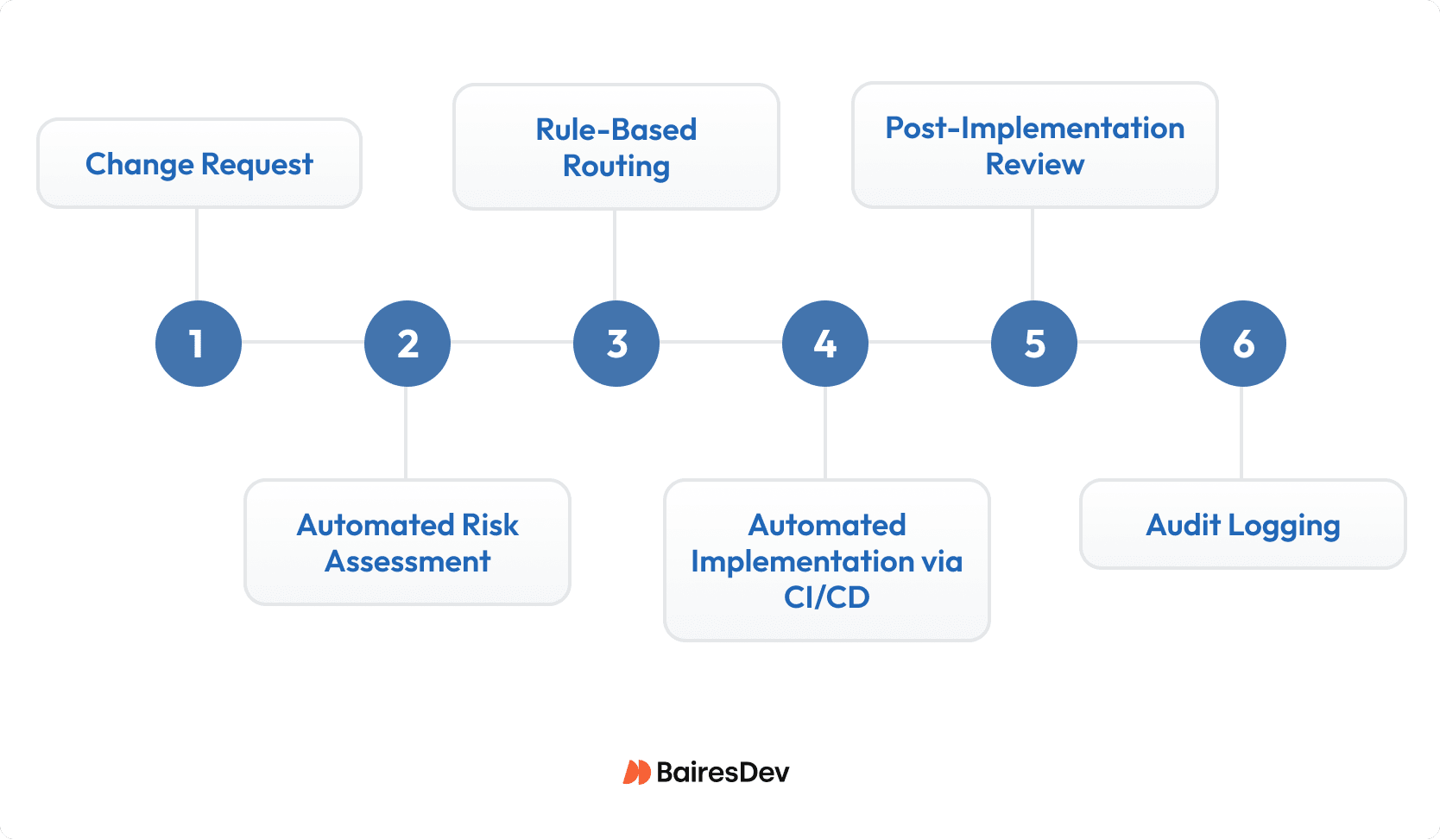
Compliance, Auditability, and Data‑Driven Decisions
Compliance is non‑negotiable for large enterprises. Regulators don’t accept excuses, and neither should internal governance teams. Modern change management tools deliver comprehensive audit trails and documentation, automatically logging every action, comment, and decision tied to a change request. This level of detail is critical for meeting stringent external regulations (SOX, HIPAA, ISO 27001) as well as internal mandates.
Just as important, the data generated by these platforms—approval times, failure rates by team, change volume—becomes a strategic asset. Leaders can use these engineering KPIs to make data‑driven decisions about resource allocation, training needs, and process re‑engineering. Tracking the success rates of different change types allows management to refine plans and move toward a more predictable, lower‑risk delivery model.
Implementation: Build, Buy, and Adoption Strategy
Enterprise leaders face a fundamental decision: invest in a commercial platform or build a custom solution. Both paths can work, but success depends on a robust adoption strategy reinforced by organizational change management. Without that, even the most advanced platform will stall.
Key Evaluation Criteria for Platform Selection
When evaluating commercial change management software, senior leaders must look beyond feature checklists and assess long‑term fit.
| Evaluation Criteria | Description | Strategic Question |
| Scalability & Architecture | Can it handle projected change volume across multiple business units and geographically dispersed teams? | Will this platform support growth for the next five years without performance degradation? |
| Total Cost of Ownership | Beyond licensing: support, maintenance, and integration costs across the organization. | Is the long‑term ROI justified against operational expense and potential vendor lock‑in? |
| Usability & Adoption | Intuitive interface and native integration with daily tools like Microsoft Teams. | Will end‑users adopt it willingly, or will they route around the new process? |
| AI Capabilities | Advanced features such as automated risk assessment, impact prediction, or root‑cause analysis. | Can it genuinely reduce human error and process normal changes faster than current methods? |
Navigating Organizational Change Management Challenges
Technology implementation is only half the battle. Adoption depends on organizational change management, and people naturally resist new processes—especially if they feel like added bureaucracy.
- Executive Buy‑in and Communication: The mandate must come from the top. Clear, continuous communication that emphasizes benefits—reduced manual effort, improved stability, faster delivery—matters more than compliance rhetoric.
- Stakeholder Engagement: Involve change managers and stakeholders early in design and testing. Tailored training and early access create internal champions who drive adoption.
- Iterative Rollout: Start small. Pilot the new process in a low‑risk department or for standard change requests only. Demonstrate early wins, gather feedback, and expand gradually. This minimizes disruption and builds confidence.
The Engine of Continuous Transformation
In an era where operational agility determines market relevance, managing change systematically is no longer optional. Modern change management software brings discipline to the chaos, giving senior technology leaders the ability to move fast without breaking things.
Think of it this way: the internal developer platform provides self‑service tools for developers, while the change management platform provides governance and guardrails. Together, they enable the organization to manage change predictably and at scale.
Selecting the right platform, embedding it into developer workflows, and driving adoption across departments are critical to realizing full benefits. Done well, change management software doesn’t just track changes—it enables continuous improvement and accelerates the path to digital maturity.