



Java multithreading improves performance, but in large organizations it can also amplify failures unless it is governed like any other high-risk capability.
- Teams reach for multithreading under latency, cost, and delivery pressure, often as a substitute for structural change.
- Concurrency risk grows non-linearly when teams “roll their own” thread pools and patterns across services.
- Leaders should learn the signals of concurrency-driven incidents.
- Use a consistent playbook to spot, stabilize, instrument, classify, fix, and standardize.
Why Java Multithreading Fails Differently at Scale
Java-heavy engineering organizations put Java multithreading bugs in a class of their own because they bring down systems faster, defy diagnosis longer, and resist resolution more stubbornly than any other kind of defect. Leaders don’t need to understand the mechanics of Java multithreading to solve these problems. Instead, they need to govern when and how to apply multithreading that meets organizational demands without creating new problems.
Multithreading is a force multiplier for both performance and failures. Problems emerge through the combined weight of concurrency design decisions applied without oversight. The larger the organization, the more this weight causes the risk of failures to increase in a non-linear fashion.
Your leadership contribution is to work with the architects to establish guidelines for all teams to follow. The decision matrix you build includes measures that lead to predictability, risk reduction, and early detection. This governance is not only preventative, it’s also diagnostic.
How Organization Pressures Drive Multithreading Use
Your IT department is under constant pressure to go faster, cost less, and deliver more. The architects talk about sweeping structural changes to meet those goals. That sounds great, but managing such large changes while containing costs and risks requires careful planning. Such accomplishments rarely get completed in time to meet ongoing organizations demands.
In most cases, your only short-term alternative is to apply some kind of optimization to address specific pain points. Concurrency is one type of optimization your teams can apply, but it comes with a different kind of risk:
- Restructuring to improved architecture: Wholesale changes risk losing business rules built across the life of the original architecture. Success can be assured by existing regression tests to make sure features still work.
- Optimizing with concurrency: Optimizing a familiar architecture risks unpredictable behavior changes. Existing regression tests may not trigger these behaviors, so they only emerge in production, usually under heavy loads.
Here are some common pressures that drive your teams to use Java multithreading when they don’t have the freedom to restructure.
| Organizational pressure | What leaders are responding to | Typical multithreading response | Hidden risk introduced |
| Latency pressure at scale | SLAs slipping as traffic, dependencies, and request paths grow | Parallelizing work inside a service to reduce end-to-end response time | Increased contention, unpredictable tail latency, and failures that only appear under peak load |
| Cost pressure | Underutilized CPU cores and rising infrastructure spend | Increasing thread counts to do more work per deployed service instance | CPU saturation, context-switching overhead, and harder-to-predict capacity limits |
| Product pressure for async behavior | Features that require background work, side effects, or long-running tasks | Spawning background threads or using internal executors instead of decoupled workflows | Silent failures, lost work, and background tasks competing with user-facing traffic |
| Delivery pressure | Deadlines that favor incremental changes over architectural redesign | Localized concurrency optimizations in individual services or components | Inconsistent patterns across teams and non-linear growth in concurrency-related risk |
| Operational pressure | Pressure to “fix it quickly” during or after incidents | Adding threads or pools to relieve immediate bottlenecks | Masked root causes, deferred failures, and harder post-incident diagnosis |
You got your marching orders from the organization and you responded in a pragmatic fashion. This is good, but it should leave you asking two questions about each optimization:
- Implemented in sound fashion, or are we going to see the predicted problems?
- Stand-in for restructuring, or a band-aid that only raises the failure threshold?
Each team that independently devises its own Java multithreading solutions contributes to an organizational risk surface. Larger organizations with more teams rolling their own solutions cause the risk to increase non-linearly.
Knowing the risks causes leaders to lose sleep. It gets worse, though, when you realize that these problems are the most difficult to diagnose and fix. This is true not just because of their insidious nature, but also because thread problem diagnosis-savvy people are rare.
Why Teams Struggle with Multithreading
Seasoned professionals find threading problems challenging to diagnose, even after long practice. Younger developers face the same challenges with more disadvantages:
- Computer science programs do not emphasize multithreading fundamentals compared to earlier times.
- As a result, recent graduates rarely have the ability to understand threading issues without on-the-job training.
Why did this happen? Modern platforms and libraries like Spring hide the gritty details that developers used to grapple with in custom code. Now, there’s not as much of a need to know it. College curricula change to chase the current trends.
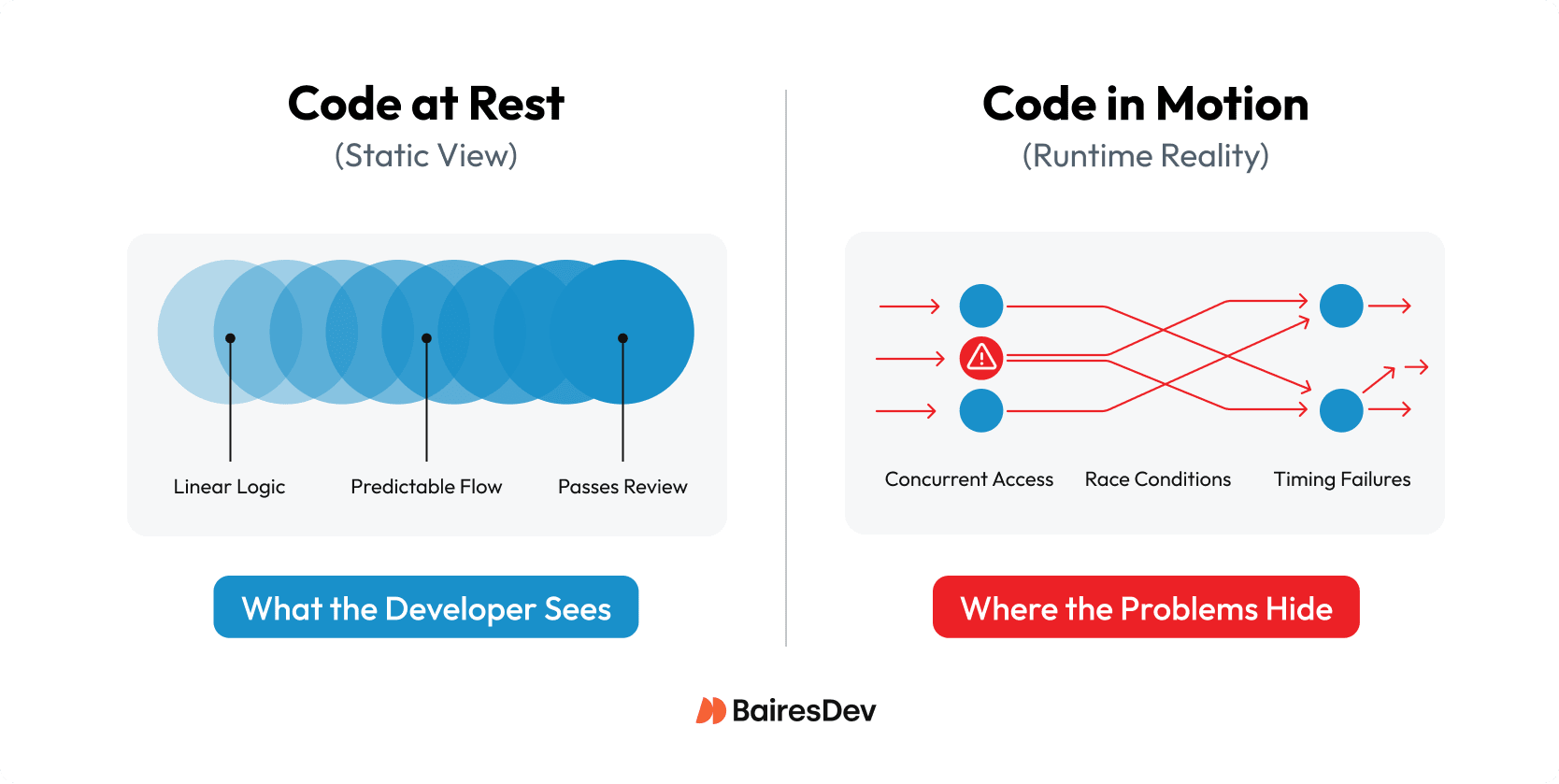
The net effect, however, creates an organizational blind spot when multithreading problems arise. Even with an expert diagnostician, these problems are hard to find because:
- They do not appear in happy-path testing.
- Static code reviews are weak at spotting the risks.
- Incidents lack clear ownership (you’ll often hear “the code is fine; it’s a timing issue”)
The problem is not with the Java platform. It was designed to support threading, and it has only gotten more capable with lightweight threading extensions. The root organizational problem stems from lack of architectural oversight.
As a leader, you need to involve the architects to:
- Review the implementation involved in every incident.
- Set design checkpoints so that multithreading technology is applied appropriately.
Let’s look first at how to recognize the occurrence of multithreading problems. Then we’ll get to diagnosis and governance.
Concurrency Risk Signals Leaders Should Recognize
Multithreading defects have problem signatures unique to their implementation. When they crop up, you may find yourself wishing for the good old days of a service showing an understandable problem:
- CPU overdrive due to transaction volume: Solve the problem by scaling instances.
- Lagging due to database overloading: Solve the problem by optimizing queries.
- Spiking memory use: Solve the problem by streamlining payloads and caching.
Threading defects show observable signals, but the root cause is harder to pinpoint. From a leader’s perspective, they stem from the following fundamentals:
- A single process (service) has N threads running inside of it concurrently.
- These threads compete for memory, CPU, and external resources.
- When transactions increase, database overloads, or memory use spikes, the effects get multiplied by a factor of N.
The first hallmark to look for is the sudden, large-scale flare-up. When incidents escalate quickly, and the team can’t explain the behavior with a simple capacity or dependency issue, you’re probably looking at a multithreading problem.
The table below provides the signals and what they map to, including the risk surface that brings pain the the organization:
| Leadership signal | What it indicates | Typical underlying cause | Why it matters |
| Unpredictable latency under load | System behavior changes non-linearly as traffic increases | Contention, blocking, or unbounded concurrency | Capacity planning becomes unreliable; SLAs fail unexpectedly |
| Throughput plateaus despite available CPU | Adding load doesn’t increase useful work | Threads blocked on I/O, locks, or downstream limits | Indicates concurrency inefficiency, not lack of resources |
| Incidents that are hard to reproduce | Failures appear only in production | Timing-dependent concurrency defects | Drives long MTTR and postmortems without clear fixes |
| High variance between environments | Staging behaves nothing like production | Thread scheduling and load-sensitive behavior | Undermines confidence in testing and release gates |
| Symptoms migrate across services | “The problem keeps moving” | Stacked concurrency and load amplification | Makes ownership unclear; increases organizational drag |
| Fixes that work briefly, then regress | Short-lived stability after tuning | Masked concurrency bottlenecks | Creates false confidence and recurring incidents |
These defects are squirrelly. You can see the usual metrics and alarms, but they don’t explain the degree and strangeness of how the system is behaving with clear cause-and-effect. It takes a different kind of diagnosis to pin them down, and architectural discipline to prevent them from happening again.
How to Diagnose and Prevent Multithreading Defects
This section contains the multithreading playbook that enables leaders to help architects and team leads:
- Identify concurrency-driven failures early.
- Contain their blast radius.
- Prevent their recurrence through governance.
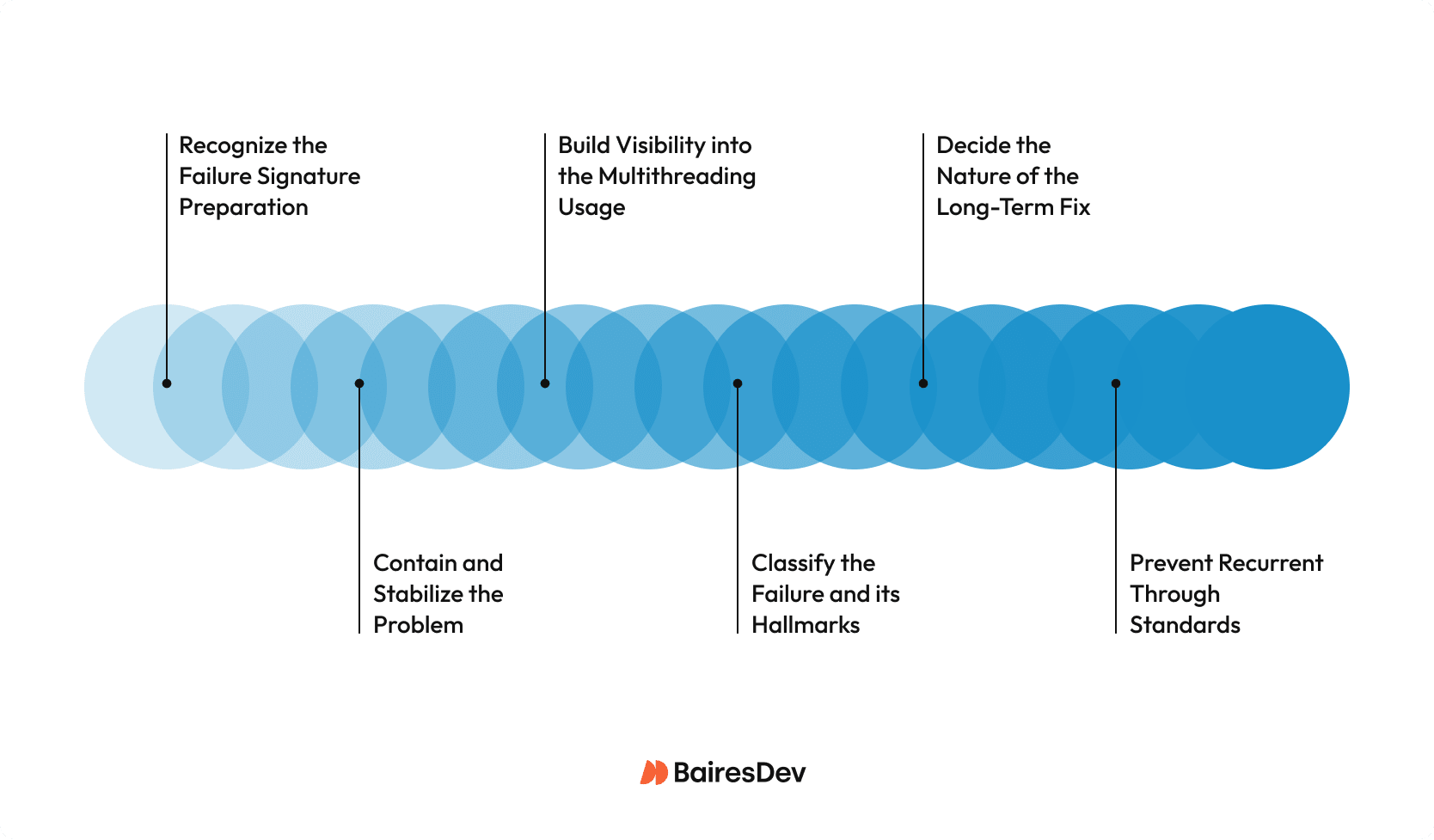
Phase 1: Recognize the Failure Signature
For the recognition phase, revisit the signal table. Review each of the patterns and decide which one matches most closely the failure behavior. A multithreading defect will often involve multiple conflicting metrics or alarms, and that is one tell that the failure is not from another cause.
When a simpler root cause is absent, then assume it’s a concurrency problem. Concurrency bugs can masquerade as:
- Capacity shortages
- Flakey dependencies
- Works in lower environments but not in production
- Regression despite no code changes in the service
Escalate the issue accordingly, and follow the remaining phases to bring it to ground.
Phase 2: Contain and Stabilize the Problem
For the containment and stabilization phase, reduce the fuel to the fire. Teams under pressure face the temptation to “change something,” including the multithreading code itself. That is a mistake, because without a clear understanding, any change may make matters worse.
Concurrency problems respond to:
- Reducing the workload to take pressure off the failure.
- Reducing the number of threads to make the problem more linear.
If the problem reduces or stops due to either of these measures, you have an even better predictor that it’s a concurrency issue.
Phase 3: Build Visibility into the Multithreading Usage
For the visibility phase, direct your architects to review the multithreading code and suggest logging and metrics to surface its specific behavior. It’s entirely possible that the implementers underestimated the possible effects of the concurrency code, and decided not to give it a first-class transparency treatment.
- Thread pools, consumers, and executors must be measurable.
- Concurrency limits must be configurable and visible.
- Saturation must be visible before failure happens.
Architects must sign off that the visibility measures have passed muster.
Phase 4: Classify the Failure and its Hallmarks
The failure incident must get a first-class write-up. The write-up must include:
- What concurrency mechanism was implemented:
- How and why did it fail?
- How should the system respond to the root cause conditions to prevent future failures?
- What limits do the architects recommend for concurrency level, machine size, etc.?
This is how the organization learns. Clear and detailed write-ups become long-term memory for the architecture team, and provide descriptions of antipatterns and proactive solutions that all teams can emulate.
Phase 5: Decide the Nature of the Long-Term Fix
This is a crucial decision point, because the long-term fix depends on clear analysis. After reviewing the case documentation and actual code, pick the final concurrency remedy:
- Bad substitute for architectural constraint: Back off the concurrency parameters and investigate a more appropriate solution to the architecture. Perhaps it’s time to do some restructuring?
- Core component of service: Replace the concurrency implementation with a standard solution required of all services, as indicated by the architects. Standardization is the governance.
- Accidental code issue: If the concurrency is warranted and is based on an accepted standard, but had flawed logic, then fix it, and reintroduce after sufficient load testing.
Going through this exercise will signal to all teams how to progress with multithreading changes. Through consistency comes predictability and easier diagnosis if something goes wrong.
Phase 6: Prevent Recurrence through Standards
All incidents and their resolution lead to the final phase, where experience informs the standards going forward.
- Have a set of approved concurrency patterns.
- Document anti-patterns that must never be followed.
- Establish load-testing expectations to exercise concurrency code before release.
- Mandate that every concurrency implementation has an owner.
- Establish gateways that must be followed for every future concurrency implementation.
When this playbook gets followed by all teams, the risk surface decreases for the organization.
Expert Perspective
I have seen organizations treat Java multithreading as a local optimization and then act surprised when incidents become harder to reproduce, harder to diagnose, and harder to permanently fix. More often than not, the problem is that concurrency decisions are made without consistent architectural guardrails.
What makes these failures expensive is the lack of a clear story. Metrics conflict, behavior changes under load, and the issue disappears when you try to reproduce it. That is why I like to start with recognition and containment: reduce load, reduce threads, and stabilize before anyone starts “tuning” code under pressure.
The turning point is visibility. If thread pools, queues, and saturation aren’t measurable and configurable, you’re flying blind. Once you can see what the concurrency mechanism is doing, you can classify the failure and decide whether the right long-term fix is standardization, rollback to safer limits, or an architectural change.
The most practical outcome is not perfect concurrency, but predictable concurrency. This means approved patterns, banned anti-patterns, load-test expectations, and a named owner for every concurrency implementation.