
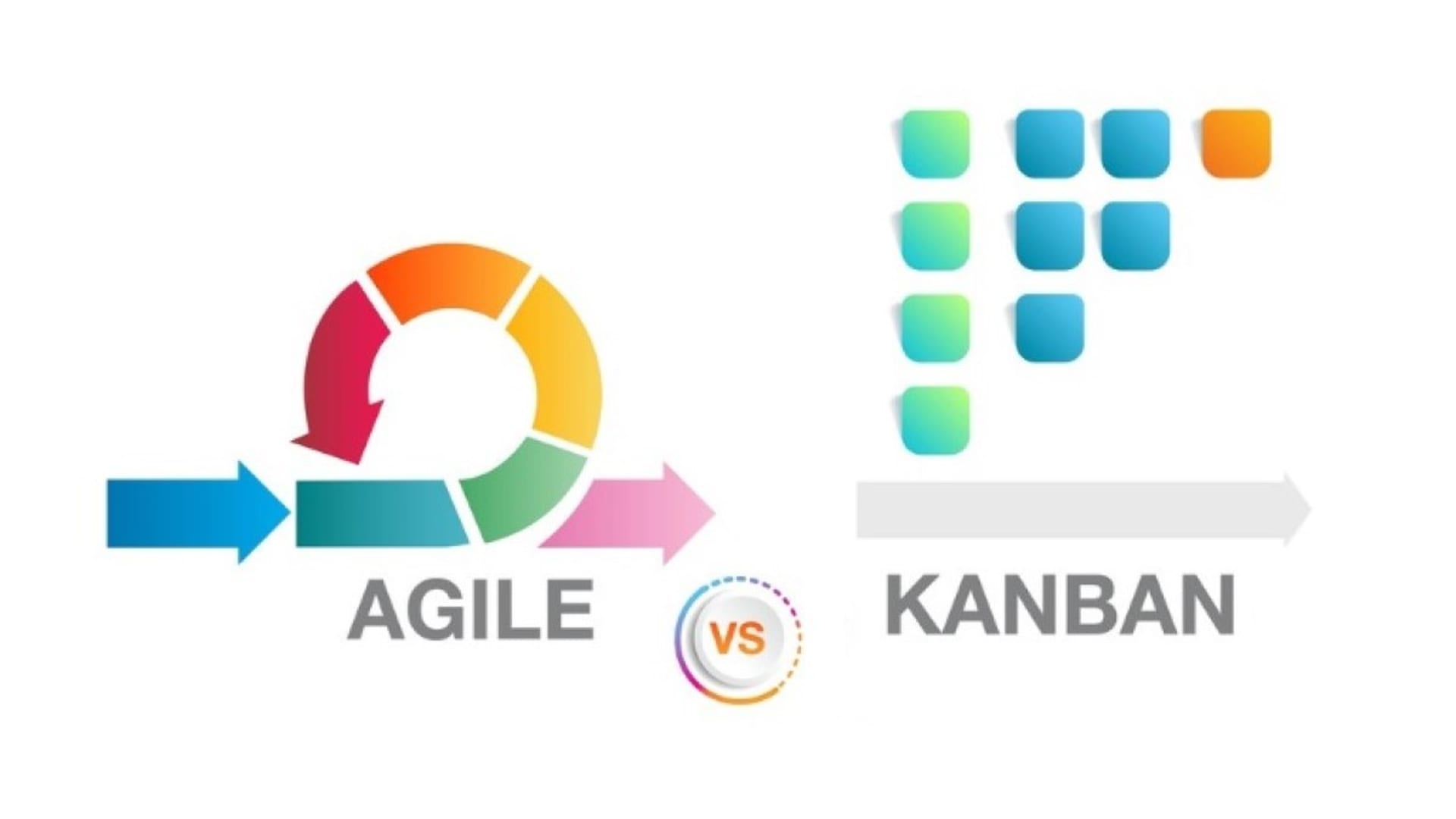


If you lead a software development team, or any team that juggles shifting priorities, you’ve probably wondered whether Kanban or Agile is the better fit. Both Kanban and Agile can work brilliantly, but they solve slightly different problems in different ways. Your job is to match the project management method to your context.
Below, we’ll walk you through how each approach actually feels in day-to-day operations. We’ll keep it practical and outline what a project manager, product owner, or executive actually needs to know to make a call with confidence.
“Kanban vs Agile” Is a Tricky Question
Agile is a philosophy, a set of values for how to deliver outcomes in complex environments. Kanban is a methodology, a concrete way to manage work. That’s the key difference people miss. You can run agile software development using Scrum, XP, Kanban, or a blend.
When people compare Kanban and Agile, they often conflate Kanban and Scrum, since the latter is the most common Agile framework. We’ll compare Kanban, Scrum, and traditional Waterfall methodology, so you can easily weigh your options.
What Agile Feels Like When It’s Working
As a philosophy, Agile prioritizes customer value, fast feedback, and an iterative approach. In practice, agile teams deliver in short cycles, learn from customer feedback, and adjust. The mindset is adaptive planning over fixed plans.
Many teams use the Scrum framework to implement that mindset:
- Work happens in time-boxed sprints—usually two-week sprints (anywhere from one to four weeks).
- The Scrum team is self-organizing and has defined roles: product owner (sets priorities), Scrum master (unblocks and coaches), and the development team (builds).
- Each sprint starts with sprint planning, pulls from the product backlog, and commits to a sprint backlog.
- There’s a daily Scrum to align, a sprint review to demo value, and a sprint retrospective to improve the process.
Leaders like Scrum because it creates a predictable drumbeat and clear checkpoints. If you need a steady cadence—“show me progress every two week period”—Scrum helps your whole team stay on the same page.
What Kanban Looks Like in Practice
Kanban is a visual method to manage work as a continuous flow. Instead of batching work into sprints, you visualize every task on a Kanban board and limit work in progress with explicit WIP limits.
You move items across columns such as To Do, In Progress, Review, and Done. The system is simple, but it changes behavior. When there’s a WIP limit on In Progress, people finish before they start something new. Context switching drops, cycle time shrinks, and quality improves because reviews happen in flow rather than in a rush at the end.
Kanban teams measure performance with cycle time and throughput rather than sprint velocity. A cumulative flow diagram reveals bottlenecks as colored bands that thicken where work piles up. If the Review column keeps growing, you don’t need a meeting to discover the problem; the data points to it.
This continuous improvement loop fits operational environments, DevOps, and mixed-mode teams that balance steady inbound work with project delivery. You can still plan releases and roadmaps. You simply forecast based on historical cycle time rather than sprint velocity.
The Kanban methodology demands discipline in a different place. The board has to match reality, not aspiration. Policies need to be explicit. WIP limits need to be enforced. When those basics hold, the visualizing work principle gives leaders a truthful picture of progress at a glance.
Where Waterfall Belongs
The Waterfall process works when the work is well understood, tightly regulated, or genuinely sequential.
If you must complete the development phase only after exhaustive design approvals, and if change control is costly, Waterfall can be the safest path.
You get clear milestones and formal gates. The tradeoff is responsiveness. As soon as requirements start moving, the Waterfall methodology resists change, which hides risk until late in the schedule.
Most software development programs today face too much uncertainty for a pure Waterfall approach, but it remains a useful reference and, in some contexts, a compliance requirement.
The Key Difference You Will Feel in Leadership
Scrum fixes time and varies the scope within the sprint. Kanban fixes WIP and lets time float per item. That’s the operational reality when you equate Agile with Scrum.
In Scrum, the sprint backlog is a time-boxed promise, a way to say, “Here’s what we commit to this iteration.”
In Kanban, the focus is on keeping the team’s workflow smooth so that individual tasks finish quickly and predictably. Scrum gives you a predictable drumbeat for stakeholder engagement. Kanban gives you responsive, continuous delivery for production-like streams of work.
Both Kanban and Scrum achieve project success with continuous improvement, but they tune different dials. Scrum tunes the planning and review cadence. Kanban tunes the flow and WIP constraints. Either way, you can align on outcomes and manage risk early.
How the Roles and Responsibilities Differ
Scrum leans into defined roles. The product owner is accountable for value and priorities. The Scrum master is accountable for improving the system and removing obstacles. The development team is accountable for delivering the increment. These roles make expectations explicit for stakeholders and can be helpful when a team is adapting to Agile.
Kanban does not prescribe formal roles, which is one reason Kanban teams are simple to start. You can keep your titles and reporting lines intact while you adopt a Kanban board and WIP limits. Many teams still designate a flow steward who watches cycle time, maintains policies, and facilitates the continuous improvement habit.
Nothing stops you from having a product owner in a Kanban system. You simply don’t need the Scrum vocabulary to benefit from adaptive planning and customer feedback.
Planning and Prioritization
With Scrum, you invest in backlog refinement, then select a slice during sprint planning. The team commits to a scope that fits the time box and the capacity. Changes during the sprint are controlled so that the sprint goal stays achievable. This is a strong fit when you need predictable commitments and stakeholder demonstrations on a schedule.
With Kanban, prioritization is continuous. You always keep the top of the backlog ready, and when capacity opens, the next item is pulled. You can still set milestones and target dates, but you negotiate them using cycle time data rather than sprint capacity. If leadership asks for a date, you offer a range based on throughput and a clear explanation of risk.
The conversation becomes data-led rather than hope-led.
Progress Tracking that Executives Actually Use
Scrum tends to rely on burn charts, sprint goals, and velocity trends. That’s useful when you want to ensure the team can meet a release window built from a series of sprints. Kanban relies on cycle time scatterplots and the cumulative flow diagram.
Those pictures answer different questions. Kanban tells you how long items typically take, whether queues are forming, and where policies are failing. Scrum tells you whether this sprint is on track and whether the team can sustainably deliver similar scope next sprint. In either case, project management lives on real numbers, not opinions.
Continuous Improvement Without Theater
Agile teams treat reflection as work, not as filler. In Scrum, the sprint review and sprint retrospective give you a reliable place to learn. In Kanban, you learn in motion, with weekly or monthly reviews of cycle time, blocked items, and WIP trends.
The method is less important than the habit. Choose a cadence that your team respects, keep it short, and always leave with one concrete change to try next. That’s how small, compounding improvements move the needle on delivery speed and quality.
Kanban and Scrum for Different Teams
Product squads with external stakeholders benefit from Scrum because the sprint review becomes a forcing function for customer feedback.
DevOps groups with production responsibilities benefit from Kanban because continuous flow matches the nature of the work. Platform or data teams that mix inbound requests and longer initiatives often adopt a hybrid. They keep Scrum’s goals and reviews for visibility while running a Kanban-style board inside the sprint for day-to-day control.
This hybrid is often called Scrumban. Think of it as pragmatic agility rather than a new religion. You keep the predictability you want and add the flexibility you need. You can set sprint goals, preserve the daily Scrum for alignment, visualize flow with a Kanban board, and enforce WIP limits so work actually finishes. The entire team gets structure without handcuffs.
A Simple Rollout that Doesn’t Rock the Boat
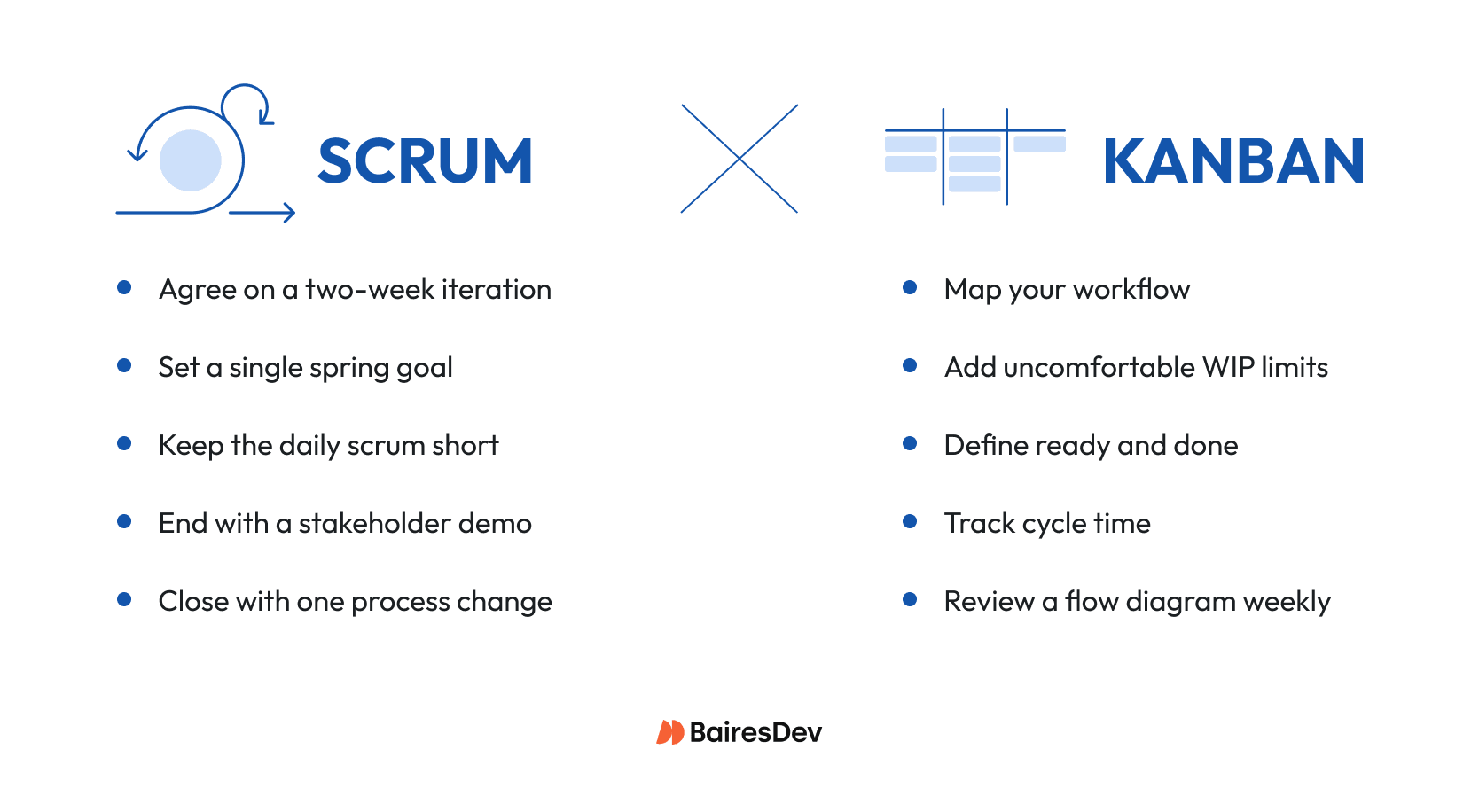
If you want to try Scrum, start by agreeing on a two-week period for your first iteration and follow the checklist below. If you want to try Kanban, start by mapping your actual workflow on a whiteboard or in your tool of choice.
Forecasting Dates Without Hand-waving
Executives expect clear forecasts. In Scrum, you can forecast with velocity. If the team consistently completes a certain number of points per sprint, you can project how many sprints a release will require, with a sensible confidence range.
In Kanban, you forecast with cycle time. If the 85th percentile cycle time is ten days, you can say that most items will complete within that window. When work items vary wildly in size, break them down before forecasting. This is not extra paperwork. It is the price of useful predictions.
Culture Change that Actually Sticks
No framework survives a hero culture or a blame culture. Whether you choose Scrum, Kanban, or both, aim for habits that lower friction and increase shared ownership.
Make the work visible so nothing depends on memory. Limit work in progress so focus beats multitasking. Clarify policies so handoffs don’t rely on whispers. Ask for customer feedback early so you stop guessing. Celebrate cycle time reduction and lead time stability.
Those are the signals that tell you your project management methodologies are serving the business rather than the other way around.
Common Pitfalls and How to Sidestep Them
One common failure mode is flooding the board with tasks. It feels busy, but it is the fastest way to slow delivery.
Work in progress becomes a graveyard of half-finished ideas. Tighten WIP limits and make that constraint real. Another failure mode is treating ceremonies as compliance exercises. A daily scrum that turns into a status report drains energy and hides problems. Keep it focused on coordination and impediments. A third failure mode is avoiding hard decisions in the product backlog. Whether you operate in sprints or flow, prioritization is still a human act. Make the tradeoffs explicit and tie them to outcomes, not opinions.
A subtler pitfall is ignoring the engineering backbone. XP practices such as continuous integration, test automation, and pair programming fit beautifully inside both Scrum and Kanban. If your development phase is brittle, no project management method will save you. Strengthen the code pipeline so that your process changes translate into real cycle time improvements and fewer defects.
Where Governance and Agility Meet
Leaders often worry that agility undermines governance. In reality, a good Agile framework or a well-run Kanban workflow makes governance easier. With Scrum, your sprint cadence becomes the heartbeat for compliance reviews, security checks, and stakeholder demos. With Kanban, your flow metrics become early-warning signals.
If blocked time spikes or a specific column accumulates work, you can intervene before deadlines are at risk. Portfolio views become more useful because they roll up living data rather than status narratives. You can keep executives informed without weekly fire drills.
What to Measure
For Scrum, track sprint goal attainment, defect trends, and stability of velocity over time. For Kanban, track median cycle time, item aging, and adherence to WIP standards.
In either approach, connect the dots to business outcomes: adoption, reliability, revenue, and customer satisfaction. A project manager or product owner who reports only on internal metrics is missing the point. Your executives care that the project delivers value sooner, with fewer surprises.