

Executive Summary:
This article outlines a CTO’s framework for when multi-cloud earns its complexity. It covers where to preserve portability, where to accept strategic lock-in, and why cloud-sovereign architecture is replacing cloud-agnostic as AI workloads and agentic systems reshape infrastructure demands. It draws on a transition that cut infrastructure costs by 40% and improved global performance 6x.
When I joined VSCO as CTO, the platform had a strong product-market fit and a passionate global community, but the underlying architecture was actively working against us. Infrastructure costs were escalating faster than the business. Engineering teams were spending meaningful time tuning web application firewall rules in reaction to recurring DDoS activity, debating storage classes and retrieval costs instead of building product features. And despite serving a global user base, we could clearly see opportunities to dramatically improve performance outside North America.
These are common symptoms of platforms that scale rapidly on top of a single-cloud or legacy-oriented architecture. What mattered to me was addressing them deliberately, and the results were measurable. Over the course of our transition, we achieved a 6x improvement in network performance in our poorest-performing markets, stopped reactively fighting API abuse as a daily operational concern, and reduced total infrastructure costs by more than 40%.
The lesson wasn’t simply “go multi-cloud.” Multi-cloud is not a strategy by default. It is a risk and capability optimization decision, and a poorly executed one can leave you worse off than a well-architected single-cloud setup. The real questions are: When is it worth the complexity? Where should you preserve portability versus deliberately accept lock-in? And, how is the calculus shifting now that AI workloads and agentic systems are reshaping what infrastructure actually needs to do?
For content-intensive, growth-oriented platforms, getting this right is no longer a background technical decision. Unpredictable costs, regional latency, and reactive security posture quietly erode an organization’s ability to reinvest in growth and innovation. When that happens, architecture stops being an enabler and becomes a constraint.
When Does Cloud-Agnostic Architecture Actually Pay Off?
The phrase cloud-agnostic is often misunderstood. For some, it implies lowest-common-denominator design or an ideological rejection of managed services. In practice, I view it very differently: cloud-agnostic means maintaining the flexibility to choose the best point solutions across providers, not avoiding clouds, but avoiding unnecessary lock-in.
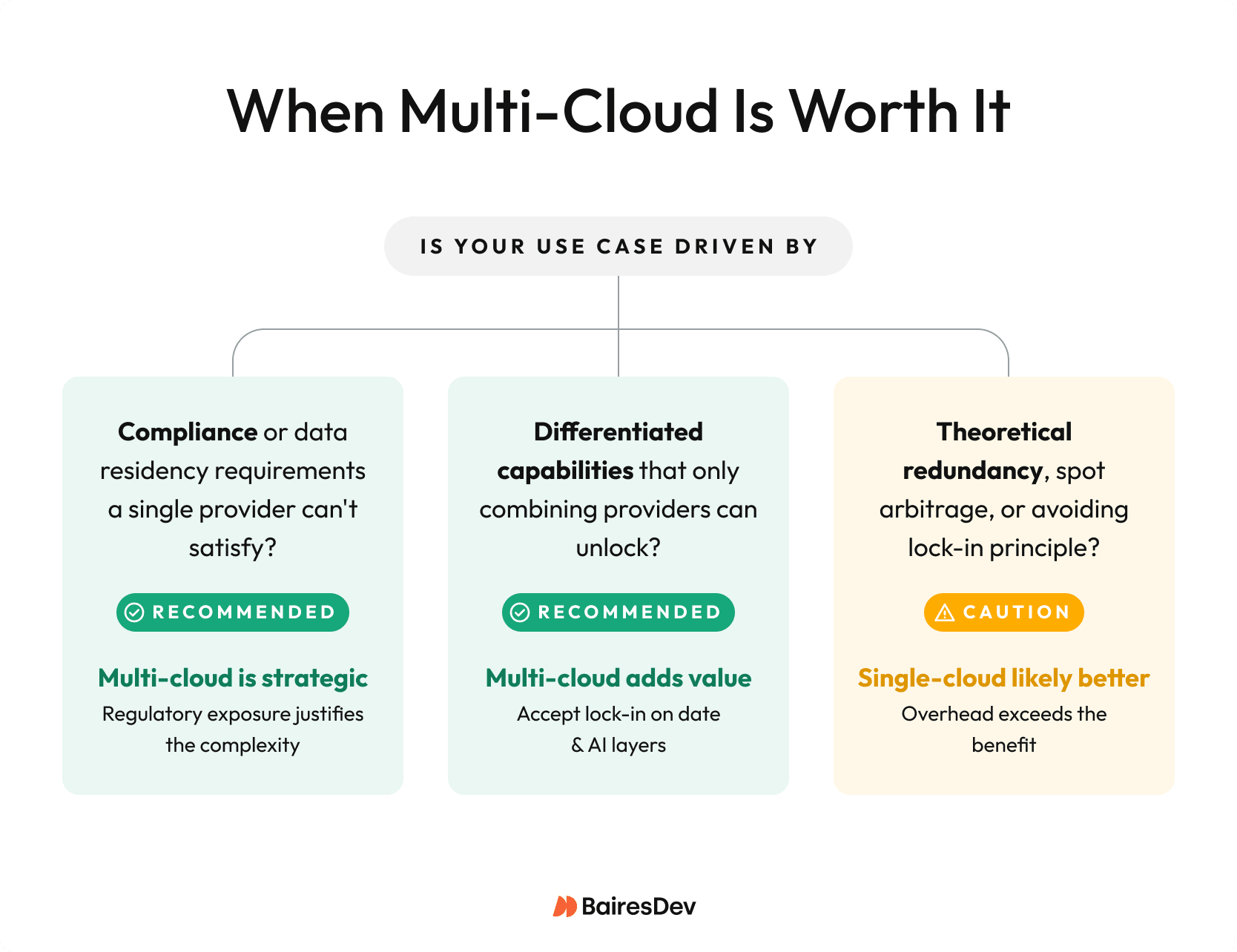
The cases where multi-cloud makes strategic sense are real: compliance and data residency requirements that a single provider cannot universally satisfy. It becomes strategic in industries like finance, healthcare, or the public sector, where reliance on one vendor can introduce regulatory exposure. And it’s justified when competitive advantage depends on combining differentiated capabilities across multiple providers.
At VSCO, we made two distinct moves in this direction. The first was migrating a portion of our assets from AWS S3 to Cloudflare R2. Cloudflare doesn’t charge egress fees on R2, which meaningfully reduced future lock-in. The tradeoff was absorbing the one-time cost of moving assets off S3, which we treated as a deliberate investment in optionality. The second was migrating our container orchestration from EC2 to EKS. That move reduced operational complexity, positioned us to run spot instances and control costs, and gave us the flexibility to migrate to other container services down the road if the calculus changed. Neither decision was about avoiding AWS. Both were about preserving the ability to choose.
Security, Performance, and Cost Are Now the Same Conversation
One of the most persistent misconceptions about cloud security is that the challenge lies primarily in tooling. In reality, the hardest part is operating security efficiently at scale. In a multi-cloud environment, that complexity compounds quickly.
The threat landscape adds another layer of pressure. Volumetric attacks are becoming more common, more automated, and more expensive. Global traffic volumes are increasing dramatically due to AI-driven crawlers and automated agents. A significant and growing percentage of internet traffic is now non-human, arriving without regard for cost models or resource constraints. In this environment, security decisions have direct financial consequences. Cost structures that penalize you for bandwidth spikes or charge aggressively during attacks effectively turn security incidents into margin events.
This is why cost efficiency is not just a finance problem. It is also an architecture problem and a leadership problem. Reactive security, bolted on after growth has already stressed the system, forces teams into constant firefighting mode and diverts focus from building long-term value. Solving it requires early cross-functional alignment between engineering, security, product, and finance. When those groups align early, organizations can design platforms that deliver strong performance, predictable costs, and resilient security simultaneously, rather than trading one off against another.
Why Is Cloud Strategy Shifting from Cloud-Agnostic to Cloud-Sovereign?
Cloud-agnostic was designed for application hosting; cloud-sovereign is designed for AI — where workload placement, data gravity, and inference economics demand automated governance that operates at machine speed. The payoff for getting architecture right is not merely operational stability. It is the ability to innovate. In 2026, that means being positioned for AI workloads that are fundamentally reshaping what infrastructure needs to do.
In 2025, my team at VSCO deployed multiple AI-powered features, and that pace is only accelerating. What became clear is that infrastructure is rarely the limiting factor for AI adoption. The raw materials already exist: internal data, APIs, event streams, and increasingly capable external models and services. More often, AI is blocked by organizational inertia and a lack of imagination. Teams struggle to rethink workflows from the customer’s perspective, internal processes slow experimentation, and legacy assumptions about how products should behave persist long after they stop serving users.
But there’s a more fundamental shift underway that changes how we should think about cloud architecture entirely. The right frame is no longer cloud-agnostic. It’s intentional cloud affinity. Organizations must make deliberate, asymmetric bets — knowing where portability truly matters, where native capability depth justifies lock-in, and how to evolve both as the underlying technology shifts beneath them.
That asymmetry is real in practice. At VSCO, we’ve continued to buy reserved capacity of DynamoDB and ElastiCache and have deliberately stayed with both services. DynamoDB in particular creates meaningful lock-in to AWS. On the other hand, it lowers the operational complexity of managing storage at scale, and the annual pricing for reserved capacity makes the economics clear. That’s an intentional bet. We know what we’re trading and why.
The Role of the Right Engineering Partner
Even with a clear architectural vision, executing a transition to cloud-native, multi-cloud systems is non-trivial. The right engineering partner can make a meaningful difference, and the variable that matters most is not geography or headcount. It is integration.
I have worked with both nearshore software development teams and offshore teams throughout my career, including BairesDev. What separates effective partners from ineffective ones is whether they embed directly with internal teams, share ownership of critical-path work, and bring expertise that genuinely complements existing strengths. The most common mistake I see leaders make when outsourcing platform or cloud work is keeping contractors at arm’s length or organizing work in silos. Both approaches undermine velocity and accountability in ways that are predictable and avoidable.
The architectural decisions described in this article don’t survive a handoff model. They require partners who operate as extensions of the team, understand the strategic intent behind technical choices, and sustain that alignment as both the technology and the business evolve.
Rethinking Architecture as a Strategic Priority
Architecture decisions compound. The tradeoffs you make today on portability, lock-in, and security posture become the constraints, or the leverage, you operate under when AI workloads hit production scale. The organizations that get this right will have one thing in common: they made calculated bets early and knew which ones to revisit.
Key Takeaways:
- Multi-cloud only earns its complexity when it clearly improves risk, performance, or cost.
- Cloud-agnostic design preserves optionality, while strategic lock-in can reduce complexity and improve economics.
- Security, performance, and cost are now tightly coupled, and architecture decisions directly impact margins.
- AI is pushing infrastructure toward cloud-sovereign models with intentional placement and governance.
- Embedded engineering partners outperform siloed outsourcing by sharing ownership and aligning with strategy.