


Software testing strategies are an essential part of the software development process, but are often misunderstood. Here’s why you need them and how to use them effectively.
Key Points
- Test strategies are an essential part of any software development lifecycle.
- They should give executives insight into how testing addresses project risks.
- Test strategies can help evaluate risks and prioritize test approaches.
- To be effective, test strategies have to be introduced with care and persistence.
What is a Software Testing Strategy?
The ISO/IEC/IEEE 29119-1 Standard defines test approaches, test plans, test strategies, and other testing concepts and how they are related. This document, available as a free download, provides foundational terminology and should be the starting point of any attempt to use software test strategies effectively.
| Document Type | Definition |
| Test Approach
|
High-level test implementation choice, typically made as part of the test strategy design activity. |
| Test Plan | Detailed description of test objectives to be achieved and the means and schedule for achieving them, organized to coordinate testing activities for some test item or set of test items. |
| Test Strategy
|
Part of the test plan that describes the testing approach for a specific project, test level, or test type. |
These definitions offer key insights into what a software test strategy is:
- It is a design activity that involves choosing the test approaches for a project.
- It is a document that describes the results of carrying out that design activity for a project.
While we’ll refer to test strategy as documents going forward, we’ll do so with the understanding that the activity that produces the document is equally important.
Test Strategies and Test Plans
A common misunderstanding about test strategy documents is that they can only exist as part of a test plan document. This comes from the definition, but even the standard admits that a test strategy “may be documented separately” from a test plan. We make the case that it should be documented separately.
This is a key point because many software engineering organizations stopped using test plan documents years ago, after adopting agile processes and tools that track testing activity as work items (epics, iterations, features, user stories, tasks, test cases, test runs).
However, executives and managers still need to understand what test approaches were selected for a project, and what risks those test approaches were intended to address. Also, which risks have not been considered? Finally, what risks does the testing activity itself create for the project? Pulling a report with a list of work items may not easily give those insights. A well-crafted test strategy document does exactly that.
Next, we’ll look at what information should be included in a test strategy document.
A Test Strategy Template
The following table describes the sections of a lightweight template for a standalone test strategy document that meets the need for executive insights. Test strategies using this template should be no more than five pages.
| Section Name | Section Description |
| Document Title and ID
|
The document title and document tracking ID, if used. |
| Owner | Owner of the document. This may or may not be the document author(s).
|
| Project Name and ID | The name of the project and project ID, if used.
|
| Project Context and Scope
|
A brief description of the project context, including history, if any. Also, the timeline of the current project and high-level scope of work to be done. |
| Project Requirements | The requirements that are driving the scope of work. Reference the names and IDs in your requirements tracking or project management system. These should inform the test approaches selected. |
| Project Risks | The project risks that are expected. If the project is a product release, these would include the product risks as well. These are not testing risks, which are covered in a later section. These should inform the test approaches selected. |
| Test Approaches | This is the most extensive section of the test strategy. It should include a brief description of the thinking behind the test approaches that were selected.
This is followed by a table with each row having a description, test type, test level, and test practice. See the Test Approach Table Template table below for more detail. A separate table in this section should list the project requirements and project risks that are addressed by each row in the Test Approach Table. This makes visible test approaches that are duplicating requirements or risk coverage, or leaving gaps. |
| Test Environments and Tools | A description of the test environments that will be used for each test approach. Include any tools and programming languages to be used as well. If your test environments include test pipelines, mention those as well.
For example, “Unit tests for the Python API will be run on the developer’s environment and in the build pipeline.” |
| Test Reporting | Describe how the status of testing will be communicated during the project. This typically includes progress of new automated test development and regression testing run reports. |
| Testing Risks | These are risks to the project that may occur from the testing activity itself. For example, if one of the testing approaches requires a new test environment that may not be ready in time, that part of the testing may not be completed. |
| Testing Staff | Describe the staffing needs for the testing on this project. Does the project require specialized expertise that the organization lacks? Are such resources available from local outsource vendors? Nearshore? Offshore? Is the time zone difference a concern? |
| Document History | Who wrote it? Who changed it and when? This could include who reviewed it as well. |
A Test Approach Table Template
Below is an example of a table to include in the Test Approach section of the test strategy.
| Column Name | Column Description |
| Approach Name
|
A unique short name for the test approach. For example “Functional Integration Testing of the API”. |
| Test Type | The types of software testing include functional and non-functional.
The major subtypes of non-functional tests include accessibility testing, compatibility testing, security testing, usability testing, and performance testing. These often require specialized expertise, testing processes, tools, or environments. |
| Test Level | Test levels consist of unit testing, integration testing, system testing, and acceptance testing, in that order.
Unit tests can be done early in a project in a developer environment, while acceptance testing requires installing and configuring the complete product as a customer would, and can only be done when the complete product exists. |
| Test Practice | Test practices focus on whether test cases are created ahead of time, how they are created, and how they are executed.
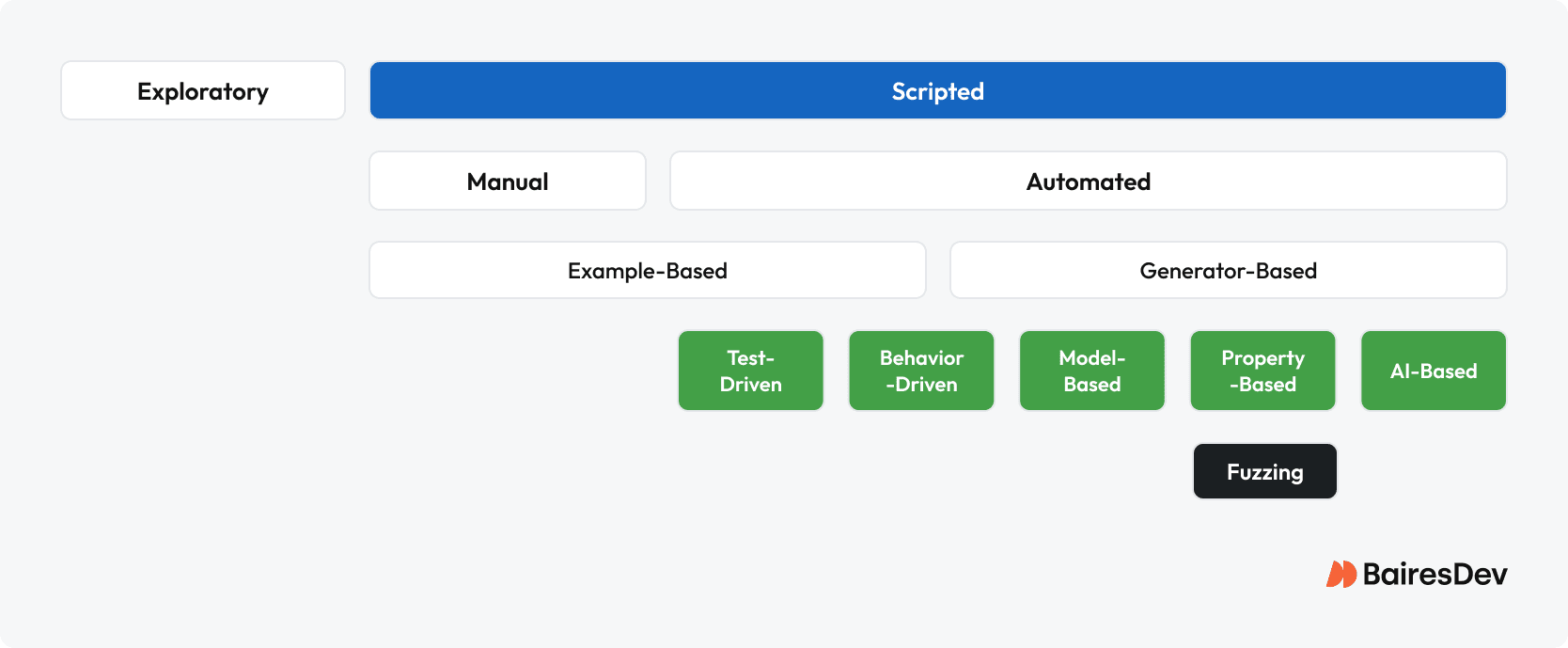
Major test practices include exploratory (unscripted) testing and scripted testing. Subtypes of scripted testing include manually executed and automated. Subtypes of automated testing include example-based where test cases are written by hand, and generator-based where test cases are generated with a tool. |
That’s all there is to it. Remember, it’s not a test plan or comprehensive testing process, and it should be no more than five pages.
Next, we’ll go in-depth into several test approaches to consider in the Test Approaches section of the test strategy, starting with the Shift Left approach.
Test Approach in Depth – Shift Left
The Shift Left approach is shown in Figure 1. It focuses on test levels, with the intent to shift testing from levels that must occur later in a project to test levels that can occur earlier in a project. The idea is to reduce risk by discovering defects earlier, when there will be more time to fix them, and when they are less expensive to fix. After applying a Shift Left approach to a project, there should be many unit test cases, fewer integration test cases, and so on.
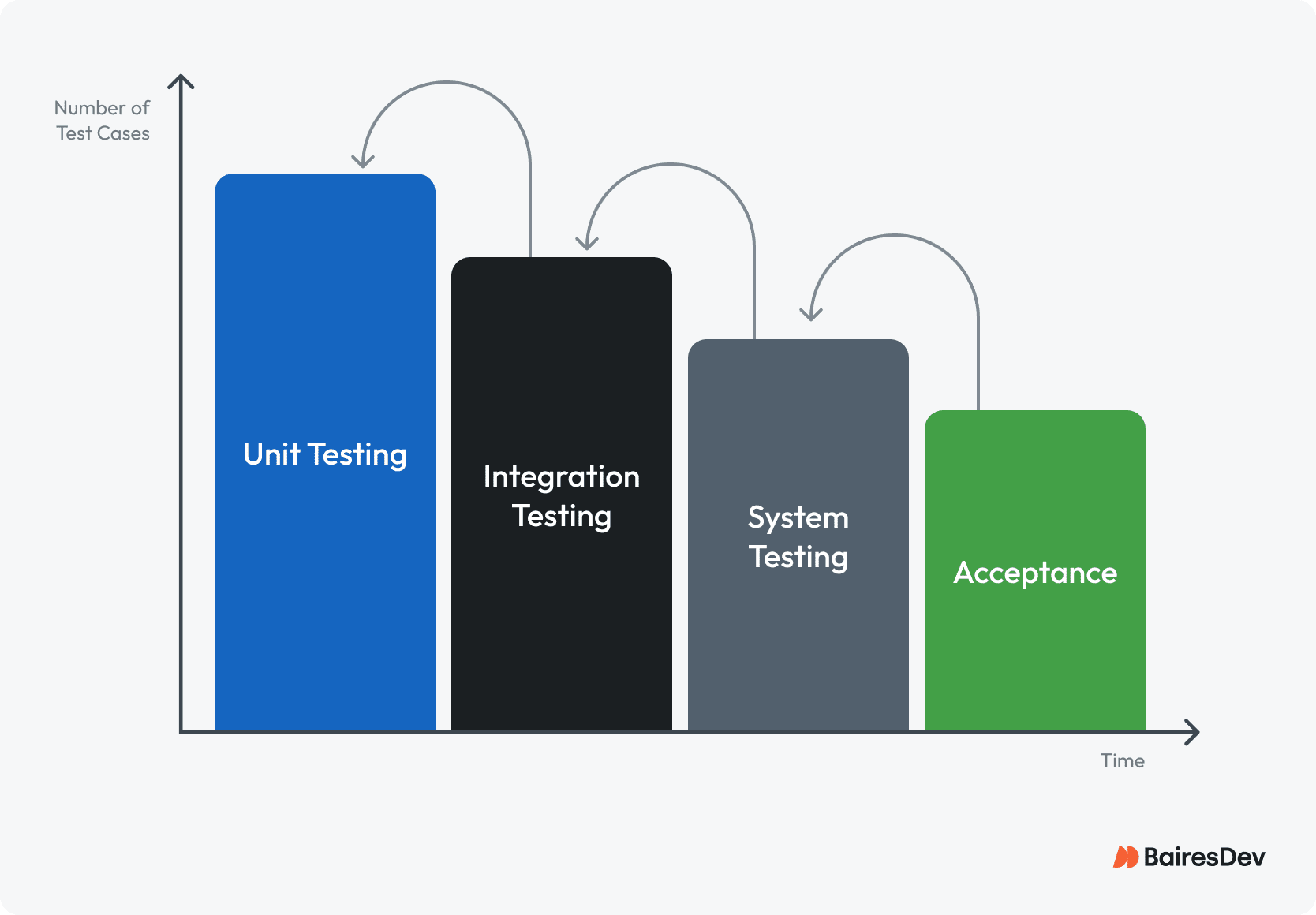
One way to shift left is to replace automated tests on the system level with automated tests on the integration level.
For example, web applications with an API called by a GUI, GUI testing can be considered as system testing, and API testing as integration testing. For REST and GraphQL APIs, Chrome browser extensions such as Rest API Inspector or GraphQL Network Inspector can be used to inspect traffic between the GUI and API, and are very helpful in creating API tests from automated or manual GUI tests. Since API tests run much faster than GUI tests, and API features may be available earlier in a project than GUI features, shifting tests from GUI level to API level can expose defects earlier with little testing risk to the project.
A test practice that aligns with Shift Left is Test-Driven Development (TDD). In TDD, unit tests are automated and are written even before the code is implemented. The unit tests will fail until the code has been implemented correctly to make them pass. TDD makes unit testing part of the development process, rather than something to be patched on after code is written. Unit tests run even faster than integration tests and can be implemented even earlier in a project than API tests.
Not all tests can be shifted left as easily as others. Returning to our web application example, some GUI tests (system level) will be difficult to shift to API tests (integration level), either because of complexity in the workflow, timing issues, or other reasons. Some integration level tests will be difficult to shift to unit testing, especially if they require complex mock data or mock code. Pressing forward in such cases will provide diminishing returns.
Test Approach in Depth: AI-Based Test Case Generation
You might wonder where AI belongs in a discussion of software test strategies. There are many areas where AI needs to be considered in software testing, and the list is growing as AI capabilities rapidly improve. We’ll focus on one use case, using AI to generate automated test cases.
From the definitions in the standard, it seems clear that AI-based test case generation is neither a test type nor a test level. It’s a test practice.
A taxonomy of test practices that should be considered in a test strategy is shown in Figure 2. AI-based test case generation belongs under “Generator-Based” test practices, along with model-based testing, fuzzing, and property-based testing. These practices generate test cases with code, and have been used for more than 25 years.
Despite this history, test case generation remains a niche practice. Today, most automated test cases are still written by test engineers one example at a time. The author of a key article on property-based testing from 2019 defined these as “example-based tests”.
If organizations have been reluctant to adopt test case generation in the past, a Jan 2026 Dev Barometer survey suggests attitudes may be shifting with respect to AI-based test case generation. The survey found that 53% of developers are comfortable having AI generate unit tests autonomously.
But the survey also cited concerns that may be slowing adoption. 55% of teams cited lack of tests and standards as a barrier to safely move fast with AI tools. In a question about validation of AI-generated output, 16% of developers cite insufficient test coverage or poor-quality test data as the biggest barrier.
Test strategies can help organizations determine if concerns like these are testing risks for the project. A testing risk does not necessarily mean that a test approach should not be used. For example, if other test approaches can cover the same project risks and requirements, that reduces the risk.
The Test Strategy Design Activity
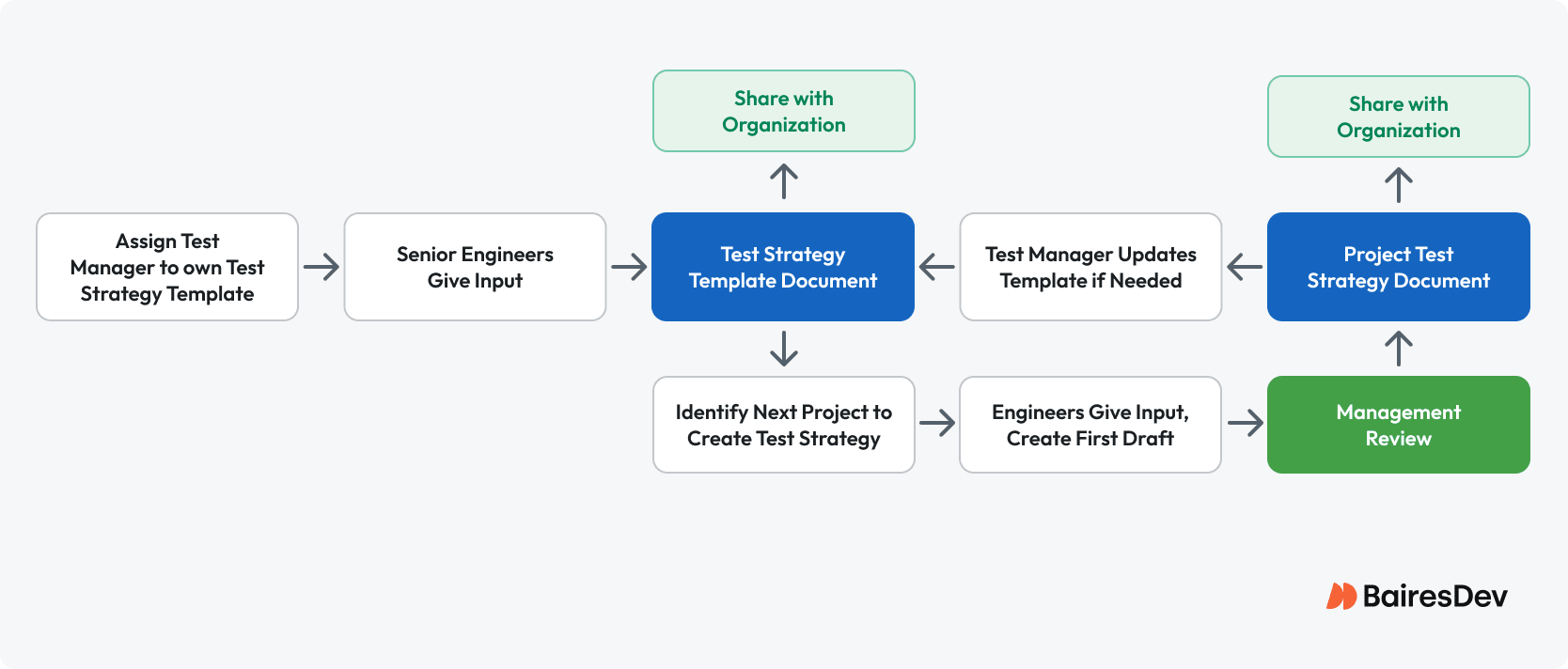
As mentioned before, the activity of creating a test strategy is as important as the document itself. In this final section, we go into steps for introducing and piloting test strategies in an organization.
If the organization does not use test plan documents, executives should make clear that it is not their intent to use test strategies as a beachhead for further changes to development processes, such as introducing test plan documents. Remind everyone of the five-page limit and it is intended to be a lightweight process.
Start with the template. The test strategy template should be owned by one of the test managers in the organization and sponsored by an executive. The test manager and senior test engineers should be invited to give input and suggest changes. The process for arriving at an initial template should be timeboxed. It does not have to be perfect or satisfy everyone. When ready, share the template with the organization.
The next step is to pilot the template on a project. This should be done at the beginning of a project iteration. For a product, it should be introduced soon after a product release, and as planning is starting for the next release. The project test strategy should be owned by the senior test engineer on the project, with input from the test engineers and development engineers on the project. Development managers, product managers, and project managers should also be invited, especially on the requirements and risks sections.
Keep in mind that the goal of the pilot is not to change the team’s project test strategy but to document it.
Once all the team members and managers have had a chance to give input, the test manager should review the project test strategy against the test strategy template. The template may need changes based on the team’s attempt to apply it to their project. Once the project test strategy is approved by the test manager, it should be shared with the executive sponsor and then with the organization.
From Pilot to Practice
Near the end of the pilot project, the team should review the project test strategy again as part of the project review. Did any of the risks mentioned come about? How effectively were each of the test approaches applied? Did the team consider the test strategy when creating their test cases? Why or why not?
Finally, the executive should meet with the test manager who owns the template to discuss the pilot. How well did the document meet the executive’s needs? Do they understand which testing approach covered which requirements and risks? Did the team apply the template effectively? What improvements to the template would the executive like to see? This could be a recurring topic as the pilot project goes along.
As test strategy documents are created for additional projects, the test engineers will become more proficient at writing them. The end goal is to reach a point where test strategies are understood as a tool to help the executive understand the risks and have confidence that the organization has solid test approaches in place.
Figure 3 shows the steps in this test strategy design activity.