


Cross-company workflows carry real cost when each party keeps its own version of the truth, from supplier onboarding to settlement reconciliation. Salesforce Blockchain runs as a low-code permissioned ledger that lives next to your CRM, giving partners a shared, verifiable record without forcing them off familiar tools. This guide explains where it earns its place and the pragmatic playbook for getting from pilot to production.
Key Points
- Salesforce Blockchain runs as a permissioned ledger with named organizations and legal agreements, which makes it easier to align with existing governance models.
- Sensitive data stays off-chain in Salesforce Blockchain; the ledger keeps proofs and consent metadata, which simplifies compliance reviews.
- The low-code deployment removes the need for Solidity or Go specialists, which collapses time-to-pilot for business-driven blockchain use cases.
- The proven playbook is to start small with one cross-organizational outcome that matters, then scale only when the metrics support it.
If you run a business unit or lead a cross-functional team, you already know the pain points that come with collaborating across company boundaries. Supplier onboarding drags on because every party repeats the same checks. Disputes linger because each system shows a slightly different “truth.” Compliance reviews swallow entire months.
Organizations need a practical way to share sensitive information, automate agreements, and pass audits without ripping out the tech you’ve got.
The result is better data integrity, clearer auditability, and more trustworthy cross-company workflows. It’s about practical blockchain applications that build consumer trust, not buzzwords, just results.
That’s the gap Salesforce Blockchain set out to close: a low-code, permissioned distributed ledger that plugs into Salesforce CRM so partners can share a single, verifiable record of transactions while your teams keep working inside familiar tools, strengthening trust through transparent, verifiable workflows.
What Salesforce Blockchain Actually Is
Salesforce Blockchain is a low-code distributed ledger technology built to live beside your customer relationship management data. Salesforce’s blockchain initiative demonstrated how low-code, permissioned ledgers could integrate with CRM workflows for secure cross-organizational collaboration.
You model blockchain data structures, roles, and smart-contract logic declaratively, tie those elements to standard CRM records like Accounts, Opportunities, and Cases (including external objects), and expose the right read/write permissions to the right participants. This approach lets you connect Salesforce products to real-world blockchain applications without duplicating all the data.
Users stay in the Salesforce experience, while the shared ledger acts as a tamper-evident substrate for multi-company processes. The goal is to make inter-organizational workflows auditable and automatable without demanding deep cryptography expertise from your teams.
The platform’s pragmatic design also matters. Because it’s permissioned, you can align participation with real-world governance, named organizations with legal agreements, rather than anonymous actors. Because it’s integrated, you can keep Salesforce as your operational front end while using the ledger as the shared evidence layer.
And because it’s low-code, you can move from concept to pilot quickly, then iterate with the business at the table, not just IT.
Where Leaders See Outcomes First
Financial Services
Start with onboarding and due diligence. Instead of every counterparty re-collecting the same KYC pack, use a permissioned ledger to confirm status once and reuse it with the client’s consent. For the back office, put settlement terms for things like syndicated loans or FX into smart contracts and broadcast state changes to a shared ledger. Fewer reconciliations, fewer exceptions, especially when markets are jumpy, and lower compliance spend add up quickly at scale.
Healthcare
Focus on two wins: compliant data sharing and clean trial records. Keep PHI off-chain; store proofs, access logs, and consent artifacts on-chain so you can demonstrate who touched which record and when. In trials, timestamp protocol versions, consents, and capture events to cut submission ping-pong and avoid version drift that stalls approvals. Evidence from EHR audits and trial ops points to real gains in assurance and cycle time.
Supply chains
Value hides in the basics: supplier credentials, quality incidents, temperature or handling exceptions, and custody hand-offs. Recording these on a distributed ledger gives procurement, quality, and logistics a single source of truth and lets auditors or regulators verify read-only history on demand. In categories vulnerable to counterfeits, verifiable provenance isn’t branding, it protects margin and keeps you onside with regulators.
Key Differentiators
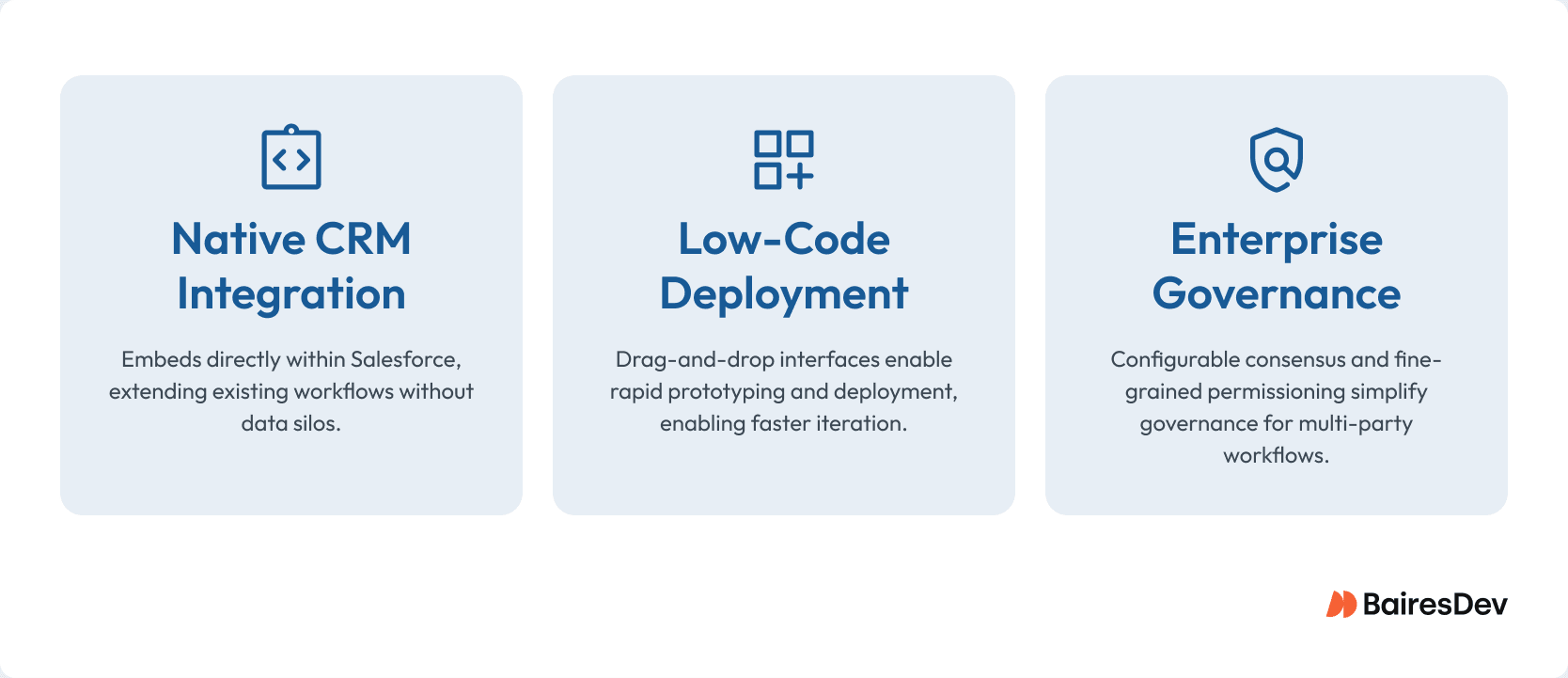
Native CRM Integration: Unlike general-purpose blockchain frameworks such as Ethereum or Hyperledger Fabric, Salesforce Blockchain embeds directly within the Salesforce platform. Enterprises can extend existing workflows, such as contract approvals, identity verification, and compliance checks, across blockchain networks, without duplicating data silos.
Low-Code Deployment: While Ethereum and Hyperledger require development expertise in Solidity or Go, Salesforce Blockchain allows rapid prototyping and deployment via drag-and-drop interfaces. This enables faster experimentation, iteration, and scaling.
Enterprise Governance: Salesforce Blockchain supports configurable consensus mechanisms (e.g., Proof of Authority) and fine-grained permissioning. This simplifies governance for multi-party workflows where participants require differentiated access and roles.
Technical Architecture and Governance
Salesforce Blockchain comprises three primary components:
- Blockchain Builder: A low-code design tool to model data objects, permission structures, and smart contract logic.
- Blockchain Connect: Enables seamless data integration between Salesforce records (e.g., Opportunities, Accounts, or Cases) and the blockchain ledger, ensuring real-time synchronization.
- Blockchain Engage: Facilitates external participant onboarding with role-based permissions, ensuring secure access and shared visibility.
Network governance can be enforced via flexible consensus mechanisms. For example, Proof of Authority is suitable for consortium networks where participant identities are known and vetted. Roles and access levels can be defined at the object or transaction level.
Security, Integrity, and Auditability
Every write to the ledger is anchored with a cryptographic hash, creating a tamper-evident chain of custody that makes “who changed what, when” unambiguous.
Key security features include:
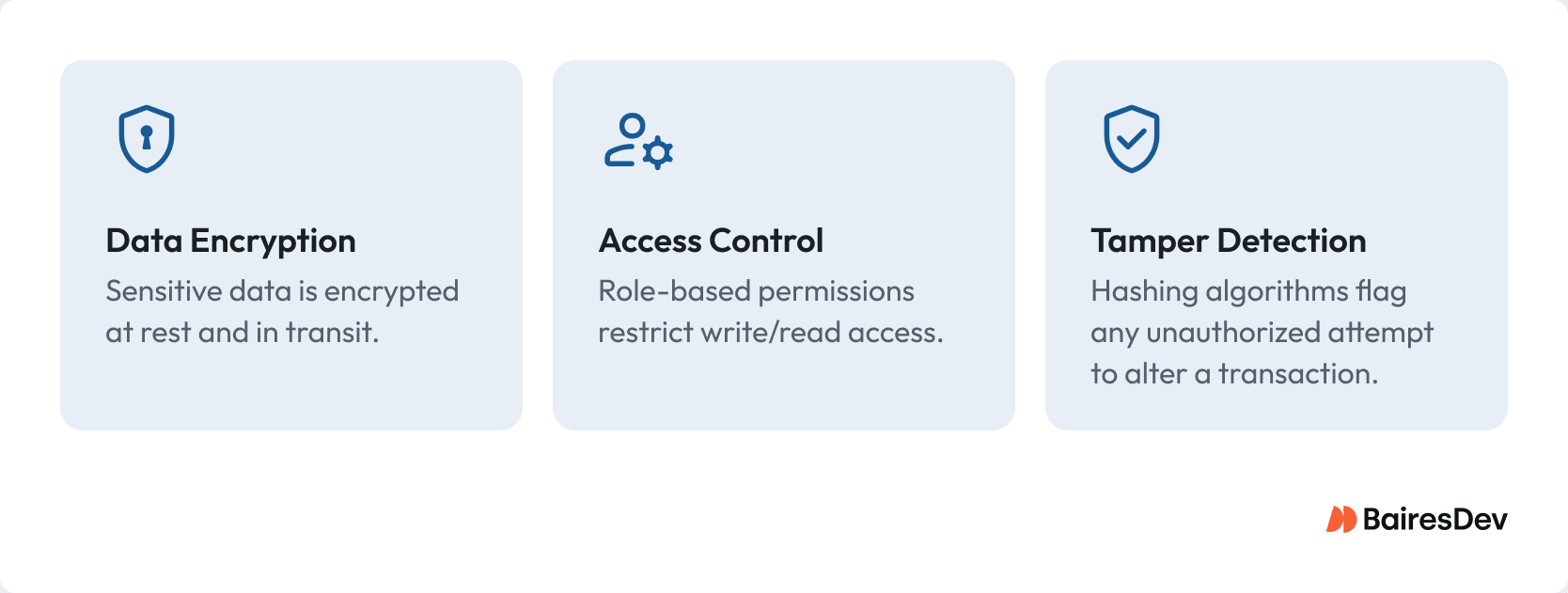
- Data Encryption: Sensitive data is encrypted at rest and in transit. Only authorized participants can access relevant subsets.
- Access Control: Role-based permissions restrict write/read access, ensuring least-privilege enforcement across partners.
- Tamper Detection: Hashing algorithms flag any unauthorized attempt to alter a transaction, ensuring rapid detection and mitigation.
This model enables real-time auditability and reduces the burden of manual reporting. Access logs, transaction records, and smart contract states can be queried or exported for regulatory review.
Operational Benefits: From Prototype to Production
Salesforce Blockchain’s low-code framework reduces the need for specialized blockchain development teams. Business units can co-design applications with IT, ensuring that governance rules, integration points, and process logic align with real operational needs.
In deployment, common workflows automated via Salesforce Blockchain include:
- Automated SLA Enforcement: Trigger actions or escalations when contract terms (e.g., delivery deadlines) are breached.
- Real-Time Data Reconciliation: Ensure consistency across ERP, CRM, and blockchain ledgers without batch synchronization.
- Identity Federation: Enable shared authentication and credential validation across business partners.
Scaling Networks and External Collaboration
As networks grow, Salesforce Blockchain supports secure onboarding of new entities, including customers, regulators, suppliers, or auditors, without compromising control. Participants receive cryptographically signed invitations and customized access profiles via Blockchain Engage.
Multi-cloud and cross-border deployments are supported through Salesforce’s enterprise infrastructure, allowing multinational organizations to maintain consistent governance standards across regions and legal frameworks.
Monitoring and Performance Optimization
Salesforce offers integrated dashboards for transaction volume, latency, participant activity, and exception handling. Engineering leaders can proactively monitor network performance, detect anomalies, and fine-tune smart contract logic based on operational insights.
Integration with Salesforce Einstein and predictive analytics tools further enhances visibility, enabling leaders to identify trends in partner engagement, supply chain risk, or compliance gaps before they impact operations.
Bottom Line
Salesforce Blockchain offers a practical way to build trusted networks on top of the CRM your teams already live in. You get enhanced security, data integrity, and auditability, with smart contracts that automate the dull, disputable parts of cross-company work.
The playbook is straightforward: start small, anchor the effort to one outcome that matters, govern it like a real consortium, and scale only when the metrics tell you to. This isn’t about chasing the latest emerging technology.
It’s about creating a durable source of truth that reduces friction, satisfies regulatory compliance, and earns trust with customers and partners, because you can prove every claim you make.