


Executive Summary
The Vue 3 Composition API provides a more flexible way to organize Vue application logic by grouping code by related functionality instead of by component options. When building a complex application, this can improve maintainability, encourage reusable logic, and support stronger TypeScript integration.
The Composition API is not a replacement suitable for all Vue Applications. The right choice depends on application complexity, team structure, and the expected lifespan of the codebase.
For most new enterprise Vue 3 applications, the Composition API is the preferred approach. It provides better patterns for managing complex features, sharing logic, and scaling development across multiple teams. Smaller applications or stable legacy systems using the Options API effectively, may see little benefit from the Composition API.
Adoption should be considered an architectural decision rather than a framework upgrade. The goal is not to use the latest API. The goal is to create a frontend architecture that reduces complexity, improves delivery speed, and supports long-term maintainability.
Key Points
- Your component’s state, watchers and lifecycle hooks can live together when grouped by feature rather than option type.
- Many teams independently implementing authentication, authorization, or user-session handling will each maintain diverging code that must be tested and secured separately.
- Combining Composition API with script setup lets TypeScript infer types without the implicit this context that complicates Options API typing.
- If your existing Options API codebase ships reliably and has strong test coverage, migrating it wastes capacity and risks destabilizing working code.
- Most organizations should adopt a progressive migration strategy rather than rewriting existing applications.
Should you use the Vue 3 Composition API?
For most new complex Vue 3 applications, yes. The Composition API provides stronger patterns for organizing large amounts of frontend logic, creating reusable composables, and scaling development across teams.
However, existing applications should not be migrated unless there is a clear business value. If an Options API codebase is stable, well tested, and easy to maintain, the cost of migration may outweigh the benefits.
What is the Vue 3 Composition API?
The Composition API is not a single API. It is an umbrella term that covers the Reactivity API, Lifecycle Hooks, and Dependency Injection features. It is an alternative to the Options API that allows developers to build Vue components using imported functions rather than declaring options. This allows code to be organized by functionality or feature rather than option type.
The Composition API is built into Vue 3 and was backported to Vue 2.7. Note that Vue 2 reached official End-of-Life (EOL) on December 31, 2023. Relying on legacy Vue 2 versions with the @vue/composition-api plugin introduces security and compliance risks, making migration to Vue 3 the standard recommendation for active enterprise codebases.
The strength of the Composition API is that it brings together several features that developers can use to build and organize component logic. These include reactivity primitives such as ref() and reactive(), computed state with computed(), watchers for responding to changes, lifecycle hooks such as onMounted(), and dependency injection through provide() and inject().
In Composition API, Vue documentation recommends ref() as the default way to declare reactive state. While reactive() remains useful for object-based state, destructuring properties from a reactive object can break reactivity unless toRefs() or toRef() is used. Teams should understand these tradeoffs when establishing project conventions.
The Vue 3 Documentation provides many useful code examples that demonstrate how the code and syntax changes using the Composition API, but syntax is not the primary architectural change that you should focus on. The most important change is how developers structure the logic of the program.
Rather than separating related logic across components, Composition API allows state, derived state, side effects, and supporting functions to be placed near each other. As the application grows, this will make maintaining and comprehending code easier.
For example, a component that is responsible for searching for customers might need to:
- Track input state
- Load state
- Manage API requests
- Handle errors
- Provide pagination
- Cache results
When using the Options API, these use cases might have code distributed across multiple component options. With the Composition API, they can be grouped into a dedicated composable such as useCustomerSearch() and be accessed by one or more components. This is why the Composition API should be thought of more as an architectural tool rather than alternative syntax.
Key takeaway: The Composition API creates the most value when an application has become complex enough that the organization and reusability of the logic have become a constraint on delivery speed or maintainability.
Composition API vs Options API: Which is better for your team?
Neither API is the best and there are no plans to deprecate the Options API. So, the right choice will depend on application complexity, team practices, and the cost of changing an existing codebase.
| Decision factor | Vue 3 Composition API | Options API |
| Code organization | Organizes related logic by feature or responsibility. State, functions, computed values, watchers, and lifecycle behavior can be kept together. | Organizes code by Vue option, such as data, computed, methods, and watch. |
| Reusability | Strong support for reusable stateful logic through composables. | Reuse is possible, but complex shared logic may require additional patterns or abstractions. |
| Scalability | Well suited to complex components, large applications, and domain-oriented logic. | Effective for simple to moderately complex components, but large components can become harder to navigate. |
| Readability | Often easier to follow when components contain multiple interacting concerns because related logic can be colocated. | Familiar and predictable, particularly for developers accustomed to Vue’s traditional component structure. |
| TypeScript support | Strong integration with TypeScript, particularly when using <script setup> and type-based APIs. | Supports TypeScript, although some complex component patterns can require more framework-specific typing. |
| Learning curve | Higher initial learning curve because developers need to understand reactivity APIs, composables, and Composition API patterns. | Generally easier for developers new to Vue because the component structure is more prescriptive. |
| Ideal use cases | New Vue 3 applications, complex SPAs, enterprise applications, TypeScript-heavy projects, and applications with significant reusable logic. | Simple components, smaller applications, stable legacy applications, and teams already productive with the Options API. |
The Composition API works particularly well with TypeScript because component logic is expressed using standard JavaScript and TypeScript patterns. This reduces some of the typing challenges associated with the implicit this context and can improve type inference as applications grow.
For a small component with straightforward code, these differences may be negligible. But for components that coordinate complex interactions, the architectural difference can be significant.
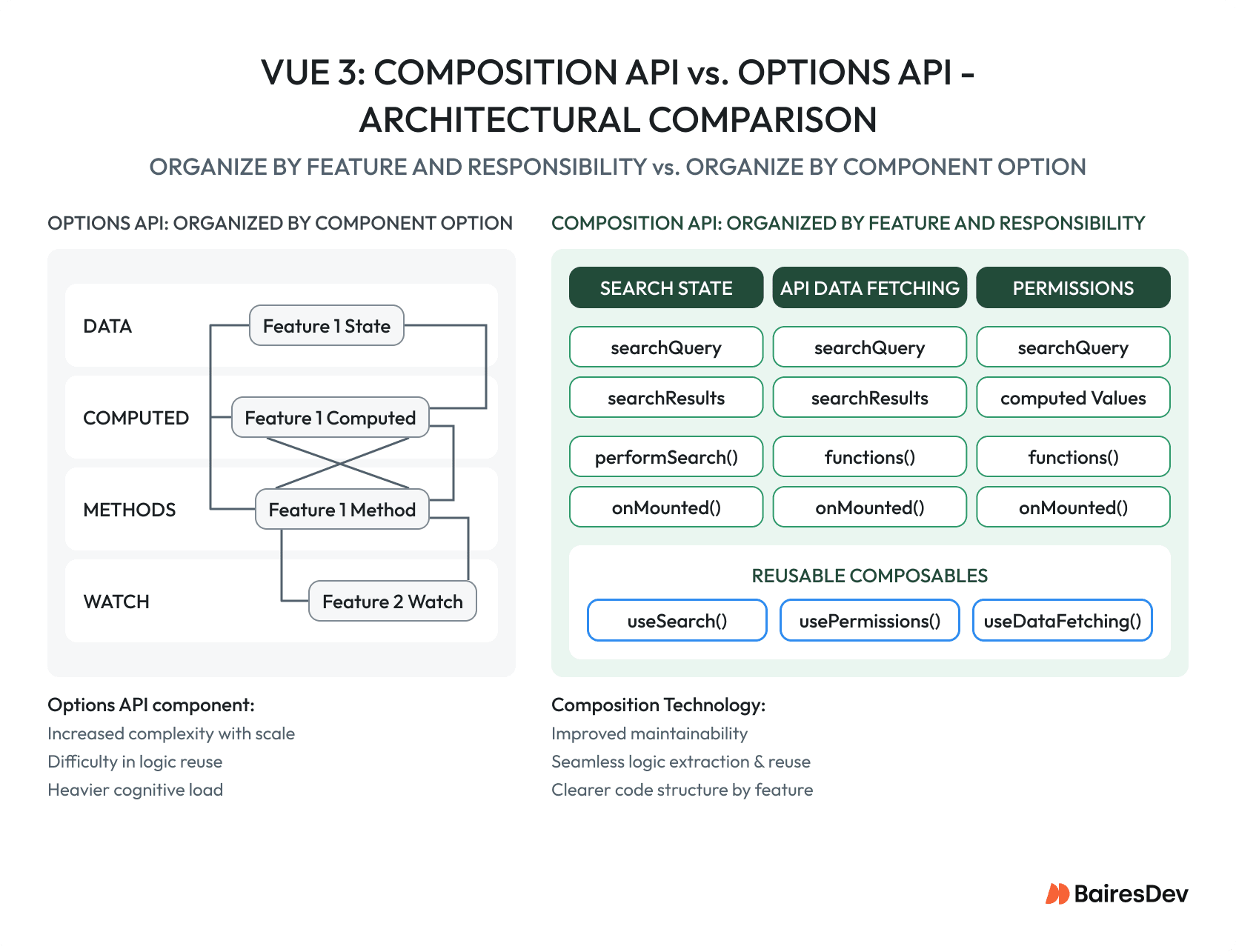
The Biggest Benefit: Reusable Logic Through Composables
One of the strongest cases for using the Composition API is its composability. A composable is a reusable function that encapsulates stateful, reactive Vue logic. Instead of implementing the same behavior separately in multiple components, a team can abstract it into a composable and establish a consistent implementation.
This matters in larger organizations because duplication in code costs more than technical debt. It creates operational inconsistency.
If several teams independently implement the same logic (for instance, authentication state) each implementation can evolve differently. Over time, this increases the number of places that must be tested, reviewed, secured, and maintained.
Composables provide a mechanism for centralizing those behaviors without forcing every concern into a single global store.
A composable is not automatically a replacement for dedicated state management. It is a way to package reusable reactive logic. Global application state that coordinates cross-feature or multi-page session data benefits from Pinia (the official Vue 3 state management library which became the officially recommended successor to Vuex for new Vue applications) while feature-specific reactive logic remains encapsulated in composables.
Composables are also used throughout the Vue ecosystem, not just for application-specific logic. For example, Vue Router provides useRouter() and useRoute() as composables that allow components to access routing functionality when using the Composition API. This gives developers a consistent way to consume router functionality alongside their own composables, rather than accessing $router and $route through the this context used by the Options API.
Composing for Scale
For a large engineering team, the value of composables is often less about saving a few lines of code and more about creating predictable boundaries for shared behavior.
A well-structured composable can:
- Reduce repeated implementation
- Improve testing and ownership boundaries
- Standardize shared patterns
- Support incremental refactoring
The key caveat is that composables can also become a source of complexity if teams create abstractions prematurely.
For example, extracting a small piece of logic into a composable before there is a clear need to reuse it can add unnecessary complexity. Encapsulating the code will require developers to go between files to understand behavior. This increases the effort required to reason about the code. A composable becomes more valuable when it encapsulates genuinely reusable logic, isolates a meaningful feature or concern, or provides a clear boundary between parts of an application.
The engineering principle here is simple: abstract repeated or independently meaningful behavior, not merely code that happens to look similar.
Composition API and TypeScript
TypeScript is another important consideration for teams evaluating Vue architecture.
The Composition API works particularly well with TypeScript projects. The Composition API expresses component logic using standard JavaScript and TypeScript, meaning variables, functions, and types are defined in ways that TypeScript can analyze directly. The Options API relies on object options and this context. As a result, TypeScript can more accurately infer types and validate component logic when using the Composition API.
This helps developers catch errors earlier and maintain type safety as applications grow. Vue supports both runtime and type-based declarations for component props, making it possible to define props directly through TypeScript when appropriate.
Using TypeScript consistently across frontend teams can make components easier to develop, maintain, and refactor as applications grow. This benefit is particularly relevant when:
- Multiple teams contribute to the same frontend
- Shared component libraries are maintained
- Domain models are complex
- API data is strongly typed
- Refactoring safety is a priority
- Frontend code is expected to have a long operational lifespan
However, TypeScript support alone should not determine the API choice. The Options API does work with TypeScript. The focus should be on whether the Composition API’s structure makes the resulting type relationships and abstractions easier to maintain at the scale of the application.
For larger Vue 3 codebases, the combination of Composition API, <script setup>, and TypeScript is often a strong foundation because it aligns component logic with standard TypeScript functions and explicit data flow.
When Should You Use the Composition API?
1. New enterprise Vue 3 applications
For a greenfield application expected to evolve over several years, the Composition API is often a good default.
This is particularly true when the application includes:
- Multiple product teams
- A shared component system
- TypeScript
- Complex business workflows
- Significant state management
- Multiple backend integrations
- Long-term maintenance requirements
The advantage is not that the Composition API guarantees scalability. No API can offer that. The advantage is that it gives teams a flexible foundation for organizing complexity without forcing all logic into a single component structure.
For a new application, establishing conventions early is also easier than refactoring them after components have been built.
2. Applications with Complex Business Logic
The Composition API is particularly useful when logical concerns extend beyond individual components and need to be shared across different parts of the application. Instead of organizing logic around the structure of the UI, related behaviour can be encapsulated based on the business functions it supports.
Consider a financial operations platform with dashboards, transaction workflows, permissions, audit requirements, and real-time status updates for thousands of users. The UI layer may contain many components, but the business functions cut across those component boundaries.
A Composition API architecture can isolate concerns such as:
- useTransactionSearch()
- usePermissions()
- useAuditLog()
- useRealtimeStatus()
These abstractions can then be tested and evolved independently.
This does not eliminate architectural complexity, but it does make the complexity more explicit and manageable.
3. Teams Building Shared Functionality
Large organizations often have multiple teams building and maintaining different parts of the same product. One team may work on customer-facing applications while another maintains internal tools. Such a split does not isolate the teams. They might both need to handle authentication, permissions, and data fetching.
Composables give teams a common way to package and reuse shared logic, including reactive properties that need consistent behavior across different parts of the application. This can improve consistency across the codebase. But it is important to note that composables do not guarantee consistency.Teams still need clear conventions for naming, ownership, testing, dependencies, and a shared understanding on how composables are designed and maintained.
4. Vue Applications Undergoing Modernization
The Composition API can also be useful during modernization initiatives.
The entire code base does not need to be converted to the Composition API architecture to begin incorporating it. New components can utilize the API while older components are incrementally refactored as need dictates.
For example, refactoring may show the most return on investment when components:
- Change frequently
- Contain duplicated logic
- Are difficult to test
- Have become a bottleneck
- Are actively being redesigned
This approach ties modernization to measurable engineering outcomes rather than treating migration as an objective in and of itself.
When is the Options API still the better choice?
Simple, Self-contained Components
For a component with limited complexity, the Options API can be an effective choice.
A simple component with few properties and methods, and a straightforward template, may be easier to understand using data, computed, and methods rather than introducing additional abstractions.
In these cases, adding composables or other layers of abstraction can make the code harder to follow without providing a clear benefit.
Mature Applications with Established Patterns
A mature Vue application does not automatically become more maintainable because it is migrated to the Composition API.
If an existing Options API application:
- Has low error rates
- Ships reliably
- Has strong test coverage
- Is easy for the current team to maintain
- Does not have significant duplication
- Is not causing developer or productivity problems
then a full migration may be a poor return on investment.
The opportunity cost should be considered. Engineering capacity spent rewriting stable code is effort wasted and risks destabilizing a code base.
Teams with Strong Options API Expertise
Technology decisions should account for organizational capacity.
If a team has years of experience maintaining a well-structured Options API codebase, moving to Composition API introduces a learning curve and creates a period where two architectural styles may coexist.
Adoption should have a measurable justification.
A Practical Adoption Strategy
Generally, it is not wise to mandate an immediate rewrite of an existing codebase. It is best to establish a plan to incorporate new code using Composition API while allowing the existing codebase to evolve according to business value.
Recommended Approach
1. Standardize using the Composition API for new Vue 3 code
For organizations using TypeScript, standardizing on <script setup> and TypeScript for new Single-File Components is a strong default. The official Vue documentation explicitly recommends <script setup> over the verbose setup() hook function because it compiles into render functions without runtime proxy overhead, reduces boilerplate, and provides first-class TypeScript macros such as defineProps<T>() and defineEmits<T>().
2. Define clear composable conventions
Document where composables live, what belongs in them, how dependencies are handled, and when logic should instead remain inside a component or move into a state management layer.
3. Avoid mixing patterns without a reason
Vue supports both Composition API and the Options API in the same project. But inconsistent patterns increase cognitive load. Teams should establish whether new development will use Composition by default and define exceptions.
Linting can help enforce component API conventions. For example, eslint-plugin-vue provides rules that can be configured to enforce specific component API styles.
4. Migrate components with the greatest impact first
Prioritize components where the current approach is creating real maintenance or development challenges.
5. Measure outcomes
Track indicators such as:
- Error rates
- Time to implement features
- Code duplication
- Testability
- Onboarding time
If those metrics do not improve, reconsider whether the migration strategy is delivering sufficient value.
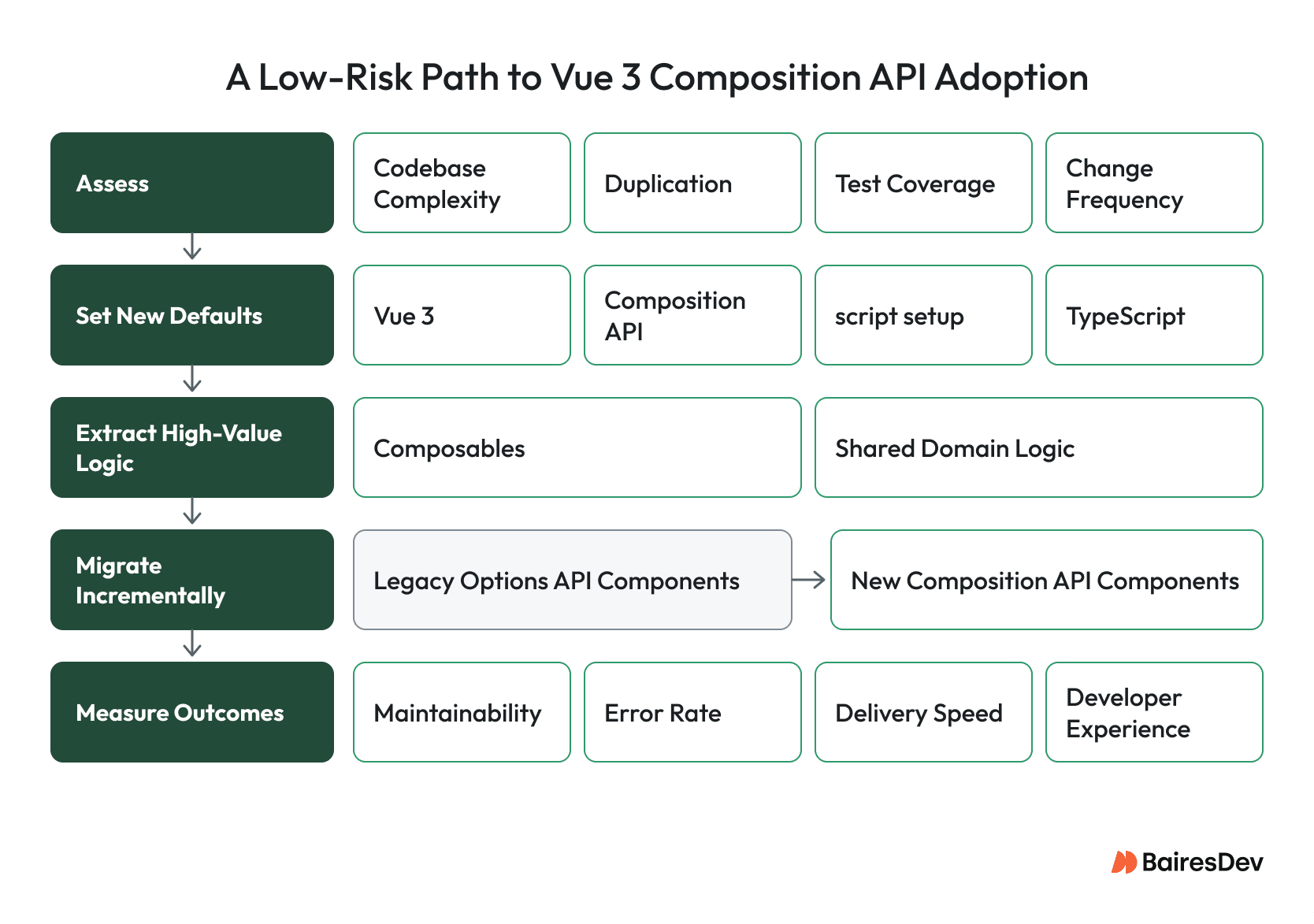
Best Practices for Adopting the Composition API
Adopting the Composition API requires more than changing syntax.
- Keep composables focused
A composable should have a clear responsibility. Focused composables improve testability and make ownership clearer.
- Separate domain logic from presentation
Composables can help move business logic out of components, but teams should keep domain logic separate from presentation logic. This creates clearer boundaries between application behaviour and the UI layer.
- Be deliberate about shared state
Not every reactive value belongs in global state. Distinguish between local state, feature-level state, shared application state, and server state.
- Establish conventions early
Large teams benefit from clear standards around naming, file organization, state ownership, testing, dependencies, and TypeScript usage.
- Prefer Progressive Modernization
Existing applications should adopt the Composition API in ways that increment value where it provides clear benefits rather than migrating solely to replace existing syntax.
The official Vue documentation provides a starting point for teams evaluating Vue architecture and modernization strategies. For organizations ready to modernize an existing application or build a new Vue platform, Vue development services can provide additional engineering support across application modernization, development, performance optimization, and scalable Vue architecture.
Final Takeaway
The Vue 3 Composition API is best understood as an architectural tool rather than a new way to write Vue components.
Its value becomes more apparent as applications become more complex. Larger codebases often require clearer boundaries between features and more consistent ways to share the logic. The Composition API provides patterns that can make frontend code easier to organize, extend, and maintain over time.
For new complex Vue applications, the Composition API is a sensible default. For existing Vue applications using the Options API, the decision to migrate should be driven by engineering outcomes.
The best strategy is usually to establish Composition API as the default for new development, define clear architectural conventions, and migrate existing components incrementally where there is a business case to justify the change.