


Java is a programming language released in 1995 that runs inside the banking platforms, Android apps, streaming services, and enterprise systems most professionals encounter daily. Organizations continue investing in Java not because they’re stuck with it, but because few technologies offer the same combination of talent depth, vendor independence, and backward compatibility at enterprise scale.
For non-technical leaders, Java is rarely a decision to revisit; it’s background infrastructure worth understanding clearly. Knowing where it operates and why it endures provides useful context for evaluating technology budgets, assessing vendor proposals, and hiring for the right skills without having to become an engineer yourself.
Key Points
- Java remains one of the most widely used programming languages for enterprise software, mobile applications, and large-scale backend systems.
- Java’s platform independence allows the same application to run across multiple operating systems without being rewritten.
- Vendor flexibility, backward compatibility, and a deep talent pool help make Java a durable enterprise technology choice.
- Modern Java continues to evolve through platform enhancements, cloud-native frameworks, and ongoing improvements to developer productivity.
- Organizations often modernize Java systems incrementally rather than replacing them outright.
Java is thirty years old and still the foundation of the systems you use every day. Understanding why helps you follow the conversation, evaluate the budget line, and hire for the right skills.
This article explains what the Java programming language is, why large organizations continue building on it, and what the terminology means when it surfaces in job posts, vendor proposals, and architecture reviews.
You Already Use Java Every Day
Java runs inside systems you interact with constantly, often without any indication it’s there.
Android apps are built with JVM‑family languages such as Java and Kotlin, and run on Android’s own runtime. Google designated Kotlin its preferred language for new Android development in 2019, but Kotlin compiles to JVM bytecode—the same underlying infrastructure Java has always used. Java remains widely deployed in Android development alongside it.
Netflix’s backend services—supporting hundreds of millions of users—run on a predominantly Java-based microservices architecture, with extensive use of Spring Boot. Several influential cloud-infrastructure libraries originated at Netflix, including Eureka for service discovery and Hystrix for fault tolerance, though some of these projects have since been retired or replaced by newer frameworks.
JPMorgan Chase runs Java 17, Spring Boot, and Maven across enterprise platforms serving more than 5K retail branches and 15K ATMs. eBay’s marketplace runs on an internal Java stack called Raptor. Government agencies and healthcare providers with long-lived, high-stakes systems often stay with Java specifically because of its vendor-support breadth and backward compatibility guarantees—the cost of failure in those environments is too high to accept the risk of a less proven platform.
The table below maps where Java sits inside organizations whose products you use or hear about regularly.
Where Java Runs in Systems You Already Use
| Organization | Java Footprint | Source |
| Android (Google) | Every Android app runs on a JVM foundation; Kotlin compiles to JVM bytecode | Android Kotlin-First Announcement |
| Netflix | Backend microservices on Java and Spring Boot; Eureka, Ribbon, and Hystrix originated here | Netflix Tech Blog |
| 1,000+ Java applications across 320,000+ hosts; Java 11 migration cut P99 latency 10%, raised throughput 20% | LinkedIn Engineering Blog | |
| JPMorgan Chase | Java 17, Spring Boot, and Maven across platforms serving 5,000+ branches and 15,000+ ATMs | JPMorgan Chase Tech |
| eBay | Internal Java stack ‘Raptor’ runs the marketplace | eBay Engineering Blog |
If you manage budgets, write job posts, or evaluate vendors at a mid-to-large organization, Java is already somewhere in your technology stack.
How Java Works, Without the Jargon
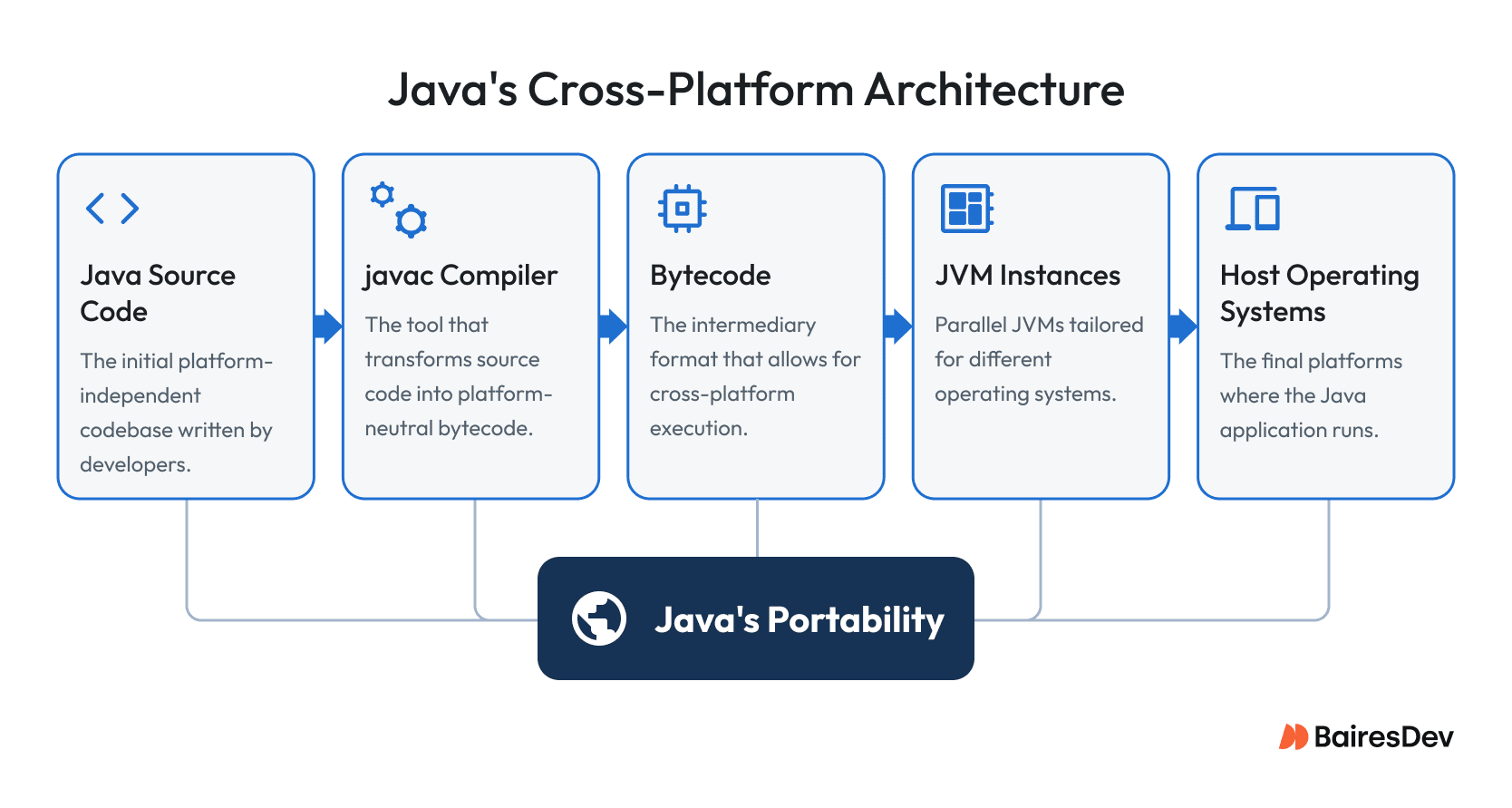
Java’s defining property is platform independence: Java programs written once run on any operating system (Windows, Linux, cloud, mobile) without being rewritten for each environment.
James Gosling created Java at Sun Microsystems, launching it publicly in May 1995 under the guiding principle ‘write once, run anywhere.’ Java celebrated its 30th anniversary in 2025, an unusual milestone for a technology platform that continues to evolve while remaining deeply embedded in enterprise software. Most software at the time had to be rebuilt separately for every operating system. Java solved that by introducing an intermediate step.
When engineers write Java source code, a compiler converts it into a format called Java bytecode—an intermediate form not tied to any specific operating system or processor. A piece of software called the Java Virtual Machine (JVM) then reads that bytecode and translates it into instructions the local machine understands. Think of the JVM as a real-time translator: the Java program speaks one language, and the JVM converts it into whatever the host computer requires—a Windows desktop, a Linux server, or a cloud instance on AWS. One codebase runs everywhere through a single translation layer. This is what engineers mean when they refer to Java’s platform independence.
Java also handles memory automatically. Rather than requiring engineers to manually allocate and release memory, the JVM cleans up unused objects through a process called garbage collection by eliminating an entire class of errors that would otherwise surface in large systems. Java also supports multithreading, meaning one Java application can handle multiple tasks simultaneously without queuing them sequentially.
Java’s design is built around the organizing principles of object-oriented programming: encapsulation, inheritance, polymorphism, and abstraction. These terms appear regularly in job posts and architecture documents. Definitions are in the glossary section below; for now, it’s enough to know they refer to Java’s structural design conventions.
These properties explain why large enterprises adopted Java early and have continued building on it. Oracle acquired Sun Microsystems in 2009 and now stewards the platform through open-source OpenJDK project.
Why Java Is Still the Default for Large Systems in 2026
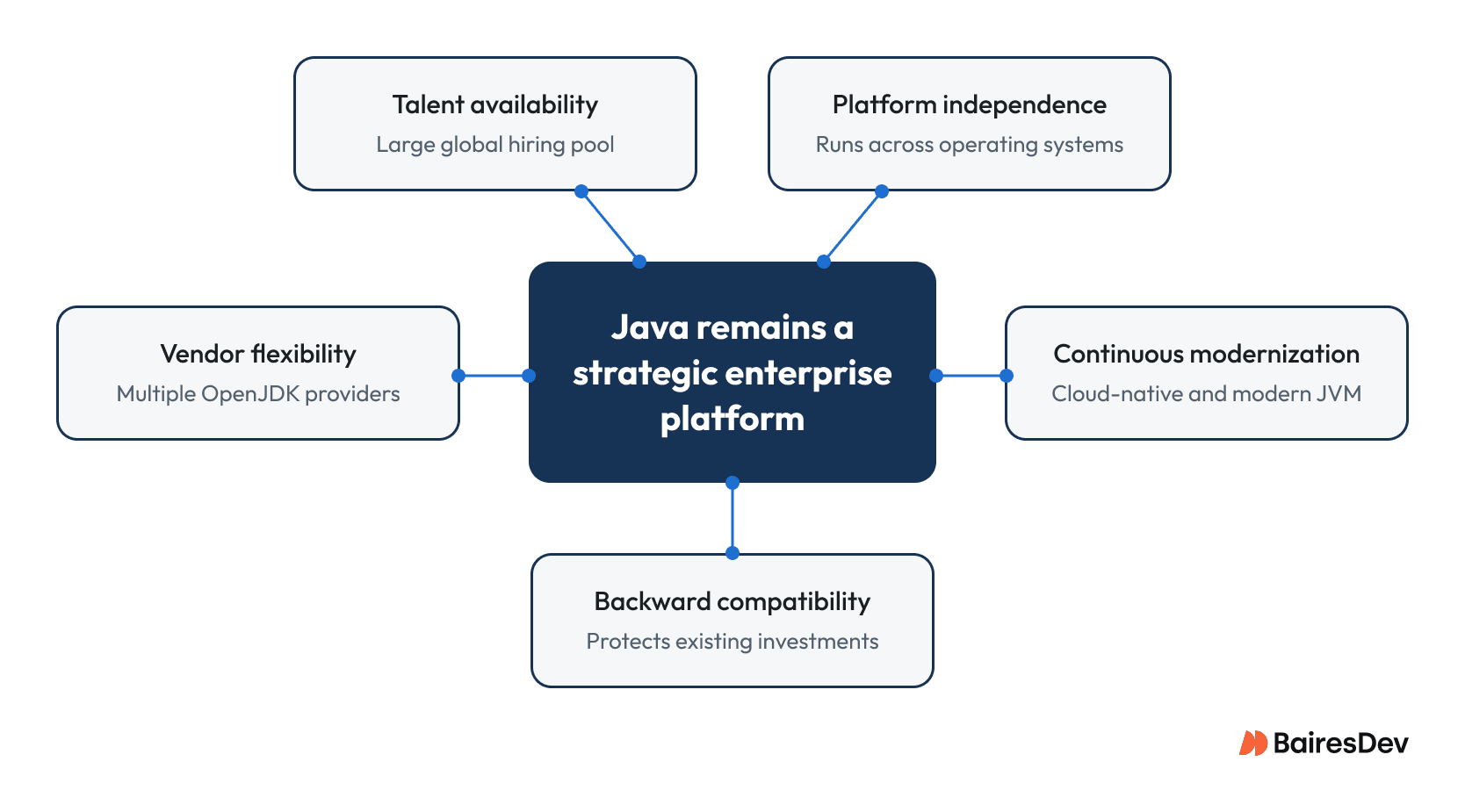
Java isn’t still everywhere because organizations are locked into it. It persists because nothing else offers the same combination of stability, talent depth, and vendor independence at enterprise scale.
The Talent Pool Is Measurable
Java remains one of the most widely used languages in industry, consistently ranking in the top five of the TIOBE Index for nearly three decades. The Stack Overflow Developer Survey 2025 reports that roughly a quarter of developers use Java regularly, with usage approaching 30% depending on category. For organizations running long-lived Java systems, that depth matters practically: finding senior engineers who can work within existing architecture without pulling focus from the core team is far more reliable in Java than in less-established stacks.
Technology decisions often outlast individual employees. Enterprise systems may remain in production for ten or twenty years, which means organizations need confidence that they’ll be able to hire, train, and replace engineers over time. This is one of Java’s strongest advantages.
A large talent pool reduces hiring risk, supports succession planning, and makes it easier to scale teams during modernization initiatives or periods of rapid growth. Organizations aren’t dependent on a small population of specialists, nor are they forced to compete for expertise in a niche technology ecosystem.
For engineering leaders, talent depth translates directly into delivery predictability. The easier it is to find experienced engineers, the easier it becomes to maintain momentum on critical projects.
No Single Vendor Controls the Platform
Java’s open-source reference implementation, OpenJDK, is distributed by multiple competing vendors. Amazon Corretto runs inside thousands of Amazon’s own production services. Red Hat, Microsoft, and Azul also publish free builds. An organization running Java can switch vendors without rewriting a line of code—a level of strategic flexibility that’s genuinely rare in enterprise technology.
Backward Compatibility Protects Existing Investment
Systems written in Java 8—released in 2014—can often run on a modern JVM with minimal changes. When LinkedIn migrated more than 200 applications from Java 8 to Java 11, its P99 latency dropped by 10% on average and maximum throughput rose by 20%—with zero rewrite of application logic. For organizations carrying decade-old codebases that still generate revenue, that compatibility record has direct financial value.
The Language Keeps Modernizing
Java isn’t just surviving—it’s evolving. Java 21 introduced Virtual Threads, which simplify handling high volumes of concurrent tasks without the complexity that previously required specialized frameworks. Project Amber continues reducing boilerplate, making Java code easier to write and maintain. Spring Boot and Quarkus have made the Java platform viable for cloud-native and serverless architectures—areas where it was once considered too heavyweight.
Java itself is rarely the problem that needs solving. The risk typically sits in the application around it—outdated framework versions, brittle deployment pipelines, thin test coverage, or insufficient engineers who understand the system well. That distinction shifts the relevant question from ‘Should we replace Java?’ to ‘Which parts of our Java estate need attention first?’
Why Enterprises Continue Choosing Java
Modernizing Java Systems Without Starting Over
One reason Java remains so common in enterprise software is that organizations rarely need to replace it outright.
When leaders discuss “legacy Java systems,” the challenge is often not the Java programming language itself. More commonly, the issues involve outdated frameworks, aging deployment processes, limited automated testing, technical debt, or a shortage of engineers who understand the application.
That distinction matters because it changes the economics of modernization. Replacing a revenue-generating application can take years, introduce significant risk, and consume engineering capacity that could otherwise support new product development. Modernization initiatives are often able to deliver many of the same business outcomes at a fraction of the cost.
For that reason, most enterprise Java programs focus on incremental improvement rather than wholesale replacement. Common modernization initiatives include:
Common Java Modernization Approaches
| Goal | Typical Approach | Business Outcome |
| Improve scalability | Move workloads to cloud infrastructure | Greater operational flexibility and elasticity |
| Accelerate delivery | Strengthen CI/CD pipelines and automated testing | Faster release cycles and fewer production issues |
| Reduce technical debt | Upgrade Java versions and frameworks | Lower maintenance burden and stronger security posture |
| Improve resilience | Modernize application architecture where appropriate | Higher availability and easier operations |
In many cases, Java itself isn’t the obstacle. The opportunity lies in modernizing the systems around it while preserving the business logic that continues to create value.
The Terms You’ll Hear in Meetings
Java generates vocabulary that surfaces regularly in job posts, vendor proposals, and architecture reviews. The table below decodes the most common terms and identifies the decision each one typically informs.
Table 2: Java Vocabulary Decoder for Non-Technical Leadership
| Term | Plain Meaning | What It Signals |
| JVM (Java Virtual Machine) | The translator that runs compiled Java on any operating system | The role or product depends on JVM-hosted infrastructure |
| JDK (Java Development Kit) | The toolkit engineers use to write and compile Java | Hiring someone who builds Java software, not only operates it |
| JRE (Java Runtime Environment) | The runtime layer that executes Java applications | Operations-focused deployment; server environments now bundle this inside the JDK |
| Java SE (Standard Edition) | The core Java platform specification (e.g., Java SE 25) | Standards conformance referenced in vendor product sheets |
| Jakarta EE | The enterprise edition for large distributed systems, governed by the Eclipse Foundation | Enterprise-grade Java infrastructure; rebranded from Java EE after Oracle’s transfer |
| Spring / Spring Boot | The dominant framework for enterprise Java applications | Production-grade enterprise stack; common in financial, logistics, and manufacturing firms |
| Maven | Dependency and build management for Java projects | Build-system fluency expected alongside Java and Spring |
| Kotlin | JVM language fully interoperable with Java; Google’s preferred Android language since 2019 | Android or modern JVM-based development role |
When a vendor proposal references Jakarta EE, or a job post lists Spring and Maven together, the underlying signal is enterprise Java work: long-lived systems, established tooling, and engineers comfortable with infrastructure that carries decades of production history.
Java Is Not JavaScript
Java and JavaScript are unrelated languages that share a name by historical accident, not technical design.
Java was created at Sun Microsystems and released in May 1995. JavaScript was created by Brendan Eich at Netscape the same month, initially under the name LiveScript. It was renamed JavaScript in December 1995 as part of a joint announcement with Sun—a marketing decision intended to borrow credibility from Java’s growing momentum. The two languages share no codebase, runtime, or design lineage.
They serve different purposes. Java is used for server-side and enterprise applications: banking systems, microservices, Android apps. JavaScript is used for web interfaces that run in web browsers, and for server-side scripting via Node.js. A team hiring a Java engineer and a team hiring a JavaScript engineer are filling fundamentally different roles.
Why Java Outlasts the Hype Cycles
For non-technical leaders at mid-to-large organizations, Java is almost never a decision to make and almost always a context to understand. It runs the systems your colleagues build on, the platforms your finance team budgets for, and the roles your recruiting team fills.
Java’s longevity isn’t inertia. It reflects a set of engineering properties—platform independence, deep talent availability, vendor optionality, and a demonstrated record of modernization—that most enterprise technology stacks never achieve simultaneously. Recognizing where Java operates and why it remains the default for systems that can’t afford disruption gives you the grounding to align business goals with engineering realities without having to take your engineers’ word for everything.