



Key Point
- A dedicated development team is an external team of engineers that works exclusively on your product, under your direction, for as long as needed.
- It’s different from traditional outsourcing, where the provider controls delivery and disbands the team after the project ends.
- It’s also different from staff augmentation, where individual engineers are added to fill gaps on your existing team.
- A dedicated team operates as a self-contained engineering unit using your tools, sprints, and codebase.
- It gives you focused engineering capacity without the delays of local hiring or the overhead of permanent headcount.
- It’s a strong fit when your internal team is stretched and your roadmap needs more capacity fast.
- This guide explains when to use the model, how it compares to other options, expected costs, and what to look for in a provider.
Expanding headcount internally is not always practical or possible due to long hiring cycles and inevitable office politics. Headcount caps stay fixed while delivery expectations don’t, specialized roles sit open for months, and roadmap commitments get made before resourcing is confirmed.
Scaling Without Adding Headcount
Let’s assume your engineering org is behind on the roadmap. Internal hiring is proving slow and since you are looking for experienced or highly specialized talent, availability is limited. The cost of adding a few seniors is becoming increasingly difficult to justify.
So, what are your options?
Expanding headcount internally is still the right call for strategic, permanent roles: architects who are expected to own platforms for years, engineering managers in charge of multiyear initiatives, or domain experts who need deep institutional knowledge to keep the wheels from coming off.
Assuming that compensation is a non-issue, this still leaves you with a long hiring cycle that can stretch for months. According to SHRM benchmarking, it can take between 6 and 8 weeks to hire. As for full productivity, new hires can take anywhere from 3 to 6 months, and some research suggests it can take even longer.
The alternative is getting external capacity. But what kind of engagement matches your needs? Contracting a boutique vendor to handle a specialized one-off project? Bringing on elite freelance talent to help an existing team, or maybe looking to offshore for volume and lower rates?
Each of these can work for the right situation, but none solves the core problem: you need a full engineering unit, operating inside your workflow, with the continuity to own a product area over 12+ months.
In that case, a dedicated development team can be the right approach, allowing you to gain quick access to a fully-staffed and vetted team in just a few weeks.
These models aren’t mutually exclusive. You can build a strong core team and use a dedicated team to fully cover a product line or initiative. Many organizations chose to combine multiple approaches, and often even throw freelancers and domain experts into the mix. That’s how they balance the need for specialized talent, time constraints, and offset part of the cost.
| Factor | Dedicated Team | Internal Hire |
| Time to first contribution | 3 to 5 weeks | 3 to 6 months (hiring cycle + ramp) |
| Cost structure | Monthly retainer, no overhead | Salary + 30% benefits + recruiting + equipment |
| Commitment | Flexible, you can scale up or down as needed | Long-term, difficult to unwind |
| Talent reach | Global (nearshore/offshore pipelines) | Local market, constrained by comp and brand |
| Knowledge continuity | High if the team stays intact | High if retained |
| Hiring risk | Low (pre-vetted, replacement guarantee) | High (bad hire = 30%+ of first-year salary) |
How the Dedicated Development Team Model Works
What does this look like in practice?
You define the team composition: what you’re building, the roles and seniority you need, the technology stack. Then, the partner provides engineers matching that profile from their existing talent bench or pipeline, which is what compresses the timeline from months to weeks. This doesn’t mean you sacrifice quality. You can still interview and approve every engineer individually.
Once contracts, NDAs, and IP agreements are executed, the dedicated team gets provisioned into your tools (Jira, GitHub, Slack, CI/CD) and joins your ceremonies. In most cases, the partner handles payroll, benefits, equipment, and compliance. This offloads some back-office work too, plus it makes spending more predictable. Also, as your roadmap evolves, the dedicated team can scale up or down.
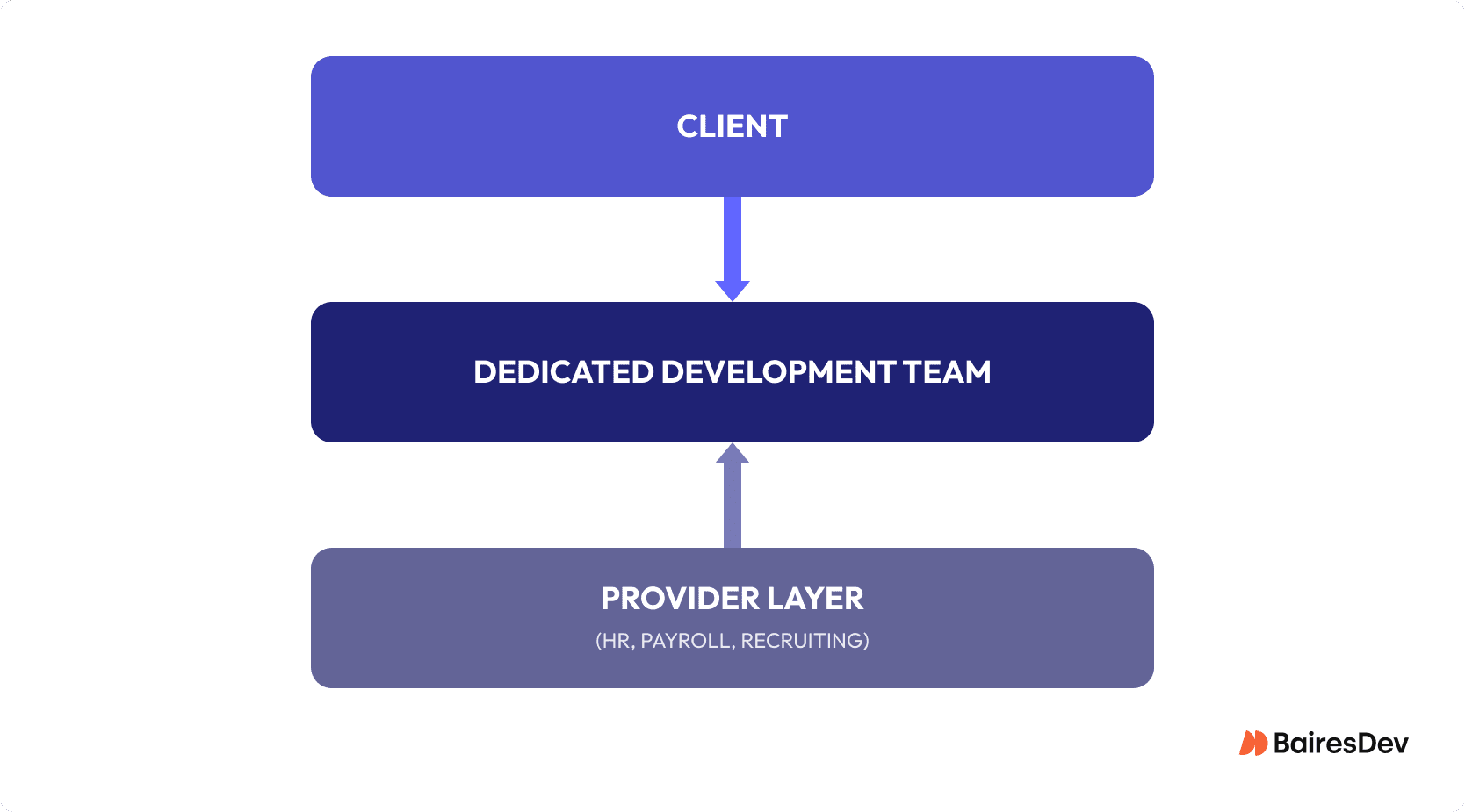
If you’ve worked with staff augmentation before, the mechanics feel familiar. The difference with dedicated teams is that you’re not adding individual contributors to an existing squad. You’re standing up a self-contained unit that owns a product area or workstream.
To an extent, a dedicated software team is self-managing, which is another point worth considering. Engineering leaders and senior developers don’t have a lot of spare time on their hands, and it’s better spent on actual engineering and management instead of hand-holding and daily coordination with external engineers.
Dedicated Team vs. Staff Augmentation vs. Project Outsourcing: Key Differences
Most engineering leaders have evaluated external engineering options before, and they’ve likely encountered these three models. The distinctions between dedicated teams, augmentation, and end-to-end outsourcing matter because they determine how much control you retain and how deep the team’s knowledge gets. These distinctions also have secondary implications, but for brevity, we will focus on the basics.
Staff augmentation adds individual engineers to your existing team structure. It’s straightforward and useful for a wide range of engagements. You manage the external engineers directly and they fill specific skill gaps. For example, you get a senior React developer and two data engineers, and they work alongside your internal team. Staff augmentation is flexible and fast, but the knowledge stays shallow because individuals rotate, and most staff aug engagements are meant to be temporary.
End-to-end outsourcing means that you hand off a defined scope to the partner. Their team (or multiple teams) manages the work, delivers the output, and moves on. You get a predictable cost for a defined deliverable, but you lose direct control over how the work gets done, and the team disbands when the project ends. This can be quite useful for certain initiatives and projects, but the limitations are obvious.
In most respects, a dedicated team sits between these two models. On one hand, it’s a complete engineering unit that works exclusively on your product, under your direction, for as long as the engagement lasts. You get the control of staff augmentation and the team cohesion of a project engagement, with continuity that neither model offers on its own.
| Factor | Dedicated Team | Staff Augmentation | End-to-End Outsourcing |
| Structure | Self-contained engineering unit | Individual contributors join your team | Vendor’s own team |
| Direction | Client-directed | Client-directed | Vendor-directed |
| Scope | Open-ended, evolves with product | Role-specific, defined by your backlog | Fixed deliverable |
| Continuity | High | Low | Low |
| Knowledge Depth | Deep | Shallow | Shallow |
| Management Overhead | Low to medium | Medium to high | Low |
| Best For | Long-term product development | Short-term skill gaps | Defined, one-time projects |
However, as we noted earlier, many companies use more than one model at the same time. For example, a company can use staff augmentation to fill an immediate gap on its existing squads working on a legacy system, while building a dedicated team to own an entirely new product. The models solve different problems and can run in parallel.
In our example, staff augmentation allows you to get specialized talent quickly and without long-term commitments (e.g., maintaining a legacy platform that will be retired in a few quarters), while the dedicated team focuses on developing the new platform.
Staff augmentation fills seats. A dedicated team owns project delivery. Most companies need both, but the question is which workstreams get which model.
What a Dedicated Software Development Team Gets You
Product Knowledge That Compounds
Stripe’s Developer Coefficient report estimated that developers spend roughly 31.6% of their time dealing with technical debt and legacy code. A dedicated team that’s been on your product for nine months knows where the debt lives and what’s safe to refactor. They catch regressions in code review that a new engineer would miss, and they bring niche expertise that’s hard to hire locally. That’s the kind of institutional knowledge you normally only get from long-tenured internal engineers.
Faster Iteration Cycles
Dedicated engineers work on your product full time, not splitting focus across multiple clients. When a ticket lands, they already know the relevant modules, the test coverage, and the deployment pipeline. That removes the overhead that slows down staff aug rotations or agency handoffs.
Improved Delivery Through Continuity
Long story short, the same engineers who built your v1 ship your v2. There’s no re-onboarding between project phases or knowledge transfer documents. Microsoft Research identifies institutional context as a major barrier to developer productivity during onboarding. Every time you swap an engineer, you pay a hefty price. Over a two-year engagement, the compounding effect on velocity is significant: fewer ramp cycles, context-loss bugs, faster time from ticket to production, and so on. A continuous team avoids this.
Scalability Without Long Hiring Cycles
Product roadmaps shift, and dedicated teams can scale with them. Need to expand the team for a major release? Your partner sources additional engineers in a matter of weeks. And when you wind down after launch, the team is right-sized without severance or backfill planning. When you run these cycles through your own recruiting function, SHRM data puts the cost-per-hire for specialized tech roles between $6,000 and $28,000. A dedicated team provider absorbs that cost and timeline.
Predictable Costs and Reduced Operational Overhead
The provider handles payroll, benefits, equipment, and local labor compliance for every professional on the team. For engineering leaders justifying spend to finance, this simplifies the business case: here’s the monthly cost, here’s the velocity output, here’s the trend line. There’s no variable billing or surprises. You manage the technical direction while the provider manages everything else.
How to Build a Dedicated Development Team
The mechanics seem straightforward, but engagements tend to succeed or stall in the details. Get the composition wrong, and you spend months managing around skill gaps. Skip the onboarding fundamentals, and you lose the first few weeks to friction that was entirely avoidable.
Define the Team Composition
Start with your business goals, not with headcount. Once the scope is clear, map out roles: frontend, backend, mobile, QA, DevOps, tech lead, and so on. Decide on seniority mix. A team of six seniors operates differently than three seniors and three mid-levels, plus the cost difference can be substantial.
Be specific about the tech stack. “Python backend” is not the same as “Python with FastAPI, Postgres, and Kubernetes.” The more precise your requirements, the faster your provider can match from their bench or pipeline. Vague requirements produce vague teams.
Set Clear Expectations Before Contracts
Align on the operational basics before the engagement starts. Define communication cadence and project management standards, e.g., async updates in Slack, weekly syncs with your engineering lead, and so on. If you run sprints, clarify the velocity targets you expect once the team is ramped.
A dedicated team typically includes a tech lead or embedded PM who handles planning and internal coordination. Your side sets priorities, reviews output, and makes product calls. Align on that split upfront, including who owns sprint planning, retrospectives, and how escalations get handled.
Onboarding: The First Week Sets the Trajectory
A dedicated team that’s blocked on access or missing context loses momentum before it starts. The difference between a strong first week and a chaotic start usually comes down to preparation on your side.
| Milestone | What’s Done | By When |
| Access and tooling | Codebase, CI/CD, project management, communication channels | Day 1 |
| Context transfer | Architecture docs, system diagrams, roadmap, current sprint priorities | Day 1 to 3 |
| Team integration | Introductions to key stakeholders, first ticket assigned, standup participation | End of Week 1 |
Access delays are the most common source of first-week friction. According to industry benchmarking on developer onboarding, half of organizations using manual provisioning processes lose the first week to IT tickets and access requests.
First Sprint Kickoff
By the end of week one, the team should have merged at least one PR, attended a standup, and participated in a planning or grooming session. The goal is not significant output. It’s proving the integration works: access is functional, communication is flowing, the team understands how your org operates.
If something is broken in week one, surface it immediately. Access issues, unclear ownership, missing documentation, etc. These never resolve themselves. A problem that lingers through week one becomes a pattern by week four, and can end up wasting a lot of time and impacting productivity.
30/60/90-Day Milestones
Senior engineers hired in-house typically reach full productivity within 3 to 6 months, assuming they join an active team. Bringing in a dedicated team should compress this because the provider handles screening and you skip the recruiting cycle entirely. That said, timelines vary based on codebase complexity and how much context transfer you can provide upfront.
By day 30, your new dedicated team should be contributing independently to well-scoped tickets without daily oversight. Code quality should match your standards, and the team should be participating in ceremonies without prompting.
By day 60, the team should own a defined area of the product or workstream. They should be participating in architectural discussions and catching issues in code review that require product context.
By day 90, they will be operating like an internal squad. Velocity should be stable, and the engineers should be proactively identifying technical debt and suggesting improvements.
Note: If you’re not seeing this progression, something is off. It could be team composition, incomplete onboarding, or a mismatch in expectations. Address it early. A good provider can swap engineers who aren’t performing or adjust the structure. If they can’t or won’t, that’s a provider problem.
Nearshore Dedicated Teams: Why Timezone Alignment Matters
The dedicated team model depends on integration and real-time communication. That integration tends to break down when you’re working across a 12-hour timezone gap.
If you’ve worked with offshore teams, you’ve probably experienced the friction firsthand. The remote team is technically available, but not operationally present. A question asked at 3pm Eastern gets answered at 6am the next day.
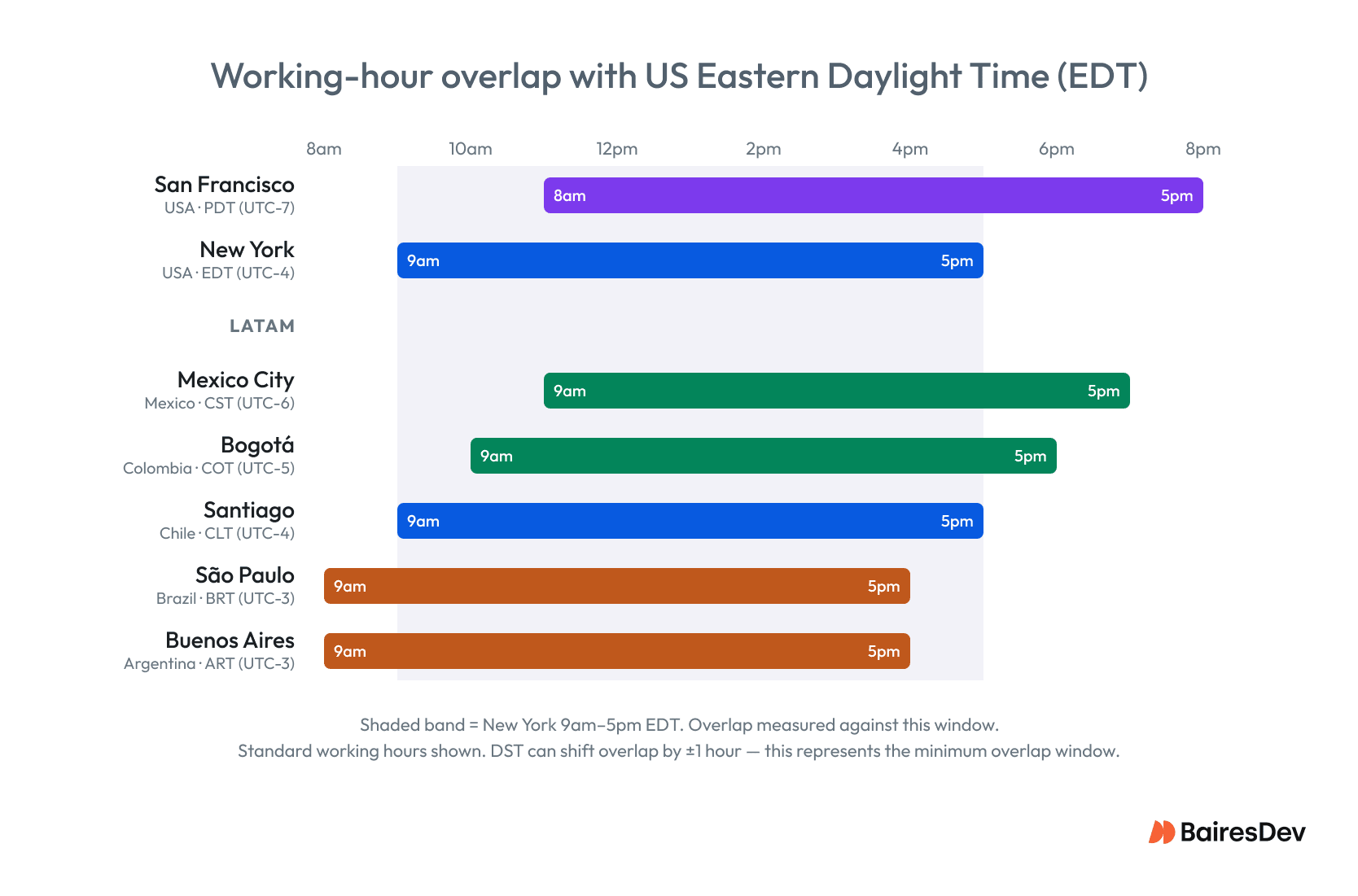
Nearshoring solves this async problem. For US companies, a dedicated remote team in Latin America offers four to six hours of real-time overlap during a standard workday. That’s enough for calls, live code reviews, and same-day resolution of blockers.
The quality is there, too. Brazil and Mexico alone graduate more STEM majors annually than Germany and Japan combined. Add Argentina, Colombia, and the rest of the region, and you’re looking at a pool of skilled developers that rivals any in the world.
Most LATAM engineers have honed their technical skills building software for US and global companies, operating in English as a working language. That experience base is what separates nearshore from the junior-heavy offshore model many engineering leaders have already tried and moved on from.
Nearshore vs. Offshore: The Tradeoffs
Offshore teams can offer lower rates on paper, but the math changes when you factor in coordination overhead. Async communication and a large timezone gap mean that every decision that requires discussion adds a day.
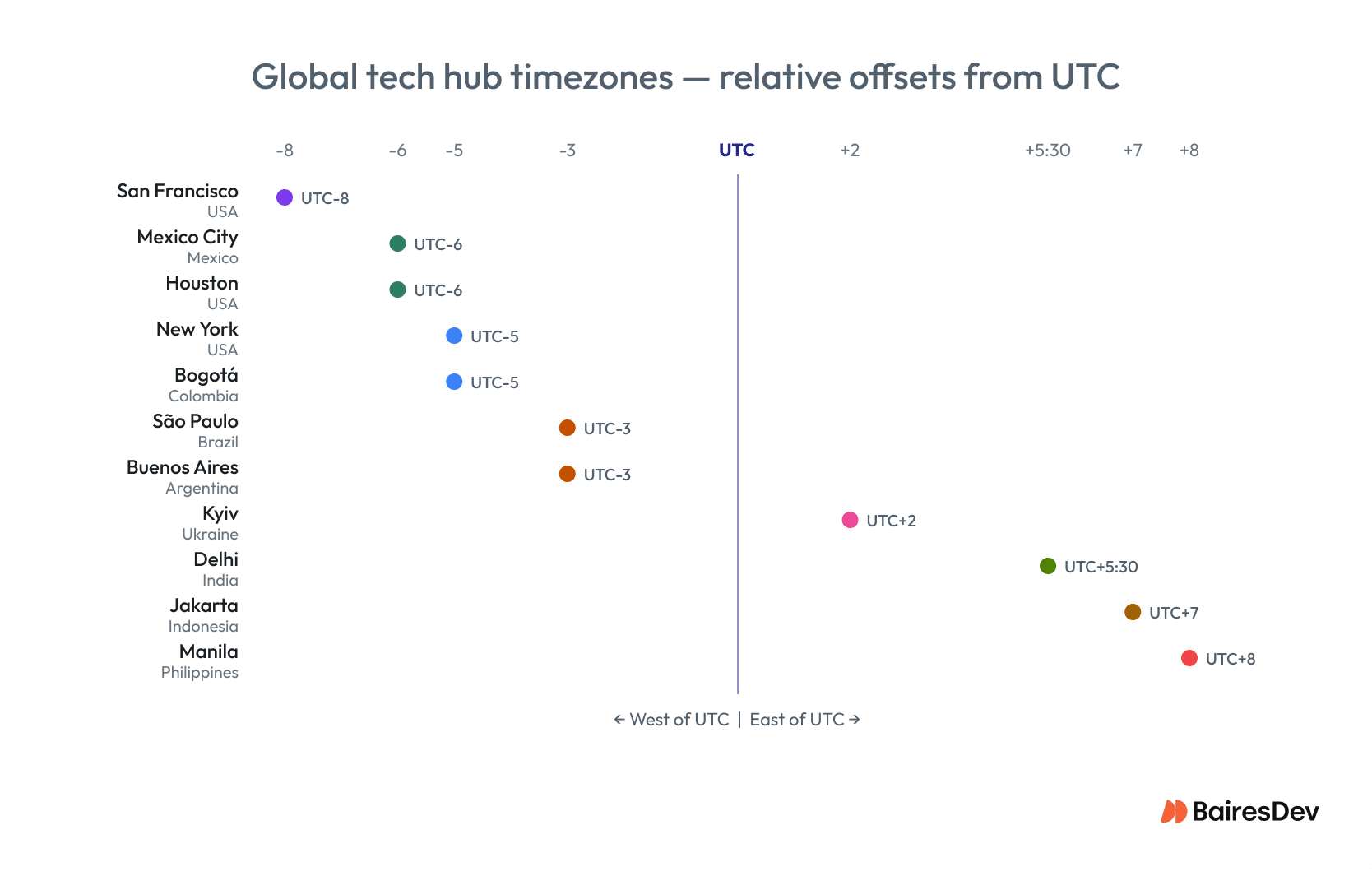
That difference shows up everywhere. If something needs to be done as soon as possible, a nearshore engineer can get started immediately, while their offshore counterpart typically cannot.
Additionally, if the handoff isn’t smooth and involves back-and-forths, you could lose another day to a handoff that would have taken mere minutes without async communication. Over a 12-month engagement, that latency compounds, as does managerial overhead.
The Cost of A Dedicated Development Team
Finance will ask for an apples-to-apples comparison. Here’s how the three models compare on what actually determines the total cost of delivery: effective output, timezone fit, and coordination load.
| Factor | US In-House | Nearshore (LATAM) | Offshore (Asia) |
| Cost vs. US baseline | Baseline | 30 to 50% savings | 50 to 70% savings |
| Timezone overlap | Full | Significant (4 to 6 hours) | Limited (0 to 1 hours) |
| Coordination overhead | Baseline | +5% | +15 to 25% |
Note: Savings estimates vary by role, team size, seniority, and geography.
Most of our clients have worked with offshore teams before. What they describe is consistent: blocked PRs sitting overnight, questions that pile up instead of getting answered in Slack, and more planning across the board.
The 15 to 25% overhead shows up as your senior engineers spending a few extra hours a week on coordination they wouldn’t need with overlapping hours.
Consider a six-person senior team. Offshore looks cheaper on paper, but a 15 to 25% coordination penalty means the effective output of that team is closer to five engineers. To match a six-person nearshore team, you’d typically staff seven or eight offshore engineers. That shrinks the apparent cost advantage, and that’s before you factor in the additional management load.
No dedicated team isn’t overhead-free, though. Your engineering leadership invests time in onboarding, integration, and coordination, especially during the first couple of months. And if you’ve been burned by a cheap offshore provider before, you already know the difference between a low hourly rate and a low total cost of delivery.
How to Choose a Dedicated Development Team Provider
The evaluation criteria for dedicated teams differ from project-based outsourcing. Instead of buying a deliverable, you’re building a team that will work inside your systems for months or years. That means continuity, flexibility, and trust matter even more.
| Criterion | What to Look For | Red Flags |
| Talent vetting | Multi-stage technical screening, English assessment, soft skills evaluation | Vague descriptions of hiring process, no rejection rate data |
| Composition flexibility | Ability to build the exact team profile you need (stack, seniority, specialization) | Cookie-cutter team structures, limited role options |
| Ramp-up time | Realistic timeline to assemble a productive team (2 to 4 weeks typical) | Promises of instant availability with no bench explanation |
| Continuity | Low turnover, clear transition protocols, long-term engineer retention | Evasive answers about churn, no data on average tenure |
| Contract flexibility | Month-to-month options, ability to scale up or down without penalties | Long lock-ins, punitive exit clauses |
| Track record | References from similar-stage companies, named clients willing to talk | Anonymous case studies only, no referenceable clients |
| Account management | Named account manager, regular check-ins, clear escalation path | No single point of contact, rotating account reps |
| IP protection | Standard NDA, full code ownership, secure access protocols | Ambiguous IP terms, shared infrastructure with other clients |
Red Flags in The Sales Process
The way a provider sells tells you how they’ll deliver. If a vendor is honest about their limitations and doesn’t overpromise, it’s likely that culture will extend to delivery as well. Here are a few things to watch out for in the sales process:
- Team composition shifts mid-process: You’re shown senior profiles, but introduced to less qualified engineers at a later stage of the process. Ask who specifically will be on your team and whether those individuals are confirmed. Never accept bait and switch.
- No qualifying questions about your environment: A provider building a dedicated team should ask about your stack, tools, processes, and how you operate. If they skip this, they’re likely staffing a generic team, not building one for your context.
- Rigid scaling terms: Dedicated teams exist to flex with your roadmap. If the partner requires too much notice to add or remove engineers, or is unable to backfill roles and expand the team with quality talent, that suggests their capacity is limited.
- Turnover treated as normal: Some churn is inevitable, and that’s an important caveat here. But if the provider can’t tell you their average engineer tenure or how they handle transitions, expect to re-onboard frequently.
Build Your Dedicated Development Team
If your engineering org can’t keep pace with the roadmap, and if you’re ready to hire a dedicated development team that operates inside your tools and processes, schedule a call to talk to our experts.