


Executive Summary
This article discusses why procurement is uniquely positioned for AI transformation. It examines procurement’s economic centrality, decision complexity, manual workload bottlenecks, and structural capacity constraints. The author argues that procurement teams are already saturated, making incremental improvements insufficient. AI must address capacity constraints directly by removing low-leverage work and enabling strategic focus.
As a long-time engineering leader, I have had both very fruitful and not-so-fruitful dealings with my partners in procurement. At its best, procurement has been a force multiplier, helping my teams negotiate smarter contracts, reduce risk, and impose discipline. Engineering teams are naturally geared to move fast and accept higher risk, so this guidance provides critical balance. At its worst, procurement has felt like a bottleneck, with slow cycles, rigid processes, unclear ownership, and the sense that rules mattered more than outcomes.
I once assumed this tension was unavoidable. Enterprises are complex, controls matter, and risk is real. Procurement exists to protect the company, and protection almost always introduces friction. Like traditional quality assurance models in software development, I assumed procurement’s role was to prevent worst-case cost scenarios while still allowing for upside, even if that came at the expense of execution speed.
I no longer believe that explanation is sufficient. Procurement is not frustrating simply because it is bureaucratic. It is frustrating because it sits at the intersection of fragmented data, human-heavy decision-making, and constantly shifting constraints, and making matters worse, we continue to manage it with tools and operating models designed decades ago. This structural misalignment, more than bureaucracy itself, is what makes procurement a compelling candidate for AI-driven transformation. And for those willing to embrace it, the possibilities are already tangible:
- Agent-driven project scoping that compresses sourcing cycles from weeks to days
- AI-powered supplier selection drawing on signals embedded deep in historical data
- Natural language analytics that eliminate the need for complex report builders
- Autonomous negotiation agents that drive toward optimal deals while representing the buyer’s style and goals
Five years ago, none of these seemed possible in the immediate future; now, capabilities like these are creating real competitive advantages for those with the vision and confidence to adopt them.
In this piece, I focus on why procurement is uniquely ripe for change. In upcoming articles, I’ll examine how that change happens, with an emphasis on architecture rather than features, why most AI pilots stall before delivering durable impact, and what success ultimately looks like.
Procurement Is Where Enterprise Economics Actually Live
Procurement governs the largest set of decisions that directly affect enterprise cost, risk, and speed.
Most non-payroll dollars are committed through procurement, often via thousands of small decisions that compound over time. Across industries, external spend routinely represents the largest share of controllable enterprise costs. Up until recently, in services businesses, procurement-managed spend can approach 30% of revenue, and in manufacturing and industrial companies, it can exceed 50%. Even in software-first organizations like the one I’m part of, vendor spend—including cloud infrastructure, SaaS platforms, data providers, and services—quickly dominates operating expenses.
This is not an abstract point. It explains why procurement performance has an outsized impact on margins, growth, and resilience. A 1% or 2% improvement in sourcing outcomes can outweigh entire internal cost-reduction programs elsewhere in the company. And yet procurement is still commonly treated as a downstream control function rather than a strategic system that shapes decisions early, guides tradeoffs, and improves outcomes before spend is committed. The tooling reflects that orientation. Most procurement systems are designed to enforce rules, capture approvals, and document decisions once they’ve been made.
That approach made sense when markets were stable and supplier relationships changed slowly. It is increasingly misaligned with today’s environment of volatile pricing, rapid vendor proliferation, and tighter regulatory scrutiny.
Why Are Procurement Decisions Contextual Rather Than Static?
Procurement decisions are contextual rather than static because they involve dynamic tradeoffs across cost, risk, speed, compliance, and supplier performance. These tradeoffs continuously shift as markets move, suppliers evolve, and internal priorities change. Understanding this complexity is at the heart of why conventional procurement systems so often fall short.
One of the biggest disconnects between how procurement works and how systems are designed is decision complexity.
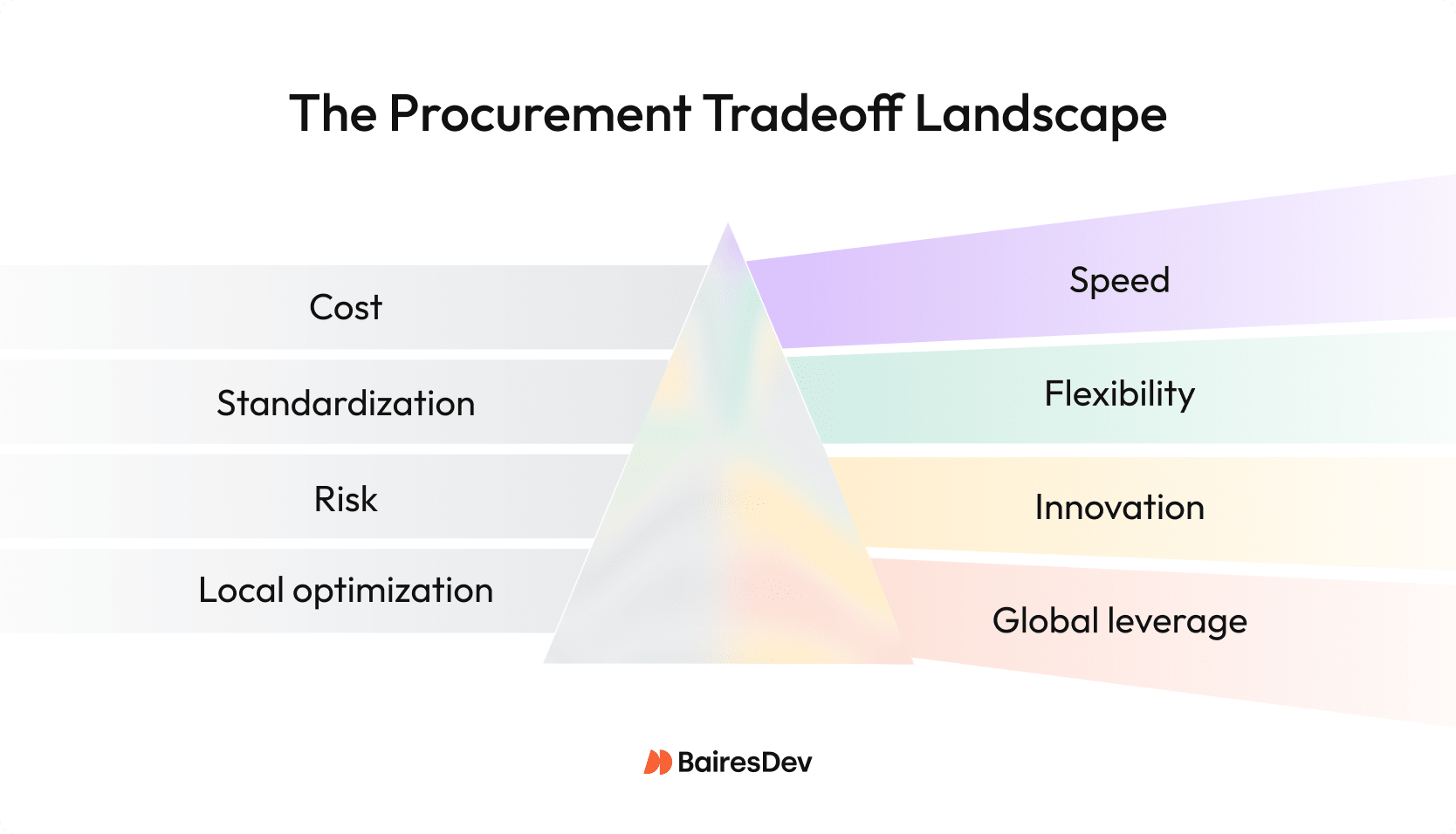
What makes this especially difficult is that these tradeoffs are dynamic. Supplier performance changes, markets move, internal priorities shift, and regulatory expectations evolve. A sourcing decision that was reasonable six months ago can quickly become suboptimal—or even risky—without anyone explicitly noticing.
Historically, enterprises have handled this complexity by adding more people to the process: category managers, sourcing analysts, vendor managers, legal reviewers. Coordination happens through meetings, email threads, spreadsheets, and shared documents. Knowledge lives in inboxes and in the heads of a small number of experienced practitioners.
My instincts as an engineer tell me this is a scaling failure. Headcount scales linearly; complexity compounds much faster. As transaction volumes increase and supplier ecosystems become more interconnected, procurement teams fall back on conservative defaults and rigid playbooks—not because they prefer them, but because the cognitive load becomes unmanageable.
This is exactly the kind of environment where AI can add leverage, but only if it is designed to reason about tradeoffs rather than enforce static rules. Much has been made in recent months of “agent orchestration,” often billed as a control plane that makes agents more efficient while constraining their behavior to fit corporate guidelines. In fact, some orchestration advocates single this technique out as the only way to govern agentic systems in practice.
I beg to differ.
Orchestration, however one tries to dress it up, is another incarnation of 90s-era workflow. Inflexibility and proceduralism have been weaknesses of business process management systems for the entire existence of the concept. Layering workflow on top of an agentic system to improve it works against the base logic of agentic architecture. This is not a reasoned take on enterprise architecture in the agentic era. It’s a view driven by fear and fear alone.
An agentic procurement system can fully oversee day-to-day procurement activities, including category management, multi-turn negotiation, and ad-hoc bid analytics. This requires the right prompts, proper context management, RAG/GraphRAG enrichment, tools with built-in constraints, MCP integration to adjacent systems, and a well-developed AI governance regime.
Done correctly, this removes procurement trench work and lets practitioners focus on high-value, strategic work. Correctly architected, orchestration-free procurement system implementations boost capacity and eliminate procurement’s backlog, allowing all needs to be appropriately sourced.
The complexity of procurement decisions is only part of the challenge. How procurement teams spend their time is the other.
Procurement Teams Are Operating Under Structural Capacity Constraints
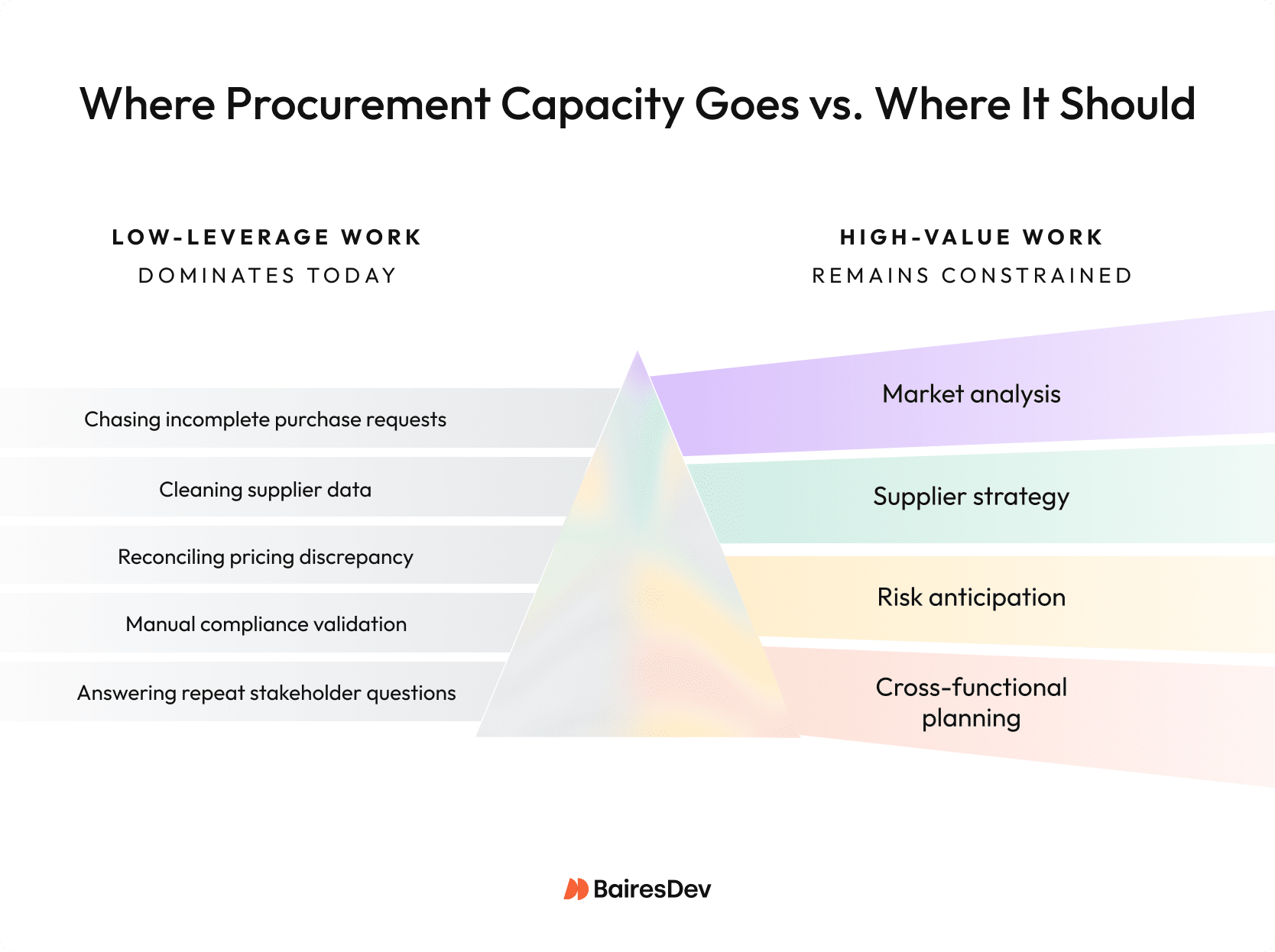
Ask procurement leaders where their teams spend time, and you hear a consistent answer: too much effort goes into work that does not require strategic judgment.
- Chasing incomplete purchase requests
- Cleaning up supplier data
- Reconciling pricing discrepancies
- Manually validating compliance
- Answering the same stakeholder questions repeatedly
Benchmarks reinforce this. A significant share of procurement and adjacent accounts payable work remains manual. Touchless invoice processing is still the exception rather than the norm (with 1 in 3 currently processed this way), and performance varies widely between average and best-in-class organizations.
This manual workload exists against a backdrop of steadily increasing demand. Procurement teams are not just inefficient. They are backlogged.
Meanwhile, the work that actually drives enterprise value, like market analysis, supplier strategy, risk anticipation, and cross-functional planning with engineering, finance, and operations, remains constrained.
This is not a talent problem. It is a systems problem.
How Does Tool Fragmentation Limit Procurement Effectiveness?
Tool fragmentation limits procurement effectiveness because disconnected systems prevent decisions from being evaluated in full context. As a result, humans are forced to manually bridge data, workflows, and policy constraints, consuming capacity that should be spent on strategic judgment. This fragmentation is not accidental; it is the predictable result of two decades of incremental digitization.
Over the last two decades, enterprises have digitized procurement incrementally rather than holistically. E-sourcing tools here, contract repositories there, spend analytics dashboards somewhere else. Each solves a narrow problem. None understands the full context of a decision. As a result, humans act as the glue between systems that were never designed to work together.
At the same time, demand for procurement involvement has increased steadily. More spend categories. More suppliers. More regulatory scrutiny. More stakeholders expecting procurement to participate earlier and more often. Headcount, in contrast, has grown slowly, if at all.
The result is predictable: procurement teams triage. They focus on the largest deals and apply standard playbooks to everything else. They default to conservative decisions that minimize downside rather than maximize value, not because they lack ambition, but because capacity is constrained.
When throughput is limited, systems optimize for survival. Variance is reduced, exceptions are avoided, and opportunity is traded for predictability. This dynamic explains why so many procurement transformations stall. New tools are layered onto existing processes, but the underlying workload does not shrink.
What It Actually Takes for AI to Create Capacity
AI changes the equation only if it addresses this constraint directly. If AI simply adds another interface or analysis step, it increases load. If it removes low-leverage work, compresses cycle time, and handles routine decisions within defined guardrails, it creates capacity. That capacity allows procurement teams to move upstream, engage earlier, and capture value that would otherwise remain unrealized.
This means architecting agentic systems with a few core capabilities. They need persistent memory layers that retain category-level context across engagements. They also need retrieval pipelines that bring together contract repositories, ERP histories, and supplier performance data in a single reasoning pass. And just as important, tool interfaces should enforce policy at the moment of action, not through downstream approval workflows.
Decision boundaries should be framed as constraints the agent works within, not gates it has to escape. That includes things like spend thresholds, preferred supplier lists, regulatory carve-outs, and delegation of authority. From there, multi-agent patterns can take on more specialized roles. A sourcing agent can run market scans and draft RFXs, a negotiation agent can handle multi-turn supplier conversations against a defined BATNA and a compliance agent can validate outputs against contract templates and regulatory requirements.
The key is that they operate through shared state, not rigid handoffs. Built this way, the system absorbs the high-volume, low-judgment work that consumes procurement capacity today.
Humans stay involved where judgment actually matters, like exception handling, strategic supplier relationships, and decisions that reshape category strategy.
Why Incremental Procurement Improvements No Longer Work?
Incremental procurement improvements no longer work because the underlying system is saturated, fragmented, and capacity-constrained. Adding tools or tightening controls does not resolve structural misalignment. It often increases complexity without increasing leverage.
A saturated system does not respond well to marginal adjustments.
Procurement is economically central, decision-heavy, and increasingly risk-sensitive. It is constrained by systems that optimize for control rather than reasoning, and it relies heavily on humans to bridge gaps between fragmented tools and data. More investment in the same direction produces diminishing returns and in some cases, makes the system more brittle.
That combination makes procurement a strong candidate for AI-driven transformation, but only if that transformation is systemic rather than additive.
Procurement will not be transformed by AI in isolation. AI has to be developed alongside changes to data, workflows, and decision boundaries so that both evolve together. Most efforts fail when intelligence is introduced without rethinking the system it operates in. That is also where the real opportunity lies.
In upcoming articles, I’ll examine what it actually takes to build AI systems that can operate inside procurement workflows, including data foundations, integration strategy, policy modeling, and trust boundaries. That is where the real work begins.
Key Takeaways
- Procurement bottlenecks are often capacity problems, not talent problems.
- Incremental tooling cannot fix systems built on fragmented data and manual coordination.
- AI only creates leverage when it removes low-value work instead of adding new process layers.
- Procurement decisions require reasoning across shifting tradeoffs, not static workflow enforcement.
- The real opportunity in AI procurement transformation is architectural, not feature-driven.