


For executives under pressure to scale faster while keeping costs in check, the shift toward everything-as-a-service (XaaS) has become hard to ignore. What started with familiar cloud services like SaaS, PaaS, and IaaS has expanded into a sweeping universe of offerings delivered on a subscription basis. From infrastructure resources and disaster recovery to security, hardware, and even energy, the XaaS model promises agility and flexibility that traditional ownership can’t match.
Yet as attractive as the model looks, business leaders know that change comes with tradeoffs. Adopting cloud computing models requires more than a budget shift. It reshapes business processes, vendor relationships, and compliance strategies. The central question isn’t whether XaaS is growing, but whether it aligns with your business model and long-term priorities.
This article unpacks the advantages, risks, and key decision points around XaaS, so business leaders can evaluate its real fit for their organizations.
Understanding the XaaS Model
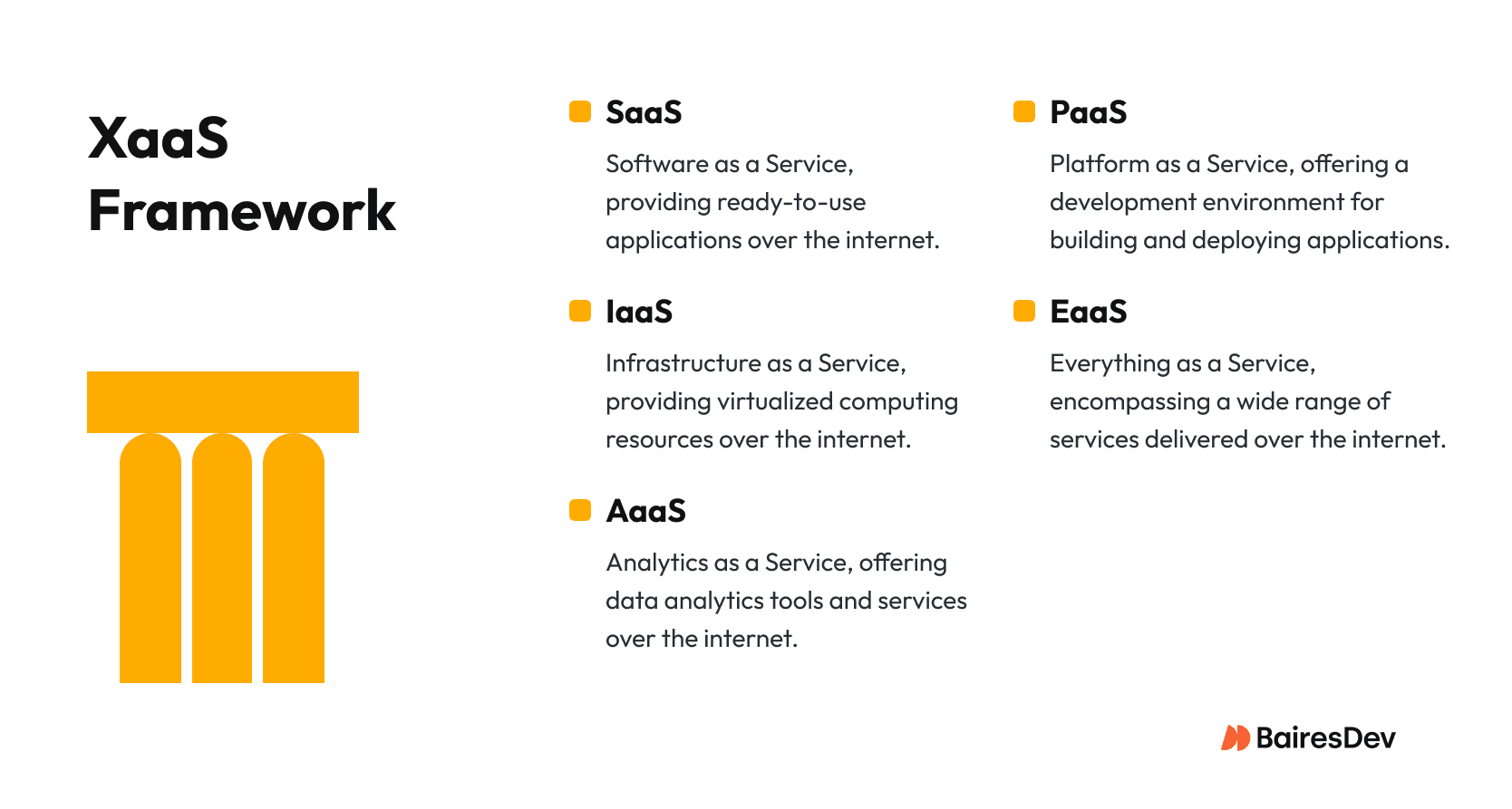
Everything-as-a-service builds on established cloud computing foundations like software as a service (SaaS), platform as a service (PaaS), and infrastructure as a service (IaaS). But instead of stopping there, XaaS extends the approach to nearly any function that you can virtualize and deliver online.
This includes hardware, databases, and security services, as well as newer models like energy as a service (EaaS) and “anything as a service” (AaaS). The delivery method is consistent: users access services and tools remotely, paying only for what they consume.
The scale of adoption is striking. Analysts estimate the global XaaS market at more than $340 billion in 2024, with projections of over $1.2 trillion by 2030. That growth is fueled by the demand for speed, flexibility, and reduced reliance on on-site systems. Supporting this momentum, Gartner reports that the global IaaS market grew 23.4% in 2024, reaching $172 billion, driven largely by enterprise cloud migration and AI workloads.
What Makes XaaS Different
While cloud service models are familiar to most enterprises, XaaS distinguishes itself in a few ways:
- Scalability: Companies expand or contract resources as needed without large upfront investments.
- Predictability: Subscription basis pricing improves budget forecasting and cash flow management.
- Flexibility: Organizations can switch offerings on or off, testing new technologies without major commitments.
- Expertise: Providers deliver updates, patches, and technical support, reducing the burden on internal IT.
In practice, this means a team can pilot application development platforms, experiment with big data tools, or add extra infrastructure resources during a seasonal traffic surge—then scale back once demand stabilizes.
Benefits of XaaS for Enterprises
Enterprises are drawn to XaaS primarily for its potential to reduce expenses and unlock agility. The financial advantage comes from shifting the company’s infrastructure spend from capital expenditures (CAPEX) to operational expenditures (OPEX). Instead of purchasing servers or licenses outright, businesses pay for access to the same resources through a cloud provider.
Key benefits include:
- Lower infrastructure costs: Providers like Microsoft Azure and Google Workspace deliver services at scale, lowering unit costs compared to in-house builds.
- Improved disaster recovery: Built-in redundancy and failover protect against downtime and performance issues.
- Faster time-to-market: Continuous updates let teams push changes weekly instead of quarterly.
- Streamlined operations: Integration and automation reduce manual effort in critical business processes.
- Access to advanced tools: From Apache Stratos to AI-driven analytics, businesses gain capabilities that would be costly to maintain internally.
To clarify the landscape, here’s a snapshot of the most common XaaS options companies are adopting today.
Common XaaS Offerings
| XaaS Type | Description |
| SaaS | Software applications accessed via the cloud (e.g., Google Workspace, Salesforce, Microsoft 365) |
| PaaS | Development platforms with middleware and OS (e.g., Apache Stratos) |
| IaaS | Servers, storage, and networking infrastructure |
| HaaS | Hardware installed locally, owned by provider |
| SECaaS | Security tools like antivirus, encryption, intrusion detection |
| EaaS | Energy optimization and management services |
For XaaS users, the agility is as valuable as the cost savings. Faster deployment of software applications, better support for different devices, and the ability to scale to meet evolving customer expectations can directly affect revenue and retention.
Customer Engagement and Business Processes
XaaS can also reshape how companies interact with their customers and manage internal operations.
- Responsiveness: When demand spikes, a cloud provider can instantly add infrastructure resources to maintain performance.
- Consistency: Enterprise-grade cloud computing models provide uptime guarantees and minimize disruptions.
- Improved customer engagement: Reliable, always-available services help build trust with users.
Behind the scenes, automation reduces manual errors, while cross-functional teams benefit from shared tools and centralized data. For example, marketing, engineering, and support can all access the same tools and data, creating tighter alignment between business processes.
Strategic Fit for Your Business Model
Adopting XaaS affects how your organization operates day to day. Leaders should weigh several enterprise-specific considerations:
- Procurement and finance: Moving to a subscription basis may require revising procurement workflows and adjusting budgeting cycles.
- Vendor management: A strong governance framework is needed to prevent vendor sprawl and keep expenditures predictable.
- User adoption: While interfaces matter, at scale the bigger challenge is aligning new solutions with existing workflows across thousands of users.
- Compliance: For regulated industries, ensure providers support required standards around security, data residency, and auditability.
PwC’s 2024 analysis shows that CEOs expect 49% of revenue to come from recurring services by 2027—up from 34% today. This shift underscores why finance and procurement leaders must adapt budgeting and vendor strategies for the XaaS era. When these factors align with organizational priorities, XaaS can become a core enabler of agility and innovation.
Risks and Considerations
Despite its advantages, XaaS isn’t a universal answer. Business leaders need to evaluate potential downsides carefully.
Potential Drawbacks
- Internet reliability: Service access depends on a stable network and may falter in regions with poor connectivity.
- Security concerns: Sensitive data stored with third parties introduces compliance risk.
- Integration complexity: Connecting new platforms with legacy software and on-site systems can be challenging.
- Loss of control: Outsourcing certain functions can reduce customization options and operational visibility.
- Hidden fees: Pricing models aren’t always transparent, creating budget surprises.
Compliance and Vendor Sprawl
Industries subject to GDPR, HIPAA, or SOX must confirm where data is stored and how it is managed. Not all XaaS providers offer detailed controls over residency or retention.
Meanwhile, without centralized oversight, different departments may adopt overlapping XaaS services, driving up expenditures and creating inconsistent operations. A governance model that consolidates vendor selection and integration helps avoid these pitfalls.
Choosing the Right XaaS Provider
Success depends on selecting the right XaaS provider. For enterprise-scale partnerships, criteria include:
- Track record: Proven uptime, strong references, and long-term customer retention.
- Support and continuity: Transparent incident response plans, tested disaster recovery, and technical support.
- Integration capabilities: Compatibility with platforms like ERP, CRM, or custom software applications.
- Roadmap: Clear investment in new features and long-term viability.
Leading cloud providers like Microsoft Azure and Google Workspace have broad ecosystems that ease integration. But specialized providers may be stronger in niche XaaS options, such as database management or security.
Forrester’s 2024 Cloud Predictions warn that hyperscalers face increasing pressure from sovereignty and sustainability demands—opening the door for specialized XaaS providers that address these gaps.
Long-Term Advantages of the XaaS Model
Ultimately, the appeal of XaaS goes beyond short-term cost savings. For many companies, it provides a foundation for scalable innovation.
- Faster product launches: Access to flexible platform as a service tools accelerates application development.
- Analytics-driven operations: Built-in monitoring and big data capabilities improve decision-making.
- Global collaboration: Support for distributed teams across different devices and geographies.
- Innovation without risk: Pilot emerging technologies on a small scale, then expand only if results justify it.
These benefits allow companies to test and iterate at speeds impossible with traditional ownership models.
Beyond Cost: A New Operating Model
The rise of XaaS signals more than a technology shift. It represents a fundamental change in how businesses structure spending, manage vendors, and enable innovation. The organizations that thrive won’t just adopt cloud services because they are fashionable. They will adopt them where they create measurable business value.
For leaders evaluating the next phase of growth, the question isn’t whether XaaS will become part of the landscape—it already has. The question is how to incorporate them into an organization’s long-term business model without losing control over security, compliance, or expenses.
Handled well, XaaS offers a way to cut expenses, strengthen resilience, and expand capabilities. Handled poorly, it can create new risks and dependencies. The difference lies in careful planning, disciplined vendor management, and alignment with strategic priorities.