



Key Points
- Lean software development, formalized by Mary and Tom Poppendieck in 2003, optimizes the entire value stream and eliminates waste using principles rooted in the Toyota Production System. Agile, established by the Agile Manifesto in February 2001, focuses on iterative development and constant customer feedback.
- February 2026 marks the 25th anniversary of the Agile Manifesto, created by 17 software practitioners at The Lodge at Snowbird, Utah.
- Digital.ai’s 18th State of Agile report, published in October 2025, found that 74% of organizations now use hybrid, blended, or homegrown Agile models, while 76% cite increased scrutiny of ROI and business impact as a leading pressure.
- AI adoption inside Agile delivery jumped from 68% to 84% in a single year, while only 49% of organizations have AI governance guardrails in place.
Every engineering leader eventually faces the Lean vs. Agile question when deciding how to structure delivery. Lean and Agile both aim to accelerate software delivery, but they take different approaches.
Lean optimizes the entire delivery flow by eliminating waste through practices like value stream mapping and Kanban, drawing on principles from the Toyota Production System. Agile, established through the 2001 Agile Manifesto, delivers work in short iterations with frequent customer feedback using frameworks such as Scrum.
Lean and Agile elements are increasingly combined rather than treated as mutually exclusive: 74% of organizations now use hybrid, blended, or homegrown Agile models.
What Is Lean Software Development?
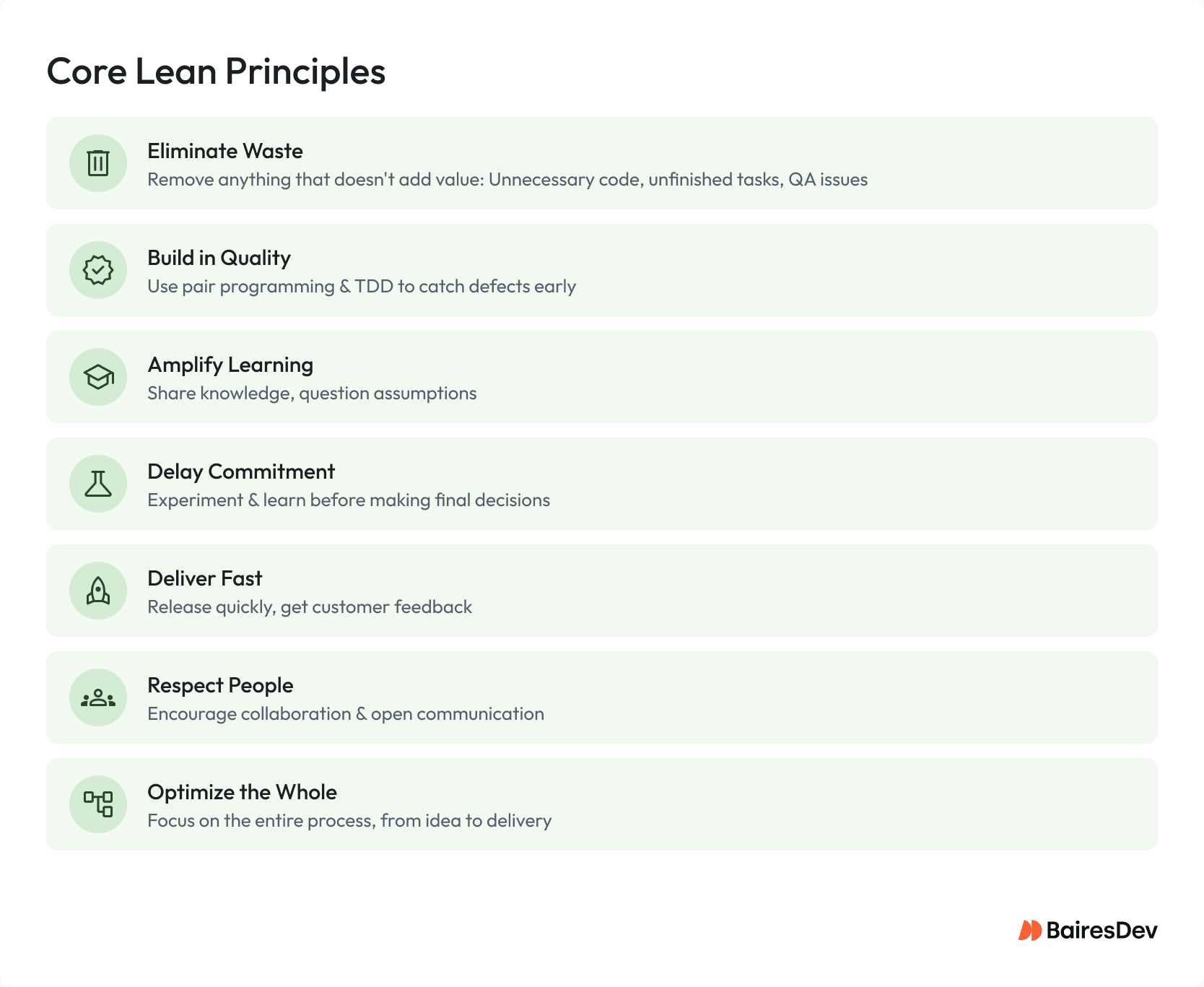
Lean software development is a management philosophy derived from Lean manufacturing that maximizes customer value while eliminating waste across the entire delivery system. Its roots lie in the Toyota Production System, which became an important foundation for the Lean manufacturing movement that was later adapted to software development.
Mary and Tom Poppendieck adapted these concepts for software teams in their 2003 book, Lean Software Development. They identified seven core principles and introduced 22 “thinking tools” that companies can use to adapt Lean practices to their own environment. Applied well, Lean methodology helps organizations build better software faster and at lower cost.
At its foundation, Lean focuses on value, flow, and people, with the goal of reducing waste and improving delivery efficiency.
What Is the Core Difference Between Lean and Agile?
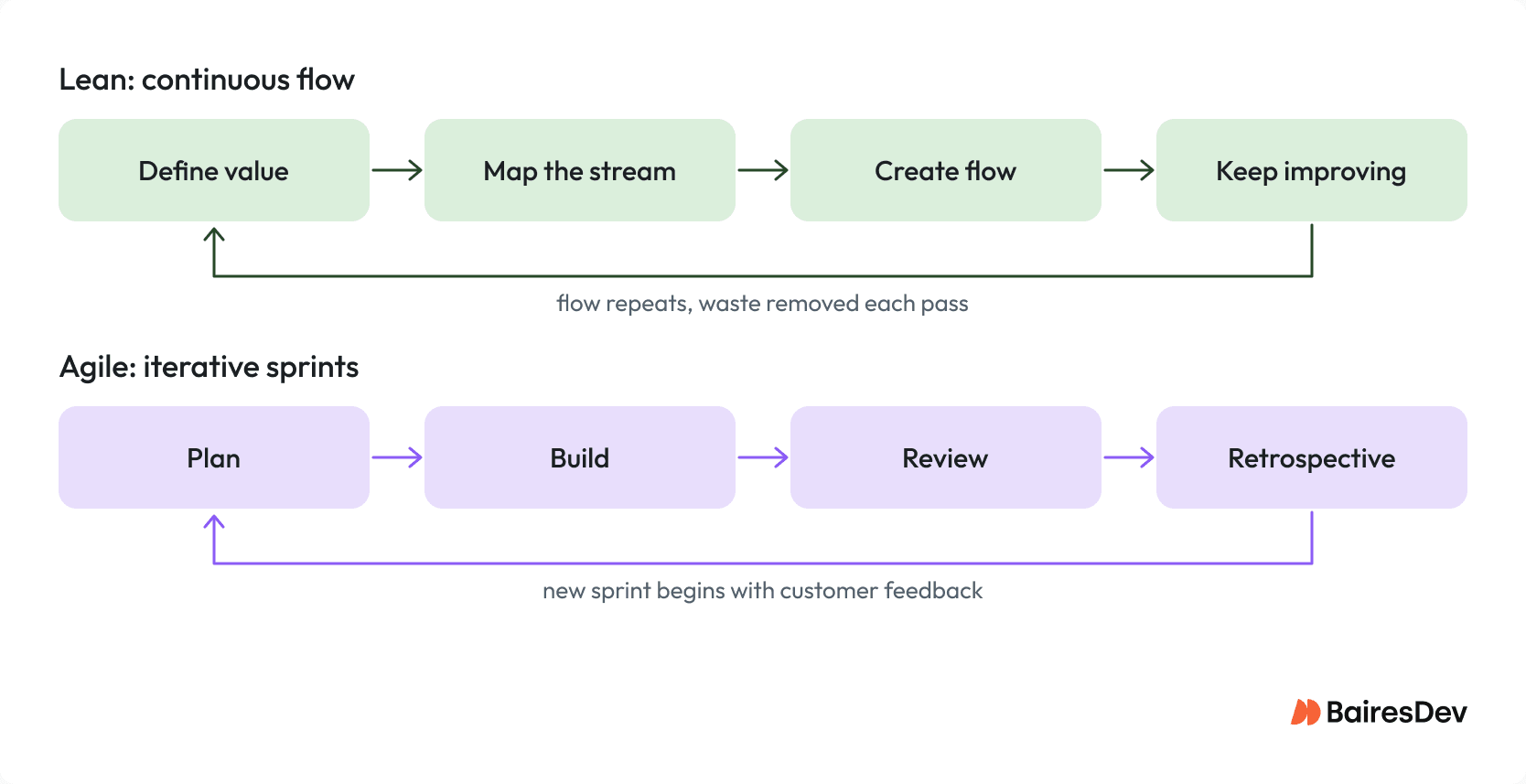
The fundamental difference between Lean and Agile comes down to mechanism. Lean increases speed by managing the flow of the entire process and removing unnecessary steps. Agile increases speed by iterating in small increments, typically through sprints, with constant feedback built into the cycle. Agile also places more emphasis on continuous feedback between developers and customers, while Lean places more emphasis on eliminating anything a customer would consider waste.
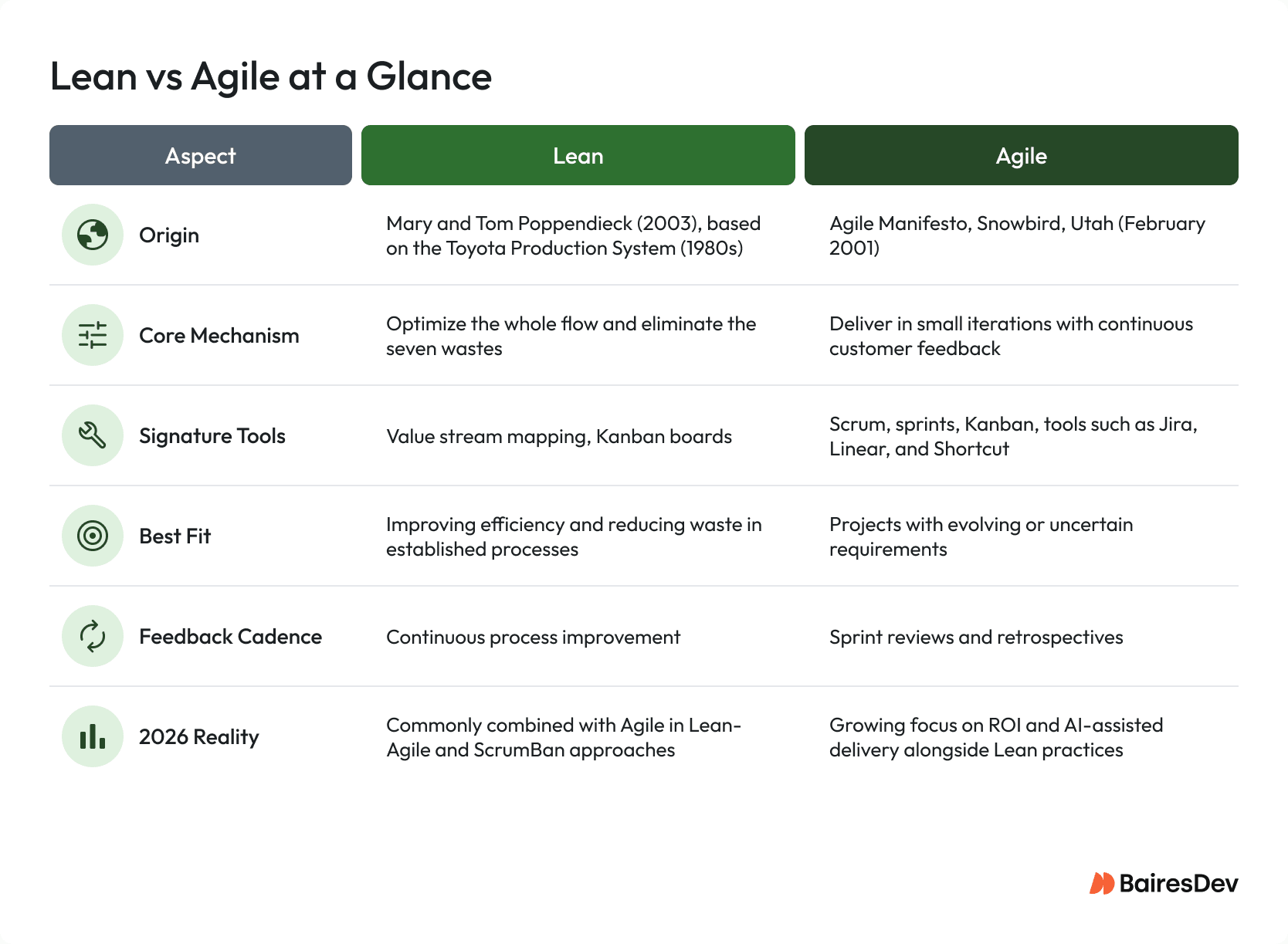
| Lean | Agile | |
| Origin | Poppendiecks’ Lean Software Development (2003), rooted in Lean manufacturing and the Toyota Production System | Agile Manifesto, Snowbird, Utah (February 2001) |
| Core mechanism | Optimize the whole delivery flow and eliminate waste | Deliver in small iterations with continuous customer feedback |
| Signature tools | Value stream mapping, Kanban boards | Scrum, sprints, Kanban, tools such as Jira, Linear, and Shortcut |
| Best fit | Improving efficiency and reducing waste in established processes | Projects with evolving or uncertain requirements |
| Feedback cadence | Continuous process improvement | Sprint reviews and retrospectives |
| 2026 reality | Commonly combined with Agile in Lean-Agile and hybrid approaches | Growing focus on ROI and AI-assisted delivery alongside Lean practices |
A note on tooling: Pivotal Tracker, once a common Agile project management tool, was officially discontinued on April 30, 2025. Teams still referencing it should migrate to an actively maintained tool such as Jira, Linear, Shortcut, or Zoho Sprints.
For enterprise teams using scaled frameworks, the current SAFe release is SAFe 6.0, released in September 2025. Scrum remains governed by the official Scrum Guide, whose current official edition is the November 2020 version by Ken Schwaber and Jeff Sutherland; community expansion packs are not official replacements.
Where Did Lean and Agile Come From, and Why Does the 2001 Origin Still Matter?
Lean’s software-development roots trace to Mary and Tom Poppendieck’s 2003 adaptation of Lean principles for software teams. Agile has a more specific origin story: in February 2001, 17 practitioners met at The Lodge at Snowbird ski resort in Utah, searching for common ground on lightweight alternatives to document-heavy development.
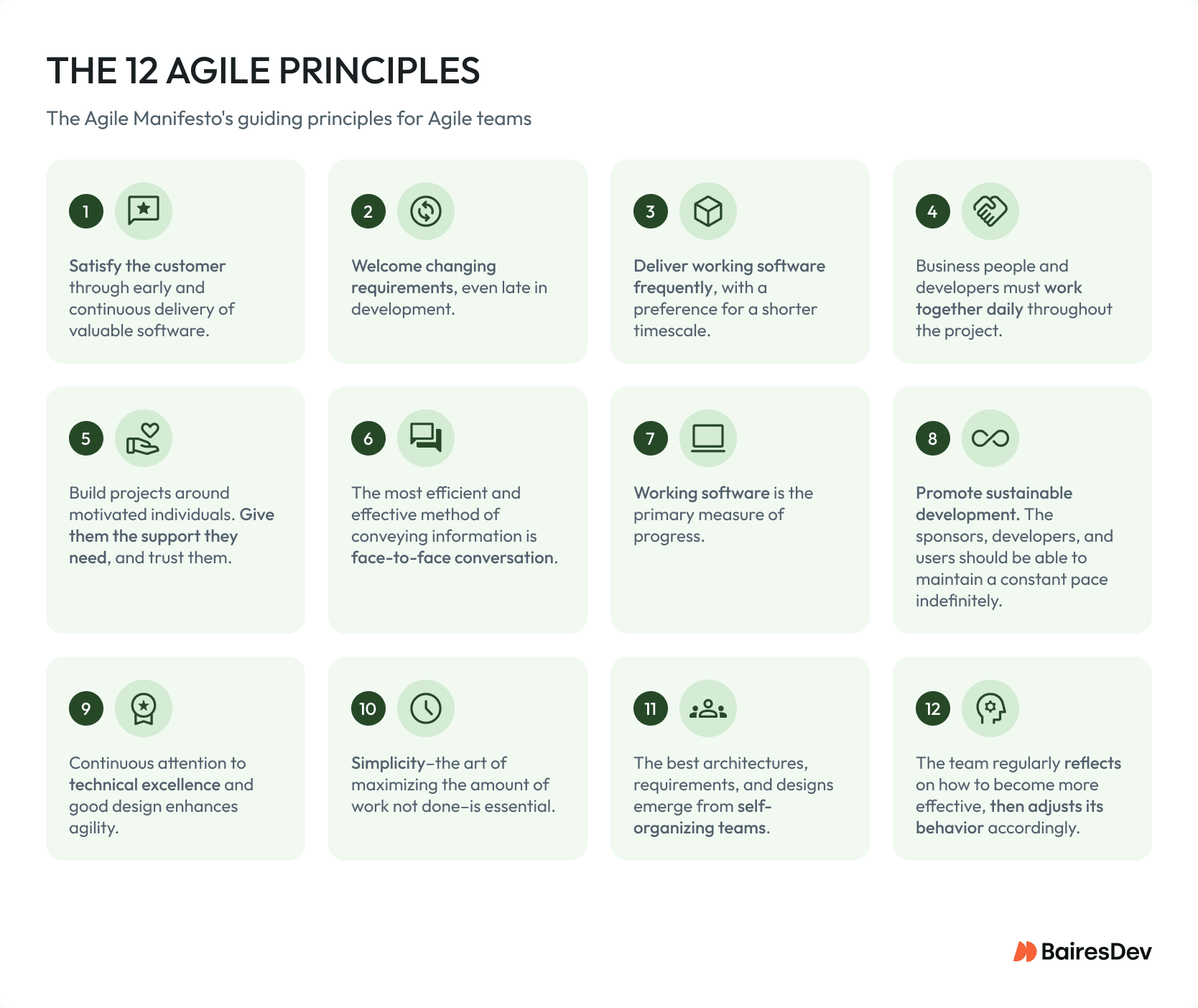
That meeting produced the Agile Manifesto, which prioritizes individuals and interactions over processes and tools, working software over comprehensive documentation, customer collaboration over contract negotiation, and responding to change over following a plan. February 2026 marked the Agile Manifesto’s 25th anniversary, and its four values still shape how Agile teams operate today.
Does Kanban Belong to Lean or Agile?
Kanban belongs to both. It originated as a visual management tool within Lean manufacturing and later became one of the most widely used Agile practices.
Lean teams use Kanban boards to visualize the entire value stream and limit work in progress. Agile teams, including those running Scrum, often layer Kanban on top of sprints to manage flow between them.
Treating Kanban as exclusively Lean or exclusively Agile misrepresents how Agile teams actually work in 2026.
| 74%
Organizations use hybrid, blended, or homegrown Agile models |
84%
AI adoption inside Agile delivery |
49%
Organizations have AI governance guardrails |
Source: Digital.ai, 18th State of Agile report, October 2025
Should You Choose Lean, Agile, or a Hybrid Like ScrumBan?
For many engineering organizations, the practical answer is a hybrid. Digital.ai’s 18th State of Agile report found that 74% of organizations now use hybrid, blended, or homegrown Agile models rather than relying on a single framework.
Combining Lean and Agile methodologies lets teams keep sprint discipline for feature work while using a continuous Kanban board for support and maintenance. A Lean-Agile approach like this tends to fit organizations balancing new development against ongoing operational demand.
Use Cases
- Use Lean when an established product or process contains measurable waste and the objective is to optimize the end-to-end delivery flow.
- Use Agile when requirements are evolving and frequent customer feedback reduces delivery risk.
- Use ScrumBan or other Lean-Agile hybrids when teams need Scrum’s structured planning together with Kanban’s continuous workflow, especially to balance feature work and ongoing support.
When to Use / When Not to Use
- Avoid treating Lean and Agile as competing methodologies. Hybrid approaches are now the norm, and Kanban legitimately belongs to both.
- Avoid Lean for highly exploratory initiatives where priorities change weekly; iterative Agile practices provide more flexibility in that situation.
- Avoid describing Kanban as exclusively Lean, since it is widely adopted across Agile teams as well.
How Are AI-Assisted Delivery and the ROI Shift Changing Both Methods in 2026?
AI-assisted delivery is changing the economics and operating model of software development, while rising ROI scrutiny is changing how organizations evaluate Agile.
Digital.ai’s 18th State of Agile report found AI adoption inside Agile delivery jumped from 68% to 84% in a single year, the fastest jump the survey has recorded, while only 49% of organizations have formal AI governance in place. Meanwhile, 76% of respondents cite increased scrutiny on the business impact and ROI of Agile work as a top pressure.
According to BairesDev’s Q3 2025 Dev Barometer survey of senior software engineers, developers save an average of 7.3 hours per week using AI tools, yet most companies still lack a clear AI strategy to capture that productivity gain.
Choosing between Lean and Agile matters far less than how effectively a team executes its chosen methodology. That’s why organizations increasingly rely on teams that pair Lean flow discipline with Agile feedback loops on real delivery work, where predictable sprint cadence and waste reduction reinforce one another instead of competing. The result is more consistent releases and stronger business outcomes.
The 2026 debate over whether AI makes the Agile Manifesto obsolete reflects a broader question for engineering leaders: which Agile practices still create value when AI changes the speed and economics of software delivery? Current analysis suggests the principles remain relevant even as teams rethink how they apply them.
When Should You Use Lean vs. Agile on a Project?
Choose based on what the project actually needs, not on trend. Lean project management fits best when a process is already defined and contains measurable waste, whether that’s redundant handoffs, idle work in progress, or steps that don’t serve the customer. The goal is to optimize an existing flow, not decide what to build.
Agile is the better fit when a product or its features are not yet well defined. Because Agile relies on iterative development, the product evolves with every release, and short feedback loops reduce the risk of building the wrong thing.
The real distinction isn’t which methodology handles continuous delivery, since Lean and Agile can both coexist with CI/CD. It comes down to where the bigger risk sits: uncertainty about what to build favors Agile’s iteration and feedback, while inefficiency in how you build it favors Lean’s flow and waste reduction.
Key Takeaways
- Lean improves delivery speed by optimizing the overall flow and eliminating waste.
- Agile improves delivery speed through incremental releases and continuous customer feedback.
- Kanban is shared across both methodologies, making it a natural component of many Lean-Agile and hybrid approaches.
- In 2026, organizations are shifting the conversation from delivery speed toward business value, ROI, and AI-assisted software development.