

An honest practitioner’s guide to the agile SDLC: the six phases, where implementations turn into ceremony, and the engineering discipline that keeps software shipping.
Key Points
- The agile software development life cycle (SDLC) has six phases: concept and ideation, inception, iteration and construction, release, production, and retirement.
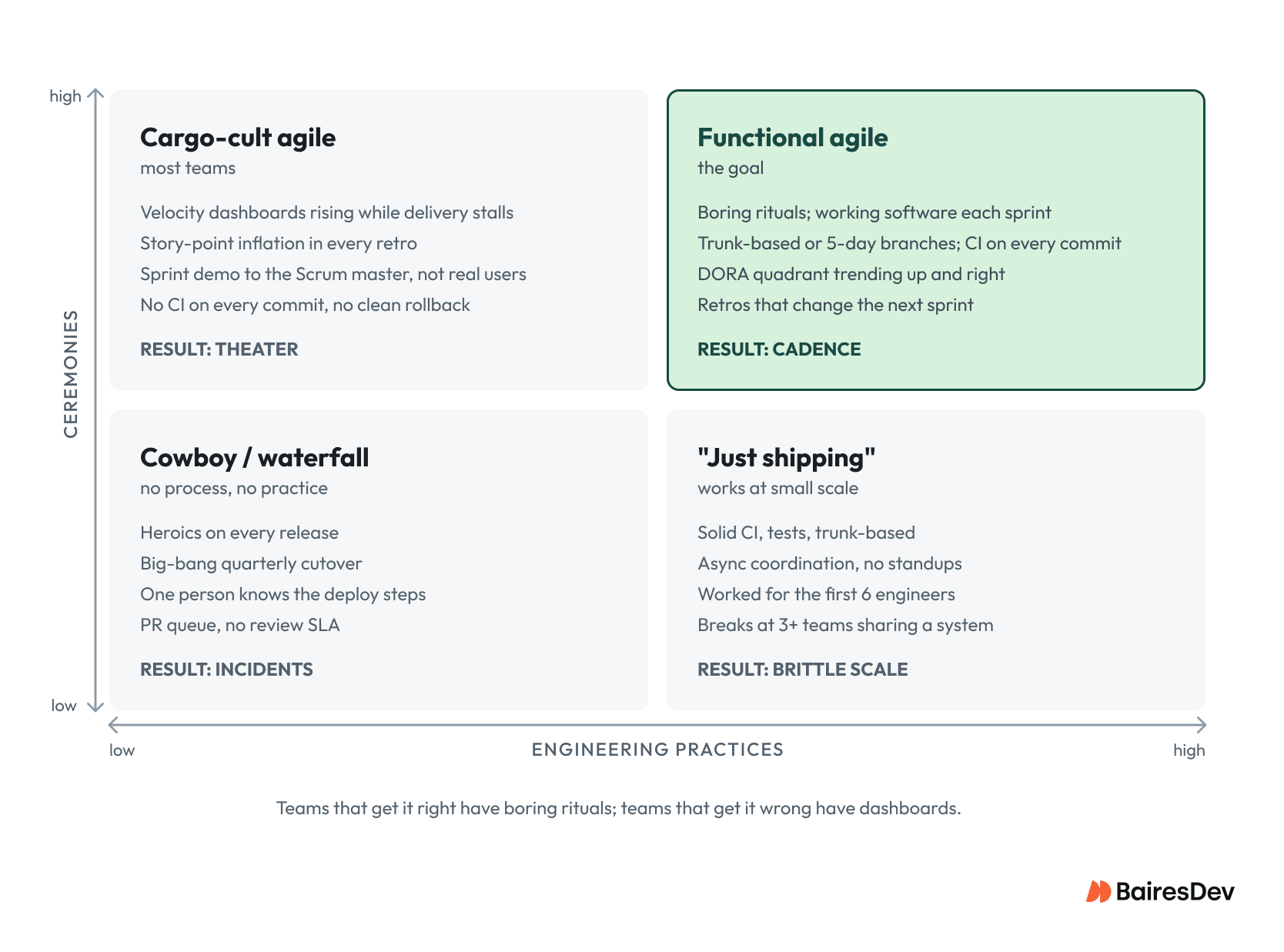
- Cargo-cult agile is a common failure mode: teams adopt ceremonies without continuous integration, automated testing, and effective source-control practices, and end up with low-value ceremony instead of real delivery gains.
- Most organizations now use a hybrid agile model: 74% report using hybrid, blended, or homegrown approaches, according to Digital.ai’s 18th State of Agile Report.
- Use DORA’s five software delivery performance metrics as your delivery signal. Don’t mistake velocity for a delivery signal; it’s a planning tool.
Most software organizations will tell you they’re “doing agile.” The truth is usually less flattering: too many just pay homage to the jargon, or a few ceremonies, and call it a day.
Teams throw in a project management tool (usually Jira), label whatever timeline exists a sprint, and then count themselves an agile shop. Unfortunately, many never see their actual cycle time from idea to deployment improve meaningfully.
If the goal is to deliver software iteratively and in a genuinely agile fashion, the fix is not more ceremony. It is stricter agile practices paired with stringent engineering discipline.
The Agile SDLC, in Practice
The agile software development life cycle is iterative. Instead of a sequential waterfall approach, where a project begins with complete documentation and ends with a single large release, agile moves through six phases, with one looping continuously. The six‑phase taxonomy is not canonical. The Scrum Guide calls its elements events rather than phases, but this phased model is the most useful operational lens I have found.
I think of the phases as artifacts and owners, not a calendar. Each phase has an assigned owner who decides what “done” looks like at the project team level.
| Phase | Owner | Output | Where It Usually Breaks |
|
PM or engineering lead | Problem statement, target user, back-of-the-envelope estimate | Backlog inherited as commitments instead of bets |
|
Engineering lead / architect | Initial plan, design spike | “Sprint 0” stretches to six sprints; no real cadence yet |
|
Delivery team | Working software each sprint | Branches outlive the sprint; CI isn’t running on every commit |
|
Engineering / platform | Deployed artifact + rollout plan | Big-bang release; no rollback rehearsal |
|
Operations, on-call, SRE | Telemetry feeding the backlog | Monitoring exists; the loop back to planning doesn’t |
|
Whoever inherits the technical debt | Service decommissioned, runbook archived | Treated as “we’ll get to it” and becomes a zombie service |
Ceremony vs. Engineering Practice
The Sprint, Ritual by Ritual
Of the six phases, the iteration and construction phase is the only one that loops every two weeks. That sprint loop is where ceremony and practice issues are easiest to see, and it is where I spend most of my time when assessing a team or high‑grading its process. For each ritual, I check whether it is healthy, meaning ceremony backed by discipline, or degraded, meaning ceremony without substance:
- Sprint planning
Agile teams pick work from their backlog, sized to the team’s capacity. Healthier teams commit to a smaller, conservative set. Weaker ones let the PM pressure the team into committing to more items than it can deliver. - Daily stand‑ups
Fifteen minutes on blockers and intent. When team collaboration is the point, it is valuable. A status meeting aimed solely at management tends to lose its effectiveness. - Development
Code, review, test, integrate. The real work. The agile development cycle happens here, not in the meetings around it. - Continuous testing
When automated tests run on every commit, teams get real continuous feedback. Without it, too many surprises get pushed to QA while the team still carries the full agile ceremony overhead. - Sprint review
Demo working software. Focus on what actually shipped, not on noise about what was almost done. - Retrospective
What worked, what did not, what needs to change. Only useful when the list is achievable and actionable. Avoid venting sessions where nobody in the room has the authority to fix what is broken.
Where the Wheels Come Off
The most common failure mode in agile engineering teams is what is usually called cargo‑cult agile, or, as Martin Fowler labeled the Scrum version, flaccid Scrum. Ceremonies run on schedule, but the codebase degrades, builds break, and shipping becomes a hope rather than a plan.
Without real adherence, the major phases become meaningless. Sprint reviews only matter if there is working software. Retrospectives only matter if the team has the authority to fix friction points.
Quick Reality Check
- Velocity tells you how the team plans, not whether the work shipped.
- “Working software at the end of every sprint” is the actual agile principle, not completed Jira tickets.
- Retrospectives without authority to change anything are venting sessions. Pointless.
Let me make this concrete with a pattern common enough to be worth naming. Picture a 200‑person engineering organization where agile got deployed naively. They had hired a high‑priced consultancy to roll out a Scaled Agile Framework (SAFe) across their twelve product teams. Six months in, the ritual was churning: Program Increment Planning every ten weeks, all twelve teams in a room or on Zoom for two days of dependency mapping, program‑board updates, and confidence votes.
The velocity charts look beautiful. Burn-down is smooth. The CTO has a slide deck.
Here’s the rub. The delivery metrics move the wrong way. Deployment frequency stays flat, change lead time stretches, and change fail rate climbs. More ceremony, less reliable releases. Agile isn’t the problem, though. The scaling rituals were layered on top of a codebase with no continuous integration
The rule that follows: don’t adopt a scaling framework without measurable DORA metrics in hand, with at least six weeks of data. If deployment frequency is monthly or longer, or the change fail rate is in the double digits, skip the scaling framework. Start with continuous integration, automated tests, and trunk‑based development instead.
Other failure modes are worth naming:
- Velocity as a target. Teams pad estimates, killing the signal.
- Retrospectives without owners. Action items nobody owns deliver the same outcome as not running retros, with extra cynicism.
- Weak product ownership. A PO with no authority to make trade‑offs hands the team a backlog of demands rather than priorities. Customer feedback gets filtered through a proxy.
- Unmanaged technical debt. It accumulates until cycle time doubles, then triples.
- Water‑Scrum‑fall hybrids. Iteration planning up front, heavyweight release management at the end. The cost of agile with the calendar of waterfall.
Each is fixable. None gets fixed by adopting more agile.
What Holds an Agile SDLC Together
The honest answer is engineering practices. The research at dora.dev is the clearest evidence base we have for measuring software delivery performance. Its current model uses five metrics, grouped into software delivery Instability and instability. DORA’s five software delivery performance metrics provide the definitions and measurement guidance.
Five engineering practices matter more than the ceremonies wrapped around them:
- Continuous integration. Every commit to main triggers a build and an automated test suite. Broken builds get top priority. Without this, sprint reviews are theater.
- Automated testing at multiple levels. Unit, integration, and a small set of end-to-end and user acceptance tests. Aim for tests that catch real bugs and run fast, not for a coverage percentage. Quality assurance lives in the test suite.
- Test-driven development, used selectively. TDD isn’t religion, but for non-trivial logic, tests-first can produce better designs. It’s the rapid-development discipline that protects you when you’re delivering software under pressure.
- Trunk-based development or very short-lived branches. Martin Fowler’s patterns for managing source-code branches make clear that long-lived feature branches drive integration pain at scale. Favor frequent merges to keep integration cost small and continuous.
- Disciplined refactoring. Every story includes some cleanup of the code it touches. Continuous attention to technical excellence and good design is the Agile Manifesto’s ninth principle. Make continuous improvement the norm, not a quarterly “tech debt sprint.”
Without these, the agile process doesn’t give you much lift, and agile principles become noise. With them, production steers toward reliable, high-quality software releases you can actually commit to.
Measure What Actually Matters
If you only take one thing from this article, change what you measure. Track DORA’s five software delivery performance metrics. DORA divides them into Instability and instability.
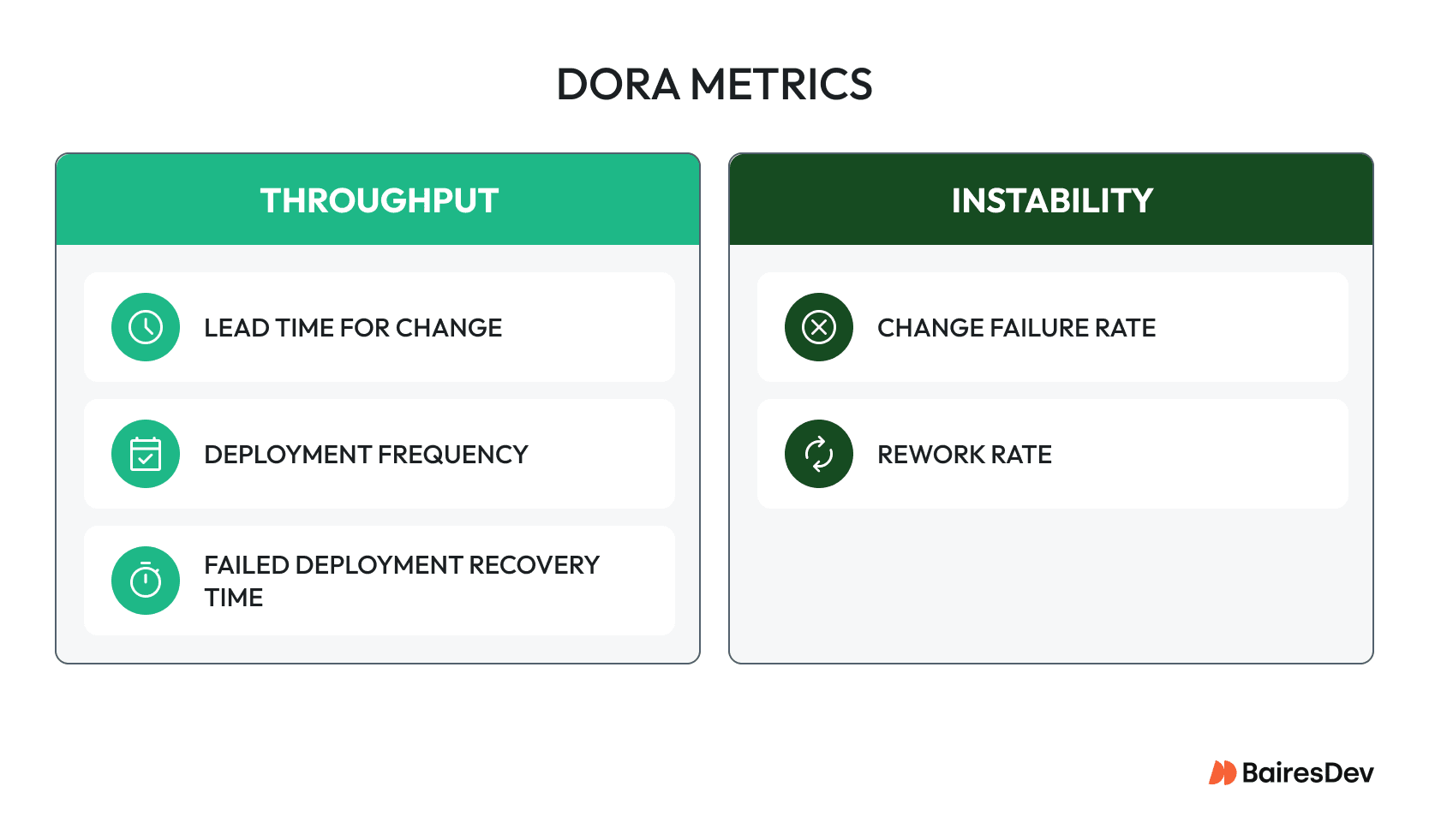
| Metric | What It Measures | DORA Category |
| Deployment frequency | How often application changes are deployed | Instability |
| Change lead time | How long it takes to go from code committed to code successfully running in production | Instability |
| Failed deployment recovery time | How long it takes to recover from a deployment that fails and requires immediate intervention | Instability |
| Change fail rate | The ratio of deployments that require immediate intervention after deployment, such as a rollback or hotfix | Instability |
| Deployment rework rate | The ratio of deployments that are unplanned work caused by an incident in production | Instability |
DORA’s original four metrics evolved into today’s five-metric model in 2024, when researchers added deployment rework rate. In 2023, DORA also renamed and refined MTTR as failed deployment recovery time to focus specifically on failures caused by changes to production.
One more update worth knowing: DORA’s 2025 report retired the four-tier elite/high/medium/low scale in favor of seven team archetypes built from cluster analysis of Instability, stability, and team well-being data. If you’re benchmarking against DORA today, look up which archetype your team resembles rather than chasing “elite” on deployment frequency alone. The same report found AI adoption now correlates positively with Instability and product performance, but it still carries a negative relationship with delivery stability for teams that lack strong automated testing and fast feedback loops.
You’ll hear a lot about velocity in agile circles, but notice it isn’t on that list. Velocity’s a planning signal, useful for a team tracking progress inside a single sprint. I don’t report it as a delivery metric. Instead, I layer in cycle time from idea to customer, and outcome metrics tied to user behavior: activation, retention, customer satisfaction, whatever metric your product actually depends on.
DORA’s 2025 research found that 90% of technology professionals surveyed were using AI at work, and subsequent DORA analysis found that higher AI adoption was associated with increases in both software delivery Instability and instability. In other words, AI can amplify existing strengths and weaknesses rather than substitute for sound engineering practices.
Methodology Trade-offs: What Each One Optimizes For
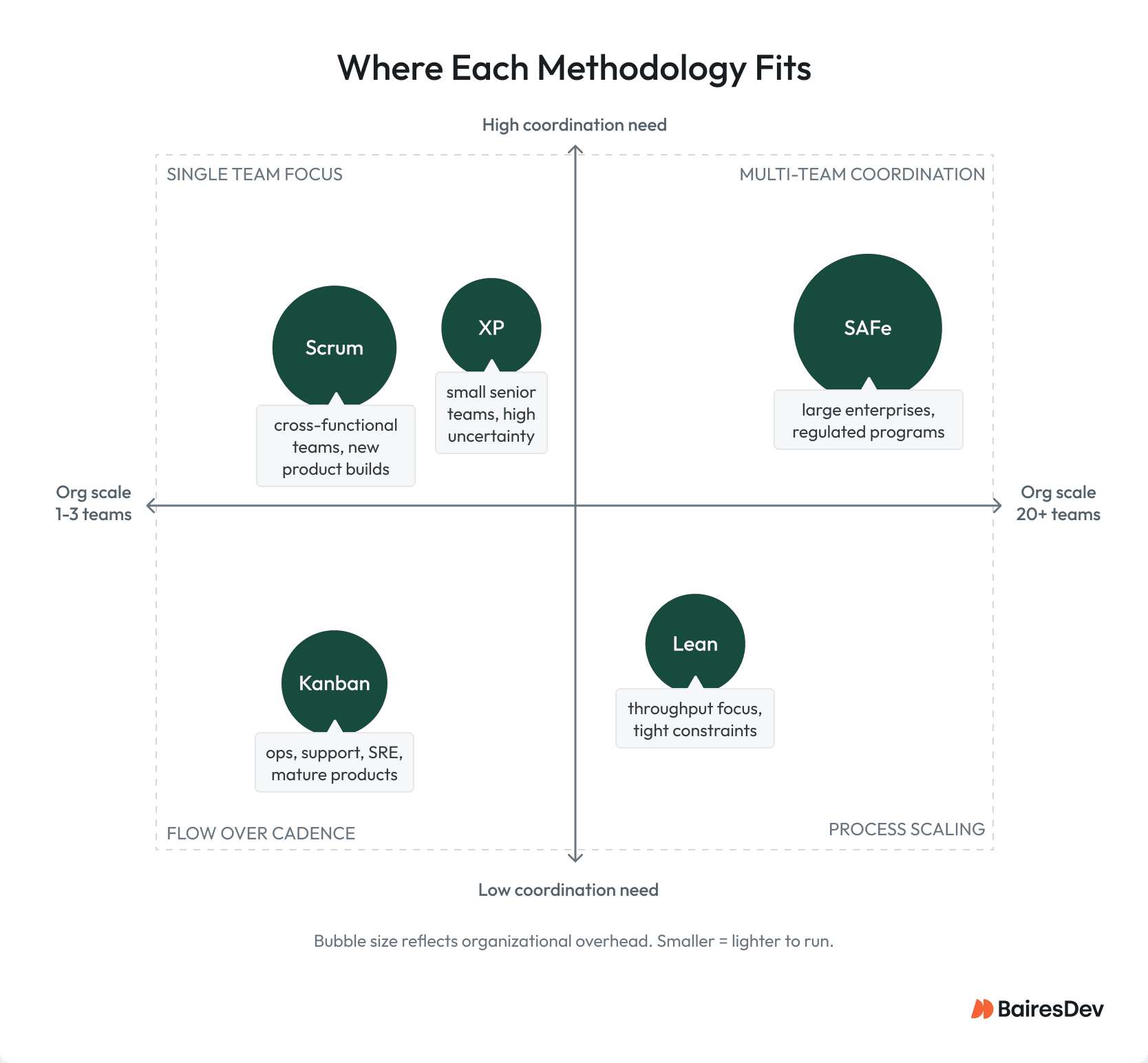
Now that we know what a successful agile lifecycle looks like, the next question is which flavor fits your team. Scrum, Kanban, XP, Lean, and SAFe aren’t interchangeable. Each methodology optimizes for something specific, and each carries a known weakness:
| Methodology | Optimizes For | Where It Fits | Known Failure Mode |
| Scrum | Predictable iteration cadence and team focus | Cross-functional teams; new product builds | Becomes ceremony without engineering practices |
| Kanban | Continuous flow and limiting work in progress | Maintenance, support, ops, mature products | Loses planning rhythm; teams drift |
| Extreme Programming | Engineering quality at the practice level | Small senior teams, high-uncertainty products | Hard to scale culturally past a few teams |
| Lean Software Development | Eliminating waste, shortening cycles | Tight resource constraints; Instability-focused organizations | “Waste” gets defined politically |
| Scaled Agile Framework (SAFe) | Coordinating many teams on shared programs | Large enterprises, regulated programs | Heavyweight ceremony, often without delivery gains |
Digital.ai’s 18th State of Agile Report shows that organizations increasingly adapt agile approaches rather than follow a single, fixed framework. The 2025 report found that 74% of organizations use hybrid, blended, or homegrown agile models. That matches what I see in practice: teams combine a framework’s planning structure with engineering and flow practices that fit their actual constraints.
SAFe is heavy. I usually run into it at organizations that need to coordinate twenty or more teams on a shared roadmap with real interdependencies, and it demands serious investment from leadership. Without that investment, why pay the operational cost for no real benefit? Digital.ai’s 2025 report puts SAFe at 44% among organizations using a scaling framework. SAFe fits when you need risk management at the program level, not just on a single project.
Kanban’s underrated for teams whose work doesn’t fit a sprint cadence: platform teams, SRE rotations, support engineering. Extreme Programming’s less a framework than a practice toolbox including pair programming, TDD, and continuous integration that can be layered into any of these methodologies.
Scaling, Distributed, and Hybrid Realities
When you have more than three teams working on related systems, coordination gets real: dependencies, shared backlogs, release trains. SAFe is one answer for these projects. There’s a lighter approach too, built around a few cross‑team rituals, a weekly architecture sync, a shared roadmap, owned interfaces, and explicit ownership boundaries that scope project requirements and project goals. The lighter version usually wins for software development teams in the 100-to-500-engineer range.
If your team spans three time zones, async‑first isn’t optional. Stand‑ups become written status in a Slack thread. Planning gets a longer prep doc and a shorter sync. Retrospectives happen in collaborative docs, and recorded demos replace live ones. The payoff is that the team functions for everyone, not just the loudest time zone.
For nearshore or external partners inside your agile SDLC, the rule’s simple: treat them as full team members. Same ceremonies, same backlog, same ownership. Anything else creates seams that show up in delivery.
My Decision Framework
When I advise on whether to adopt or change an agile SDLC, I ask three questions.
First: do you deliver working software frequently, at least every two weeks? If not, you have an engineering-practices problem involving CI, testing, or branching before you have a framework problem. Skip the engineering investment and adopt a framework first, and things get expensive fast. Teams that deliver high‑quality software have already invested here.
Second: how many teams? One to three can run a lightweight Scrum or Kanban variant on Slack and a shared roadmap. Four to fifteen need a deliberate coordination layer, and lightweight is usually still right. Twenty or more with hard interdependencies is where a scaling framework can become worth the overhead, but lean toward the leanest version you can get away with.
Third: what is the regulatory or commercial envelope? Two contexts call for a hybrid SDLC. Safety-critical embedded systems, including medical devices, aviation, and automotive products, as well as FDA Class II and Class III products, and audit-graded work, can require verification and validation steps that do not fit neatly inside a two-week sprint. Fixed‑scope, fixed‑price contracts are the other case: the scope can’t move, so the iteration has to happen inside the envelope.
An honest hybrid beats pretending to be agile when you are really running waterfall. The Agile Manifesto was written for an environment that welcomes changing requirements and favors working software delivered frequently. It does not prescribe a single software development life cycle for every regulatory or commercial context.
Ship the Habits, Not Just the Framework
The agile SDLC is less a framework than a set of operational habits: continuous integration, automated testing, short-lived branches, disciplined refactoring, and honest measurement. The frameworks, Scrum, Kanban, XP, Lean, and SAFe, are scaffolds for those habits, useful once you have built the underlying engineering practices.
Regardless of which approach you take, use DORA’s five software delivery performance metrics this quarter and base decisions on real numbers. The metrics will show clearly whether you’re running an effective agile SDLC or just playing at it. Too many teams don’t know which until they measure.