Carlos is a senior software engineer with 10+ years of experience specializing in Java and Python. At Pinterest, he engineers the backend for the Shopify App, powering automatic product syncing and Pin creation for thousands of merchants.
Expertise



Python type hints are optional annotations that document the types your code expects. They matter because they let tools catch misuse before you deploy. They don’t enforce types at runtime unless you add enforcement.
If you’re setting standards across platform and ML teams, the real decision is whether you want a reliable interface contract for the code that has to survive refactors and org churn. You only get that value if you settle two things up front. First, decide how strict you’ll be, then decide which static type checker becomes the source of truth for merges.
This article breaks down those tradeoffs so you can adopt typing in a way that reduces production regressions. That will save you from creating PR churn around Any, cast() and # type: ignore.
Executive Summary
Python type hints pay off most in the shared libraries, service APIs and data pipelines that many teams depend on. With static checking enforced in CI, many interface mismatches become pre-merge failures instead of runtime defects. The leadership work is in deciding how strict to be, which checker gates merges, and how to keep feedback fast enough that teams don’t bypass it.
Key Points
- Type errors surface in CI: A static checker in CI turns shared library contract drift into a pre-merge failure instead of a production incident.
- Less reviewer guesswork: Your reviewers spend less time reconstructing intent when request and response shapes are explicit at every boundary.
- Strictest in internal SDKs and service APIs: Your strictness standard should tighten at repo boundaries and stay flexible inside dynamic cores like ORM layers.
- Mypy and Pyright are a policy choice: Your team needs one designated checker for merge decisions so your team has a single source of truth for actual type safety.
- Type-check latency determines adoption: If local checks feel slow your engineers will stop running them and your CI gate becomes meaningless.
Python Type Hints, Defined
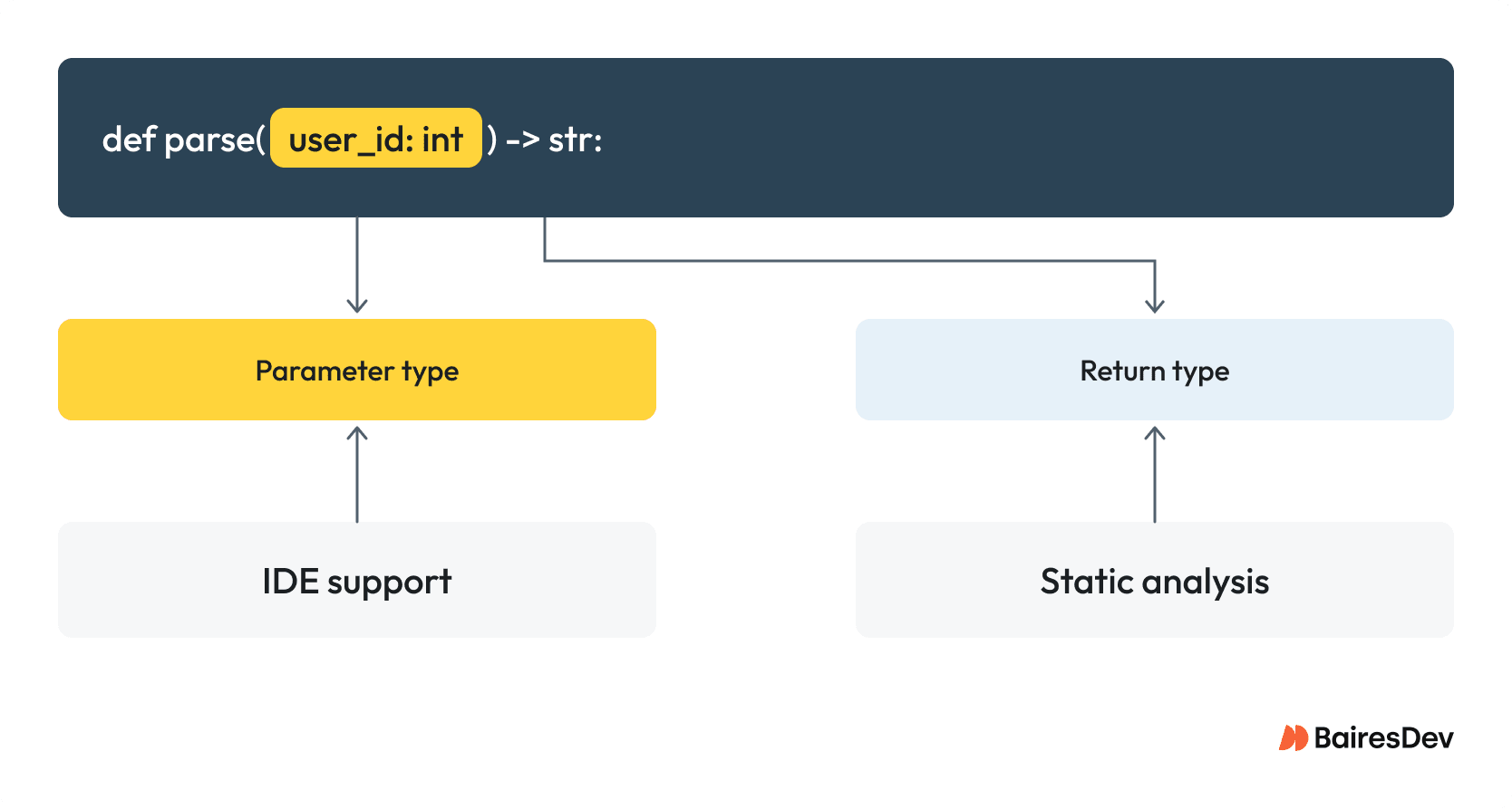
Python type hints are annotations on variables, parameters, user-defined classes and return values that state the intended types. They’re useful for static analysis and developer tooling. Python’s typing system and the typing module supply the constructs, and separate checkers like mypy and Pyright read the annotations to power IDE autocomplete and type checking.
Type hints don’t enforce anything at runtime by default. For example, def parse(user_id: int) -> str: will still accept a string in production. The function expects an int, but nothing stops the call unless you add a static check in CI or a runtime validation layer. Teams that treat annotations as runtime guards standardize the wrong things and wonder why nothing got safer.
Think of this in three levels. Annotations document intent and improve IDE support. A checker makes CI enforce those annotations at merge time. Runtime validation checks external data, which no static tool can do. Most teams need the middle level on shared code and the last one at system boundaries.
Typed vs Untyped Python in Practice
In a small repo with a stable team, untyped Python code can feel faster because you ship with fewer up-front constraints. The trade shows up once platform and ML teams share modules and APIs evolve. As shared interfaces multiply, teams without static checking lean harder on tests, reviewer context, and runtime feedback to catch incompatible types. Treating untyped Python as the productivity default at enterprise scale optimizes for the wrong phase of the system.
As an example, an API handler that returns either a dict or None based on flags might work fine in production, but it forces every caller to re-learn the same edge cases. A checker in CI won’t object to that contract. What it catches is the caller that assumes the result is always a dict, and it catches it before merge instead of in a support ticket.
| Dimension | Python With Type Hints | Python Without Type Hints
|
| Readability | Intent is explicit at boundaries (parameters and return types) | Expected types live in tribal knowledge and tests |
| Maintainability | Refactors are safer with static feedback loops | Refactors rely heavily on runtime coverage |
| IDE Support | Stronger autocomplete, navigation, and inline warnings | Heuristics work, but break on dynamic patterns |
| Error Detection | Detects potential type errors before deploy | Finds issues later via QA, logs, or incidents |
| Scalability | Better for multi-team, shared-library ecosystems | Coordination cost rises sharply with codebase size |
| Onboarding | New engineers can reason locally and move faster | New engineers need more context and reviewer time |
| Ideal Use Cases | Long-lived services, platforms, ML pipelines with shared code | Short scripts, prototypes, and one-off automation |
Where Type Hints Pay Off Most
You can annotate thousands of lines and still not reduce risk if the parts that matter most stay effectively untyped. The value is in the interfaces other teams depend on, not the code that only one team ever touches.
They pay off most in shared, long-lived interfaces that multiple teams depend on, like internal libraries and service APIs. In those environments, ambiguity creates coordination work. Reviews run longer, refactors slow down, and mistakes get pushed to production. Typing treated as a readability nicety gets underfunded right where it reduces delivery risk.
Say a platform team publishes an internal SDK for auth or billing. With hints plus CI type checking, any drift the type system can see fails before merge. Without them, it can surface as a runtime incident days later. Callers in separate repos get that protection once they pick up the new version and run their own checker.
Type hints tend to deliver the most ROI when enforced on stable service and library boundaries shared across multiple teams. You’ll typically see the highest value in:
- Large codebases: Safer refactors and fewer regressions when ownership is distributed
- APIs and services: Clear request and response shapes and fewer handler edge cases leaking to callers. When a response field changes from str to str | None, callers that assumed a string fail in CI instead of in production
- Data pipelines: Fewer type and nullability surprises between stages, though runtime data validation stays a separate job. When a transform changes an ID from int to str, typed stage interfaces catch the internal misuse while schema validation still checks incoming records.
- Machine learning systems: Better boundaries between feature code, model interfaces and serving code as experiments evolve.
- Collaborative development: Type hints speed onboarding and reduce the reviewer time spent reconstructing intent.
The Real Costs and Failure Modes
You ship a reassuring green checkmark in CI, then a breaking change slips into production anyway because the boundary was typed as Any. The worst failures look like progress right up until the incident review.
The biggest way typing rollouts fail is when you measure “coverage” instead of reliability. If engineers can silence the checker with Any or broad cast() calls, you’ll get the appearance of safety while keeping the same runtime risk. Case in point: a platform team annotates an internal SDK, but callers still pass loosely shaped dicts as function arguments. Everything type-checks because the boundary is effectively Any. You’ve paid annotation cost without reducing coordination cost.
Another derailment is structural. Python’s most valuable patterns often depend on dynamic typing, including plugin registries and ORM models. Type checkers can model some of this, but teams often end up rewriting code to satisfy the checker rather than the business. That’s a signal you need clearer typed boundaries around the dynamic core rather than strict typing everywhere.
Finally, you’ll hit tool and ecosystem gaps. Third-party libraries may have incomplete or incorrect stubs, and checkers can disagree on the same codebase, turning policy into churn. Operationally, watch for the early warning signals. Type-checking PR comments devolve into ignoring debates, and engineers skiping checks locally because latency makes the feedback loop feel optional.
How Strict Should Your Standard Be?
Set strictness based on where a type error turns into delivery risk, not on an abstract “type coverage” target. Picking one global setting and calling it a standard either slows teams down in dynamic areas (ML notebooks, ORM-heavy services) or ships a policy so permissive it can’t prevent boundary breakage.
A practical framework is to treat typing as an interface-control system: be strict at the seams where teams integrate and be pragmatic where code churns. For instance, you can require tight type annotations for anything that crosses a repo boundary (internal SDKs and shared libraries), while allowing more escape hatches inside experimental feature code as long as you don’t leak any through public surfaces.
Use these questions to choose the strictness level per code area:
- Blast radius: If this function is misused, does it break one job run or a fleet of services?
- Caller diversity: Will many teams call it, or is it owned and consumed by one squad?
- Change rate: Will the interface stay stable for months, or will it churn weekly?
- Enforceability: Can engineers get fast feedback locally, or will checks run slowly enough that they’ll bypass them?
Mypy vs Pyright vs ‘Both’
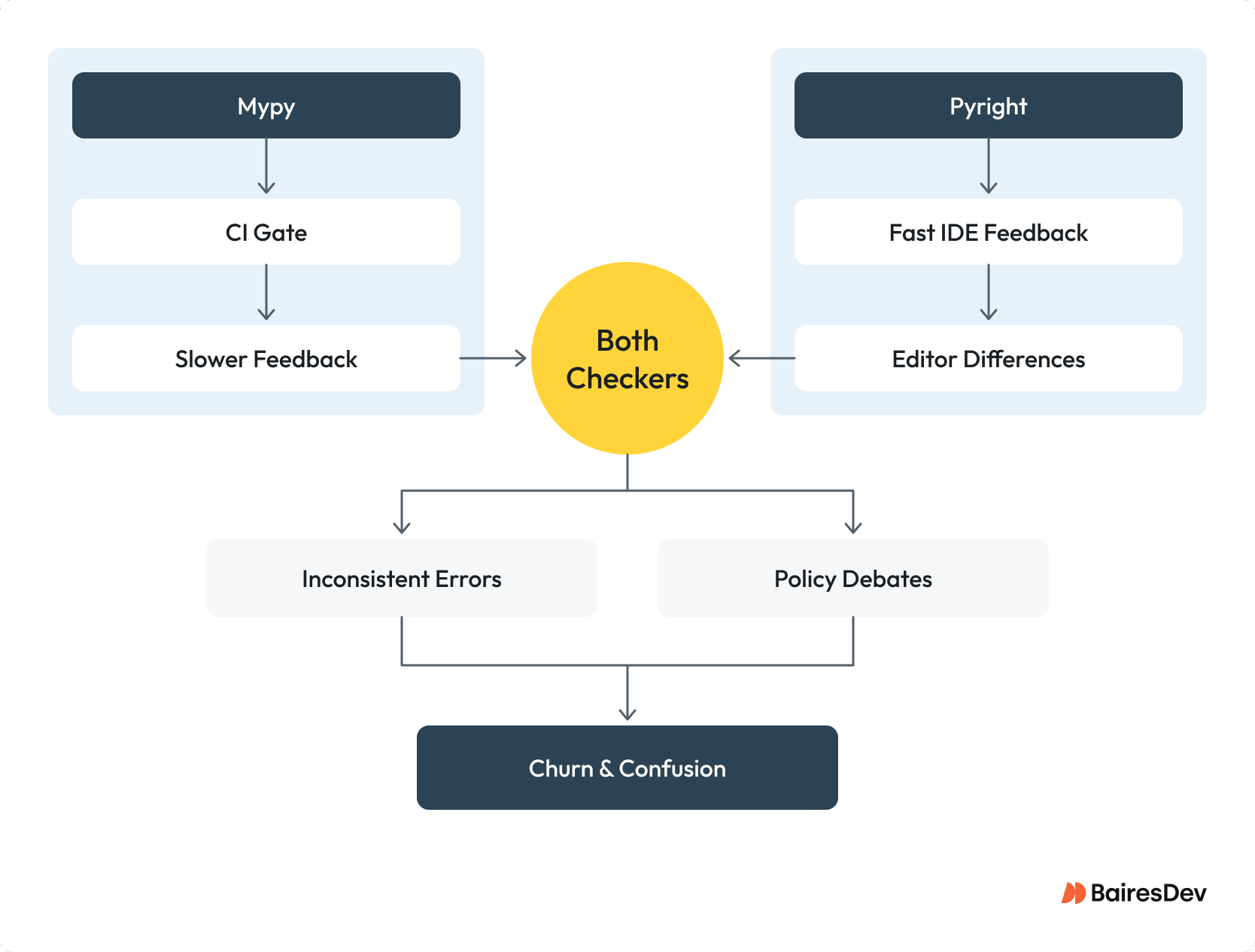
A platform team enables one checker, and half the org sees new errors in their editor that CI does not recognize, or the reverse. Without a single source of truth, standardization turns into debate.
Choosing static analysis tools centers on the feedback loop your org will run. Some teams end up with Pyright powering fast IDE feedback while mypy gates CI (or the reverse), because editor ergonomics, speed, and legacy configs rarely align perfectly across a 200 to 5,000-person environment. The 2024 typed Python survey run by Meta, JetBrains and Microsoft found 67% of respondents using mypy, 38% using Pyright and 24% using both.
The risk is that they can disagree on the same codebase, as practitioners comparing the two keep finding. That turns standardization into churn and undermines trust in the gate.
Decide up front which checker is your source of truth for merge decisions, then treat the other as advisory, with a written policy for when # type: ignore is allowed and where it’s prohibited (especially at public module boundaries).
Performance and DX: Preventing Type-Check Latency
When local checks feel slow, teams stop running them, and type checking becomes a CI-only gate that people work around. The friction is real: in the 2024 Python typing survey discussion, latency shows up as a top adoption complaint, with one respondent noting mypy is the only pre-commit hook they cannot use because it often takes 30-plus seconds to run.
Write performance into the standard. Scope checks to changed packages when possible and prefer incremental workflows for local runs. Keep downstream dependents in the check graph, or changed-package runs will miss breakage they cause elsewhere.
A Practical Adoption Plan for Teams
Typing can work like a guardrail, cutting review cycles and raising code quality, or it can become a tax that engineers learn to bypass. The difference is the rollout.
Treat typing rollout like any other cross-team standard: phase it, assign ownership, and avoid creating a gate people will bypass. Flipping strict everywhere on a mixed Django and internal-SDK estate produces a cottage industry of ignores and casts.
Start with a sequence you can sustain:
- Pick a checker of record: Use one tool as the merge gate; let IDE feedback be advisory if you need to support multiple editors.
- Type the seams first: Require annotated function signatures on public APIs, internal SDKs and shared libraries before you chase deep internal coverage.
- Make enforcement incremental: Enforce type hints only in the packages you’ve onboarded. Block new Any from leaking through public surfaces.
- Keep the loop fast: Slow local checks train teams to ignore the policy.
- Name owners and milestones: Platform sets rules and CI; service teams own their modules and pay down typing debt during planned refactors.
In practice, incremental rollout works best when you start with a few repos, define ownership and expand enforcement once teams trust the workflow. That trust signals the workflow is stable enough to scale.
Frequently Asked Questions
Do Python Type Hints Enforce Types at Runtime?
No. A required CI check enforces your typing policy as a merge condition. Python itself still accepts a wrong value at runtime. If you need runtime guarantees, add a separate validation layer.
Do Python Type Hints Replace Runtime Validation?
No. Type hints and static checkers only cover the contracts between your own modules. They can’t see the JSON payloads, database rows, or dataframes that show up at runtime. You need a separate validation layer at every external boundary. Let typing handle the code behind that boundary.
Should You Gate Pull Requests on Type Checking?
Yes, but only with a clearly chosen checker of record and a feedback loop fast enough that teams won’t bypass it. CI gates work best inside a broader testing strategy that keeps feedback fast and failures actionable for developers. Type checking that routinely slows PRs creates churn and ignore debt instead of reliability.
How Do You Roll Type Hints Out in a Large Legacy Repository?
Start by enforcing typed boundaries on the modules that act like APIs: shared libraries, request and response models, and internal SDK entry points. Then make the gate incremental so you prevent backsliding in newly touched code without blocking delivery on unrelated legacy hotspots.
What Do You Do When Third-Party Libraries Have Bad or Missing Type Information?
Treat it as a supply-chain quality issue: pin versions, patch with local stubs or overrides where it matters, and avoid letting any leak through your public surfaces. If a dependency’s typing breaks your CI, the practical fix is usually to constrain the dependency upgrade path, not to relax your entire standard.
Carlos is a senior software engineer with 10+ years of experience specializing in Java and Python. At Pinterest, he engineers the backend for the Shopify App, powering automatic product syncing and Pin creation for thousands of merchants.
Expertise