


Justice Erolin is Chief Technology Officer at BairesDev, translating the company's vision into technical roadmaps and leading engineering teams. He previously served as CTO at Hawthorne and held technology leadership roles at major advertising agencies.



The Dev Barometer has tracked the impact of AI on software development since Q3 2025, with a special focus on talent. The Q3 2026 edition found that one in five developers got a pay increase related to AI in the past year. However, the skills they credited for it weren’t the ones tech leaders are investing the most money in.
The Q3 2026 survey reached 705 developers and 41 US-based CTOs. We asked developers which skills they believed drove salary raises, and we asked leaders which skills they had been actively investing in for the past year. Their answers coincided at the top, listing AI tool fluency and prompting as the most relevant skill from their perspectives, but the rest of their rankings diverged.
What’s Moving the Needle for Developer Pay?
Of the 705 developer respondents, 20% said AI had contributed to pay raises in the past year. On the other hand, 12% said AI was cited as a reason for capping their raise, downsizing their team, or restructuring their role. The rest, 60.8%, reported no direct effect, and 7.5% weren’t sure.
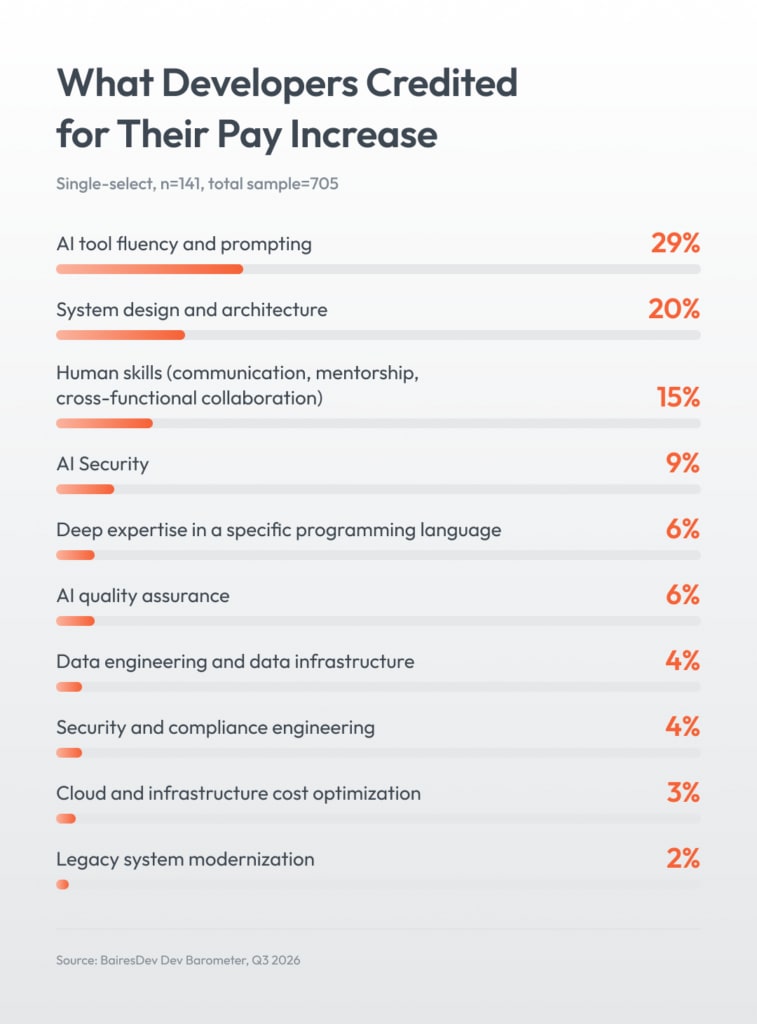
We asked the share of respondents that reported an AI-related pay raise to name the single skill they believe contributed most. AI tool fluency and prompting came first at 29%, followed by system design and architecture at 20%, then human skills such as communication, mentorship and cross-functional collaboration at 15%. Only one of the top three is AI-specific.
An IMF analysis analysis of early 2026 US job postings found that the skills used to build and train AI systems carried wage premiums above 8% within occupations, compared with close to 2% for skills used to work with AI tools in existing jobs. The premium goes to building, not only using. The dev’s top three responses sit on the building side.
What Skills Are CTOs Investing In?
AI tool fluency and prompting topped the CTOs’ list, too. Seventy-eight percent of them reported actively investing in this capability over the past 12 months. Following AI fluency and prompting, data engineering and data infrastructure sat at 66%, and around half (51%) invested in AI quality assurance.
These figures come from 41 US-based CTOs, who named the skills they had hired for, trained their teams in, or increased budget toward. While the devs were asked to identify only one pay raise driver, CTOs could select as many as applied, showcasing the full picture of their priorities.
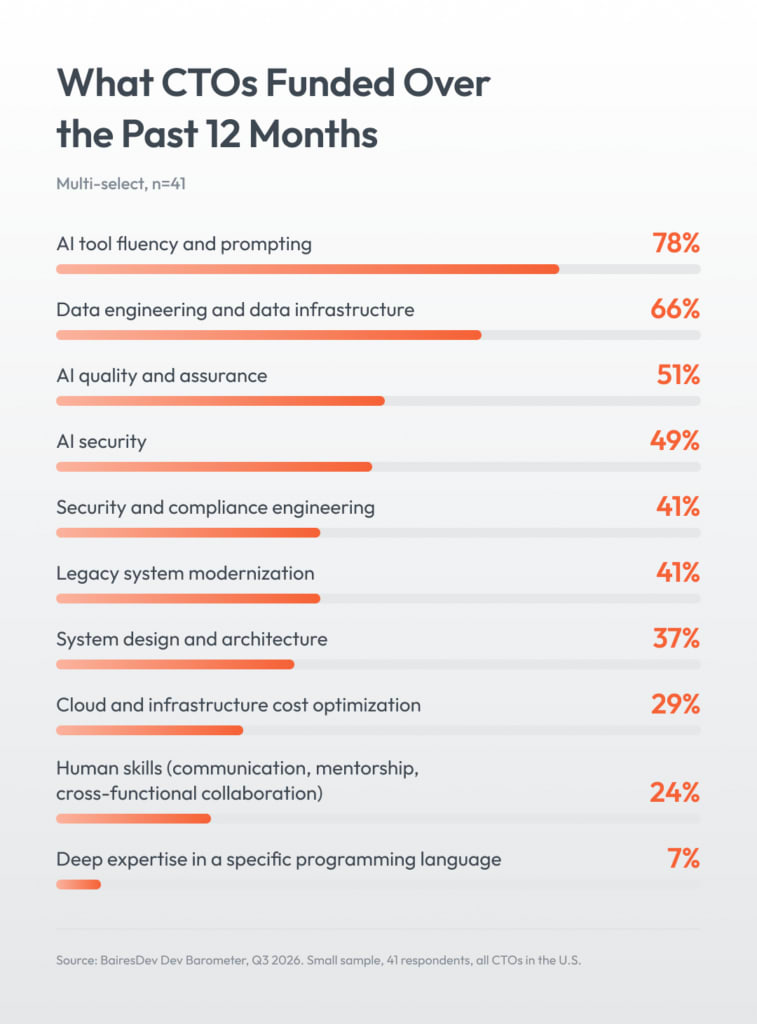
Data engineering ranks second for CTO investment but seventh among the skills devs view as drivers for a raise. System design and architecture runs the other way. It sits second for developers and seventh for CTOs. Human skills, including communication, mentorship and cross-functional collaboration, ranked third for developers and a low ninth for CTOs.
This comparison shows where the two sets of priorities meet and where they part, without establishing cause between them. The two lists cover the same capabilities, seen through an operational lens on one hand and a leadership perspective on the other.
How Are AI Skills Changing Pay and Expectations?
AI is also changing what employers expect people to bring to technical roles. PwC’s 2026 Global AI Jobs Barometer reported that tasks requiring empathy, judgment and creativity were added 2.5x faster in the most AI-exposed roles than in the least exposed. When it comes to US entry-level openings, the more AI-exposed roles were 7x more likely to call for skills typically related to senior roles, like leadership and strategic thinking.
Our Q3 2026 data shows what skills like judgment and strategic thinking look like in software development. Over half (58%) of developers said they feel increasingly accountable for code they didn’t fully write and 67% are spending more time reviewing AI-generated code than a year ago. Additionally, around a quarter (24%) now spend a significant share of their workweek writing specs, requirements or AI prompts.
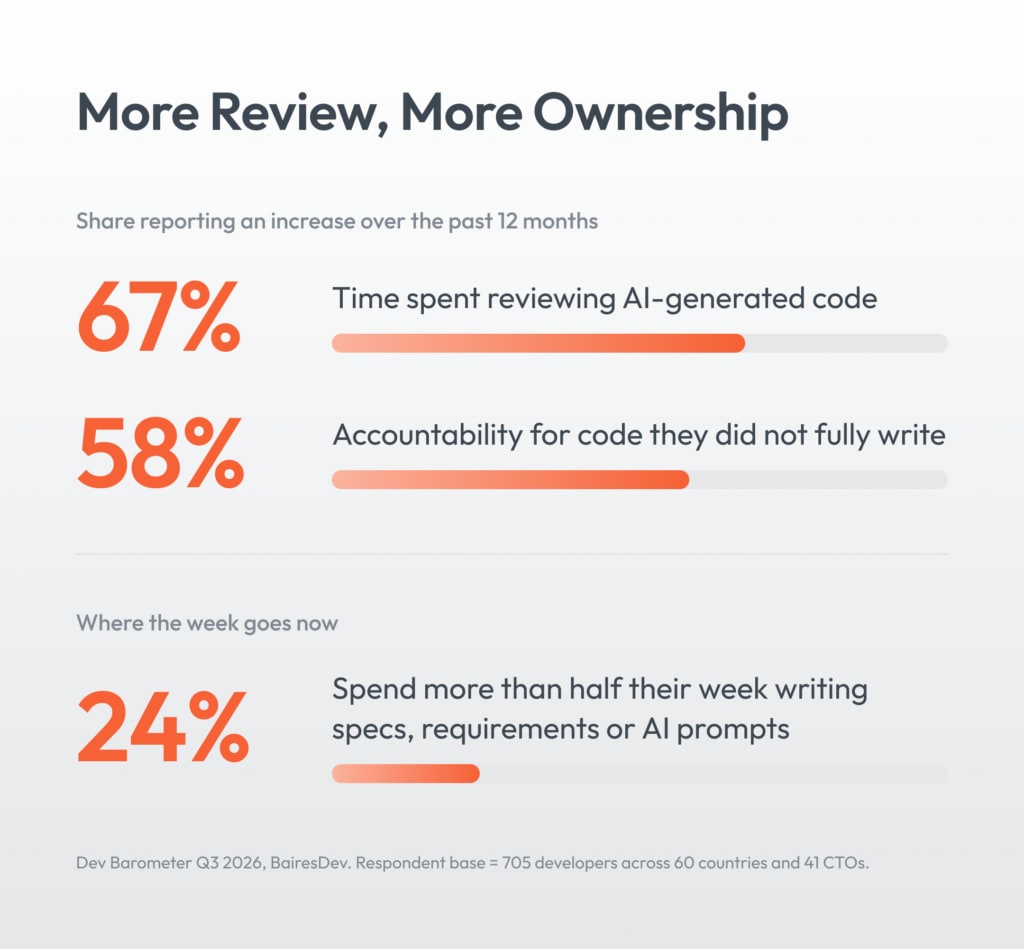
Reviewing AI-generated code checks that it meets the requirements, fits the existing architecture, and handles the cases the request left out. Communicating changes and explaining decisions is part of the job too, drawing on the combination of skills positioned at the top for developers who got AI-related raises.
What Does the Gap Between These Rankings Mean?
The difference between these rankings doesn’t mean CTOs are investing in the wrong capabilities or that developers are being rewarded for skills that matter less. CTOs’ budget priorities lean in a more AI-specific direction. What developers attributed their raises to lines up more closely with the work they described doing, from reviewing code to specifying requirements and answering for what they didn’t write.
Methodology
The BairesDev Dev Barometer Q3 2026 surveyed 705 developers, primarily in Brazil, India, Mexico, and Colombia, and a small group of 41 US-based CTOs in August 2026.
The 141 developers reporting an AI-linked raise selected the single capability they credited most, while CTOs identified all capabilities they had invested in through hiring, training, or increased budgets over the previous 12 months. The percentages measure different things and should not be compared directly.
Justice Erolin is Chief Technology Officer at BairesDev, translating the company's vision into technical roadmaps and leading engineering teams. He previously served as CTO at Hawthorne and held technology leadership roles at major advertising agencies.