

Over the past year, we have watched AI move from something software teams were experimenting with to something they are answerable for. Gartner’s May 2026 forecast puts worldwide AI spending at $2.59 trillion this year, a 47% increase over 2025. The money is moving. Whether the week changed with it is a different question, and it’s the one our data answers.
The Q3 2026 edition of the Dev Barometer was fielded in August 2026 among 705 software developers across 60+ countries. For the first time, we also surveyed 41 enterprise CTOs at Fortune 500 and mid-market organizations, which allows developer experience and executive investment to be read side by side.
This is also the first edition with a full year of quarterly data behind it. A year ago (Q3 2025), the widely voiced concern was that AI would write developers out of the work. A year of responses describes a role that was redefined rather than reduced. Fewer developers now spend most of the week writing new code from scratch. Review, validation, and continuous learning absorb a growing share of the hours, and budgets and compensation are starting to register the same shift.
To access the full survey dataset, click here.
Nearly 80% of Developers Spend Less Than Half Their Week on New Code
Writing new code from scratch still fills most of the week for 21% of developers. For the other 79%, it does not.
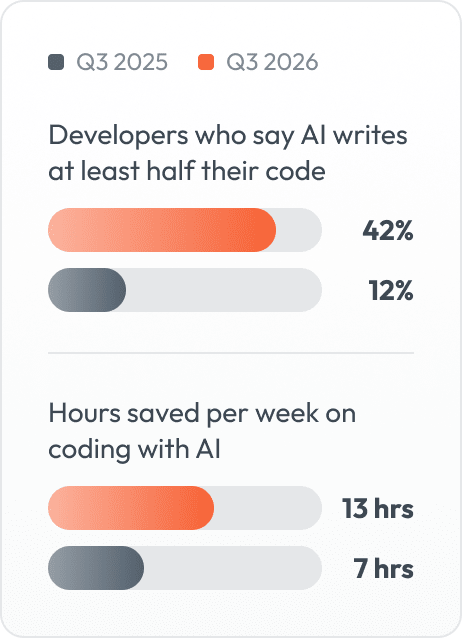
That tracks with how much of the code developers are producing themselves. The share whose code is at least half AI-written climbed from 12% to 42% in a year, and the largest single group, 30% of respondents, now puts AI assistance somewhere between a quarter and half of their code.
The hours moved with it. Developers report saving an average of 13 hours a week on coding with AI, up from about 7 hours in Q3 2025. The median sits at 10 hours, so the average is pulled upward by a group reporting much larger gains than the typical developer sees.
Those hours are moving toward work that takes judgment and decision-making. Just over half of developers, 51%, now spend more than a quarter of their working week reviewing AI-generated work, and 67% report spending more time on that review than they did a year ago. Keeping current takes another share. Developers report an average of 9 hours a week learning AI tools and new technologies, up from 4 hours a year ago.
The work week has been rearranged and writing code takes less of it. Reviewing, validating, and staying fluent in the tooling take more. Once review occupies that much of the week, the question of who answers for the result gets sharper.
“Developers nearly doubled the time AI saves them in coding, to 13 hours a week. Not one of those hours came back. Reviewing check-ins. Fixing what the model broke. Learning next quarter’s tool. A year ago we read the first seven hours as capacity, and we got that wrong. The time mostly moved up the stack, into work that takes more judgment than the coding it replaced.”
Darren Shimkus, CEO, BairesDev
Nearly Six in Ten Developers Report Greater Accountability for Code They Did Not Fully Write
Ownership has concentrated. 58% of developers report increased accountability for code they did not fully write. The direction is not new. It is deepening. In Q1 2026, 51% already said accountability for AI-driven outcomes sat primarily with them.
What moved most is harder to see on a timesheet. 59% report greater mental effort to catch subtle bugs in AI-generated code, the largest increase of any item we tested, ahead of the 52% reporting more time spent debugging problems AI introduced. The cognitive load moved further than the clock did.
Code review is holding as a human checkpoint. 41% of developers say virtually no AI-generated code reaches production without a specific human review of that code. Within that structure, specific decisions are moving closer to AI. 32% say the decision to ship a build to production is delegated to AI with a developer in the loop, and 7% say it happens without developer involvement. Developers own the code AI wrote, the errors it introduced, and the call on whether it is safe to ship.
“In Q3 2025, 12% of developers said AI wrote half their code. Today it’s 42%, and the decision to ship it still sits with one engineer, for far more code than it used to. That’s why 78% of CTOs increased spending on review and validation. Every one of those dollars buys the same thing, which is an accountability layer that is currently one person deep.”
Darren Shimkus, CEO, BairesDev
78% of CTOs Increased Investment in Code Review, QA, and Validation
Over the past 12 months, 78% of the CTOs we surveyed (a base of 41) increased investment in code review, quality assurance, or validation infrastructure to support AI-generated work. The reallocation developers describe in their own week is showing up in budgets.
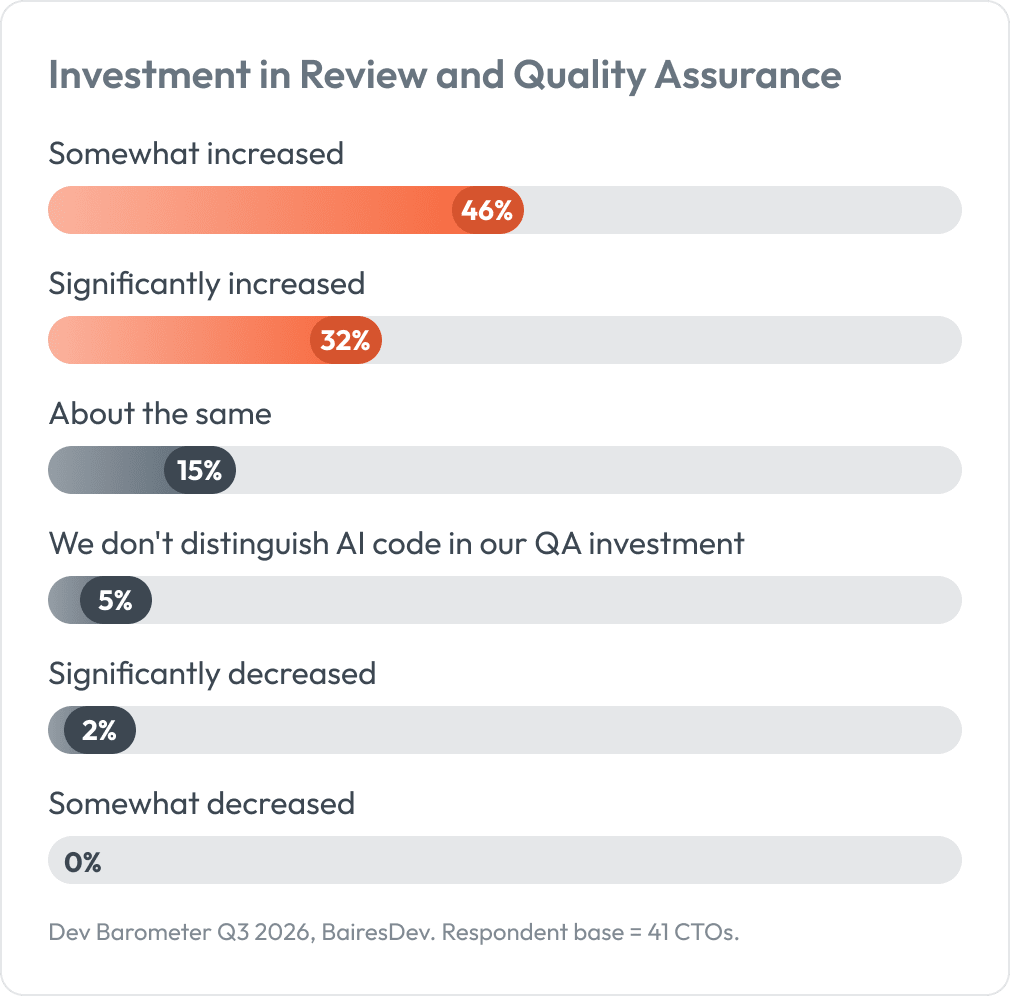
Over the past 12 months, 78% of CTOs increased investment in code review, QA, and validation to support AI-generated code. Combines “significantly increased” and “somewhat increased”.
Investment in skills sits close to the same ground. Just under eight in ten CTOs put money into AI tool fluency and prompting, the top category on their side. Data engineering and data infrastructure followed at 66%, AI quality assurance at 51%, and AI security at 49%. Human skills such as communication, mentorship, and cross-functional collaboration register with 24%, behind the technical categories. Access the full data breakdown here.
Compensation drivers point to a similar place. Among the developers whose pay moved on AI-related grounds, AI tool fluency and prompting ranked first as the top driver at 29%, followed by system design and architecture at 20% and human skills at 15%.
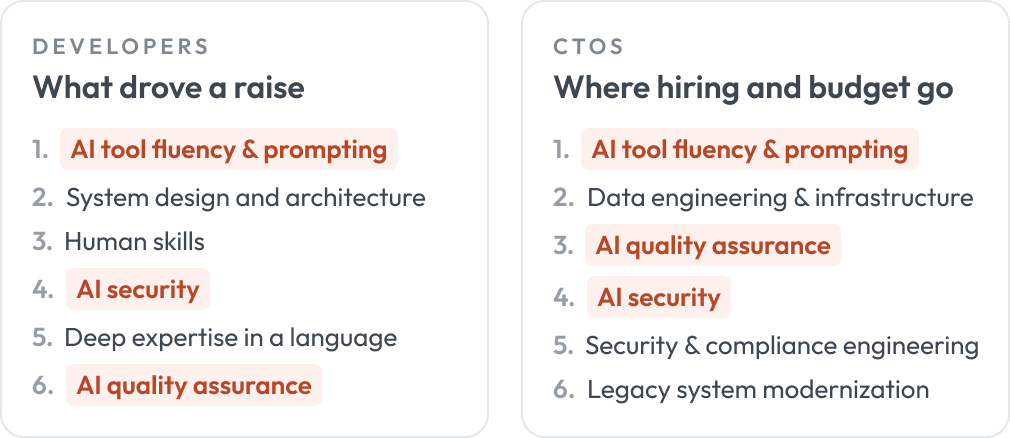
The two lists measure different things. One is the percentage of developers who credited a skill for their raise, the other, the percentages of CTOs who invested in a skill area. They still agree at the top: AI tool fluency and prompting leads both.
System design and architecture is where the two lists separate most. Developers rank it second among the skills that moved their pay. On the CTO side it sits sixth of nine funded areas, behind data engineering, AI quality assurance, AI security, and legacy modernization. Reviewing AI output well depends on knowing how a system is supposed to hold together, so this is the capability the oversight layer runs on.
The oversight disciplines in that mix, AI quality assurance and AI security among them, call for engineers who can evaluate output as much as produce it. Nobody has settled what the right mix looks like, and developers are the ones working it out in practice.
86% of Developers Say AI Has Made Their Role More Fulfilling
Developers are finding their job more rewarding than they did a year ago. 86% say AI has made their role more fulfilling, up from 76% in Q3 2025.
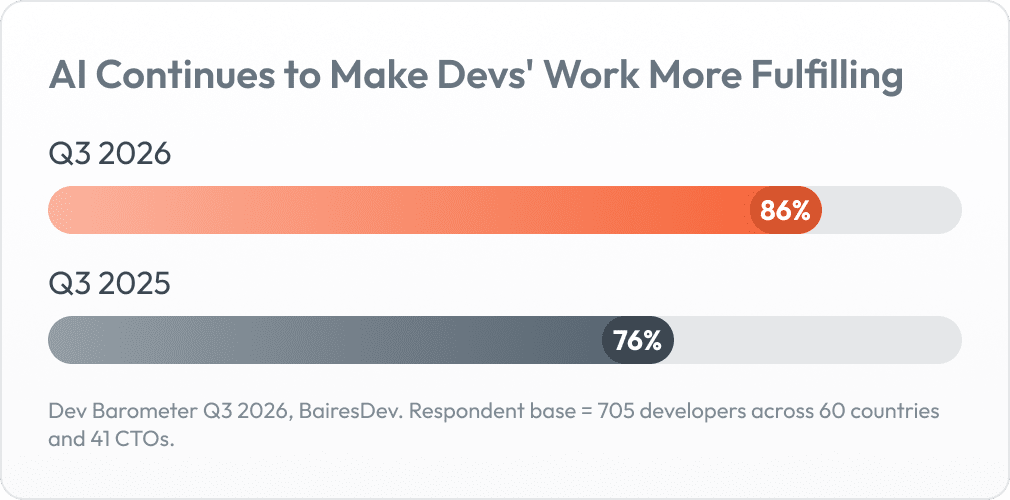
That sentiment aligns with how deeply they have gone into the tooling. Satisfaction climbs with use. Developers who barely use AI report a more fulfilling role 58% of the time. Developers who lean on it heavily, 95%. Depth of use is what appears to separate those groups and it has a cost attached to it.
Almost half (46%) of developers say token costs or usage limits changed their approach over the past year, and the most common response was to cut back on their own. The rationing is happening at the individual level, ahead of any policy telling them to.
Self-management shows up in tool choice, too. 21% use AI tools their employer has not approved, and the reason they give most often is that the approved options lack features they need. That is a procurement gap potentially surfacing as a compliance one.
The absence of clear AI guidelines has become a retention question. For 38%, it has affected whether they want to stay in their current job, and 9% would decline an attractive offer over it, ranking it higher than training budget and senior mentorship. Rules about AI now sit alongside pay and growth in what makes a job worth keeping.
What the Next Year of AI on the Job Will Test
Across four quarters, the answer is that AI moved the work. Writing code takes less of the week. Reviewing it, validating it, and deciding whether it should ship takes more.
Review and validation have always been part of the job. What changed is how much of the job they account for, and how much of what gets reviewed came from somewhere other than the developer reading it. The shift is measurable in hours, in budgets, and in the decisions companies are now willing to hand over. Staying current belongs to the work itself, with learning time doubling in twelve months.
What comes next rests on who is prepared to answer for the code.
We will keep tracking how software development roles change in the final 2026 edition of the Dev Barometer.