



What Is Staff Augmentation?
Staff augmentation is a staffing model in which a company engages external professionals—typically through a specialized provider—who work as embedded members of its internal team for a defined project or time period. The augmented staff operate under the client company’s management and direction, integrate into existing workflows and tools, and can be scaled up or down based on business needs. It is most commonly used in software development to quickly fill skills gaps, expand engineering capacity, or accelerate product delivery without the overhead of full-time hiring.
Modern staff augmentation can trace its roots back to IT consulting in the late 90s, when enterprises staffed up for ERP rollouts and infrastructure projects by bringing in external specialists. The mechanics today are the same: you define a role, a staff augmentation services provider matches you with a pre-vetted expert, and that engineer works on your team while the provider handles employment and HR.
However, what you actually get from providers varies enormously. At the low end, body shops cycle junior developers through senior titles and route every question through an offshore project manager who adds latency without adding value. On the other side of the spectrum, augmented engineers own features end-to-end, push back in design reviews, and operate with the autonomy you’d expect from a senior internal hire.
This guide focuses on the mechanics that determine which of those outcomes you get: the end-to-end process, common failure modes, a week-one onboarding playbook, the nearshore cost and timezone advantage, and how to evaluate a partner before you commit.
How Staff Augmentation Works
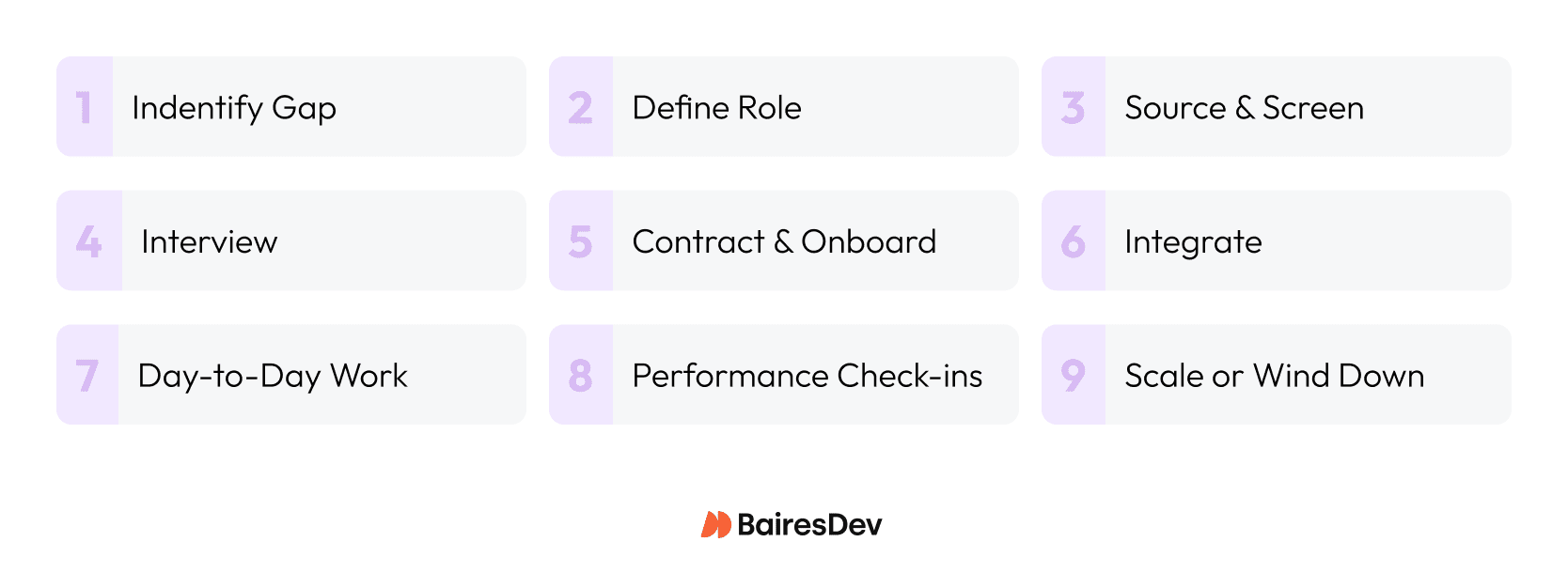
Most engineering leaders have been through some version of this process before. The engagement breaks down at 2 specific points: screening and integration.
| Step | What happens | Who owns it |
| 1 | Identify capacity gap or missing skill | Your team |
| 2 | Define role profile, stack, timezone, duration | You + partner |
| 3 | Source and pre-screen candidates | Partner |
| 4 | Interview and select engineers | Your team |
| 5 | Contract, NDA, security onboarding | Both |
| 6 | Integration into team tools and rituals | Your team |
| 7 | Day-to-day work and delivery | Augmented engineer (your direction) |
| 8 | Ongoing performance check-ins | You + partner |
| 9 | Scale, extend, or close engagement | Your call |
Body Shops Survive Poor Screening
The most common failure pattern is a provider presenting senior resumes backed by junior engineers. You conduct what feels like a solid interview, the person starts, and within weeks, your team leads are reviewing code that should never have passed a mid-level screen.
Ask any company you’re evaluating to walk you through their vetting pipeline: how many stages does it have, what their acceptance rate looks like, whether they screen for your specific stack or run a generalized assessment.
A partner with a rigorous pipeline (multiple technical evaluations, real-time problem solving, English fluency testing) can answer with metrics and facts. A firm that can’t is probably reselling resumes.
You should also be talking directly to the engineer or lead who will join your team, not just a sales rep presenting curated profiles. If a provider filters communication through an account manager during the interview process, expect them to do the same after the contract is signed.
Integration is Where Ramp-up Time Is Lost
Repo access, CI/CD credentials, Jira permissions, VPN setup, staging environment: if those aren’t provisioned before the engineer’s start date, you lose days of sprint capacity to admin. Most teams treat onboarding as a first-day task.
Teams that ramp augmented engineers fast treat it as a day-zero task, with access verified and a scoped onboarding ticket assigned before the engineer logs in.
The Week One Playbook
What happens in the first week determines whether the engineer will be contributing to your sprint by the second week or still context-gathering and requiring a lot of input from your in-house team.
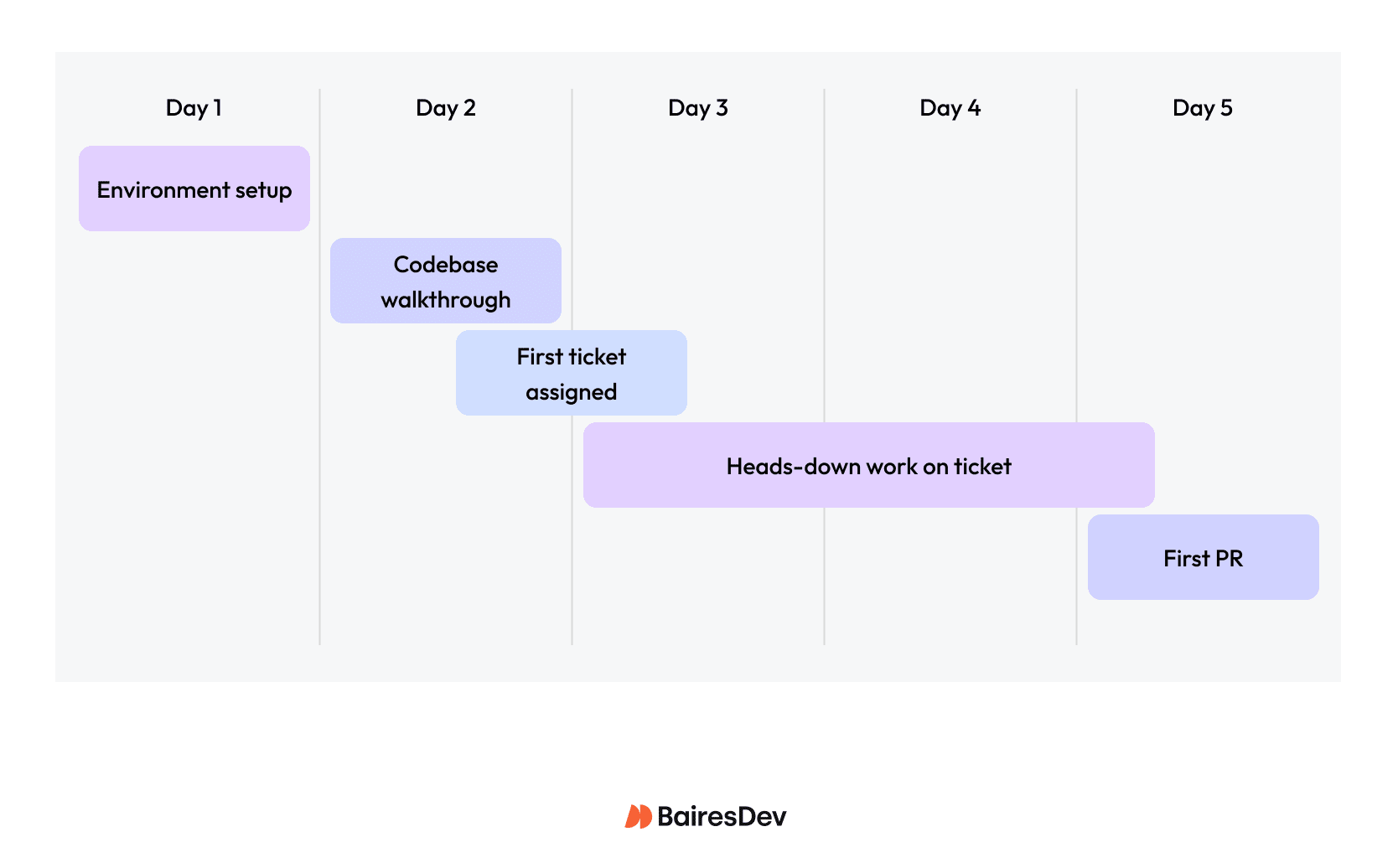
- Day 1 is about getting the environment running locally. The engineer pulls the repo, builds the project, sorts out configuration, and confirms they can deploy to staging. They meet the team and start learning how they operate and communicate. Remember, not everything is documented!
- Day 2 is when the codebase walkthrough happens. An engineer on your team walks through the area where the new person will work first. They cover repo structure, branching conventions, how CI runs, where tests live, the PR template, the definition of done, and the style guide. Keep it scoped to what they need for their first ticket. Don’t provide a tour of the entire system until later.
- Day 2 to 3 is when the first ticket gets assigned. Pick something isolated enough that it won’t block other work, but meaningful enough that completing it requires the engineer to touch the build pipeline, submit a PR, and go through your review process.
- Day 3 to 5 is heads-down work on that ticket. If the engineer is stuck on environment issues at this point, your provisioning missed something. Difficulty with ticket scope or code conventions is a different problem and worth flagging to your partner early.
- Day 5 is the first PR. Did the engineer follow your conventions and produce something your team lead can review without rewriting? A clean PR means ramp-up is on track. A weak one gives you a documented basis for a conversation with your partner.
Operational Guidance
If possible, assign an internal buddy engineer for the first couple of weeks. Set explicit expectations on communication: which Slack channels, async update frequency, standup attendance. Your partner should be running separate check-ins with the engineer during this period, handling logistics so they don’t land on you.
Define the “graduate” milestone: when the augmented engineer moves from buddy-supported to fully independent. For most teams, that’s the end of week two, though it can take longer depending on the scope. If you’re still providing daily context past that point, raise it with your partner.
Staff Augmentation vs. Outsourcing vs. Managed Services
The choice between these models comes down to how much control you want over the engineering work and how much management capacity you can afford. Many companies evaluating staff augmentation have tried software outsourcing before and ran into the same problems: siloed handoffs, code that didn’t meet quality standards, no visibility into day-to-day execution, etc.
Staff augmentation solves most of these issues by keeping the work inside your team. Augmented engineers join your standups, commit to your repos, and work under your leads. Your leads retain direct control over priorities and code quality.
End-to-end outsourcing makes sense when you have a scoped deliverable with clear requirements that your team won’t own long-term. For example, a migration, a standalone integration, or a platform your internal team doesn’t need to maintain. The external team manages its own process and delivers against defined milestones. The tradeoff is visibility: you review output at checkpoints rather than watching work happen in your sprint.
Managed Services sit between the two. An autonomous team with its own PM, engineers, QA, and design takes ownership of an ongoing function or product area at a fixed monthly cost. You define outcomes, not tasks. This works when you need sustained delivery capacity but don’t have or don’t want to allocate engineering management to run it.
| Factor | Staff Augmentation | Project Outsourcing | Managed Services |
| Direction of work | Client-directed | Provider-directed | Outcomes-based |
| Integration level | Embedded in your team | Separate team | Autonomous unit |
| Team composition | Individual contributors you select | Provider assembles the team | Cross-functional team (PM, devs, QA, design) |
| Scope | Flexible, ongoing | Fixed deliverable | Ongoing function or product area |
| IP ownership | Client retains full IP | Requires contractual clarity | Requires contractual clarity |
| Management overhead | You direct work; partner PM handles coordination | Provider manages delivery | Provider manages delivery |
| Best for | Scaling existing engineering capacity | Defined project with a clear end date | Sustained delivery without building internal management |
| Choose this model if you… | Have engineering leadership and need capacity | Have a scoped project your team won’t maintain | Need ongoing delivery without managing the team |
When to Use Staff Augmentation
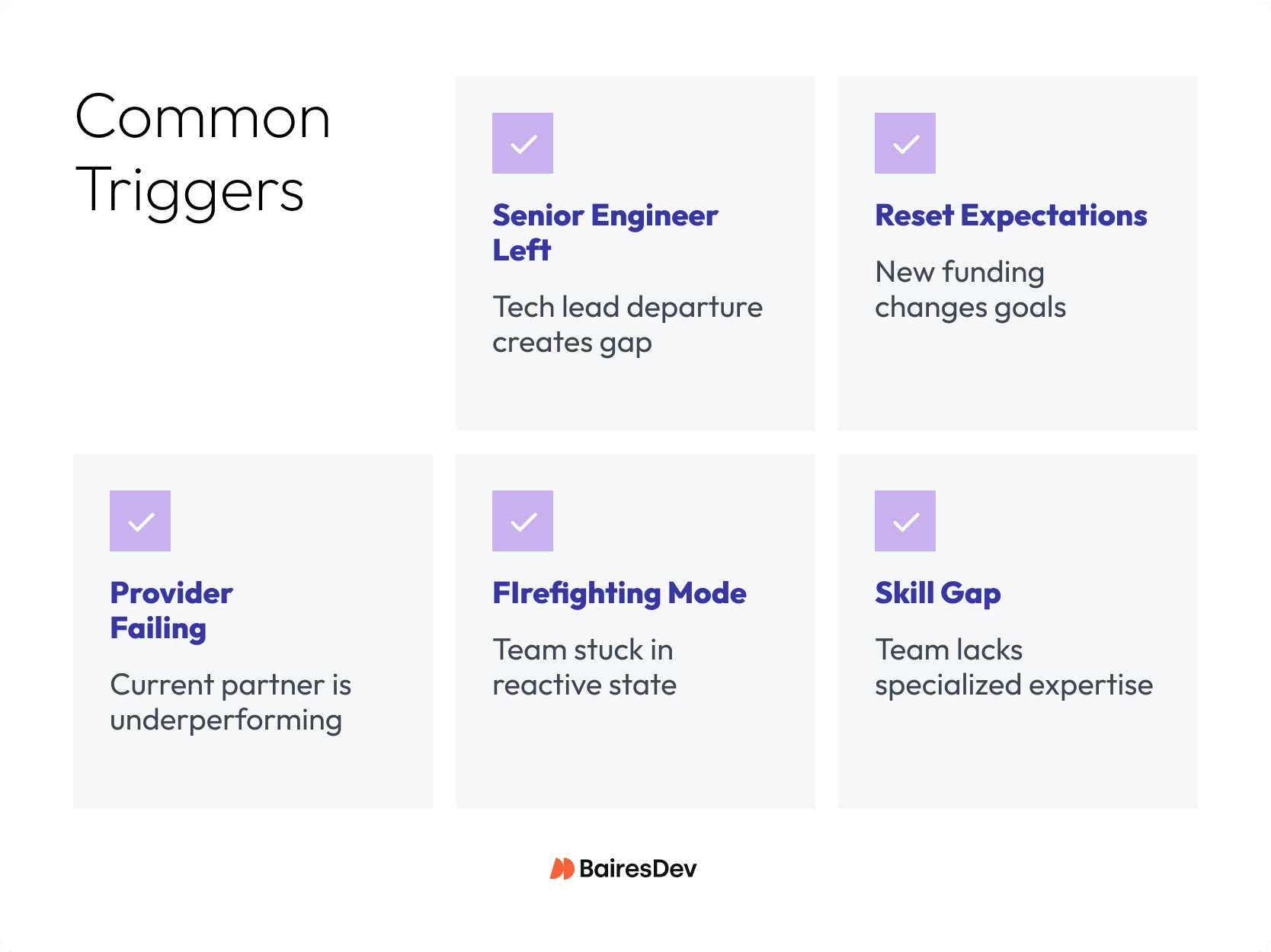
Most companies evaluate staff augmentation because something has already broken. The trigger is usually one of the following six situations, and each scenario points to a different type of engagement.
Your Team Can’t Hit a Deadline With Current Headcount
You have a fixed launch date, a contractual commitment, or a fiscal year cutoff that won’t move. Your engineers are already allocated, and there’s no slack. This is commodity-based augmentation: you need more development capacity doing the same type of work your team already does, and you need it in weeks rather than the months a hiring cycle takes. Staff augmentation can accelerate project timelines in exactly this scenario because you’re adding throughput without restructuring the team.
A Senior Engineer or Tech Lead Just Left
The departure creates a hole in a specific area of the codebase or a critical function, like architecture review. Internal backfill takes 2 to 4 months if you’re lucky. Augmentation targets this gap directly by placing a senior engineer or architect who can step into a leadership function and operate with minimal ramp-up.
Your Team Is Stuck in Firefighting Mode
The backlog is growing, but every sprint gets consumed by production issues, bug fixes, and support escalations. Strategic work keeps getting pushed. Adding capacity here isn’t about a single skill or a single deadline. It’s about giving your existing team enough breathing room to get back to building.
You Need a Skill Your Team Doesn’t Have
An AI/ML initiative, a mobile launch in React Native, a legacy system migration that nobody on your team has done before. Conducting a thorough gap analysis helps identify exactly which capabilities are missing before you engage a partner. Skill-based augmentation fills that gap with a specialist who works inside your team for the duration of the project, then rolls off when the work is done.
New Funding or a PE Acquisition Just Reset Expectations
The growth mandate changed overnight, but your engineering org is sized for pre-investment velocity. You need to scale from 8 to 20 engineers across multiple workstreams without a 6-month hiring ramp. This is where the ability to augment a full team, not just individual roles, matters.
Your Current Provider Is Failing
The code quality is poor, the engineers need constant oversight, or the provider did a bait-and-switch on seniority. Replacing a failing provider with a credible staff augmentation partner lets you keep the engagement model your team is already structured around while fixing the talent and screening problems that caused the failure.
Why Nearshore Staff Augmentation Makes Sense
Nearshore software development relies on engineering talent from countries in your timezone or within a couple of hours of it. For example, EU teams outsource work to Eastern Europe, the Middle East, and Africa. For US companies, nearshore means Latin America.
LATAM has matured as a tech talent market. Brazil and Mexico produce more STEM graduates annually than Germany or Japan. The senior engineers working out of Buenos Aires, São Paulo, Medellín, and Guadalajara have spent their careers providing software development services to US and global companies, operating in English as a working language.
That experience base is what separates nearshore from the junior-heavy offshore model that most engineering leaders have already tried and moved away from. Another important piece of the puzzle is cultural alignment, as LATAM professionals are exposed to US business culture from an early stage.
North America/Latin America Timezone Overlap
Mexico and Colombia provide near-full overlap with US Eastern time. Argentina and Brazil run 2-3 hours ahead, but still cover enough shared hours for standups and same-day resolution on blockers.
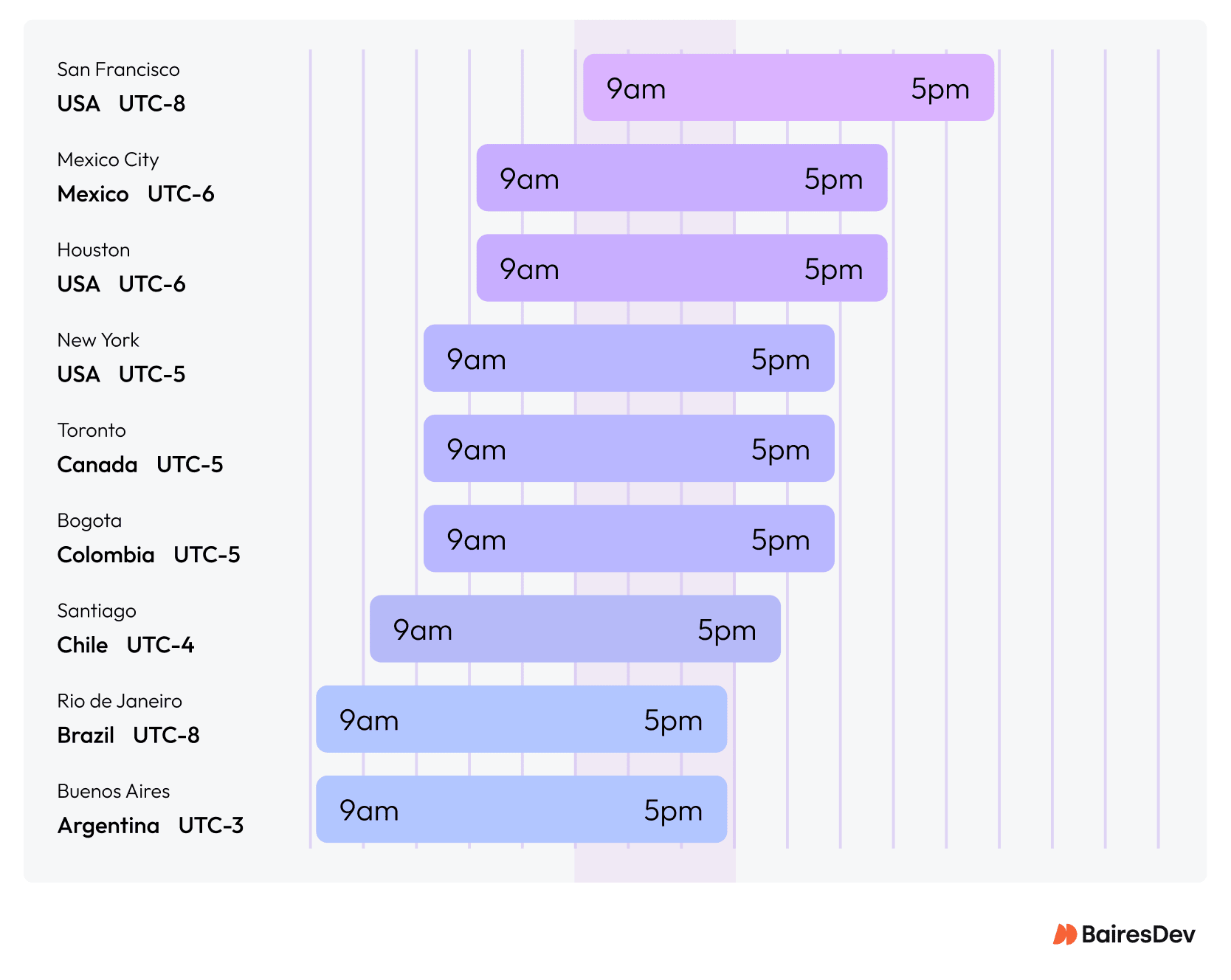
The practical difference? Questions get answered in real time, not tomorrow or after the weekend. In addition, timezone overlap and regular communication tend to improve team cohesion and build personal connections. This is often overlooked, but it means external team members are viewed as a natural extension of your team, which helps.
English Proficiency
Argentina and Colombia have the strongest English fluency among LATAM developers. Mexico’s tech hubs in Guadalajara and Monterrey are strong due to long-standing proximity to the US market. Brazil trails the rest of the region but is improving.
English is a baseline skill for LATAM professionals. A rigorous partner will screen for it explicitly: B2 (intermediate) as a floor, C1 (advanced) as the standard for client-facing work.
Cost of Delivery
According to the Bureau of Labor Statistics (BLS), the median pay for a software engineer or QA specialist in the US is $131k. Senior engineers with 10+ years of experience cost $180k-$250k per year fully loaded (base salary plus healthcare, 401k match, employer taxes, equipment, and office overhead).
| Factor | Staff Augmentation | Full-Time Hire |
| Time to start | 1-4 weeks | 2-4 months |
| Cost | Monthly rate, no overhead | Salary + 30-40% overhead |
| Commitment | Flexible, no long-term obligation | Long-term |
| Specialization | Access to niche talent globally | Limited to local market |
| Risk | Lower (short-term, tested talent) | Higher (wrong hire cost = 1-2x salary) |
| Best for | Short- to mid-term capacity needs | Core team roles |
What about offshore or nearshore talent? On average, LATAM senior engineers can cost 30 to 50% less. Offshore hourly rates are even lower, often as much as 70% lower, though lack of timezone overlap can cause friction and reduce efficiency.
In practice, the managerial overhead added by async communication tends to reduce the cost-effectiveness of offshore teams. This largely depends on the type of projects they’re working on.
Offshore augmentation is usually a better fit for well-scoped work, e.g., maintenance, QA, and standalone module development. It causes friction for fast-moving product engineering that depends on real-time feedback and same-day decisions.
How to Evaluate a Staff Augmentation Service
Vendor selection sounds straightforward, but this is where most problems start. Companies focus on the wrong criteria, skip due diligence, or let procurement drive a decision that engineering has to live with.
| Criterion | What to evaluate | Red flags |
| Screening transparency | How many vetting stages, acceptance rate, whether they test for your specific stack | Can’t describe their pipeline with numbers. Generic “we hire the best” language. |
| Direct engineer access | You interview the person joining your team. No intermediary filtering communication. | Sales presents profiles but won’t schedule a direct technical screen. |
| Swap guarantee | Written replacement commitment within days. No cost during the initial evaluation window. | No replacement policy. Vague “we’ll work through it” responses. |
| Seniority verification | Engineers who own architecture decisions, lead design reviews, push back on requirements. | Seniority defined by years alone. No evidence of technical leadership or autonomy. |
| Timezone overlap | 6+ hours of synchronous overlap. Real-time standups, same-day blocker resolution. | 1-2 hours of overlap. Async-first communication as default. |
| Contract flexibility | Monthly rolling terms. Scale up or down without penalties. | Lock-in periods. Buyout fees. Termination clauses. |
| Track record | Retention rate, average engagement length, referenceable clients in your industry or at your scale. | No available references. High client churn. Case studies older than 2 years. |
This table gets you to a shortlist. The final decision includes a few things that don’t fit neatly into rows.
References Over Case Studies
Case studies are marketing. References are real clients answering real questions. Ask for them. When a CTO or VP of Engineering agrees to take your call and endorse a provider, that carries more weight than any published testimonial.
Continuity
Ask about engineer turnover and average tenure on client engagements. Some providers pitch senior people and staff juniors. Others churn developers constantly. Both patterns create a repeating onboarding tax on your team. The longer an engineer stays embedded in your codebase, the less management overhead they require.
Communication Fit
Some teams want async updates and written documentation, while others want daily standups and constant Slack access. Both approaches are valid, but a mismatch creates friction. Your provider’s communication style should match yours. This includes business culture as well.
The Sales Process Can Reveal Red Flags
One of the best predictors of delivery quality is how the potential provider runs the evaluation. If they’re responsive, ask qualifying questions about your budget, timeline, and internal constraints, and are honest about limitations, that’s a strong signal. If they overpromise or evade direct questions, you can expect the same behavior after the contract is signed.
We’ve worked with hundreds of companies that used staffing providers before switching to us. Most share similar stories, and here are the failure patterns that come up repeatedly:
- Estimates without discovery: The sales team quotes a budget and timeline before understanding what you’re building. The numbers sound reasonable but they’re guesses. The delivery team inherits a commitment they can’t keep.
- Senior rates, junior staff: You’re quoted a senior rate but the person doing the work doesn’t match. The provider pockets the margin and you don’t get good value. Ask who will actually work on your project and what their experience level is.
- High turnover, low-quality replacements: Some providers cut costs by replacing experienced engineers with juniors mid-engagement. If your point of contact keeps changing, ask why.
- No qualifying questions: A provider that takes on every lead is chasing revenue without evaluating fit. If they didn’t ask about your budget, timeline, or internal constraints, they’re not setting the engagement up to succeed.
- Sales can’t explain the work. If the salesperson can’t walk through how they’d approach your project or what roles would be needed, they don’t understand what they’re selling. That disconnect surfaces during delivery.
- Poor matching. The engineers being proposed don’t match the role description. This happens when the provider’s bench is thinner than they let on or when their internal teams don’t understand technical requirements.
The wrong provider costs multiples of the right one when you factor in rework, delays, and the time your engineering leads spend managing problems that shouldn’t exist.
What Can Go Wrong and How to Prevent It
Assuming there were no red flags and you started working with a partner, what sort of problems can surface after the engagement starts? More importantly, what can you do to nip them in the bud?
Management Overhead Creeps Back In
The whole point of staff augmentation is adding capacity without adding management burden. But some engagements quietly reverse that equation. The augmented engineer attends standups, submits PRs on schedule, and still generates a steady stream of questions that pull your leads out of their own work. Management overhead tends to reveal itself a couple of months in, when the engineer should be operating independently but isn’t. Track how often your leads are answering questions or spotting work that needs significant revision. If that frequency isn’t declining week over week, raise it with your partner.
Quality Drops Mid-Engagement
The engineer who started strong gets swapped out for someone weaker. Alternatively, the original engineer’s output gradually declines. Either way, you notice more rework and slower delivery. The fix is treating performance reviews as a continuous process. If your sprint metrics show a sustained dip, don’t wait. Your partner should be running their own performance tracking and flagging issues.
Knowledge Walks Out the Door
Every augmented engineer accumulates context: how your services interact, why certain architectural decisions were made, where the undocumented workarounds live. When that engineer rolls off after 6 months or longer, the knowledge gap can stall the people who depended on them. The mitigation is simple but has to be intentional. Augmented engineers should be contributing to your documentation from the start. When the engagement is winding down, overlap the outgoing engineer with their replacement for at least a week or two.
You Become Dependent on Augmented Staff
Long-running engagements sometimes create a quiet dependency where the augmented engineers own critical systems and no internal team member can step in. You need to build knowledge transfer into the engagement from the beginning. If you wait for offboarding, that’s just too late.
The Engineer Absorbs Responsibilities Beyond the Original Role
It starts with a small request outside their scope and eventually they’re the point person for something nobody planned for. When they roll off, a function disappears, and this is often accompanied by a lack of documentation. Revisit role boundaries quarterly.
Your Provider Has a Structural Problem
What about acquisitions, leadership changes, financial trouble? These are rare, but when a provider restructures, your account priority can shift overnight. Ask about stability during evaluation and focus on partners who have been around for years.
Next Steps
Staff augmentation works when you have solid engineering leadership in place and a clear capacity gap that won’t wait for a hiring cycle. If you’re ready to evaluate partners, BairesDev’s staff augmentation services page has details on our vetting process, engagement models, and how to get started.