By Pablo Bassil
Pablo is a senior software engineer with 15+ years of experience in full-stack development. He serves as tech lead at Red Ventures, building serverless architectures using React, Go, Node.js, and AWS. Pablo has also worked with Paychex on mobile and web applications.
Expertise


Key points:
- Your derived DTOs will silently widen to include new sensitive fields if you use Omit instead of Pick at API boundaries.
- Whether a derivation belongs at each boundary requires a human decision; the compiler tracks the dependency but cannot evaluate whether it should exist.
- Pick and Omit never strip fields from a runtime object, so external API responses require a mapper or schema to prevent data leaks.
- Naming every shared derivation as a type alias makes coupling visible during code review before it reaches production.
TypeScript utility types are built-in generic types, including Partial, Pick, Omit and Record, that create a new type by transforming an existing type, for example, tturning a domain model with fields like name (string), age (number) and email (string) into a scoped request payload. Teams reach for them to build request payloads and view models off one authoritative domain model, rather than maintain two definitions of the same shape that quietly diverge.
TypeScript became the #1 language on GitHub by monthly contributors in August 2025, and at type-system decisions are architecture decisions across large TypeScript projects. An organization running dozens of services cannot manage utility-type derivation informally.
Utility types keep teams from defining the same fields twice. Each Pick or Omit also settles which layers of a codebase change together, and very few teams review that call explicitly.
When a domain model change cascades through derived data transfer objects (DTOs) and API contracts across services, the question is where a team should derive types and where that coupling becomes a liability.
We provide TypeScript development services to organizations running very large TypeScript codebases, and the derive-or-declare question is one of the least well-specified governance gaps we see.
What Utility Types Control and What They Risk
Utility types are all defined as modifications of an existing type. That structural relationship to a source type is the main advantage and the main risk at once.
The TypeScript handbook lists a longer set of TypeScript utility types; the ten below bear most of the architectural weight in application code, and each has been stable since TypeScript 3.5 (May 2019). These fall into structural transformers, which modify a set of properties on an object type, and type-set operators, which operate on unions, function signatures and parameter types.
Coupling risk runs higher with structural transformers. They bind the shape of a new type to one particular source.
Table: Utility Type Risk Profiles for Architecture Decisions
| Utility Type | What It Transforms | Primary Production Use | Coupling / Misuse Risk |
| Partial<T> | Makes all properties of T optional | Scoped update commands (with Pick), optional config input | Permits states the domain never allows an empty object, for example, passes the check. Requires runtime validation at the boundary. |
| Required<T> | Makes all the properties of T required | Enforcing full hydration of an optional-in-source model | Couples to the full source shape. New optional properties in the source become required. Tighten scope with Pick first. |
| Readonly<T> | Produces a read-only version of T, with every property non-reassignable | Immutable config objects, frozen domain entities | Shallow only: each top-level entry becomes a read-only property, but nested objects remain mutable. Working as intended, per the TypeScript team. |
| Pick<T, K> | Selects a set of properties from T | Internal response shapes, view models | Explicit coupling to named properties. Renaming a picked key surfaces a compile-time error at the derivation. Compile-time selection only: a full object assigned to a Pick type keeps every field at runtime. |
| Omit<T, K> | Excludes named properties from T | Removing internal fields from derived types | K extends keyof any, not keyof T. Omitting nonexistent keys produces no error, so renaming a source field breaks the exclusion without a compiler warning. New sensitive fields join the type unless the list is updated. |
| Record<K, V> | Constructs an object type with keys K and values V, using Record to create a new type suited to lookup tables and config maps | Lookup tables, config maps | Exhaustiveness enforced only when K is a finite union of literal keys. Record<string, V> types every lookup as V, so a missing key returns undefined at runtime unless noUncheckedIndexedAccess is enabled. |
| Exclude<T, U> | Removes members of U from union T | Narrowing a union after discriminating on variants | Operates on union members, not object properties. On a single non-union object type, produces never or returns the type unchanged. Works correctly on discriminated unions. |
| Extract<T, U> | Extracts members of T assignable to U | Isolating a subset of a discriminated union | Same union-only scope as Exclude. Both results change automatically with the upstream union, which is useful internally and an unreviewed contract change at a boundary. |
| NonNullable<T> | Removes null and undefined from T | Typing primitive types and other values after a null check or validation | Performs no runtime check. Unvalidated external data or an unsafe assertion can still deliver null under a NonNullable string type or any other NonNullable type. |
| ReturnType<T> | Extracts the return type of function T to create a new type, leaving its parameter types unresolved | Typing values from factory functions or handlers, independent of their parameters | Tight coupling to the function’s implementation and function type. Return type changes cascade to all consumers, and overloaded functions use only the last signature. |
For a codebase review, the last column is the one to scan. It shows where selecting specified keys with Pick, excluding specific properties with Omit, or excluding null and undefined with NonNullable narrows a given type safely, and where the same move creates a liability instead.
What the Compiler Can and Cannot See
TypeScript utility types inherit the language’s structural-typing design: two types with the same shape can be used interchangeably regardless of their name or where they were declared, and TypeScript Design Goal #9 commits the language to “a consistent, fully erasable, structural type system.”
The compiler does track the dependency a derivation creates. Rename a key that a Pick references and the build fails. What it cannot judge is whether that dependency belongs there at all, since a derived Pick<User, ‘id’ | ’email’> and a hand-written { id: string; email: string } are assignment-compatible.
That “fully erasable” clause has its largest consequences at an API boundary. Types are erased at compile time, so assigning a full User object to a variable typed as Pick<User, ‘id’ | ’email’> leaves passwordHash sitting on the object that gets serialized.
Utility types govern what the compiler accepts. They remove nothing at runtime.
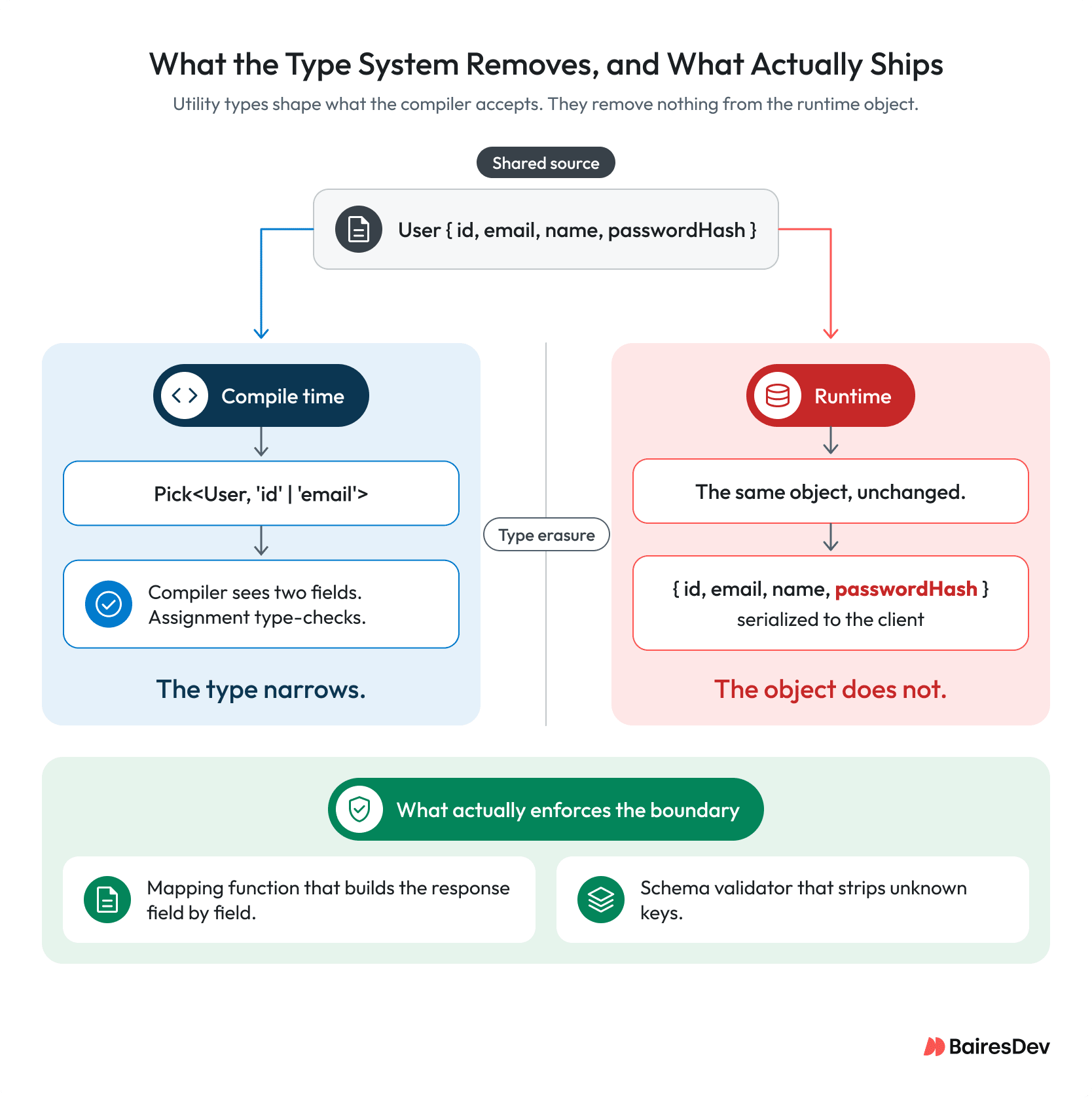
Enforcing a boundary takes a runtime mechanism. A mapping function that builds the response field by field will do it, and so will a schema validator that strips unknown keys. That is the point where compile-time architecture ends and production code needs its own boundary controls.
Where Utility Types Reduce Drift
The best place to use utility-type derivation is at internal API payload and update operation boundaries. These are the primary places where a new type should in fact track changes to its source.
Utility-type derivation solves type drift: when the existing type, the domain model, changes, the derived type follows it automatically at compile time.
Declare a copy on its own and you create an opportunity for the two to drift apart, because no code links them together. This usually occurs when frontend and backend teams each maintain their own version of the same contract.
Internal update commands show this process most directly. Starting from an interface User { id: string; name: string; email: string; createdAt: Date }, a UserUpdateCommand type written as Partial<Pick<User, ‘name’ | ’email’>> tracks the domain model’s field types and allows write access only to the fields the command owns, which keeps server-owned fields such as id and createdAt out of reach. On the read side, service-to-service reads work similarly, using a named Pick to prevent the same opportunity for drift.
However, this solution breaks down if downstream consumers begin to rely upon the derived type as the de facto standard. The domain model has to remain the authority.
A Pick will also generate a compile-time error if a picked key is renamed in the source. The maintenance costs of this approach occur at build time, prior to any code reaching production.
As another example, application state and application configuration follow a similar rationale. A store typed as a discriminated union can hand each view Extract<State, { status: ‘loaded’ }>, so a component developed for loaded data cannot be handed a loading state. Similarly, the Partial utility type accepts user overrides through Partial<Config>, and the merged result can be typed as Required<Config>, which spares business logic from handling a missing setting.
If the derived type needs to track every change to its source, derivation is the right architectural default. A different approach is required when two types serve layers with independent change drivers.
Where Derivation Creates Unwanted Coupling
The boundary where derivation becomes a liability is the one between layers that have independent reasons to change. UI models, form state, and cross-layer persistence types account for most such cases.
Form state is the simplest example. A form’s shape is dependent on UI constraints, such as draft values and field-level errors, that the domain model does not store. When you derive form state from a domain model using Partial or Omit, the form’s type is tied to domain concerns it has no stake in.
When the domain model evolves for persistence reasons, the form type has to evolve too.
Omit carries a specific risk at external API boundaries. Its constraint is K extends keyof any, not K extends keyof T. If a source type renames a property, Omit<T, ‘oldFieldName’> becomes a no-op instead of throwing a compiler error.
Adding a new sensitive property to the source type also expands every Omit-derived type to include it, so the compiler does not protest when a handler returns the added property.
Pick is the safer compile-time choice since it enumerates fields positively. Neither utility, though, removes anything from the runtime object.
As nested composition increases, readability decreases. A useful review threshold is three nested transformations: beyond that depth, every reader has to unwrap each step mentally, and an explicit interface with a doc comment beats complex type definitions that only the original author can parse.
Partial<T> permits states the domain never allows. An empty object passes the type check. Use it as a function parameter and you accept inputs that business logic will reject at runtime.
For example, one schema change demonstrates where each approach holds. Suppose User gains an internalRiskScore field for the fraud team.
Table: A Worked Example, One Schema Change, Three Layers
| Layer | Type | When User Gains internalRiskScore | Right Control |
| Internal update command | `Partial<Pick<User, ‘name’ | ’email’>>` | Nothing changes. The new field sits outside the picked keys. |
| External API response | Omit<User, ‘passwordHash’> | The contract type widens to include the score, and no compiler error flags a handler that returns it. | Explicit PublicUser contract, built by a mapper or schema |
| Account settings form | Partial<User> | The form type now includes a back-office field users should never edit. | Independent UserFormState, mapped to the update command on submit |
The same field addition is harmless in one layer and a data exposure in another. That is why the derive-or-declare call gets made per boundary rather than once for the codebase.
The Derive-or-Declare Framework
When two types share the same owner and a compatibility promise, deriving a new type is the right answer. When either the owner or compatibility promise differs, declare each side explicitly and map between them at the boundary.
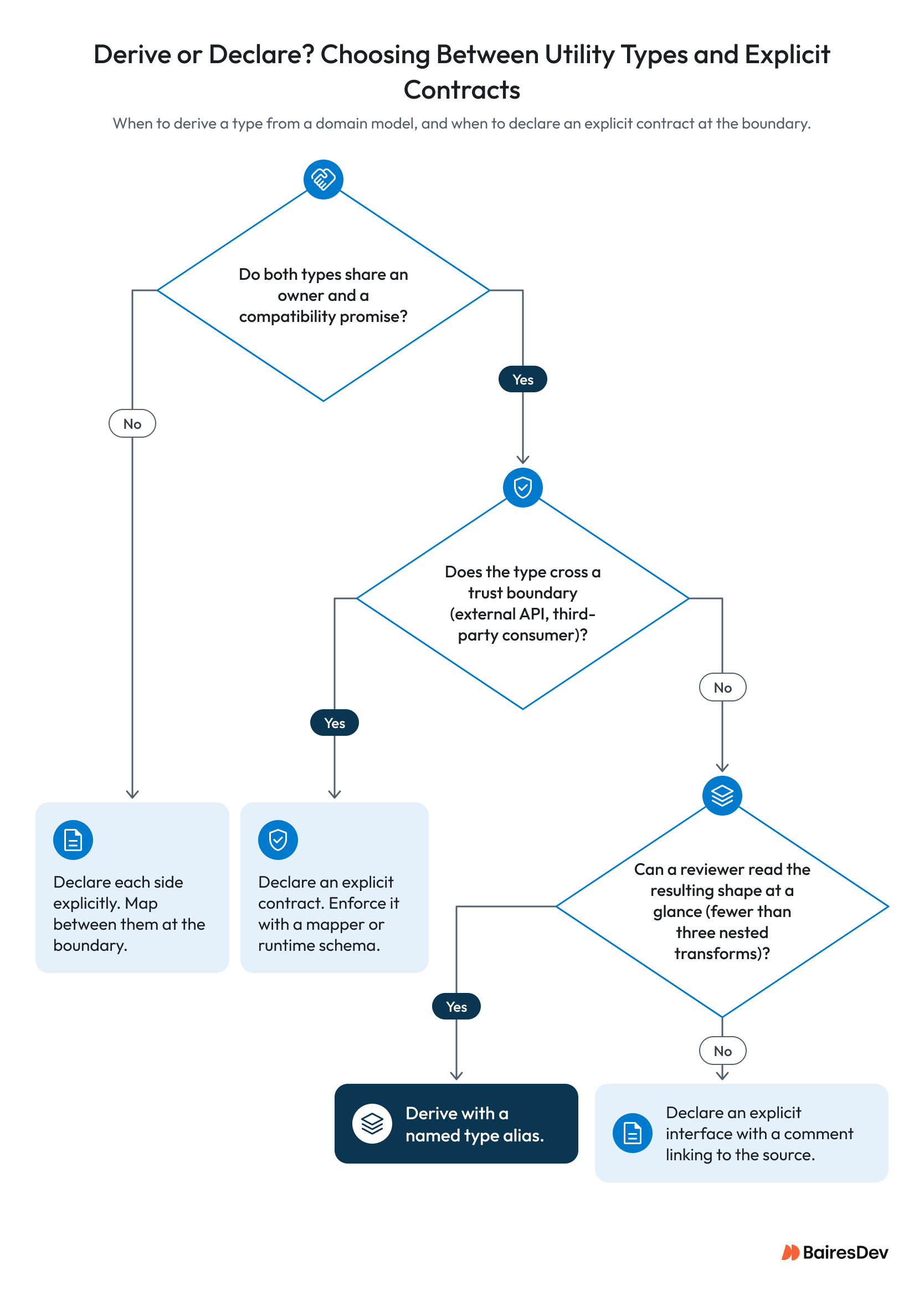
The following six practical examples map common situations to a recommended approach:
Table: Derive-or-Declare Decision Heuristics
| Situation | Recommended Approach | Rationale |
| Internal update/patch DTO that must track the domain model | Partial<Pick<T, writableFields>> | Compile-time drift detection outweighs coupling cost |
| External API response type | Explicit contract type plus a mapper or runtime schema | The type documents the contract; the mapper or schema controls what actually leaves the service |
| Form state or UI model | Explicit interface, mapped to the update command on submit | UI changes on its own schedule; derived form types break when the domain changes for unrelated reasons |
| Config object with all-optional fields | Partial<T> with runtime validation at boundary | Optional shape is the intent; validate completeness before entering business logic |
| 3+ nested utility-type transforms | Explicit interface with doc comment | Readability outweighs derivation precision; reviewers cannot reconstruct the shape at a glance |
| Shared lookup table with known key union | Record<K, V> where K is a finite union of literal keys rather than a loose string type | Exhaustiveness checking prevents missing-key runtime errors |
The framework makes the coupling decision explicit at every boundary, which is the prerequisite for reviewable, maintainable code.
Setting Governance Standards for Utility Types at Scale
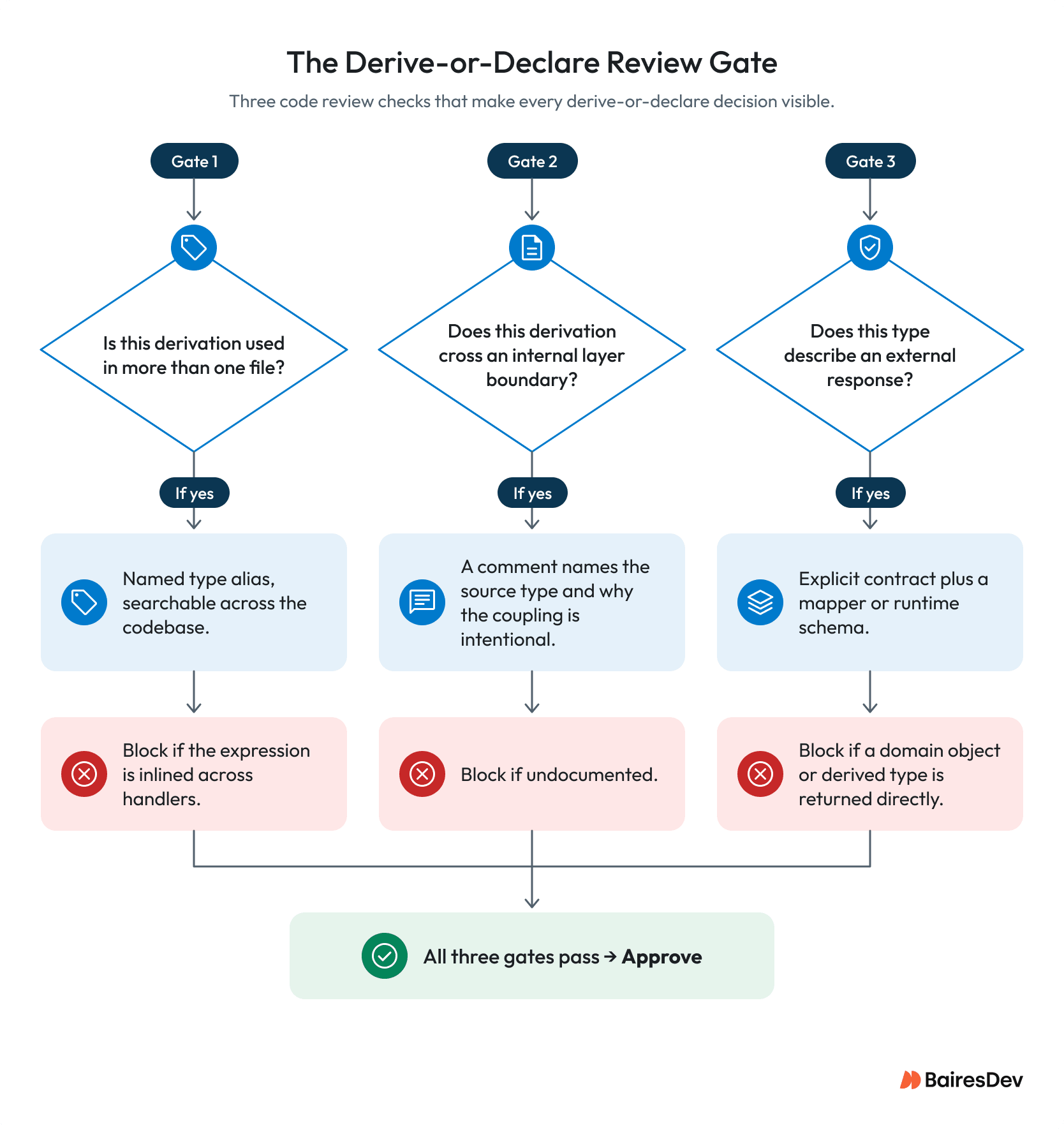
Three review conventions make the derive-or-declare decision, and the custom utility types it produces, visible at every architectural boundary.
- Name every shared derivation: Any utility-type expression that appears in more than one file becomes a named alias, in effect, a small library of custom utility types built from the originals. For example, type UserUpdateCommand = Partial<Pick<User, ‘name’ | ’email’>> is legible and searchable; the same expression inlined across a dozen handlers is neither.
- Document intent at layer boundaries: When a derivation crosses from persistence to API, or from domain to UI, it carries a comment naming its source type and why it should follow that source.
- Map what leaves the service: External response types are explicit contracts, and a mapping function or runtime schema builds every response from the domain object.
The reason these conventions are effective is because they force coupling into view during code review. A reviewer must be able to tell at a glance whether a derivation was intended or accidental; if they cannot, the convention is failing.
Teams that want the compiler to carry more of this load, beyond what the built-in utility types already enforce, can set exactOptionalPropertyTypes and noUncheckedIndexedAccess in tsconfig. The first stops Partial from treating an absent field and an explicit undefined as the same thing. The second makes every Record<string, V> lookup return V | undefined.
Without these conventions, decisions about TypeScript utility types become a matter of personal taste and fall to whoever puts the type down first. The resulting coupling remains obscured until a shift in the domain model ripples through the services, which is the most expensive moment to find it.
Frequently Asked Questions
When Should Teams Prefer Pick Over Omit for Safe API Responses?
Pick is the safer compile-time choice because it keeps only the specified keys, so new source properties stay out of the type until someone adds them. Neither utility removes properties at runtime, so external responses still need a mapper or schema that builds the payload explicitly.
Omit also accepts keys that do not exist on the source type, so a renamed field slips out of the exclusion without a compiler error.
At What Point Do Nested Utility-Type Compositions Become a Maintainability Liability?
Treat three or more nested transformations as a signal to stop and declare an explicit interface instead. Past that depth, your reviewers have to mentally unwrap each layer to understand what shape they’re looking at. An explicit interface with a comment naming its source type is faster to read and easier to maintain than a deeply nested expression that only the original author can parse at a glance.
Can Extensive Use of Partial Across API and Form Layers Create Type-Safety Gaps?
Yes, for example, an empty object passes the type check because Partial<T> makes every property optional. At form submission boundaries, that empty payload can reach API handlers.
Pair Partial with runtime validation at the boundary.
Should Teams Generate External API Types From a Schema Instead of Deriving Them?
For external contracts, usually yes. A schema, such as an OpenAPI document with request and parameter validation, or a runtime validator library, defines the contract once and enforces it at runtime, with the TypeScript type generated from it rather than typed by hand in application code.
The built in utility types then stay inside the service, where compile-time derivation is enough.
What Is the Difference Between Exclude and Omit, and Why Does the Confusion Matter?
The Exclude utility operates on union types, removing union members; the Omit utility operates on object types, removing properties. See the TypeScript handbook for the full signature.
The confusion matters because Exclude<User, ‘passwordHash’> compiles without a TypeScript error and returns User unchanged. A developer who reaches for it at an API boundary gets no filtering and no warning.
By Pablo Bassil
Pablo is a senior software engineer with 15+ years of experience in full-stack development. He serves as tech lead at Red Ventures, building serverless architectures using React, Go, Node.js, and AWS. Pablo has also worked with Paychex on mobile and web applications.
Expertise